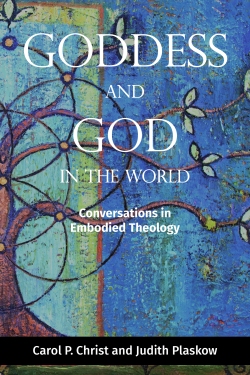
Talking about our deepest beliefs and feelings can be surprisingly intimate. In our new book Goddess and God in the World, we discuss our different theologies and challenge each other’s views. In the conclusion, we consider whether there is any way to judge between our positions. While we believe that theologies are rooted in experience, we also insist that they must make sense of the world we share and provide the orientation we need as we face the social, political, and environmental crises of our time.
Theologically, we disagree on two fundamental issues: whether divinity is personal or impersonal; and whether divinity is good or inclusive of good and evil. Does one of our views meet our criteria for adequacy more fully than other?
Does the notion of a personal or impersonal deity make more sense of our experience of the world? Carol argues that if consciousness and intelligence is a fundamental aspect of human existence and is found in varying degrees throughout the web of life, then it makes sense to think of divinity as also having consciousness and intelligence. Judith responds that the notion of a personal deity seems to her a holdover from the biblical picture of God and that she can find no evidence in her experience or reflection that a divine individual who is conscious and intelligent exists. We seem to be at a standoff here. There is some consolation in recognizing that this is a fundamental divide in the history of religions, but this insight does not resolve our disagreement.
Does one or the other of our views offer better guidance in making moral decisions? Judith argues that her view places moral responsibility firmly in human hands, which is where it belongs. Carol agrees with Judith that humans and other individuals are the ones whose decisions will determine the fate of the world, and she finds recognition of the interdependence in the web of life sufficient grounds for moral decision-making. But she would add that the love and understanding of a divine individual inspires her to love and understand the world and to promote its flourishing. Judith believes that the idea of one divine presence that enlivens and unites the universe is a sufficient basis for ethical action.
Our other major theological difference concerns whether divinity is good or inclusive of good and evil. Judith argues that if divinity is inclusive of the world, it must be inclusive of both good and evil. Carol counters that if divinity is reflective of what is best in ourselves and in other individuals in the world, then divinity must be good, not evil.
Does one of our views provide better moral guidance? Carol argues that a divinity who is good inspires us to try to make the world better. Judith replies that the notion that divinity is good leads us to idealize ourselves and to forget or deny our capacity to do evil. Carol feels that a clear focus on the world is sufficient to remind us of our capacity for evil.
Does one of our views offer a more adequate account of the existence of evil in the world? Judith asserts that the idea that divinity is the ground of both good and evil provides a better answer to the problem of evil: the potential for both good and evil are inherent in the creative process that is the foundation of life. Carol believes that the world is created by a multiplicity of individuals, including the divinity. The capacity for good and evil is inherent in the creative process that structures the world. The divinity is good but not omnipotent. What we call evil is created by individuals other than the divinity. Judith replies that this view does not adequately account for the origin of evil.
Is there any way to choose between our different positions? Each of us is firmly convinced that her view is clear, consistent, coherent, and comprehensive, that it takes full account of the complexity of human experience, and that it provides the moral orientation we seek….Each of us has tried without success to win the other over to her perspective. In the process, we have gained a deeper appreciation of each other’s views and clarified our own. This is as far as we have been able to go. We acknowledge that, in the end, we cannot know which, if either, of our theologies expresses the nature of ultimate reality or provides the crucial ethical guidance we need. Our views have been shaped by our standpoints, including personal, communal, cultural, and historical factors, and this means that they are relative and partial. Because we cannot see into the future, we cannot know the long-term effects of either of our theological worldviews.
At the same time, we are unwilling to throw up our hands and declare that all theological perspectives are of equal value. We firmly reject the fundamentalist insistence that particular texts, traditions, or truths are universally and eternally valid. This position denies that people create and interpret traditions, and it has repeatedly led to intolerance and violence. We continue to insist that the views of divinity we have articulated make more sense of the world as we know it and provide better orientation as we face the problems of our time than the traditional views we have criticized. On the one hand, all theologies—and all worldviews—are relative to experience and limited by human finitude. On the other hand, they can be examined, evaluated, and debated in relation to their understanding of the world and the kind of life they make possible for both the self and others.
Excerpted from Goddess and God in the World: Conversations in Embodied Theology–order now. Ask for a review copy (for blog or print) or exam or desk copy. Post a review on Amazon. Share with your friends on social media using the links below.


Carol P. Christ and Judith Plaskow are co-authors of Goddess and God in the World and co-editors of Womanspirit Rising and Weaving the Visions. Judith wrote the first Jewish feminist theology, Standing Again at Sinai, while Carol wrote the first Goddess feminist theology, Rebirth of the Goddess. Judith is co-founder of the Journal of Feminist Studies in Religion. Carol leads the Goddess Pilgrimage to Crete. Space available on the fall tour!


 In the first blog in this series, I argued that one of the hallmarks of a good theology is recognizing that the source of authority must be located in individuals and communities who interpret texts and traditions as they encounter divinity anew in the present. In our new book Goddess and God World, Judith Plaskow and I suggest that a second hallmark of good theology is the “turn to the world.” What we mean by this is not only that divinity is immanent in the world, but also that the purpose of human life is to be found in this world—not the next.
 Theology is often viewed as abstract and removed from the problems of the real world. Yet many of the problems of the real world are caused by bad theologies. If bad theologies shape the world, might the same not be true of good theologies?
 The image of the Goddess as Maiden, Mother, Crone is widespread in contemporary Goddess Spirituality. The Triple Goddess honors three ages of women, in contrast to the wider culture that: affirms young women as sex objects while shaming them as sluts; celebrates mothers on Mother’s Day, while providing few legal and economic protections for mothers; and ignores older women.
 History offers few instances of women helping create scripture. Hinduism’s sacred Rigveda may have been partly composed by women, and scholars believe the biblical Book of Ruth was possibly written by a woman, but the evidence for each is wanting. And while Muhammad’s widow was entrusted with the manuscript that would become the Quran, its scribe was a man named Zayd ibn Thabit. The only clear exception to this is the Book of Mormon, which Joseph Smith partially dictated to his wife Emma. The central role of Mormon women in the church was therefore fixed from the start.

 Thus through an enormous network of mythological narrative, every aspect of culture is cloaked in the relationship of ruler and ruled, creator and created. . . . [Sumerian] legend endows the Sumerian ruler-gods with creative power; their subjects are recreated as servants. . . . [This new narrative was] deployed with the purpose of conditioning the mind anew.(20, italics added)
 A few days ago I watched the movie
  Feminism and Religion