Interpretations, Interpretations, Interpretation by Carol P. Christ

Carol Molivos by Andrea Sarris 1The Pope’s call for a new study of the possibility of ordaining women as deacons in the Roman Catholic Church and the impasse in the United Methodist Church over homosexuality and abortion, once again ask us to recognize that theories about interpretation and interpretations underlie each of these hotly contested issues. It is not only that individual texts and traditions are subject to conflicting interpretations about their meaning in their own times or in ours. The decision to cite a particular text or tradition, is itself based on an interpretation about which texts and traditions are important or reliable enough to be cited.

The Pope may be convinced that Jesus chose only twelve male disciples, and he may cite certain texts in the Bible, centuries of tradition, and recent church decisions. But others would counter that there is evidence that Jesus had many more than twelve disciples, and that Mary Magdalene was among them. Those arguing that United Methodists should not ordain homosexuals as clergy or permit the sanctifying of homosexual marriage may feel they are on firm ground when they cite Leviticus 18:22 in support of their view that the practice of homosexuality is contrary to Christian teaching. But those on the other side ask why this particular passage is held to be binding on today’s Christian communities, while (for example) the many others affirming a man’s right to have more than one wife are not.

When traditionalists cite the Bible or traditional church teachings as definitive, others may counter that their alternative reading is the “true” interpretation of these same texts or traditions. What is often lost is the fact that all interpretations of texts and traditions are situated. Although it may not be easy to convince traditionalists that the widely accepted theory of situated interpretation is true, at minimum, we should not forget it as feminists.

Thus, if we hope to change inherited traditions, feminists have two tasks. One is to bring forward texts, traditions, and interpretations that have been ignored by those who support traditional (male dominant, anti-homosexual, anti-abortion) positions. But, in doing so, we should not succumb to the temptation to conclude that our new interpretations are unequivocally “true.”

To do so would be to ignore the feminist “first principle” that all interpretations of texts and traditions are situated. If we wish to argue that traditional teachings on the priesthood, abortion, and homosexuality are situated in standpoints we might call “patriarchal” or “anti-queer,” then we must also acknowledge the relativity of our own positions as well.

When this is recognized the ground beneath us shifts. We are no longer arguing about the “true” meaning of inherited traditions. We are no longer asking: “What does the Bible say?” or “What does God say?” Instead we are asking a more nuanced question that begins with the recognition that there is not only more than one interpretation of the meaning of a text, but also more than one interpretation of which texts should be considered central to the meaning of a particular tradition. It is in recognition of the principle that every interpretation is situated that Biblical scholar Elisabeth Schüssler Fiorenza always insists that the idea that Mary Magdalene was among the disciples of Jesus is true from the perspective of women (or wo/men) seeking liberation.

When we recognize the relativity of all standpoints including our own, we recognize that the right question is not “what God has revealed,” but rather, what kind of communities we wish to create and transmit to future generations.  It is our responsibility, individually, and as communities, to answer this question.  If we wish to create communities that are more inclusive than those we have inherited, then we can choose as “true from our perspective” and even as “divinely inspired in our experience and understanding” those interpretations of texts and traditions that support the kinds of inclusive communities we believe Goddess or God calls us to create.

As feminists, we must present new interpretations of texts and traditions. But this is the beginning not the end of the task before us. We must also insist loudly and clearly that all interpretations are situated. The interpretations we advocate are not any more “objectively true” than the interpretations of our adversaries. We cannot avoid naming and examining our standpoints and justifying our interpretations in relation to them.

Recognizing that all interpretations are situated does not mean that all interpretations are equal. We can and must justify our interpretations on linguistic and historical and other grounds. We can and must reflect upon our standpoints, asking what kind of communities and worlds are justified and envisioned from the perspectives of our own standpoints and those of others. And we can and must discuss contested questions about the meaning of traditions and the nature of divinity.

Though I have been speaking about interpretations of Christian tradition, the principles discussed here apply to every religion, including those newly discovered or created. Recently I have been noticing a tendency among some contemporary Neo-pagans to assume that mythic traditions are “true” and to make definitive statements that begin with the phrase “our tradition teaches.”  But there is no reason to believe that pagan traditions are inevitably true–especially since many of them reflect patriarchal points of view–or that they are not subject to a variety of interpretations. While we can learn from traditions, we inevitably interpret them from our own standpoints. We can and must take responsibility for our standpoints and for our interpretations of every tradition.

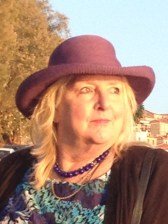
Carol P. Christ is author or editor of eight books in Women and Religion and is one of the Foremothers of the Women’s Spirituality Movement. She leads the Goddess Pilgrimage to Crete in Spring and Fall: Sign up now for spring tour and save $100. Follow Carol on Twitter @CarolP.Christ, Facebook Goddess Pilgrimage, and Facebook Carol P. Christ.  Carol speaks in depth about the Goddess Pilgrimage to Crete in an illustrated interview with Kaalii Cargill. Photo of Carol by Andrea Sarris.

A Serpentine Path Cover with snakeskin backgroundA Serpentine Path: Mysteries of the GoddessGoddess and God in the World final cover design will be published by Far Press in 2016. A journey from despair to the joy of life.

Goddess and God in the World: Conversations in Embodied Theology with Judith Plaskow will be published by Fortress Press in August 2016. Exploring the connections of theology and autobiography and alternatives to the transcendent, omnipotent male God.

Moving Away from Normative Maternal Roles in the Catholic Church by Michele Stopera Freyhauf

FreyhaufEarlier this week, social media was all abuzz about the Pope’s investigation into restoring women to the diaconate. In the complete transcript of the Pope’s comments,  the traditional notion of women’s maternal role in the church is mentioned in relation to the Church.  Certainly this is nothing new.  Here the Pope describes important “maternal” work such as working with the marginalized, catechesis, and caring for the sick – once again, nothing new.

However, in the next sentence, a very subtle shift is seen when it comes to normative gender roles:

…. there are men who do the same [work as consecrated women], and it is good…..and this is important.

What does this mean – a change in language?  a laying of groundwork? or nothing at all?

imgres

It is no secret that cultural constructs of women as maternal and how a mother is defined as or even does has radically changed in today’s society; but, the Church continues to remain steadfast in normative roles between the priesthood and the “motherhood” of the Church (and therefore “motherhood” in general).

Continue reading “Moving Away from Normative Maternal Roles in the Catholic Church by Michele Stopera Freyhauf”

What Does Mother’s Day Mean in a Patriarchal and Matricidal Culture? by Carol P. Christ

Carol Molivos by Andrea Sarris 2When we seek immortality or spiritual “rebirth,” are we not saying that there is something wrong with the “birth” that was given to us through the body of our mothers? In She Who Changes and in “Reading Plato’s Allegory of the Cave as Matricide and Theacide,” I asserted that our culture is “matricidal” because it is based on the assumption that life in the body in this world “just isn’t good enough.”

What is so wrong with the life that our mothers gave us that we must reject it in the name of a “higher” spiritual life? The answer of course death.

Can we love life without accepting death?

Can we love our mothers if we do not accept a life that ends in death? Continue reading “What Does Mother’s Day Mean in a Patriarchal and Matricidal Culture? by Carol P. Christ”

The Pope Punts and Catholics Vote with Their Feet by Carol P. Christ

Reading the receCarol Molivos by Andrea Sarris 1ntly released papal letter “The Joy of Love,” I was surprised to see that it opens a “new” discussion of marriage and the family with a very old patriarchal trope from Psalm 128:

Blessed is every one who fears the Lord,

who walks in his ways!

You shall eat the fruit of the labour of your hands;

you shall be happy, and it shall go well with you.

Your wife will be like a fruitful vine

within your house . . . (see ch. 1, pp. 7-8)

Notwithstanding the “inclusive language” translating the male generic in Hebrew as “one,” there is no way around the fact that this psalm is addressed by a male God to men. It compares women to property owned and tended by men. Nor does it provide any opening to consider the blessings of same sex marriage. Continue reading “The Pope Punts and Catholics Vote with Their Feet by Carol P. Christ”

Islamic Feminism and Heterosexual Dogma by Vanessa Rivera de la Fuente

12065675_170600583286234_3734458453482361154_n
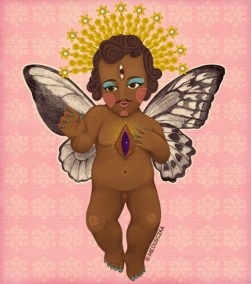
Santa Niña Marica

Reza Aslan says in his book “No God But God” that religions are myths. He explains that “religion” is a set of stories fluctuating between truth and fantasy that serve to explain and answer questions about human fate. Taking this idea as base, I think “religion” is a historical product that enables other mythical stories and must be addressed critically about its truth and meanings.

Patriarchal religious discourses, currently mainstream, have a common element that often is left outside the reading of equality and is part of the myth: Heterosexual belief.

Feminisms in Religions aim at challenging patriarchal readings. However, questioning the nature of God is not enough if we don´t challenge heterosexual belief that may or may not include the idea of a God Father/Male. In Islam, Allah has no sex or gender, is not masculine nor feminine. However, the heterosexual belief exists in the Islamic religious narrative. Continue reading “Islamic Feminism and Heterosexual Dogma by Vanessa Rivera de la Fuente”

Updates on Listening by Xochitl Alvizo

X.Alvizo CSUN Profile 2-editedThe pieces of my dissertation are beginning to float to the surface, piece by piece, released into the world as smaller parts of the whole. At some point this all may become a book, but for now, I have enjoyed the opportunity to share some of the learning from my dissertation research in book chapters, articles, and blog posts, which I’d like to share with you all so that you can see some of what I’ve been up to these days.

The most recent piece that has come to be is an article on The Listening Guidethe particular method of narrative analysis I used to analyze the transcriptions of the interviews I conducted with participants of Emerging Church congregations. I’m particularly excited about this piece because I think it could be a useful tool to many of us in our respective fields of study and work. And although my particular context is theological and, even more specifically, Christian, as a tool and method, The Listening Guide can be used for reflection and be of great value in a variety of contexts.  Continue reading “Updates on Listening by Xochitl Alvizo”

Caroline Schelling’s 4th Letter by Stuart Dean

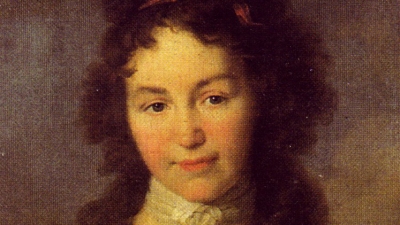
Caroline Schelling

Caroline Schelling (‘Caroline’) wrote the fourth letter of hers that survives (the ‘4th Letter’) on October 7, 1778, shortly after she had turned 15, to a girl she met at boarding school who was to become her lifelong friend (Luise).  The intensity of her friendship with Luise is evident already in the 4th Letter, for she tells Luise that in writing to her she “portrays her entire soul.”  What prompted such depth of feeling for this letter relates not just to a significant moment in Caroline’s life but in every person’s life.  In the second paragraph she refers to what was most likely her first sexual relationship.  Given that context, Caroline demonstrates remarkable emotional maturity and intellectual sophistication in how she expresses herself.

She begins by referring to the “sensations of my heart,” telling Luise how she struggles to find “adequate words” to express them.  She is not, she proudly insists, an “enthusiast” who simply gives into feelings, insisting instead on the importance of “going over” (Überlegung) them herself.  Though Caroline was not taught Latin, it seems as if she had been taught the relevance to German of a Latin treatise from the 4th century CE on the method for defining words.  Caroline’s ‘going over’ her feelings before writing Luise is consistent with its methodology: first, to confront the question of whether something even exists (an sit, Existenz) and then determining, to the extent possible, what it is (quid sit, Wesen) and what its qualities are (quale sit, Eigenschaften)–i.e., its relationship to other words (grammar) and hence how it can be communicated.  

This methodology, which is applicable to a wide range of disciplines (e.g., legal argumentation, psychiatric diagnosis), is also analogous to a language theory Charles Segal argued is implicit in what remains of the writings of the 5th century BCE Sicilian Gorgias, a theory Segal related to Sappho’s poetry.  That is relevant, because given the failed sexual relationship about which Caroline writes to Luise, the 4th Letter bears comparison to two poems by Sappho (S. 31 and S. 1) that Caroline surely then knew in translation.  Caroline’s “sensations of my heart” is directly comparable to the palpitations of the heart Sappho refers to in the second stanza of S. 31.  The immediate effects are comparable; Sappho cannot speak and Caroline cannot find “adequate words.”  Though S. 31 appears to break off, S. 1 can be read as a continuation of it.  There Sappho prays for divine intervention (Aphrodite) to deal with a failed sexual relationship; the closing prayer of its final stanza is analogous to the last sentence of the 4th Letter’s first paragraph: “Lord, you who know my heart . . . fulfill no wishes that are not pleasing to you, I am depending on you!” 

In each case it would seem the answer is anticipated to be one that is not heard or read but rather felt in the heart, intuitively understood as the center point of all bodily feelings.  That would be not an abstraction from the senses but an inward intensification of them.  Such intensification becomes the basis for its outward expression not just in words, but in all forms of art.  

Caroline grew up during a time of renewed interest in ancient Greek art and particularly nude sculpture, which rightly can be taken to symbolize the belief in the sacredness of the entire human body (a belief that correlates with heart centeredness).  It is notable that the floruit of such sculpture predates Plato by almost a century and quite literally embodies principles utterly antithetical to his philosophy.  It is also analogous to another art form that predates him and that he disparaged: reciting poetry (whether or not incorporated into a theatrical production).  Poetic recitation requires fully identifying with the poet and poem to such a degree that it can be thought of as internalized sculpting.

The principles underlying sculpture and recitation are thus similar and of general applicability.  Caroline, who enjoyed (and was appreciated for) reciting poetry, makes the point in a review she wrote of a book of essays on artistic appreciation (the “Review”).  To judge art, she says, it is necessary to penetrate “deeply into the meaning and sensibility of both it and its initiator . . . surrendering oneself in quiet reflection to a disposition of loving, receptive observation . . . [to be] transpose[d] . . . into the world of the poet or artist.”  She defends the book’s use of a fictional friar to voice religious reverence for art, effectively equating artistic appreciation with religious devotion, since it is only from feeling the divine within (i.e., internalizing god as the artist) that the divine outside is to be understood.   

This was not something new for Caroline, as is evident from the 4th Letter that was written nearly twenty years before the Review.  Not only does she seem to have internalized Sappho, but the opening line of S. 31 (a man, “equal to the gods”) and the closing line of S. 1 (“my comrade,” the goddess) arguably encouraged her transition in the 4th Letter’s first paragraph from describing her feelings to Luise (psychology) to praying to God (theology).  That transition anticipates the identification of psychology with theology Caroline articulates in the Review.  

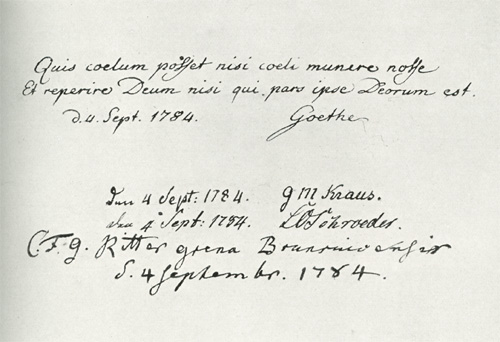
The remote antiquity of this identification and its association with goddess worship to which Sappho attests, as well as the recognition of it by Caroline at such a young age deserve attention, for it has quite a history, especially in German culture.  Goethe quoted two lines of a 1st century CE Latin poem on astrology that essentially echo it in the guestbook atop Mount Brocken on September 4, 1784: who is able to know heaven except by a gift from heaven, who finds god unless a part of the gods is within them.  It is not known when Caroline met Goethe; it has been speculated that he was the father of her first daughter, Auguste, born April 28, 1785.  In August 1784 Caroline was living in a mining town not far from Brocken.

The opening paragraph of an essay published by Caroline’s third husband in 1809, only months before her death, contains a reference to the principle of knowing the god outside from the god within, correctly noting that its connection with Empedocles proves it predates Plato.  In 1936 Heidegger characterized that essay as “one of the most profound works” of Western philosophy.  In my next post(s) I hope to show that its profundity relates to a critique of Plato (and other philosophers) that derives from Caroline and her appreciation of ancient Greek female spirituality, and not to glorifying supermen.

Stuart WordPress photoStuart Dean has a B.A. (Tulane, 1976) and J.D. (Cornell, 1995) and is currently an independent researcher and writer living in New York City.  He has studied, practiced and taught Tai Chi, Yoga and related disciplines for over forty years.  Stuart has a blog on Sappho and the implications of her poetry for understanding the past, present and future: http://studysappho.blogspot.com/

Seasons in Church and Life in the Company of Women by Elise M. Edwards

TElise Edwardshis week, the Christian season of Lent began. Ugh. Lent can be so somber and serious and gloomy. Last year, I didn’t want to place myself in that frame of mind. I was experiencing grief and self-doubt and loneliness, and felt that an extended period of reflection about self-denial, Christ’s suffering, and the sinful condition of humanity might pull me into an unhealthy depression. Also, I questioned why I should seek silence and solitude when I was already experiencing too much of it. I felt isolated.

This year is different for me. Once again, I’m entering the season with a grieving heart. I’m mourning the death of my cousin. But I do not feel isolated. I am not self-doubting. This January, I spent four continuous days with mentors and peers in academia who poured love and wisdom and inspiration into me. The women in our group sought each other out and had honest and authentic conversations about the successes and struggles in our lives. We affirmed self-care. We affirmed milestone birthdays. We affirmed our bodies, despite the physical limitations we sometimes feel. We affirmed the tough decisions some had made, the transformations some were pursuing, and the exciting opportunities that had developed for others since we last met over the summer.

It was a powerful experience, but there was pain, too. We confronted fear, rejection, anxiety, exhaustion, and frustration. I felt blessed—divinely gifted—to have an opportunity to speak honestly with my sisters in the spirit about the people and issues on our hearts: challenges with students, systemic racism and sexism, menopause, children, research questions, financial decisions, romance, and health.

I was on an emotional high from the power that comes from being truly known and loved and I was reveling in the power of that love. Continue reading “Seasons in Church and Life in the Company of Women by Elise M. Edwards”

Wisdom Fiction (Part 2) by Elise M. Edwards

Elise Edwards“There are years that ask questions and years that answer.” from Their Eyes Were Watching God by Zora Neale Hurston

In my previous two posts, I’ve discussed the wisdom that can be found in black women’s literature. Continuing this series, I’m sharing a statement from the most well-known novel written by Zora Neale Hurston. Hurston was an American novelist, folklorist, anthropologist, and cultural critic whose work was first published in the 1920s-1940s. Their Eyes Were Watching God was published in 1937 and has since been reissued and adapted into film.

“There are years that ask questions and years that answer.” This quote is one that has circled around my mind every New Year and every birthday for many years. These times of year are when I’m likely to reflect on the previous year and wonder what has come from it.

Continue reading “Wisdom Fiction (Part 2) by Elise M. Edwards”

In the Beginning by Natalie Weaver

Natalie Weaver editedDear Friends,

Every year on New Year’s Eve, I read creation stories to my family.  We light candles, sit in a circle, eat, drink, and read.  This little ritual began as my protest to the vulgar commercialization of the New Year and the ponderous weight of trying to be/do/achieve something new every twelve months.  Last year, I discovered, however that I felt like the ancient creation myths and the new ways of bringing in the new year messaged similar things.  I wrote about it in my blog post from January 2015, committing to write my own creation myth to read this year.  I like where it is going… even this little exercise is causing me to think differently about sacred literature.  I am becoming Inspired, I gasp to myself, to write my own Scripture, my own sacred truth.  Here’s what I’ve got so far.  I hope you enjoy it.  Happy New Year!

Sirius in the Sky1 The beginning could not be reckoned in the time before time was reckoned.  2 For, what was had yet to know itself, and it could not know itself alone.  3 But, for its love, it could not be known.  So it was that the beginning that could be reckoned was not the beginning but the beginning of loving, which was the beginning of knowing, which was the beginning of being.  4 And, in that beginning, a great ellipsis had already become of particle and light, and the particle and light thrummed through darkness forming a whole body.  5 Of the great ellipsis of particle and light, a body and a body and a body were formed, in and of the great ellipsis, thrumming through darkness.  6 The thrumming ellipsis pushed forward so far that its particle and light extended beyond itself and then beyond itself and then beyond itself, as though it were to separate, but it did not.   7 A whole body was formed, which was the beginning of the simultaneity of what was and what is and what will have been.  Continue reading “In the Beginning by Natalie Weaver”