


Delilah is a beautiful name on its own merits. As a biblical personage Delilah is forever connected to Samson for their tales are intertwined. As it is told in Judges, Samson is the clear hero of the tale and Delilah is merely the temptress who betrays him. But as in all spiritual accounts there is more here than meets the eye. A spiritual journey is never a linear affair. When reading the story of Samson and Delilah, it immediately becomes clear that something mythical is afoot. The root of Samson’s name is the same as the word shamash, the Hebrew word for sun. The root of Delilah is lila, meaning night. Right away we understand that this story contains apparent opposites, heavenly aspects, the sun and the night, light and dark . . . Continue reading “Delilah, Lost by Janet Maika’i Rudolph”
Category: Feminist Theology
Yes, there are Goddesses in the Bible, Part 5 by Janet Maika’i Rudolph
As I wrote my last blog post, the Great Goddess of the Canaanites, Ashera was honored and worshipped (according to the bible) within and through groves of trees. Ashera and El, the “great bull god” were deeply connected. In fact, in Canaanite mythology, El and Ashera were married.
But before delving into their relationship, I would like to start in a different (but connected) direction – the lovely archetype of the morning star and the evening star. The planet Venus, named for her namesake Goddess (or vice versa), is both the planetary vision of the morning star and the evening star. Whether She be Goddess, planet or evening/morning star, when She appears in one form, She embodies them all. Continue reading “Yes, there are Goddesses in the Bible, Part 5 by Janet Maika’i Rudolph”
Yes, there are Goddesses in the Bible, Part 4 by Janet MaiKa’i Rudolph
This is the 4th in a series of blog posts about finding goddesses in the bible who had been hidden away through translation or denigration or other means. In my last blog post I discussed Lilith as a Great Goddess symbolized by both tree and bird. You can see it here.
Today I continue with the topic of trees along with an examination of reversals and how many of beautiful, female pagan symbols were changed or removed from the texts. Perhaps the most obvious and pernicious has been that Eve “caused the fall” of humankind through a sinful act. Thus, the logic goes, it was Her action that has created the “grand curse” that we have labored under ever since. As I wrote in my last blog post, Lilith is another example, being portrayed as a demon in order to denigrate her Great Goddess roots. Lilith originally embodied both bird and tree energies. In my last blog post I showed one image of the Goddess in the tree which was a common theme in ancient Levantine cultures. The image today shows the goddess breast in the tree, which is identified as Isis suckling the future pharaoh Tutmose III. These images show the “Goddess in the Tree” as freely bestowing Her gifts and nurturing (not cursing) humankind. Continue reading “Yes, there are Goddesses in the Bible, Part 4 by Janet MaiKa’i Rudolph”
Who Are You to Tell Me I’m Not Really a Catholic? by Jamie Marich
 Many opinions are flying around during this election cycle about what makes a Catholic a Catholic. Yes, Joe Biden is a practicing Catholic, only the third Catholic candidate to ever run on a major party nomination in the United States (the first being President Kennedy, the second John Kerry). Yet for conservative Catholics who support President Trump, declarations abound that Joe Biden isn’t really a Catholic, especially due to his support of a woman’s right to choose and full civil rights for LGBTQ+ individuals. In the eyes of such commentators, including many priests, people like me are no better— Feminist Catholics who openly support a Democratic candidate. If you’re reading this piece, maybe you are a confused Catholic who is feeling bullied by your own priest or other American Catholic thought leaders right now. Rest assured, not all Catholics are the same, and how you identify in your faith is truly between you and the God of your understanding. Be cautious of anyone who is promoting a theology of exclusion, making you feel less than for practicing your faith authentically and in a way that lines up with all of your values and points of identity. Continue reading “Who Are You to Tell Me I’m Not Really a Catholic? by Jamie Marich”
Yes There are Goddesses in the Bible, Part 3
 This blog post is the 3rd in a series of looking for female deities in the bible who have been translated out of easy reach or otherwise hidden within its words. In my last blog post I discussed bird imagery and the bible. It is available here.
You can’t complete a discussion about birds without also bringing up Lilith. She appears by name only in one place in the bible; Isaiah 34:14. Isaiah uses the word liyliyth as a feature in a hellish landscape. Although it is also a name, liyliyth is treated as a common noun. The most prevalent translation is “screech owl” although others have included such names as night creature, night monster, night hag, and she-vampire. Continue reading “Yes There are Goddesses in the Bible, Part 3”
Yes, There are Goddesses in the Bible – Part 2 by Janet Maika’i Rudolph
As I wrote in my last blog post, there are female deities and goddesses sprinkled all throughout the bible. They just aren’t obviously in plain sight.
One example is the Goddess and Her association with birds. Many ancient creation myths have stories about life emerging from a cosmic egg and the Goddess who carries and/or lays that primordial egg-of-life. Like the bird, women carry the eggs of life’s creation within our bodies. This has given rise to numerous cultural symbolisms that have come down to us associating the Goddess with birds. The dove is Venus’ hallmark. Mother Goose is the keeper of our cultural stories. It is the stork who brings us babies. As I will show below, divinity, or the biblical LORD is sometimes depicted as a bird, making this biblical description of god a female. Continue reading “Yes, There are Goddesses in the Bible – Part 2 by Janet Maika’i Rudolph”
What’s Changed? by Elise M. Edwards
 Friends, it has been a few months since I’ve posted in this community. I’m amazed at how much our world has changed since then. Here in the northern hemisphere, spring came and went. It felt like a tide of turmoil rolled in, leaving debris all along the shore and now we are trying to clean it up while keeping our eyes on the sea for more dangerous waves that are coming.
The issues we now face began before March, but for many of us, that was when the COVID-19 pandemic began to alter our patterns of daily existence. In-person instruction at my university and most schools was suspended and spring semester courses shifted online. In March and April, we quarantined, self-isolated, and sheltered in place. While a gradual re-opening of businesses and services has occurred in the months since then, I don’t know anyone who has resumed daily life as it was before. The virus continues to spread and the death toll rises.
Yes, There are Goddesses in the Bible by Janet Maika’i Rudolph

“Freud once asserted that mortals are not made to keep secrets;
what they would like to conceal oozes from all their pores.”
Psychoanalyst Theodore Reik[1]
It’s remarkable how much female imagery there is in the Bible hidden within its wording. The more I delve into its passages, the more that I have found these hidden/not so hidden sacred feminine images, even deities. I have begun a project of digging in and rooting out these little gems. When people think about the sacred feminine or female deities in the Bible the most well known is the Shekinah. The Shekinah is a lovely presence. The word means “dwelling” and usually represents “god’s divine presence” or a place where the divine resides.
The problem is that the Shekinah as a feminine essence of the divine is never stated explicitly, it is an interpretation of how the word is used. I love the concept of the Shekinah but as an essence that upholds the entire weight of the feminine divine in the bible, I find it unsatisfying by itself. Luckily for me, Goddess Shekinah has lots of company. Sometimes they are indeed hiding in plain sight. Sometimes they hide in the translations. The passage I am presenting today has some of both going on. The following is the King James Version of Genesis 49:25. Jacob has been giving blessings to each of his sons and this is part of the blessing he gives to Joseph: Continue reading “Yes, There are Goddesses in the Bible by Janet Maika’i Rudolph”
The Messy, Wild Mystery that’s Stronger than Wrong by Trelawney Grenfell-Muir
 I am an annoying feminist. I annoy pretty much everyone about it, because I’m never NOT applying a feminist lens to every aspect of life: science (looking at you, Larry Summers), politics (Joe Biden is a rapist), art (objectification is NOT empowerment), culture (make-up is a prison), and, of course religion. I’m perhaps most annoying of all when it comes to religion. I annoy Christians by raving about Christ The Cosmic Vagina, and I annoy secularists by raving about feminist Jesus. I especially annoy my church friends and colleagues by refusing to use the (male) word “God” to talk about the Infinite Divine Mystery, much less male pronouns or oppressive symbols such as Lord, King, or Kingdom.
Yep, I’ve been cheerfully annoying the hell out of everyone for decades, drawing vagina art during male-centric worship services, changing lyrics on the fly, slipping female words and symbols into prayers and startling whomever sits near me… I am a feminist. Not the fun kind. Continue reading “The Messy, Wild Mystery that’s Stronger than Wrong by Trelawney Grenfell-Muir”
Visions of the Goddess: A White Horse by Carol P. Christ
Imagine my surprise when, a few days ago, I looked out my window to see a dappled horse munching on flowers in the field across the street from my house. In the next days I got used to her being there. I would look for her in the mornings and at odd times during the day. Sometimes she was visible and sometimes she was not. When I could see her, I would open the window and call out, “Hello, white horse, you are very beautiful.” Once or twice she turned her head to look at me and seemed to respond, “Thank you for noticing.”
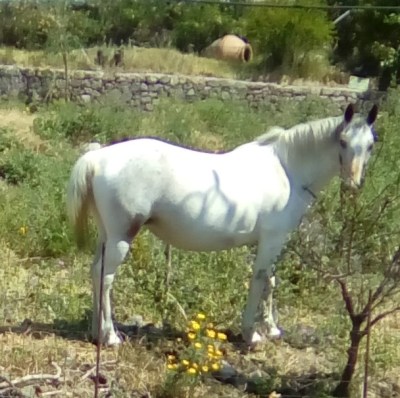
Many hundreds of years ago, Sappho must have had a similar vision in a field near a grove of trees where she and her students waited for the Goddess to appear, for she wrote: “In meadows where horses have grown sleek among spring flowers, dill scents the air.“ These lines are part of a longer poem addressed to Aphrodite that begins: “Leave Crete and come to us.” In this place, “incense smokes on the altar,” there is a stream, there are apple trees and rose bushes and horses in a field of flowers. Continue reading “Visions of the Goddess: A White Horse by Carol P. Christ”
 Feminism and Religion