Book Review: Hild & The Patron Saint of Ugly by Mary Sharratt

OLYMPUS DIGITAL CAMERA

Literature touches our spirit in a way that film, television, and even art cannot. Instead of presenting the passive viewer with a visual image, good writing demands our participation and co-creation. The words become the springboard for our own imagined vision of other worlds and other lives. In this imagined space, we can experience profound insights and revelations–soul-growing experiences we carry with us forever.

Books that try too hard to be spiritual can have the opposite effect. Discerning women demand books that respect us instead of preaching to us. Too often religion has been interpreted by and for men, but when women writers reveal their spiritual truths, a whole other landscape emerges, one we haven’t seen enough of.

Marie Manilla’s The Patron Saint of Ugly (Houghton Mifflin Harcourt, June 17, 2014) and Nicola Griffith’s Hild (Farrar, Straus and Giroux 2013) are two such transporting novels. They both draw on the lives of female saints in fresh and evocative ways.

Continue reading “Book Review: Hild & The Patron Saint of Ugly by Mary Sharratt”

Tis Babos: The Dance of the One Who Gives Life by Laura Shannon

Laura Shannon

The one who gives life, the one who gives birth: this was the original image of the Creator. Not God but the Goddess, both mother and midwife to the world. Throughout Eastern Europe, Asia Minor, North Africa and beyond, Goddess worship laid the foundation for European culture. Thousands of years later, a deep reverence for the woman who gives life – the midwife – survives in Greek and Balkan dance rituals which still echo from the distant past.1

The mamí (from mámmo, grandmother) or bábo (old woman) was a respected woman, usually older, with the wisdom and experience of age. The midwife is publicly honoured on Midwivesʼ Day, January 8th. Known as Babinden in Bulgaria, Tis Babos in Greece, this women-only celebration is an important holiday in Bulgaria and in numerous villages of displaced Thracians now relocated in Greek Macedonia. One such village is Kitros, whose inhabitants originally came from Bana, on the Black Sea coast of northern Thrace (today Bulgaria). A hundred years have passed since they left, but the womenʼs festive costumes still indicate their old Bana neighbourhoods; traditional foods, songs, dance, and other customs are kept alive despite decades of brutal loss and change. Continue reading “Tis Babos: The Dance of the One Who Gives Life by Laura Shannon”

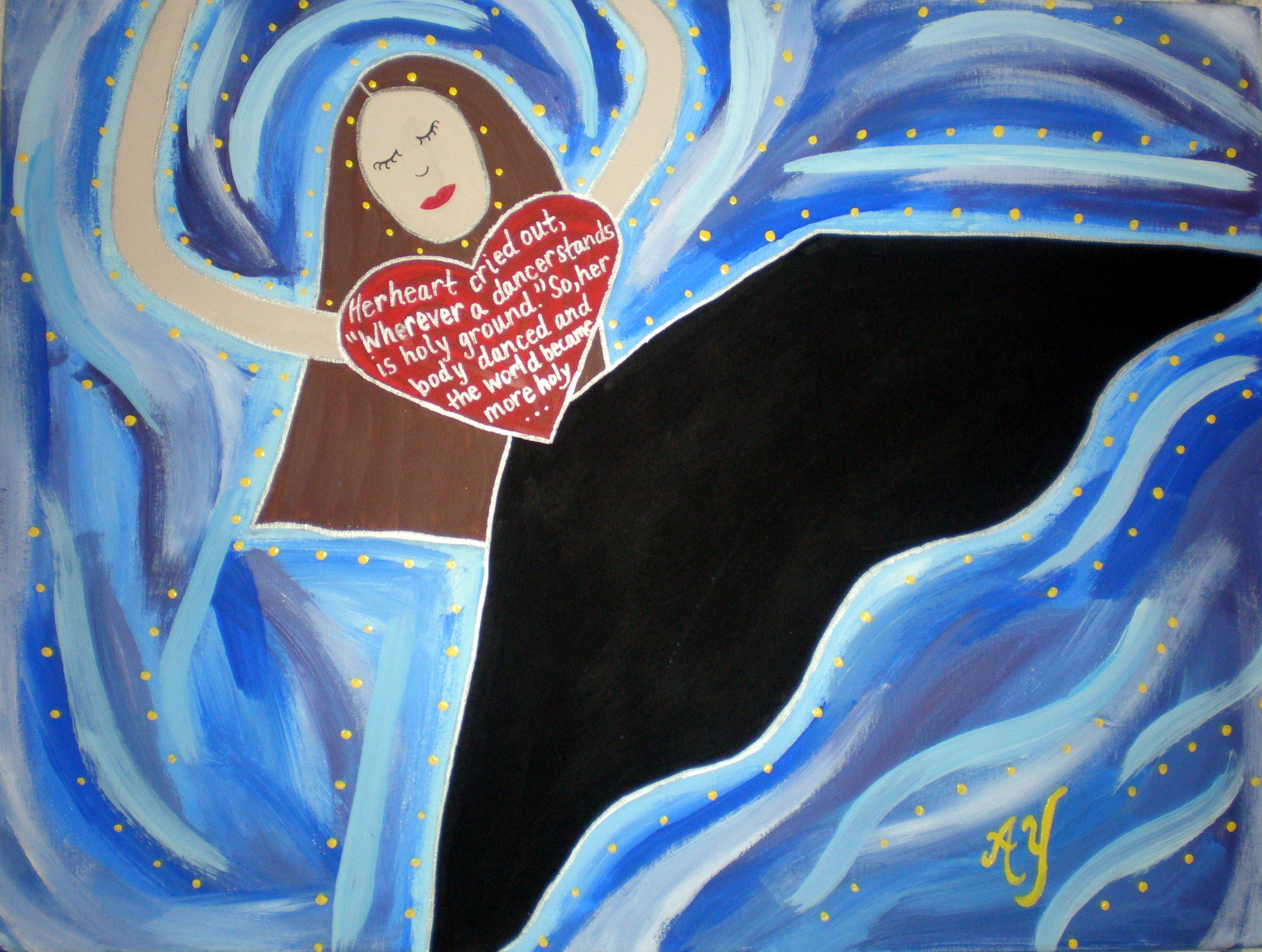
Writing Holy Women Icons by Angela Yarber

angelaFor two years I have had the great privilege of writing a monthly article about one of my Holy Women Icons with a folk feminist twist for Feminism and Religion. Virginia Woolf , the Shulamite, Mary Daly, Baby Suggs, Pachamama and Gaia, Frida Kahlo, Salome, Guadalupe and Mary, Fatima, Sojourner Truth, Saraswati, Jarena Lee, Isadora Duncan, Miriam, Lilith, Georgia O’Keeffe, Guanyin, Dorothy Day, Sappho, Jephthah’s daughter, Anna Julia Cooper, the Holy Woman Icon archetype, Maya Angelou, and many others that will follow in the months and years ahead have guided, empowered, and inspired me as an artist, activist, feminist, scholar, and preacher.

I knew from that outset that writing about them would deepen my relationship with each of these amazing women. I also knew that their power and efficacy monumentally increases when they join together. This colorful cloud of witnesses has filled myriad galleries, reminding viewers of the powerful women who have paved the way for us today. Many have left the group, finding a resting place in the homes, offices, and galleries of friends, colleagues, and strangers who have purchased or commissioned an icon along the way. And those that remain erupt the hallways of my home with a cavalcade of color, daily reminders of who I am called to be and become.

Between researching their stories, painting them, hanging them in galleries, and selling them, I knew that one day I would bind their stories together in a book. So, it is with tremendous joy that this dream has become a reality. Parson’s Porch Publishing, a non-profit publishing house whose mission is to “turn books to bread” by giving their profits to feed the poor, has lifted up the stories and images of nearly fifty of my beloved Holy Women Icons in a book. So, along with originals, commissions, and prints, Holy Women Icons are now available as a book and as individual greeting cards. It is my sincere hope that by binding the stories of these holy women together, they may provide inspiration and empowerment for all readers, binding all our diverse stories together in a collective cry for beautiful, unabashed, prophetic justice for all. Continue reading “Writing Holy Women Icons by Angela Yarber”

The Soul is Symphonic: Reclaiming Sacred Music

https://i0.wp.com/media.tumblr.com/55c2821e2413450d48ec03b96e4cd426/tumblr_inline_mqcp4y6ZwN1qz4rgp.jpg

Here is a hymn of praise, a beautiful and intimate piece meant to be sung.

Hail, O greenest branch,

sprung forth on the breeze of prayers.

. . . . a beautiful flower sprang from you

which gave all parched perfumes their aroma.

And they have flourished anew  in full abundance.

The heavens bestowed dew upon the meadows,

and the entire earth rejoiced,

because her flesh brought forth grain,

and because the birds of heaven built their nests in her.

Behold, a rich harvest for the people

and great rejoicing at the banquet.

O sweet Maiden,  no joy is lacking in you . . . .

Now again be praised in the highest.

When I posted this sacred text on my blog back in 2008, I asked my friends who come from a diverse range of spiritual backgrounds to guess the author and the divine figure to whom the text is addressed. Some thought it might be an ancient hymn to Persephone. In fact, it is one of Hildegard von Bingen’s ecstatic odes to the Virgin Mary. This song, O viridissima virga, can be found on a number of CDs of Hildegard’s music.

Born in the rich green hills of the German Rhineland, Hildegard von Bingen (1098-1179) entered the religious life at the age of eight. A Benedictine abbess, she composed an entire body of sacred music, including seventy-seven songs and a musical morality play which can be regarded as our first surviving opera. A polymath well versed in science and the healing arts, she developed her own form of natural medicine that is still practiced in Germany today. During her own lifetime, she was most famous for her prophecies which earned her the title Sybil of the Rhine.

Since earliest childhood, Hildegard experienced profound visions which directly influenced her music, theology, and healing practices. Her visions revealed the feminine face of the divine, which is mirrored in her music. Many of her songs are addressed to Mary or female saints, such as Ursula. Even the Godhead itself appeared to her in feminine form. In Scivias, her first book of visionary theology, she writes, “She is with everyone and in everyone, and so beautiful is her secret that no person can know the sweetness with which she sustains people, and spares them with inscrutable mercy.”

Hildegard’s sacred songs are filled with a deep sensuality and reverence for the natural world. In her hymn O viridissima virga, she transforms the Latin word virgo, or virgin, into virga, or branch, addressing Mary as the most verdant and lushly abundant branch on Jesse’s tree. Hildegard was Christian, yet her music and visions have profound resonance for people from all spiritual backgrounds. The more I study mystics and visionaries, the more I am convinced that they draw on the true heart of divinity. They tap into the ineffable.

Sacred music was the bedrock of Hildegard’s spirituality. For her, song was the highest form of prayer, sacred harmonies rising like incense in a perfect offering to heaven. Hildegard believed that the soul is symphonic. Such is the sweetness of music that it banishes human weakness and fear, and draws us back into our original state of grace, reuniting humans to their divine Source.

Benedictine monastic life was structured around the Divine Office: eight times a day, from the dawn office of Lauds to the night vigil of Matins, the choir nuns gathered to sing the Psalms of David and other sacred songs. Near the end of her long life, Hildegard and her nuns at Rupertsberg Abbey were subject to an interdict, or collective excommunication. A supposed apostate lay buried in their churchyard and they refused to allow the ecclesiastical authorities to exhume this man and desecrate his grave. As a result of the interdict, Hildegard and her nuns were denied the Mass and the sacraments—a very old woman, Hildegard herself might have died without the final sacraments or Christian burial. Yet what infuriated her most was that she and her sisters were forbidden to sing the Divine Office. Sacred song was absolutely central to her identity as a religious woman. The interdict was lifted only shortly before her death. I imagine her singing until her dying day.

What relevance does this have for us today? When I listen to recordings of Hildegard’s music, I am struck by its ethereal beauty. Nowadays, for people across the spiritual spectrum, there seems to be a dearth of good music. Much of what is sold as meditation music or inspirational music seems shallow and insipid to me. A regular church-going Catholic is more likely to experience the guitar mass than the mysterious beauty of Hildegard’s music.

As contemporary spiritual people, are we to live our lives severed from the kind of music that can truly feed our souls?

What can we do to reclaim the power of sacred song? Few of us are gifted composers. Many of us cringe to even hear ourselves sing. How do we integrate sacred music into our spiritual practice? Most of us lead busy lives and the stillness of a monastic lifestyle remains an impossible dream. Yet we might find sung devotions at morning and twilight to be deeply enriching. We might start by listening to recorded music that inspires us. From my own practice, I’ve discovered that Hildegard’s music definitely works as a backdrop to meditation and contemplation. It soothes the soul and draws the heart and mind to a higher place. Over time we might gain the courage and will to take the leap to sing for ourselves. It’s not necessary to play an instrument. The voice  God gave us is enough. The next logical step is creating our own new music.

If we can’t find the music to nourish our soul, we must create it. Hildegard took the established tradition of plainchant and wedded it to her own vision to create hymns of incomparable beauty that still move us today. Most of us aren’t visionaries like Hildegard, but we can write our own heartfelt lyrics in praise of the Divine as we see Her. We can write songs to celebrate the sacred cycles of the year and the days we hold sacred. We can take ancient sacred texts and find a melody to carry the words. Medieval plainchant is beautiful in its simplicity. Or perhaps a haunting old folk air will inspire you.

When you offer your songs as prayers, sing like you mean it. It’s not a performance to impress other humans but a pure act of devotion. Meet together with friends in an informal devotional gathering. Share your songs. Inspire each other. Our modern sacred music will inevitably keep evolving as people compose new songs and add to the canon. We each have the opportunity to be part of this evolution.

Mary Sharratt is the author of Illuminations: A Novel of Hildegard von Bingen (Houghton Mifflin 2012, Mariner 2013), winner of the Nautilus Gold Award: Better Books for a Better World. Visit her website.


Sacred Music Discography:

Hildegard von Bingen:
11,000 Virgins: Chants for the Feast of St. Ursula, Anonymous Four, Harmonia Mundi, USA.
The Dendermonde Codex, Dous Mal/Katelijne Van Laethem, Etcetera.
A Feather on the Breath of God, Gothic Voices, Hyperion.
Canticles of Ecstasy, Sequentia, Deutsche Harmonia Mundi.
Voice of the Blood, Sequentia, Deutsche Harmonia Mundi.

Women’s Ritual Dances: The Dancing Priestess of the Living Goddess by Laura Shannon

Laura ShannonKyria Loulouda calls to her sister to help her wind the yards of woven girdle around and around my waist. Kyria Stella’s aged fingers, still strong, tuck the sash ends in tightly, smoothing down the fabric she and Loulouda wove themselves. The snug embrace of the sash supports my back and encourages me to stand proudly upright.  As they help me with the intricate tucks and pleats of the festival dress, and the careful tying of the flowered headscarf, I see their tired, careworn faces come alight with joy and expectation. When they are satisfied, they turn me towards the mirror, smiling.

We gaze at ourselves, a row of three women, dressed alike. Like the butterflies embroidered in bright silks on the dark cloth of the bodice, we too are transformed. The food is prepared, the housework is done, the animals taken care of for the night; the other women await us in the square where, by tradition, they will open the dance with their own singing as they have done countless times throughout their lives. We are in the village of Pentalofos in Greek Thrace in the early twenty-first century, living a timeless scene which has been repeated through the generations for hundreds, perhaps thousands of years. Continue reading “Women’s Ritual Dances: The Dancing Priestess of the Living Goddess by Laura Shannon”

Dr. Debbie Downer Discourses on the Lives of Early Pious and Sufi Women by Laury Silvers

Silvers, Bio Pic FRBlogI’ve been called a downer because I take what seems like a jaundiced perspective on the early history of pious and Sufi women. There is a tendency in some scholarship, and nearly all contemporary popular treatments of these women’s lives, to over-focus on the positive. They fasten to aspects of their lives that we (post) moderns regard as “positive” or even “liberating,” while ignoring what we find less attractive or troubling. For them, these treatments tell a story of a lost tradition of feminine and egalitarian spirituality representing a golden period that we only need to reclaim to overcome the present state of sexist affairs in our religion. I know these kinds of stories work for women, or they would not keep retelling them. But they don’t work for me. Continue reading “Dr. Debbie Downer Discourses on the Lives of Early Pious and Sufi Women by Laury Silvers”

Echoes of Mesopotamia by Molly

IMG_0522

Echoes of Mesopotamia
small figures from ancient places
ancient times
and ancient faces
ancient words
and ancient wisdom
still flowing in my veins

Clay in my hands
clay in her hands
running on the rivers of time
spiraling in the mysteries of being
spinning in the eddies and ripples of eternity…

I have a strong emotional connection to ancient Paleolithic and Neolithic goddess sculptures. I do not find that I feel as personally connected to later goddess imagery, but very ancient figures call to something deep and powerful within me. I have a sculpture of the Goddess of Willendorf at a central point on my altar. Sometimes I hold her and wonder and muse about who carved the original. I almost feel a thread that reaches out and continues to connect us to that nearly lost past—all the culture and society and how very much we don’t know about early human history. There is such a solid power to these early figures and to me they speak of the numinous, non-personified, Great Goddess weaving her way throughout time and space. Continue reading “Echoes of Mesopotamia by Molly”

WOMEN AND WEEDING, THE FIRST 10,000 YEARS* by Carol P. Christ

carol-christMary, Mary, quite contrary, how does your garden grow? With silver bells and cockle shells, and pretty little maids all in a row.

From the beginning of horticulture about 8000 BCE or earlier to the present day, weeding has been women’s work. Women, who were the gatherers and preparers of food in traditional nomadic societies, no doubt were the first to discover that seeds dropped at a campsite one year sometimes sprung up as plants the next year. When this discovery was systematized, agriculture was invented, and human beings began to settle down in the first villages and towns.

In the early days of horticulture (the name for the earliest stage of agriculture before the plow was developed), the cycles of planting and harvest and all the stages in between were understood to have been given to mothers by the Great Mother, the Source of Life.  The secrets of planting, seed collection, harvest, and food preparation and preservation were all perceived to be “mysteries” connected to the ongoing cycles of birth, death, and regeneration in the universe.

My grandmother Lena Marie Searing who was born on a farm in Michigan must have learned agricultural secrets from her mother, for she not only created a beautiful garden, she also farmed an orchard and preserved its fruits in glass jars that lined her pantry.  It was she who taught me and my brothers and cousins to love nature.  My mother learned to garden from her mother, but she did not harvest food crops. I think of both of them whenever I work in my garden.

The past few days I have been weeding my garden after heavy rains that left the soil clumpy and moist.  I have weeded before, but I have never enjoyed it so much.  My garden has matured over the past seven years, and now the weeds are more “under control.”  There aren’t so many of them, and as I have now been weeding them out over the years, their roots are shallow.

As I slide a trowel into the earth the weeds lift up and with my fingers I gently pull the plants with their roots from the soil.  The weeds are familiar, though I don’t know all of their names. The “sticky weed” has many tough roots, the clover has many fine ones—both are hard to eradicate. Other weeds are easy to pull up and do not reappear again until the next year.

wild chamomile blooming among "weeds"
wild chamomile blooming among “weeds”

I am discovering that weeding is a delicate process. Sometimes the roots of plants I want in the garden are entangled with those of the weeds. I work carefully choosing the ones to save and the ones to discard.** I leave poppies, chamomile, yellow daisies, and marigolds where I find them, as I consider them to be wildflowers that will provide beauty in my garden when they bloom in spring. I also take care to “keep the soil in good heart” by not discarding too much of it along with the weeds.

As I weed, I think of the women in my village who harvest greens from the fields, feeling certain that some of the weeds I discard are edible.  I marvel at all of the knowledge women have shared and passed down over the past 10,000 years and more, as I realize how little of it I know. My suspicion that some of my weeds could be food is validated when a friend and I order boiled “greens from the mountains” for lunch at a local taverna and are served one of the plants I had thrown into the garbage can.

As I weed, I am reminded of an essay called “Keeping the Soil in Good Heart: Women Weeders, the Environment, and Ecofeminism” by Candice Bradley which was published in Karen J. Warren’s EcofeminismBradley writes that weeding is women’s work in almost all cultures.  As I work, I understand that this is so because weeding is delicate work that requires concentration and patience and that must be repeated. Bradley says that in many cultures men disparage weeding as they disparage housework—not considering either to be “real” work.

Horticulture is the most environmentally friendly form of farming, according to Bradley, because it does the least harm to the soil, and because the weeds that are not eaten are burned or composted and turned back into the earth to replenish it.

While weeding by hand has been considered work for women and children, men have generally controlled the plow and its recent successor, the tractor. However, as Bradly states, the plow and the tractor do not eliminate the need for hand-weeding.  In many cases they encourage the weeds to regenerate. Women and children still weed.

The chemical gardening and farming industry (“round it up”) is based on the premise that weeds can and must be eradicated. Rachel Carson warned us of the danger this approach to agriculture presents to human and all other forms of life.  A by-product of chemical agriculture is that the careful work of women weeders is further discounted.

I do not use chemicals or pesticides in my garden, and I will be out there weeding on a regular basis in the next months.  As I put my hands in the earth, I will think of all the women before me who have weeded and planted, weeded and harvested, and weeded again. Blessed be.

*The title of this essay is an homage to Elizabeth Wayland Barber’s Women’s Work: The First 20,000 Years which discusses and celebrates women and weaving.

**I am aware that no plant was born a “weed” and that the designation of some plants as weeds is a by-product of human digestive systems, human taste, agriculture, and the creation of gardens for the celebration of beauty.

Carol P. Christ created a newly released new website for the Goddess Pilgrimage to Crete which she leads through Ariadne Institute.  Early bird special for the spring pilgrimage available until February 15.  Carol can be heard on a WATER Teleconference.  Carol’s books include She Who Changes and Rebirth of the Goddess and the widely-used anthologies Womanspirit Rising and Weaving the Visions

Women’s Ritual Dances and My Journey to Healing by Laura Shannon

Laura ShannonSince 1985, I have been researching Balkan folk dances and teaching them in women’s circles all over the world. Common symbols in dance patterns, textile motifs and archaeological artifacts from southeastern Europe have remained the same from ancient times to the present, which leads me to suggest that the dances may be descended from ritual practices dating back to Neolithic times. In my view, these patterns serve as a symbolic language, expressing reverence for the cycle of life. Emphasizing connectedness and continuity, homecoming and support, women’s ritual dances can rekindle ancient values of sustainability, empathy and equality, and provide an antidote to the alienation of self which is epidemic in the western world. In nearly thirty years of teaching, I have found that women all over the world respond to these dances as valuable tools for healing and self-discovery. Continue reading “Women’s Ritual Dances and My Journey to Healing by Laura Shannon”

Rosemary Radford Ruether’s Quests for Hope and Meaning by Gina Messina-Dysert

Gina Messina-Dysert profileRosemary Radford Ruether is one of the most brilliant theologians of our time and her newly released autobiography, My Quest for Hope and Meaning, is a gift to those of us who have been so touched by her work.  In this intimate and beautiful piece, Ruether shares her personal journey in feminist scholarship and activism.  The autobiography opens with a profound forward by Renny Golden (that is also shared here on Feminism and Religion) and continues with an introduction and six chapters where Ruether guides us through an exploration of the influence of the matriarchs in her life, her interactions with Catholicism, her continued exploration of interfaith relations, her family’s struggle with mental illness, and her commitment to ecofeminist responses to the ecological crisis.

Ruether states that “Humans are hope and meaning creators” (xii), and her autobiography details her own quests for hope and meaning.  She reflects on the incredible impact made by the female-centered patterns in family and community in her life.  According to Ruether, these “matricentric enclaves” grounded and shaped her interest in feminist theory and women’s history.  She also describes the spiritually and intellectually serious Catholicism that she received from her mother and articulates her continued frustration with Vatican leadership that has undermined the efforts of Vatican II.   For Ruether, her ongoing affiliation with feminist theological circles is crucial as she continues to work toward shaping an ecumenical and interfaith Catholicism.

Continue reading “Rosemary Radford Ruether’s Quests for Hope and Meaning by Gina Messina-Dysert”