Updating our Fairy Tales by Anjeanette LeBoeuf

Anjeanette

The rising voices of female empowerment, consciousness, and position has been an undertaking in the last two centuries. Yet societies are still using fairy tales; tales that were written at least 500 years ago. Many of the fairy tales can be read in a 21st Feminism lens as being harmful and products of a patriarchal society. The movement can only gain more strength and momentum if we start from the ground up – reworking the stories, fables, and myths we teach our children, we make into movies, and that children want to dress up as.

Continue reading “Updating our Fairy Tales by Anjeanette LeBoeuf”

A Tribute to Viktoria Maroniva by Judith Shaw

judith shaw photoIt’s been a very tough month for women. The “Me Too” movement started in 2006, when Tarana Burke coined the phrase “Me Too” as a way to help women who had survived sexual violence. Then on October 15, 2017 it was turned into a huge movement with a tweet by Alyssa Milano, “If you’ve been sexually harassed or assaulted write ‘me too’ as a reply to this tweet.” The tweets and the speaking out have not stopped – they continue to grow –  but the Patriarchy’s defense of a man’s right to sexually assault and abuse women continues. 

Continue reading “A Tribute to Viktoria Maroniva by Judith Shaw”

Fierce Heart: The Power of Women’s Voices by Elizabeth Cunningham

“Women, when you begin to make fierce sounds on your own, don’t be surprised if it’s difficult at first. Start gently. Get close to the earth. These sounds may bring up memories, emotions. Have a way to work with them. When you get together to make fierce sounds with other women, experiment. Try a growl, a howl. You are sounding for all the beings that have no voice. It’s bigger than your personal story. The sounds of outraged women have not been heard collectively on this planet for a long time. Let them out. We are a force of nature. It’s time to quit being afraid of our power. Many women are terrified of their outrage. They confuse it with anger. Anger is a small, though intense, emotion. Outrage is rooted in love.  It’s ok. Understand it’s time. Time for these sounds to come out.”Rebecca Singer, founder of the Fierce Heart movement

One hot summer day my friend Rebecca and I both participated in local marches in different towns in support of immigrants’ rights. A lively band called Tinhorn Uprising led our march in song. At Rebecca’s march there were choruses of an oft heard call and response: “Tell me what democracy looks like! This is what democracy looks like!” Nothing wrong with the sentiment, but Rebecca suddenly knew she was done with the old chestnuts, chants and songs. A powerful vision came to her:

Thousands of women in the streets, roaring, howling, banging pots and pans, beating drums, sounding their outrage on behalf of the planet. Women in an ancient lineage of women, raising their voices together, making fierce sounds beyond words. Continue reading “Fierce Heart: The Power of Women’s Voices by Elizabeth Cunningham”

A Time for Organized Rage by Gina Messina

Version 2With the recent confirmation of Brett Kavanaugh and the torturous treatment of Christine Blasey Ford, we are reminded that we continue to live in a rape culture and very often, Christianity — and religion in general — is used as means to perpetrate misogyny and control the lives of women.
While there were many moments of the Kavanaugh hearing that made me gasp, one in particular was when Senator Kennedy asked the now Supreme Court Justice if he believes in God. Kennedy used Kavanaugh’s Catholic faith as the basis to vote in his favor. Rather than using his time to explore critical information revealed through testimony and investigative reports, Kennedy decided that God should be the focus of his questions and that Kavanaugh’s affirmative response meant that he did not assault Ford. 

Continue reading “A Time for Organized Rage by Gina Messina”

Unexpected Divine Encounters by Katey Zeh

andrei-lazarev-719761-unsplash

As I finalize my manuscript for Women Rise Up, to be published with the FAR press in early 2019, I want to share this excerpt from my chapter on Mary Magdalene. 

The Spirit of God moves at unexpected times and places. When I spot a single red bloom among the barren trees in wintertime. When I watch my daughter takes a bite out of sun-ripened strawberry. When something catches me off guard and pulls my full attention to the present moment. These breath-taking moments illuminate the presence of Spirit at work.

One frigid Saturday morning I took the two-hour train ride from New Haven, Connecticut where I was living at the time to New York City for the day. I’d been invited to join a gathering of advocates working to end gender-based violence. Around a hundred of us made our way to an upper-floor classroom at The New School in Greenwich Village. When we entered the room, most of us were strangers, but in a matter of hours, we managed to form a sacred community of survivors. We took turns sharing our own pain-filled  stories of violence, betrayal, survival, and hope. Both gut-wrenching and healing, the act of naming our collective suffering fused us together: our cacophony of individual experiences blended into a unified chorus for justice. What once was hidden had now come into the light. Continue reading “Unexpected Divine Encounters by Katey Zeh”

The Women of Lech Lecha by Ivy Helman.

29662350_10155723099993089_8391051315166448776_oThe parshah for this week is Lech Lecha (Genesis 12:1-17:27).  I’ve actually written about Lech Lecha on this forum before, concentrating on the parental aspects of the divine.  See here.  However, this time I want to look at the Torah portion from a different angle: what happens to the women?

While I’m concentrating on this theme, the parshah is rich with other material on which one could comment.  For example, the Holy One asks Abram to leave his home and all he’s known to travel through and eventually live in a foreign land.  There seems to be much fighting and strife between various rulers in the area through which they travel.  Abram too goes to war when Lot is kidnapped.  The first covenant between G-d and humanity takes place.  The deity promises many blessings (from land and material prosperity to innumerous descendants) for Abram and Sarai if they obey the terms of the covenant.  We also learn of the markers of the covenant: name changes and circumcision. Continue reading “The Women of Lech Lecha by Ivy Helman.”

All Hallows Tide in Old Lancashire by Mary Sharratt


My 2010 video docudrama about the Pendle Witches. Fun fact: my Welsh pony makes a guest appearance here.


Come Halloween, the popular imagination turns to witches. Especially in Pendle Witch Country where I have lived since 2002. This rugged Pennine landscape surrounding Pendle Hill was once home to twelve individuals arrested for witchcraft in 1612. The most notorious was Elizabeth Southerns, alias Old Demdike, cunning woman of long-standing repute and the heroine of my novel Daughters of the Witching Hill.

How did these historical cunning folk celebrate All Hallows Eve?

All Hallows has its roots in the ancient feast of Samhain, which marked the end of the pastoral year and was considered particularly numinous, a time when the faery folk and the spirits of the dead roved abroad. Many of these beliefs were preserved in the Christian feast of All Hallows, which had developed into a spectacular affair by the late Middle Ages, with church bells ringing all night to comfort the souls thought to be in purgatory. Did this custom have its origin in much older rites of ancestor veneration? This threshold feast opening the season of cold and darkness allowed people to confront their deepest fears—that of death and what lay beyond. And their deepest longings—reunion with their cherished departed.

Continue reading “All Hallows Tide in Old Lancashire by Mary Sharratt”

Women v. Religion: The Case Against Faith and for Freedom BOOK REVIEW by Katie M. Deaver

In the book, Women v. Religion: The Case Against Faith and for Freedom, editor Karen L. Garst puts together the voices of women from a variety of backgrounds in an effort to present a case against faith.

While the introduction to the full volume suggests that women ought to turn away from all forms of religion the majority of the individual pieces that the book features focus on the Abrahamic religions: Judaism, Christianity, and Islam.  The included pieces are written from a variety of disciplines and viewpoints, some feature historical facts and timelines, while others are the raw and difficult personal stories of women struggling to leave the religions they were raised within.

Most of the articles dig into many of the traditional critiques of religion.  For example that the Abrahamic faiths are inherently patriarchal, and cannot be redeemed for women.  Others take these traditional arguments against religion a step further and argue that in addition to religion being a tool for female subjugation, religion has in fact inhibited Western progression and is a key reason why the United States has not yet had a female president, and why women continue to have to fight for their bodily and human rights.

Continue reading “Women v. Religion: The Case Against Faith and for Freedom BOOK REVIEW by Katie M. Deaver”

“First Blood” Celebration by Esther Nelson

This semester I’m teaching a course titled “The Abrahamic Traditions: Women and Society.”  Because I believe story is one of the best ways to understand a point of view, I use a novel or memoir to accompany each tradition. The novel I use in the Judaism unit is Anita Diamant’s, The Red Tent.

The Red Tent focuses on Dinah, Leah and Jacob’s daughter.  Early in the novel, the narrator says, “My name [Dinah] means nothing to you.  My memory is dust….The chain connecting mother to daughter was broken and the word passed to the keeping of men who had no way of knowing.”

The biblical account (Genesis 34) tells us that Shechem, King Hamor’s son, “seized her [Dinah] and lay with her by force.”  It also says that Shechem’s “soul was drawn to Dinah” and “he loved the girl,” and insisted that his father arrange things so Dinah could be his wife.  Nowhere in the biblical account do we hear Dinah’s voice. She’s portrayed as a victim and used as a bartering tool by Jacob and his sons in their attempt to gain power in the region.  Jacob and his sons required that Hamor and all the men within his kingdom be circumcised as a condition for the marriage between Dinah and Shechem.  King Hamor agreed, but on the third day after the men were circumcised and in pain, Simeon and Levi, two of Jacob’s sons, entered the city “and killed all the males,” for “defiling” their sister.  “Should our sister be treated like a whore?” Dinah then disappears from the narrative.

Continue reading ““First Blood” Celebration by Esther Nelson”

You Can Make Your Own Rose BOOK REVIEW by Lila Moore

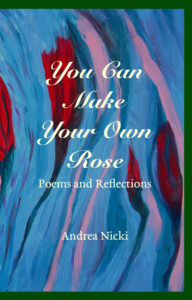
You Can Make Your Own Rose by Andrea Nicki is a collection of poems infused with the spirit of feminist sensibility, social justice and activism. The poems offer more than mere therapeutic comfort while depicting shamanic-inspired healing rituals and magical encounters. They are trauma-free in the sense that Nicki doesn’t ask for our sympathy nor does Nicki simply wish to share traumatic memories. On the contrary, she utilizes somewhat analytical and educational language, interlaced with subtle picturesque and lyrical details alongside a severe social critique, to depict the emotional, intellectual, and social landscape of her reflections on incest and other gender-related forms of abuse.

Continue reading “You Can Make Your Own Rose BOOK REVIEW by Lila Moore”