From the Wasteland Rises Hope by Carolyn Lee Boyd

Carolyn Lee BoydFor millennia, humans have told stories of goddesses who have decreed that, because terrible crimes have been committed against their female loved ones or those under their protection, our world would become a desolate wasteland. They withdrew their spiritual power that made life possible so that no fruits or vegetables would grow to nourish us or no sunlight would warm our bodies. Only when justice was done did these goddesses heal the wasteland so human life could continue.

In ancient Greece, the youthful daughter Persephone was kidnapped from her idyllic wildflower meadow to the Underworld by Hades. Her mother, the great Earth goddess Demeter, wandered the world in great despair seeking her daughter while the crops withered and the people starved. Only when Persephone was returned to live on the Earth was it again abundant. Amaterasu, the Shinto Sun Goddess, hid her life-giving light when she was angered by her brother’s desecration of her queendom that resulted in a friend’s death. Finally, when her brother was banished from heaven and she was lured from her cave and saw her sacredness and beauty in a mirror, the sun’s rays nourished the Earth once more. You may know of more stories from your own tradition.

Continue reading “From the Wasteland Rises Hope by Carolyn Lee Boyd”

Death is a Gift, and Christ is a Hag by Trelawney Grenfell-Muir

My father is dying, and I am haggard with grief and exhaustion. Over a month of frantically arranging child care, driving to the ICU in the middle of the night, fighting to protect my Dad from neglect and malpractice, chasing case managers, begging doctors, negotiating with nurses, sensitive, depleting, agonizing family debates about hospice and DNR, and hour after hour sitting and holding my Dad’s hand, singing, comforting, soothing, reassuring. Washing his face. Massaging salve into his feet and legs. Continually checking to see if he is too cold, too warm, in pain, breathing ok. Weeping as I drive home through snow and rain and dark, watching car accidents happen just one lane over, trying to soothe my frazzled and anxious little children, support my husband in his degree program, and not lose my own career entirely.

So when my daughter asked me, “Mummy, why does Grampy have to die?” I felt dizzy for a moment with my exhausted, overwhelmed, haggard inability to have an instant, perfectly formulated response to provide comfort and meaning for my child. Finally, I said, “Because, darling, if no one died, no one could live. All of us, our bodies are made from the food we eat, which is made from plants, which is made from dirt, which is made from everything that has died. Death is the only way for life to exist. Death allows life, births life, IS life. Death is our only path and connection to eternity.”  Continue reading “Death is a Gift, and Christ is a Hag by Trelawney Grenfell-Muir”

Remembering MLK’s Life, not Death by Gina Messina

Gina-MD-5-UrsulineYesterday marked the 50th anniversary of the assassination of Martin Luther King, Jr. Thousands gathered at his memorial and many more rallied across the U.S. to honor King’s commitment to civil rights and non-violent action. His message continues to resonate in a nation that has never ceased to struggle with complex issues related to race, gender, sexuality, religion, and so on. 
While the Land of the Free is invested in honoring King’s death, we could instead be focused on how he lived. As Rev. Jesse Jackson explains, 

He mobilized mass action to win a public accommodations bill and the right to vote. He led the Montgomery bus boycott and navigated police terror in Birmingham. He got us over the bloodstained bridge in Selma and survived the rocks and bottles and hatred in Chicago. He globalized our struggle to end the war in Vietnam.  How he lived is why he died. Continue reading “Remembering MLK’s Life, not Death by Gina Messina”

Toil and Trouble (Part 2) by Barbara Ardinger

Continued from Part 1.

“Mirror, mirror, on the table,
Show us all that you are able…”

The witch and her ad hoc coven and the ravens are leaning forward to see and hear more clearly what the mirror is showing them. The scarecrow wearing the human mask and his Gollumesque advisor are suddenly standing in a formal garden and addressing an audience that consists of a dozen rows of handsome but uncharming and self-important princes and (possibly) some princesses.

“Those girls are all captives,” Ella says. “Like I was until I started thinking for myself.” She gasps. “Oh, look—my sisters Annette and Darlene are there, too. When did they surrender?” As she begins weeping (she can’t help it), Mrs. Bezukhov pulls her into her arms. “Look, my Pierre is there, too,” she whispers. “He was always so kind, so smart…he spent his days helping other people. How could he stand among those, those—I don’t know what to call them.” Continue reading “Toil and Trouble (Part 2) by Barbara Ardinger”

The Heraklion Museum: A Critique of the Neolithic Display by Carol P. Christ

If I had been asked to write the words that introduce visitors to the Heraklion Archaeological Museum of Crete to its earliest inhabitants, I would have said something like this:

While there is evidence that human beings visited Crete as early as 150,000 years ago, the first permanent settlers arrived from Anatolia in the New Stone Age or Neolithic era, about 9000 years ago, bringing with them the secrets of agriculture and soon afterward learning the techniques of pottery and weaving. As the gatherers of fruits, nuts, and vegetables and as preparers of food in earlier Old Stone Age or Paleolithic cultures, women would have noticed that seeds dropped at a campsite might sprout into plants. Women most likely discovered the secrets of agriculture that enabled people to settle down in the first farming communities of the New Stone Age. As pottery is associated with women’s work of food storage and preparation, and as weaving is women’s work in most traditional cultures, women probably invented these new technologies as well. Each of these inventions was understood to be a mystery of transformation: seed to plant to harvested crop; clay to snake coil to fired pot; wool or flax to thread to spun cloth. The mysteries were passed on from mother to daughter through songs, stories, and rituals. Continue reading “The Heraklion Museum: A Critique of the Neolithic Display by Carol P. Christ”

The Power of Black Panther by Xochitl Alvizo

Note: Black Panther movie spoiler alert.

I attended my friend’s dinner party (now my beautiful partner) recently in honor of her birthday. It was an intimate gathering of nine, mostly her immediate family, so I felt privileged to be included. At one point during the dinner, her sister-in-law initiated a ritual in which we went around the table taking turns to share words of wisdom in honor of the birthday woman. Her words in particular stayed with me. And looking back, I see how the ritual she initiated was in itself an embodiment of the words she spoke:

Stand in your power. We got you. We have your back.

She said more, but the gist of it all was summed up in those three short sentences. Looking my friend in the eye as she raised her glass in her honor, her sister-in-law’s words meant something. I could feel the truth of them – I have seen the truth of them in her relationship with her. She, along with her wife (who is my friend’s sister), really do have her back and truly do want to see her “stand in her power.”   Continue reading “The Power of Black Panther by Xochitl Alvizo”

Centering Women’s Circles with Altars and Ritual by Anne Yeomans and the Women’s Well

 From 1994 until 2012, the Women’s Well, based in Concord, Massachusetts, offered thousands of women the opportunity to participate in women’s circles of all kinds. Here, in their own words in the second of this three-part series, Anne Yeomans, a co-founder of the Women’s Well, and others who co-created the Women’s Well, share with you how altars and ritual furthered the sacred inner and outer work of the circle.  The first part of the series discussed the power of women’s circles. This post is adapted from the Women’s Well website at www.womenswell.org.  

At the Women’s Well there was always an altar at the center of the circle. It became a place of great creativity, and meaning. Some women were uncomfortable with the use of the word altar. The Deep River groups, created by Abby Seixas, came up with the word “hearth” as an alternative. By whatever name it was called, a beautiful and conscious creation at the center became essential to informing the sacred space of the circle. Continue reading “Centering Women’s Circles with Altars and Ritual by Anne Yeomans and the Women’s Well”

Crowding into the Spirit World: Reclaiming a Metaphysics of Multiplicity by Jill Hammer

A number of years ago, I had the opportunity to take a class with Chava Weissler, a scholar at Lehigh University who studies Jewish history, community, and sacred practices– particularly those practices related to women.  My fellow students in the class were other rabbis, taking a break from their work in order to do some learning.  Dr. Weissler was teaching about an Ashkenazi Jewish women’s practice known as “soul candles”—the making of candles during the High Holiday season to honor the dead of the community as well as the mythic ancestors.  Candles for Abraham and Sarah were made alongside candles for grandparents and other deceased relatives, using wicks that had been laid out along the graves to take the “measure” of the dead.  During the making of the candles, the candlemakers would ask that these ancestors would pray for the living, just as the living prayed for the dead.  As Dr. Weissler described this practice, a nervous giggle passed through the room.

I remember being shocked.  I understand that my colleagues have varying beliefs around life after death and around spirit in general.  And, hearing my colleagues laugh at such a ritual and its attendant beliefs surprised me.  Those same colleagues would never laugh at the idea that God wrote the Torah (even if not all of them believe that) or at the idea that God answers prayers (even though I’m sure many of them struggle with that idea too).  But the belief in ancestors who could intercede on behalf of their relatives was alien enough to be funny.  This caused me to notice that the contemporary spirit world, for some Jews, is rather empty.  It contains an abstract God, and no one else.

Continue reading “Crowding into the Spirit World: Reclaiming a Metaphysics of Multiplicity by Jill Hammer”

We All Come From Stardust by Judith Shaw

judith shaw photo“We are a way for the universe to know itself. Some part of our being knows this is where we came from. We long to return. And we can, because the cosmos is also within us. We’re made of star stuff,” astrophysicist Carl Sagan famously stated in one episode of his 1980’s series, Cosmos. These ideas set my mind on a voyage through eternity filled with vast darkness illuminated by billions of specs of light. 

Continue reading “We All Come From Stardust by Judith Shaw”

Vagina Happy Fact by John Erickson

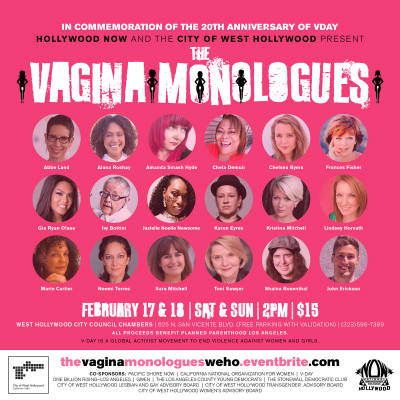
HNWH_TVM_Cast_Social_1200x1200_020918_A_REV2

A month ago, the Hollywood Chapter of the National Organization for Women (NOW) and the City of West Hollywood presented the Vagina Monologues.  The event was a complete success and we raised over $5,000 for Planned Parenthood Los Angeles!  While the cast and crew worked together and formed a community in West Hollywood, communities were being ripped apart by senseless gun violence that took the lives of 17 beautiful souls at the Marjory Stoneman Douglas High School in Parkland, Florida

The cast and crew began to have discussions over a specific monologue and whether or not the audience, or cast members, would be triggered by its use of gun specific language in relation to the power of the vagina.

Continue reading “Vagina Happy Fact by John Erickson”