A Mystical Journey: Psalm 93 by Janet Rudolph MaiKa’i

Sometimes I’m asked where I get my inspirations for verses to explore. In this case it was from the God Squad’s Rabbi Marc Gellman who discussed Psalm 93 in a recent column. In his analysis, he used Psalm 93 to wax poetic about how powerful god is outside of nature. In fact, he declared that the worship of nature is idolatry because it only points toward God but can’t completely match God’s majesty. Ahem and Excuse me! With my ire raised, I had to go and look at the Hebrew from my own Mystic Pagan perspective. Rabbi Gelman looks at these verses and his take-away is that “God is more powerful than even the most powerful storm.” Ahem and Excuse me again!  

After delving into the Hebrew words, I see a whole other side to this powerful Psalm. I see the “power of God” [as he would say] or the “beauty of the divine [as I would say],” is that most awesome ability to midwife creation and birth. In other words, to make love manifest. I see in Psalm 93, an esoteric poem bursting with motion that begins by creating a place (Earth) for life to exist. This poem is filled with sound vibrations, thunderous surf, the movement of water and descriptions of thresholds. As the motion unfolds, one is invited to participate in the energies [powers] of the divine pouring out through these threshold gateways.

Continue reading “A Mystical Journey: Psalm 93 by Janet Rudolph MaiKa’i”

Biblical Poetry, 5th Installment

This is the 5th in a series of work I have been doing to translate passages of the bible into poetry that strips out the patriarchal overlays. You can read the previous posts.

In this installment I am grouping together some passages that deal with vibrational energy and its role in creation. We humans often express sacred vibration as song or chant. When we get into the vibrational flow they are truly uplifting. In the translations below, I have kept two of the words in Hebrew because of their wonderful vibrational essences:

Continue reading “Biblical Poetry, 5th Installment”

Maternal Gift Economy: Webinar Gifts by Carol P. Christ

In the 1960s and 1970s, American-born Genevieve Vaughan was living in Rome with her husband, philosopher Ferruccio Rossi-Landi, and their three daughters. When Rossi-Landi, using Marxist models, began to write about language as a form of “exchange,” Vaughan was inspired to articulate her alternative theory based on the idea that language was developed and is learned through the gifts of the mother to the child. From that beginning, Vaughn developed an alternative theory of culture based on what she calls the “gift economy.”
We are born into a Gift Economy practiced by those who mother us, enabling us to survive. The economy of exchange, quid pro quo, separates us from each other and makes us adversarial, while gift giving and receiving creates mutuality and trust.

According to Vaughan, the “exchange economy” is based in the gift economy, while at the same time it denies the gifts it has received from mothers and mothering figures and disparages mothers and their work. Mothers rear children who enter into the exchange economy, but these children would not be alive to enter the exchange economy unless they had first been nurtured by the freely given gifts of mother. Vaughan writes that prior to patriarchy, cultures and societies valued the gifts of mothers and were organized around the principle of gift-giving. Vaughan states that gift-giving economies are based in the idea of meeting the needs of others, while exchange economies are focused on the enrichment of the individual self. She believes that re-valuing and re-instating the gift economy is the only path to creating and restoring peace and justice in the world. Continue reading “Maternal Gift Economy: Webinar Gifts by Carol P. Christ”

A Thanksgiving Litany for Living through Fractious Times by Alla Renée Bozarth

Alla Renée Bozarth, Philadelphia 11, Philadelphia ordinations
All things being relative, remember
that collective and individual histories
are cyclical but open-ended, and discern
the kind of moment you are in and part of.

Remember how to make it better
by holding on to all that is dear in life,
and becoming more prayerful and thoughtful.

When deprivation comes, return to what is essential—
first, beauty, so look for and create beautiful behavior 
and encourage it.

Continue reading “A Thanksgiving Litany for Living through Fractious Times by Alla Renée Bozarth”

Dancing for Forgiveness and Reconciliation – Part Two By Laura Shannon

In Part One of this article, I described dancing Jewish, Romani, and Armenian dances for forgiveness and reconciliation with groups in Germany and all over the world. I also offered danced rituals of remembrance at former concentration camps and other places scarred by the atrocities of war.
I went to camps including Dachau and Auschwitz, to genocide memorials and sites of massacre throughout Eastern Europe, in Australia, and the Americas. At first, my prayers were private: I brought flowers, lit candles, danced my grief, and spent time in meditation. I tried to visualise the prisoners in those places, sending them my deep sorrow and regret back through time. I wanted to let them know that they are remembered and mourned by people from their future. My prayers contained a fervent apology as well as a soul commitment to do my part in this lifetime to overcome prejudice and stand for peace.
In time I invited others to dance with me for healing and peace. We danced at former camps in Germany, including Bad Gandersheim, a subcamp of Buchenwald, and on many occasions in Steyerberg, a former prison camp and forced-labour munitions factory which is now the site of an intentional community called Lebensgarten (‘Garden of Life’), a centre for permaculture, non-violent communication, and other ecologically and spiritually oriented ways of living.

Continue reading “Dancing for Forgiveness and Reconciliation – Part Two By Laura Shannon”

The Sacred HU by Janet Maika’i Rudolph

Sing to the LORD, all you godly ones! Praise his holy name.
Psalm 30:4 (New Living Translation)

Therefore I will give thanks unto thee, O LORD, among the heathen, and I will sing praises unto thy name.
2 Sam 22:50

Let them praise the name of the LORD: for this name alone is excellent.
Psalm 148:13

The wording of these passages is very odd. After all, why is God’s name always being praised? It’s like saying to someone, “you must be a wonderful person because you have a lovely name,” or “the LORD must be great because ‘he’ {sigh} has such a great name.” Actually though, as I began to go deeper into my own personal practices of spirit work and chanting, I found that there is a profound truth to this use of praise. Most, if not all, of the ancient names of deities are made up of power syllables. By this I mean certain sounds that have a vibrational essence which not only resonate within our bodies but connect us with all the vibrations that surround us. Sounds made by these syllables are a bridge between worlds created by our breath.

Mystically speaking we could say that the breath of creation and our own breath interfuse. We can experience this through the vibration of power syllables. The most common syllables in the west are familiar ones – AL LA HA AH YA LO WAH and the mighty HU. Think of all the names of divinity that can be created by experimenting with these syllables. Continue reading “The Sacred HU by Janet Maika’i Rudolph”

The Holy of Holies and the Umbilical Cord: The Evolution of a Ritual Object by Jill Hammer

In the Jewish calendar, we’re just past the holiday season—the High Holidays, the harvest festival of Sukkot, and the concluding festival of Simchat Torah when the last verses of the Torah are read and the first verses are started again. The Torah readings for these holidays speak often of the offerings once made on the altar in the Tabernacle in celebration of these festivals.  Particularly on Yom Kippur, the readings mention the kodesh kodashim: the holy of holies. This enclosed sacred space contained, according to legend: the tablets of the Commandments inside an ark, topped by two cherubim that held up an empty space between them—an empty space understood to be the amplified presence of an invisible God.  As I think back over my powerful summer, which was largely spent with Jewish priestesses on various retreats and adventures (in Connecticut, Mississippi, California, Costa Rica, England and Scotland), I am thinking about a unique ritual object we use, and realizing that in its own way, it is a kind of Holy of Holies.

Continue reading “The Holy of Holies and the Umbilical Cord: The Evolution of a Ritual Object by Jill Hammer”

Let’s Talk About Shame by Janet Maika’i Rudolph

Disclaimer/Trigger Warning: This post includes content about rape, sexual assault, domestic abuse, violence.

The recent, meaningful discussions on this forum about how so many of us feel broken due to our own personal histories have fortified and inspired me. I’ve marveled as women have spoken up so honestly and even brutally about the effects of trauma, rape, cold and dismissive mothers, abusing fathers and so on.

Some of you know my own story. I am a survivor of my father’s childhood abuse and then a rape at knifepoint in my early twenties. I carry a deep and abiding sense of shame. This feeling has always flummoxed me. Why should I feel shame when I didn’t do anything to create my own abuse? Shouldn’t my father have felt the shame? The rapist? Why did I get saddled with it? I was the victim (and survivor), not the perpetrator. But shame is indeed the feeling I carry and I’m not alone. Why is this feeling so pervasive? I don’t have all the answers, but I do have some clues about where to look.

Continue reading “Let’s Talk About Shame by Janet Maika’i Rudolph”

Facing Life Part 1 by Janet Maika’i Rudolph

I remember the first time I killed a living animal for food. I was a college student. I was traveling with other students on a month-long backpacking trip along the Sea of Cortez in Baja, Mexico. It was a very long time ago, yet the experience was so impactful that the memories are etched into my being.

Truth be told, my prey wasn’t all that sexy. It was scallops. There are certain benefits to “hunting” scallops. They have no legs or fins to force someone into a chase, no arms to fight back, and no reproving eyes to haunt dreams. All fairly milquetoast. Or so it appeared to me on the surface.

The way to harvest scallops is straightforward. They are made up of two shells, the lower one is plastered to rocks in the water. The upper one moves up and down by pivoting on a membrane. A diver plunges into the depths of the sea to find them. Then a diver inserts a knife between the two halves of the opened shells in order to cut the membrane at the back. There is delectable meat inside both shell halves. The top shell will come free to be taken to the surface. The meat is cut out of the lower shell, which is immovably attached to the rock.

Continue reading “Facing Life Part 1 by Janet Maika’i Rudolph”

Birds, Their Song Stills My Heart by Deanne Quarrie

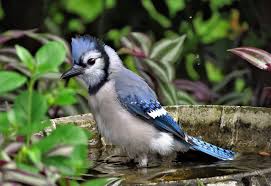
Bluejay

I see you perched on the tree
checking the perimeter for cats lurking.
The feeder below, inviting you down
but you, ever cautious,
make sure that none are about.

Suddenly the sparrows swarm in,
eagerly eating the seed offered.
They flit and flap, and fly about,
scattering seed as they cover the feeder.

Throwing caution to the wind,
down you fly,
eager for your share of the offerings.

You find treats on the ground,
seeds from the tallow above,
a seed so large,
from my window, I see it in your mouth.

I watch you prance, a friend joining you,
Your perky crest and colorful plumage,
your morning dance brings pleasure
as I ponder my coming day.
over my first cup of coffee.

Continue reading “Birds, Their Song Stills My Heart by Deanne Quarrie”