Fear and Need in the Absence of Mother God, part 2 by Caryn MacGrandle

Yesterday’s part 1 post quoted from the book, The Malleus Maleficarum

Witches Well in Edinburgh, Scotland, …the Roman numerals for 1479 on one side and 1722 [years when witch persecution was most prominent]

The book wasn’t just a message for women but for all. The tenets that formed the backbone of colonial culture:

  • Paddle your own canoe. 
  • Success comes with hard individual effort when you stay within the lines that we draw. 
  • And if you fail?  Well, that’s on you. 
  • Maybe you will get another shot if you are lucky, work relentlessly and act as you should.
  • And never ever forget that your worth is defined by the number of 0’s in your bank account.
Continue reading “Fear and Need in the Absence of Mother God, part 2 by Caryn MacGrandle”

Why We Need to Bring Back God as a Woman, part 1 by Caryn MacGrandle

26,000 years ago, life was precarious and dangerous.  And so the human race revered the Mother.  Mother Earth, who provided food amidst scarcity, protection from the dangers of the wild and healthy babies who grew to adulthood.

The Goddess.

In her many forms.

Some of these Goddesses.

Venus of Willendorf.  The artifact known as the Venus of Willendorf dates to between 24,000–22,000 B.C.E., making it one of the oldest and most famous surviving works of art.

Continue reading “Why We Need to Bring Back God as a Woman, part 1 by Caryn MacGrandle”

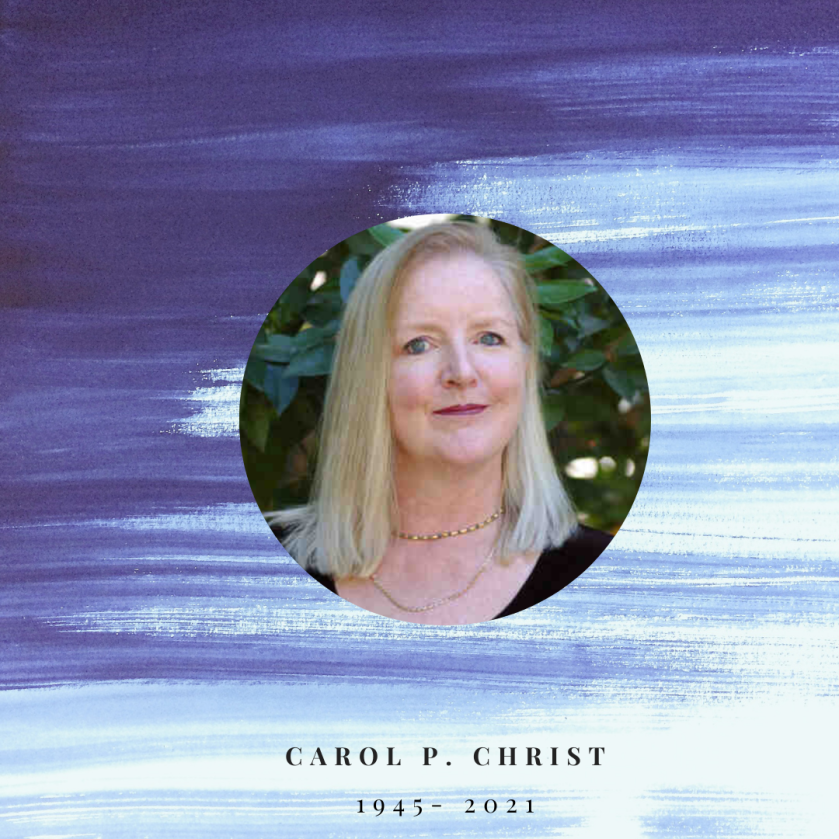
Legacy of Carol P. Christ: Sacred Marriage or Unholy Cover-up?

This was originally posted on November 7, 2016

Many women are drawn to the image of the Sacred Marriage—perhaps especially those raised in Roman Catholic or Protestant traditions where sex is viewed as necessary for procreation but nothing more, and who learn that the naked female body as symbolized by Eve is the source of sin and evil. In this context, the positive valuing of sexuality and the female body found in symbols of the Sacred Marriage can feel and even be liberating.

Jungians have claimed that the Sacred Marriage is an archetype of the wedding between the “masculine” and the “feminine.” Many women have been attracted to this idea as well. It “softens” the radical feminist critique of patriarchy and male dominance. Rather than “castrating” the “phallocracy” as Mary Daly urged, we can think in terms of the “marriage” of qualities traditionally associated with male and female roles. Women, it is said, can use a good dose of ego and assertiveness traditionally associated with the masculine, while men need to have their dominating rational egos tempered by feminine qualities like care and compassion.

Continue reading “Legacy of Carol P. Christ: Sacred Marriage or Unholy Cover-up?”

Inanna’s Sisters, by Molly M. Remer

Sometimes I feel like my own Ninshubur. 
I set up a lamentation in the street. 
I call my own name,
beat the drum 
to lead myself back home,
prepare the temple
for my own arrival. 
I will not give up on myself,
will not abandon my own wholeness,
I refuse to sacrifice my Self. 
I will not stay in the underworld forever. 
We all need people in our lives who will say:
No, this will not do. 
I’m coming after you. 
I will help you to crawl back up, 
back out, back through. 
I will reach out to you. 
I will boost you up.
I will rise with you into becoming. 
You will not stay behind defeated 
and alone so long as I,
your Ninshubur,
draw breath.
I will beat the drum for you. 
I will call your name. 
You are not alone. 
Come back to me.
I see your power 
and your strength. 
I hear your longing. 
Return, 
return,
return.

I first met Inanna in the firelit darkness of a midwifery retreat in central Missouri. Toddler son at my breast, I watched, spellbound, as the charismatic, dark-haired midwife recounted the tale of Inanna’s descent into the underworld, through the seven gates we traveled, to the seat of our own wounding and our own medicine.

Continue reading “Inanna’s Sisters, by Molly M. Remer”

Ancient Her-Story by Annelinde Metzner

Lately I’ve been rereading and refreshing myself with important books of the Great Goddess.  Three books at a time! I would switch off, chapter by chapter, among  When God Was a Woman by Merlin Stone, When the Drummers Were Women by Layne Redmond, and one that had remained overlooked on my shelf, Sanctuaries of the Goddess, The Sacred Landscapes and Objects, by Peg Streep (1994.)  I’ve been immersed in the knowledge of 30,000 years of honoring and worship of women’s bodies and the Great Goddess. When I got to Chapter 7 of Peg Streep’s well-researched book, “The Goddess at the Peak: Crete,” I was blown away with the evidence we still have, in art, architecture, religion and culture, of a highly advanced society, full of life and joy, where women were central to all life. With my mind, my heart, my intuition and my sense of past lives, I’ve attempted to place myself there, before any influence of patriarchy.

Continue reading “Ancient Her-Story by Annelinde Metzner”

From the Archives: The Found Goddesses of Good Eats by Barbara Ardinger

This was originally posted on August 1, 2013. We usually do Carol Christ’s legacy posts on Mondays. Given the closeness of Lughnasadh, it felt appropriate to share the work of one of our other long-time writers today. Carol’s legacy posts will be back next week.

Lughnasadh (pronounced LOON-us-uh) or Lammas—is the first of the three traditional harvest festivals of the traditional Celtic calendar that most pagans follow today. And what naturally follows harvest? Feasting, fairs, and festivals. To help us celebrate the season, here are two Found Goddesses of good eating. The term “found goddesses” was created in 1987 by Morgan Grey and Julia Penelope, authors of a hilarious book titled Found Goddesses. After reading this book and having never met a pun I didn’t instantly love and being of a naturally satirical state of mind, I started Finding—i.e., inventing—my own goddesses shortly before the turn of the century. After I found a hundred of them, they were published in 2003 in my book, Finding New Goddesses.

Continue reading “From the Archives: The Found Goddesses of Good Eats by Barbara Ardinger”

Celebrating Lammas in Troubled Times by Nan Lundeen

Tallgrass Prairie at Fernwood Botanical Garden, Niles, MI
credit: Ron DeKett

Lammas, that Celtic Earth-based spiritual tradition, has long been dear to me. Having grown up on an Iowa farm in the 1950s, I am accustomed to living close to the rhythms of the land. Gratitude for Earth’s first fruits comes naturally. The tradition calls for ritually baking a loaf from the first-harvested grain of the season, usually corn, and blessing it. It is a harvest festival and a time of gratitude and joy.

Continue reading “Celebrating Lammas in Troubled Times by Nan Lundeen”

Embracing the Dark Goddess – Empowering Paradigm Shifts, Part 2 by Judith Shaw

 The Dark Goddesses, with qualities that are mysterious, magical, chaotic, destructive, violent and transformational bring a wholistic understanding of ourselves and of nature. They are wild and untamed.  Today I finish up my initial dive into the Dark Goddesses which began yesterday with the publication of Part 1. Look for a more detailed look at these goddesses and more in the coming months.

Erishkigal, Underworld Goddess

Dark goddesses are wild, free, and sexual – Lilith, Erishkigal and Medb

Lilith and Erishkigal
Long before the rise of civilization, people lived together in very different ways and Goddess was understood as the force that encompasses all life – the light and the dark. It’s very interesting that two of the world’s oldest dark goddesses – Lilith and Erishkigal –  are found in the creation story of Sumer, considered as the world’s first civilization.

Continue reading “Embracing the Dark Goddess – Empowering Paradigm Shifts, Part 2 by Judith Shaw”

Embracing the Dark Goddess – Empowering Paradigm Shifts, Part 1 by Judith Shaw

I always approach the Dark Goddesses with trepidation, preferring to focus on the bright, life affirming aspects of the Goddess. Yet now I find that the difficult break-downs and violent conditions of these days are calling me to explore the terrifying aspects of the ones called “Dark Goddesses.” 

But who are the Dark Goddesses and why are they called dark? That question is one of controversy within the Goddess community. Carol Christ has written that the Dark Goddess only exists as a projection of patriarchal values onto the Goddess, turning the Goddess into a force of war and terror, in particular the War Goddesses found in various cultures. Christ views war as an abnormal desire for the Goddess. Whereas others view the Dark Goddess as a part of the one Great Goddess, who encompasses all. 

A painting I did in 2013 inspired by Kali and in response to the destruction caused by oil drilling. “Gaia Wields Her Sword of Justice”
Continue reading “Embracing the Dark Goddess – Empowering Paradigm Shifts, Part 1 by Judith Shaw”

Legacy of Carol P. Christ: TWO TORTOISES IN THE WEB OF LIFE

This was originally posted on March 14, 2014

The Gods made only one creature like them—man.  Greek TV documentary

The sight of a reptile or an amphibian usually provokes, at the very least, a feeling of repulsion in most people. Natural History of Lesbos

testudo marginata face

In the past days and weeks thetwo tortoises with whom I share my garden have woken up from a long winter’s sleep.  Henry, testudo marginata, has been up for a while now.  More than a month ago when I was cutting back and weeding in the area of the garden where he had been sleeping, Henry roused himself to sit in the sun near me for a few hours each day before creeping back under a shrub.  At first I thought I had disturbed him, but when he came back out day after day while I worked, I began to wonder if he was coming out to say hello.

Continue reading “Legacy of Carol P. Christ: TWO TORTOISES IN THE WEB OF LIFE”