Is Goddess feminism an old religion or a new creative synthesis? Can it be both? Goddess feminism draws on the feminist affirmation of women’s experiences, women’s bodies, and women’s connection to nature; the feminist critique of transcendent male monotheism as the symbolic expression of male domination of women and nature; and 19th and early 20th century discussions of Goddesses and matriarchy.
Most Goddess and other spiritual feminists have experienced Wiccan rituals, which are often simply called Goddess rituals. For many of us, elements of Wiccan practice strike a chord of knowing, while other aspects seem odd or strange or even just plain weird. What are the roots of Wiccan ritual?
This was originally posted on June 24, 2015. You can see the original comments here.
In the ancient Celtic world the Goddess was the One who expressed Herself through the many. Grainne is such a one. She is both Winter Queen/Dark Goddess, nurturing seeds through winter, and Solar Sun Goddess, welcoming the rebirth of spring. She is Aine’s sister or another aspect of Aine. She, like Aine, was honored at the summer solstice and the first grain harvest of early August with bonfires and torchlit processions on top of her sacred hill at Leinster, Ireland. Remnants of these festivals are still found in folk ritual today.
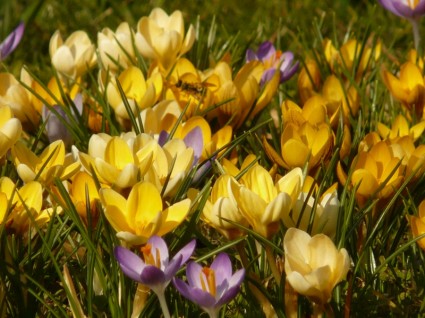
While researching Minoan Crete I learned that each autumn young girls once gathered blue violet saffron crocus to leave as an offering for the Wild Crocus Goddess as they prepared for adolescent female initiation rites. I was intrigued by the reference to autumn because I associate flowers more with spring than any other season. From other sources I discovered that in Minoan Crete young girls also gathered bright yellow crocus to celebrate the Great Goddess and the return of the growing season and that yellow was the color associated with the Great Goddess because of the golden color of the dye made from the precious saffron crocus. Later in Greece during the Lesser Mysteries, flowers, especially yellow crocus were also picked to celebrate Persephone’s return from the Underworld. I was particularly delighted by the reference to Persephone picking bright yellow crocus because my relationship with this goddess has been a somber one; I have always associated her with death. And yellow is a joyous color that I associate with early spring.
I felt a wild sense of hope as a volcanic fire erupted inside me when I first imagined Persephone picking spring flowers because of my uncomfortable relationship with this mythical figure and also because I love flowers.
“There’s a river of birds in migration, a nation of women with wings.”—Goddess chant, Libana
On the Goddess Pilgrimage to Crete, I explain that many of the names given to “Minoan” (c. 3000-1450 BCE) Cretan artifacts and architecture are products of patriarchal and Eurocentric imaginations, and as such, are misleading. For example the name “Minoan” was given to the culture of Bronze Age Crete in honor of “King Minos,” who was said to have ruled in Crete a few generations before the Trojan War–several hundred years after the end of the culture to which his name was attached. In fact, despite his eagerness to find evidence that King Minos ruled at Knossos, the excavator Sir Arthur Evans finally had to concede that the best he could do was to produce a fresco of a “Prince of the Lilies” which he identifed as the image of the male ruler of the culture he called “Minoan.” Evans’ Prince had white skin, a fact that Evans conveniently overlooked–because according to his own interpretation of “Minoan” iconography, white skin would mark the figure as female. Mark Cameron, who reviewed Evans’ reconstruction of the fresco, suggested that the Prince is more likely to be a young woman who is perhaps leading a bull to take part in the bull-leaping games. He also stated that the “crown” belonged to another fresco altogether.
I am passionate about sharing the image, essence and energy of the sacred feminine. Having presented this material to thousands of men and women at universities, conferences, corporations, expos and theaters across the US, Canada, from Kauai to Dubai, to the Parliament of the World’s Religions, and twice to the UN Commission on the Status of Women, I have humbly witnessed its healing effect. (I return to UNCSW on March 21, and welcome you to join this free online event, which you can find here.
When I first encountered the word, “Goddess,” I didn’t like it. Using it felt strange, and I wondered why I should bother. The word “Goddess” felt uncomfortable and unnecessary.
I imagine many of you share my feelings of anger, grief and dread about this invasion of Ukraine. It is hard to know what to do and terrible to feel so powerless. I would like to offer a practice which I am finding very helpful: to meditate on Ukrainian Goddess embroideries as a prayer for peace.
Early 20th C. Goddess embroidery, central Ukraine. Photo: Ukrainian Museum. In The Tree of Life, the Sun, the Goddess: Symbolic Motifs in Ukrainian Folk Art, p. 99
Goddess figures are ubiquitous in Ukrainian folk art, in woven and embroidered clothing, ritual textiles, pottery, painting, and pysanky, ceremonially decorated Easter eggs (which I will explore in a future post). Goddess embroideries are also found throughout the entire Slavic world, Eastern Europe, the Near East and North Africa, and even farther afield, as Mary Kelly and Sheila Paine have diligently shown.
Moderator’s note: This marvelous FAR site has been running for 10 years and has had more than 3,600 posts in that time. There are so many treasures that have been posted in this decade. They tend to get lost in the archives. We are beginning this column so that we can revisit some of these gems. Today’s blogpost was originally posted January 28, 2014. You can visit it here to see the original comments.
Well the Golden Globe awards have been handed out. I don’t have a television, so I didn’t actually watch, but a quick google search gives the results. Highest honors go to a movie about blacks as slaves and whites as criminals. That’s appropriate.
But this is feminism and religion, so let me get to the point. It’s about a chance discussion on social media about the “merciful god” and historical institutions like slavery (holocaust, or oppressions like misogyny, homophobia, Islamaphobia and others…).
My view of the divine, the cosmos and of the world is shaped by my slave ancestry. Recent area studies about Islam in America estimate that one third of the Africans forced to the Americas were Muslim. My first African relative on US soil identified as Moor (another term used for “Muslim”). But Islam did not survive slavery.
A warm summer sun smiles down upon the British coastline, the low tide reflecting jewels which are wash up and dispersed upon fine sand. A welcome breeze dances around a gathering of Goddess devotees encircling a small bonfire. Amongst them stands a banner and statue depicting and imitating Botticelli’s Venus and bouquets of roses. Just before the sun sets, those gathered lovingly collect these assembled artifacts, holding them aloft, and begin to process barefoot towards the sea.
Aphrodite-Venus’s banner and sculpted face shines in the low afternoon sunlight. As the procession slowly steps, weaves, and dances, towards the sea to the beat of a drum, the sun reaches further behind the hills, casting a long shadow upon the beach. The Goddess’s image dances with them, banner swaying and statue bobbing with the dance of its carrier. By the time the procession reaches the sea, the sun has dipped behind the now black silhouette of the hills bathing the beach ahead in dusky oranges and brilliant blues. At the shoreline, a priestess steps forward and turns the Goddess’s statue to face the procession, which has now fanning out into a semi-circle.
Moderator’s Note: We here at FAR have been so fortunate to work along side Carol Christ for many years. She died from cancer in July, 2021. Her work continues through her non-profit foundation, the Ariadne Institute for the Study of Myth and Ritual and the Goddess Pilgrimage to Crete. To honor her legacy, as well as allow as many people as possible to read her thought-provoking and important blogs, we are pleased to offer this new column to highlight her work. We will be picking out special blogs for reposting. This blog was originally posted February 10, 2014. You can read it long with its original comments here.
Mary, Mary, quite contrary, how does your garden grow? With silver bells and cockle shells, and pretty little maids all in a row.
From the beginning of horticulture about 8000 BCE or earlier to the present day, weeding has been women’s work. Women, who were the gatherers and preparers of food in traditional nomadic societies, no doubt were the first to discover that seeds dropped at a campsite one year sometimes sprung up as plants the next year. When this discovery was systematized, agriculture was invented, and human beings began to settle down in the first villages and towns.
Moderator’s note: This marvelous FAR site has been running for 10 years and has had more than 3,600 posts in that time. There are so many treasures that have been posted in this decade that they tend to get lost in the archives. We have created this column so that we can all revisit some of these gems. Today’s blogpost was originally posted July 1, 2018. You can visit the original post here to see the comments.
I bet almost no one knows this secret: the United States is being watched over by two goddesses! One of them stands on top of the Capitol dome in Washington, D.C. The other stands on an island in New York harbor.
The goddess standing above our congressional building is named Libertas, or Freedom. She’s a Roman civic goddess whose sisters are Concordia and Pax. Although the Romans hardly ever experienced freedom, civic harmony, or peace, they always kept their eyes on the possibilities. Libertas was sometimes merged with Jupiter, sometimes with Feronia, who was originally an Etruscan or Sabine goddess of agriculture or fire. In Rome, Feronia became the goddess of freed slaves. Libertas is shown on Roman coins as a matron in flowing dress and wearing either a wreath of laurel leaves or a tall pilleus, which is called a “liberty cap” and looks like a witch hat without the brim. And there’s also a bird—is it a raven?? She holds either a liberty pole (vindicta) or a spear, and in some paintings of her (she was a popular subject in the 19th century) there is a cat at her feet.
Because the late 18th century is sometimes referred to as the Augustan Age (for classicism in architecture, literature, and art and named after the first Roman emperor, Caesar Augustus), the Roman Libertas became Lady Liberty during the American Revolution. To celebrate the repeal of the Stamp Act in 1766, Paul Revere created an obelisk with an image of Lady Liberty on it, and a short time later, Tom Paine addressed her in his poem, “The Liberty Tree.” An enormous bronze statue of Lady Liberty was commissioned in 1855 for the top of the Capitol building, and she was hoisted up there in 1863, where she stands, hardly visible, to this day.
Here’s my idea. This FAR community has lots of power. We—and at least two thirds of the U.S. population—are very unhappy with the antics of the Lyin’ King and his court…excuse me, the executive and legislative branches of our national government. So let’s visualize Libertas coming to life. Watch her stomp her heavy bronze feet so hard she breaks a hole in the top of the dome. Watch her fly down into the main lobby of the Capitol. Now she turns in one direction and stalks into the Senate. “Gentlemen and Ladies,” she begins, “you were sent here to do a job. You’re not doing your jobs. Work together! Learn to compromise. Stop talking so much. Get to work!” And then she marches into the House. “Why are you here?” she asks. “And why are you here only three or four days a week, and why aren’t you working for the benefit of all the citizens of the United States?” I suspect that Libertas, who is 19 feet 6 inches tall and weighs approximately 15,000 pounds, could indeed put a scare into Congress, not to mention all the lobbyists. Remember, she also carries that spear. And she no doubt knows how to use it.
Our second national goddess? “Liberty Enlightening the World,” whom we call the Statue of Liberty, was a gift from France to the U.S. circa 1886 on the occasion of our centennial. Designed by Frederic-Auguste Bartoldi and Alexandre Eiffel (who also built a famous tower in Paris), Lady Liberty holds a tabula ansata (a tablet evoking the law) in one arm and with her other hand raises a torch, a common symbol of truth and purification through illumination. She wears a crown of solar rays similar to the crown worn by the Colossus of Rhodes, one of the seven wonders of the ancient world.
For almost a century and a half, Liberty has welcomed immigrants to our Atlantic shore. Those immigrants were the grandparents and great grandparents of nearly all of us. Now let’s visualize Liberty taking action. Goddesses can perform magic; let’s visualize Liberty multiplying herself into 10,000 Liberties, and then let them travel to Texas, New Mexico, Arizona, and California and—you guessed it—let them stand facing south. Let these 10,000 goddesses with torches of purification replace the Xenophobe-in-Chief’s wall/fence/border army. Let’s ask Liberty to welcome people into the U.S. Because she’s smart (and the flames of that torch can reveal a lot) and there are indeed drug smugglers traveling in addition to men, women, and children who are coming for sanctuary or safety or work, let her use her torch to reveal the small proportion of criminals trying to sneak in. And let her welcome and protect everyone else and keep families together. (Maybe she could send all the ICE agents off hunting coyotes, who are no doubt smarter and more humane than they are.)
Here is the full text of “The New Colossus” the poem by Emma Lazarus that Lady Liberty proclaims to the world. Maybe our senators and representatives should read it—for the first time, I bet. They should pay attention to what it says and obey the words and principles of this goddess.
Not like the brazen giant of Greek fame, With conquering limbs astride from land to land; Here at our sea-washed, sunset gates shall stand A mighty woman with a torch, whose flame Is the imprisoned lightning, and her name Mother of Exiles. From her beacon-hand Glows world-wide welcome; her mild eyes command The air-bridged harbor that twin cities frame. “Keep, ancient lands, your storied pomp!” cries she With silent lips. “Give me your tired, your poor, Your huddled masses yearning to breathe free, The wretched refuse of your teeming shore. Send these, the homeless, tempest-tost to me, I lift my lamp beside the golden door!”
Let us visualize both of these American goddesses doing their work and protecting the hard-won rights of everyone who lives in the United States.
BIO:BIO:Barbara Ardinger, Ph.D. (barbaraardinger.com), is the author of Secret Lives, a novel about crones and other magical folks, Pagan Every Day, a unique daybook of daily meditations, and other books. She really enjoys writing her monthly blogs for FAR. Her work has also been published in devotionals to Isis, Athena, and Brigid. Barbara’s day job is freelance editing for people who have good ideas but don’t want to embarrass themselves in print. To date, she has edited more than 400 books, both fiction and nonfiction, on a wide range of topics. She lives in Long Beach, California, with her rescued calico cat, Schroedinger.








 Feminism and Religion