Painting Aurora by Angela Yarber

angelaFor those of us in the northern hemisphere, December is one of the darkest months. The days are shorter. Night comes earlier. Each morning I eagerly await the dawn, the potential sliver of sunshine seeping through my window and warming my otherwise cold wintery skin. For those of us who struggle with seasonal depression, December can be difficult. The colder and shorter days cast shadows on our spirits as we yearn for the warm glow of light. Each December as we inch toward the winter solstice, I am reminded of the Goddess of the Dawn, Aurora, and of the unique ways in which a variety of wisdom traditions invoke the coming of light amidst the stark December night skies.

So, this December I welcome Aurora into the vast witness of Holy Women Icon with a folk feminist twist that I feature each month: Virginia Woolf , the Shulamite, Mary Daly, Baby Suggs, Pachamama and Gaia, Frida Kahlo, Salome, Guadalupe and Mary, Fatima, Sojourner Truth, Saraswati, Jarena Lee, Isadora Duncan, Miriam, Lilith, Georgia O’Keeffe, Guanyin, Dorothy Day, Sappho, Jephthah’s daughter, Anna Julia Cooper, the Holy Woman Icon archetype, Maya Angelou, Martha Graham, Pauli Murray, La Negrita, Tiamat/tehom, Mother Teresa, and many others.

Aurora is the Goddess of the dawn in Roman mythology; each morning she soars across the sky to announce the arrival of the sun. As the nights grow longer and longer, I can think of few other goddesses I hope for more than Aurora. In fact, many faith traditions invoke the coming of light during this month of long nights and short days.

In my own tradition, we are not yet celebrating Christmas (despite the capitalist consumer onslaught that has been on full throttle since October). Rather, we still dwell in the deep blue darkness of Advent, when we wait, long, and prepare for light to be birthed into our world. For most Christians, a candle is lit each Sunday during Advent and the light grows brighter as they anticipate the birth of Christ. Continue reading “Painting Aurora by Angela Yarber”

An Archaic Trinity of Goddesses? Not Necessarily. by Barbara Ardinger

Barbara ArdingerIn her comment following my last post which was about mythology, my friend, Carol Christ, expands on my paragraph about how the so-called “ancient triple goddess” was really invented in 1948 by Robert Graves in his book, The White Goddess. (Thanks, Carol.)

Back in the 1970s and 1980s, when the Goddess movement was just getting up on its feet and our ovular books were being published, the idea arose that if “they” have a holy trinity, “we” have one, too. And ours is older and holier. We see it in the three phases of the moon, new (Virgin), full (Mother), and dark (Crone). Here’s a tiny sample of these books that changed the lives of so many women and men:

  • Woman’s Mysteries Ancient and Modern by M. Esther Harding (1971, but first published in 1933)
  • The Goddesses and Gods of Old Europe (1974) by Marija Gimbutas
  • When God Was a Woman (1976) by Merlin Stone
  • Lost Goddesses of Early Greece: A Collection of Pre-Hellenic Myths (1978) by Charlene Spretnak
  • The first edition of The Spiral Dance (1979) by Starhawk
  • The Chalice and the Blade (1987) by Riane Eisler
  • Laughter of Aphrodite (1987) by Carol P. Christ
  • The Holy Book of Women’s Mysteries (1989) by Z. Budapest
  • The Reflowering of the Goddess (1990) by Gloria Feman Orenstein
  • Whence the Goddesses: A Source Book (1990) by Miriam Robbins Dexter

Triple goddess? ’Tain’t so. Our beloved triple goddess is one of our foundational myths. It’s nice and it’s perhaps inspiring, but it’s only a myth. Anyone who looks at a calendar or almanac—or up into the sky every night for a month—can easily see that the moon doesn’t have three phases. It has four: waxing, full, waning, and dark. And since the late 20th century, women have lived long enough to go through more than three stages of life. Continue reading “An Archaic Trinity of Goddesses? Not Necessarily. by Barbara Ardinger”

Journey into Light by Mary Sharratt

mary sharrattDecember 7 marks the Second Sunday of Advent.
Here in Northern England, I find myself plunged into the depths of midwinter darkness. It is in this dark womb of stillness that the Light is reborn. Through the ages and across cultures, world faith traditions have marked this sacred passage through the darkness.

In Christian tradition, Advent is a period of expectant waiting, of anticipating the birth of Christ. The word Advent comes from the Latin adventus, which means “coming.” This First Sunday of Advent marks the beginning of the Western Christian liturgical year.


hildegard's house of light erickson_house_72dpi

 Image: “Hildegard’s House of Light,” painting by Elizabeth Erickson

The Advent wreath and Advent calendar are relatively recent innovations. Christmas and Advent celebrations have gone through many permutations throughout history. Continue reading “Journey into Light by Mary Sharratt”

When Baby Girls and Old Crones Ruled by Jeri Studebaker

Jeri Studebaker

The data came as somewhat of a shock to me.  I stumbled across it one day in The Civilization of the Goddess, a mammoth book by the late Lithuanian-American archaeologist Marija Gimbutas about what Gimbutas dubbed “Old Europe” – a culture area in southeastern Neolithic Europe that she maintains was centered around female deity.

Until she had the temerity to suggest that people at some point in the past might have worshipped goddesses rather than gods, Gimbutas had a sterling reputation among academics, even being hired to teach at two of the most prestigious of all  American archaeology departments, Harvard’s and UCLA’s.  After presenting her goddess theory of Old Europe, however, Gimbutas came under attack by a few powerful male archaeologists, after which her reputation among academics began to plummet (see Spretnak 2011 for a good accounting of Gimbutas’ fall from grace).

Marija Gimbutas
Marija Gimbutas

Before I get to the data that so startled me, I need to tell you a bit about archaeologists.  Like the members of many academic disciplines, they disagree with each other – sometimes vehemently (and perhaps even somewhat more vehemently than scholars in other disciplines).  One thing however they all agree on is this: the higher the quality and quantity of grave goods buried with an individual, the higher that individual’s status in her or his society. Continue reading “When Baby Girls and Old Crones Ruled by Jeri Studebaker”

Dance of the Bees: Reading the Language of the Goddess by Carol P. Christ

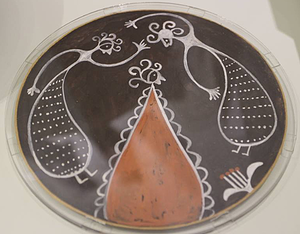
bee women dancing croppedThe image from an ancient Cretan bowl (c.1700 BCE) from the Sacred Center of Phaistos pictured here has often been interpreted as an early depiction of Persephone’s descent or rising. But are clues from later Greek mythology pointing in the right direction in this case?

Recently, my colleague Mika Scott posted the Phaistos bowl image on our Goddess Pilgrimage Facebook site in conjunction with the bee pendant from Mallia. This juxtaposition led me to think again about the importance of bees and pollination in agricultural societies and to offer an alternative reading of the symbolism on the bowl. Continue reading “Dance of the Bees: Reading the Language of the Goddess by Carol P. Christ”

Has the Phaistos Disk Been Cracked? by Carol P. Christ

Carol Christ in LesbosRecent headlines in the international press announced that the enigmatic language of the ancient Cretan “Phaistos Disk” has been translated—in part—by the Welch-Cretan scholar Gareth Owens. Owens states that the Phaistos Disk records an ancient hymn to a Mother Goddess. More specifically he claims that one side is dedicated to a Pregnant Goddess and the other to a Birth-Giving Goddess.

All of this is very exciting, but is he right? Continue reading “Has the Phaistos Disk Been Cracked? by Carol P. Christ”

Max Dashu: Feminist Scholar, Author, Historian, Artist by Jassy Watson

JassyI had the honour of hosting Max Dashu, Feminist Scholar, Historian and Artist here at Goddesses Studio this weekend past. Max is currently on her second Australian tour and we were blessed for her to come on quite the journey to present to an intimate group of Wide bay Goddesses, “Rebel Woman Shamans: Women Confront Empire” and “Deasophy: Goddess Wisdom” with a little “Female Iconography” thrown in.

Max’s knowledge and gift of story-telling is inspirational. “Rebel Woman Shamans: Woman Confront Empire” looked at holy women and female prophets who led many rebellions to resist conquest, slavery, and colonization. These women visionaries, priestesses, diviners and medicine women challenged systems of domination on multiple levels and drew on their cultural traditions to resist empire. It was their direct access to transformative power that these women had, that makes the spiritual political, as they act to lead, defend, and protect their peoples. Continue reading “Max Dashu: Feminist Scholar, Author, Historian, Artist by Jassy Watson”

Kali Ma (Part 3 of 3) by Nancy Vedder-Shults

nancymug_3In contrast to the linearity of our time concept in the West, Indians view life as infinite and cyclical.  Although Hindus, like ancient Greeks, believe in four ages of humanity (the so-called yugas), these occur not just once, but repeat cyclically every several million years.  Similarly, the creator god Brahma is said to have a daily cycle which has recurring effects on the existence of the world.  When Brahma awakes the world is created anew, and when he falls asleep it dissolves once again into the primal waters of eternity.  Fortunately for us, Brahma’s day lasts 4,320,000,000 human years.

Holland Cotter, in reflecting on Eastern art, once brought these temporal differences into sharp focus when he contrasted two of the major icons of East and West  — Christ on the cross and the dancing Shiva.  He said, “The Christ figure embodies the Judeo-Christian concept of divine history as a straight, purposeful line from the Fall of Man (sic.) to redemption, but with a tragic human story of self-sacrifice, loss and atonement at its heart.  The dancing Shiva is, by contrast, a dynamic, joyous cyclical image: a poised, uplifted foot and hands form a circle echoing the nimbus of flames surrounding the figure.  The image represents a culture which…views both humans and gods as participants in a cosmic game that periodically grinds to a catastrophic halt only to begin again.”[i]

Like Shiva, Kali has been depicted surrounded by a halo of flames.  But unlike Shiva, her portrait is far from a joyous image.  In one example, a 17th or 18th century North Indian sculpture, Kali is personified as a voracious, old hag squatting on a victim whose entrails she eats.  Slicing open the belly of the anonymous corpse, Kali scoops out its intestines with her bony fingers and gobbles them with her protruding teeth.  The anonymity of the victim brings home to the viewer the fact that ultimately we are all Kali’s prey.  And the flames burning around her head reemphasize this point, for as the aureole of the Dancing Shiva, they are the fires of the final conflagration at the end of each world period.  But in this image we realize that such flames flicker constantly, since time erodes all that has ever existed and Kali swallows all she has ever birthed.[ii] Continue reading “Kali Ma (Part 3 of 3) by Nancy Vedder-Shults”

The Ancestors Live in Us by Carol P. Christ

Carol Christ in LesbosOn the recent Goddess Pilgrimage to Crete women had the option of riding up a winding road on a mountainside in the back of a farm truck singing “She’ll Be Comin’ ‘Round the Mountain” or could choose to go with the guard in his closed automobile.

That evening one of the older women who had chosen to ride in the car said, “I saw how much fun you were all having, but I have done that before. This time I was happy to let the rest of you do it.”

“That’s exactly how I feel about death,” I responded. “Some people want to live on after death, but I don’t. I am happy to let others do it. The only thing that would upset me would be if life did not go on after me.” Continue reading “The Ancestors Live in Us by Carol P. Christ”

The Descent of Inanna to the Underworld by Deanne Quarrie

Deanne QuarrieInanna provides a many-faceted image of the feminine. She is a goddess of order, fertility, grains, love, war, heaven and earth, healing, and emotion. She is called the “Lady of Myriad Offices”. Most of the powers once held by her, “the embodied, playful, passionately erotic feminine; the powerful, independent, self-willed feminine; the ambitious, regal, many-sided feminine” were eroded by the patriarchy throughout time.

Her descent to the Underworld is a valuable story at any time of the year but even more so here as the wheel turns fully into the dark of the year. During the dark of the year, we are to turn inward, our most introspective work is to be accomplished at this time. It is vital that we enter the darkness as did Inanna, bare and bowed low. Continue reading “The Descent of Inanna to the Underworld by Deanne Quarrie”