On May 12th families will gather together in the United States to celebrate another Mother’s Day. This is a good time to reflect on mothers, motherhood and why we take a day to celebrate our mothers.


Exploring the F-word in religion at the intersection of scholarship, activism, and community.

On May 12th families will gather together in the United States to celebrate another Mother’s Day. This is a good time to reflect on mothers, motherhood and why we take a day to celebrate our mothers.
My ritual today
is to forgive myself
and to begin again
with what I have….
A rite of renewal:
Step out under the sky
whether it holds thunder or sun.
Rest your hands against your heart.
Say: I am here.
I am grateful.
Open your arms to the sky.
Feel air soothe you
and wind bless you.
Say: I am radiant in my wholeness.
I am loved.
Sweep your arms down
to touch the Earth (or the floor.)
Say: I am connected.
I belong.
Settle your hands against your belly.
Say: I am centered.
I am powerful.
I am strong.
Return your hands to your heart.
Wait.
The sacred will meet you here.
We pause today in the middle of the road to listen to a mockingbird perched in a crabapple tree by an abandoned house. In clear and rapid succession, it runs through its impressive repertoire: Phoebe, cardinal, chickadee, titmouse, laser-gun, a few extra trills and beeps and back again. We stand, heads cocked and silent, to experience the performance before walking on with a smile, pausing again to inhale deeply as we pass the wild plum trees so sweet and fleeting. I have been preoccupied with projects, feeling bright, creative energy burgeon inside me as it does around me, so many things tug at the mind and ask for time, leaving my dreams restless, my eyes wild, and my mind awhirl with both pressure and possibility, a persistent urgency that calls me on and away and out of being where I am. On the way back home, we stop again because there are five red winged blackbirds, conversing by the neighbor’s pond and we circle through the grass to examine white flowers in the pear trees and to check for peach blossoms (none). I love spring in Missouri, it restores and nourishes me. It reminds me I am home. I sit with my tea listening to a distant chainsaw and the wild turkeys in their rites of spring, a light rustle of wind, and the clinking of my flattened spoon wind-chimes from years gone by. A lone crow glides in to alight on an oak tree beneath the sun. It tips back and forth briefly, wings a satin shimmer in the sunbeams and then drifts away like a black kite through the spring sunshine. I have joked that the description of my next book could be: “I sat. I saw these things.” And, this is true, for I did, and this is my news for today.
Continue reading “Margins for Magic, by Molly Remer”Part 1 was posted yesterday. You can read it here.
The Eleusinian Mystery Rites derived from early planting and harvest festivals, agricultural rites from the late Neolithic. They celebrated the growth of the plant from a seed in the ground, but their purpose was also to convey a new way of seeing, an opening of the eyes, the Epotopia. The golden grain signified the alchemical gold of a new consciousness, the miracle of a plant turning to gold. Through fasting, initiates experienced a ritual identification with grief and loss, followed by a return of life and joy, a rebirth, Persephone’s triumphant return from Hades. Demeter was a giver of agricultural rites, but she laid down spiritual laws as well, hence her title of Thesmophoria, or Lawgiver.

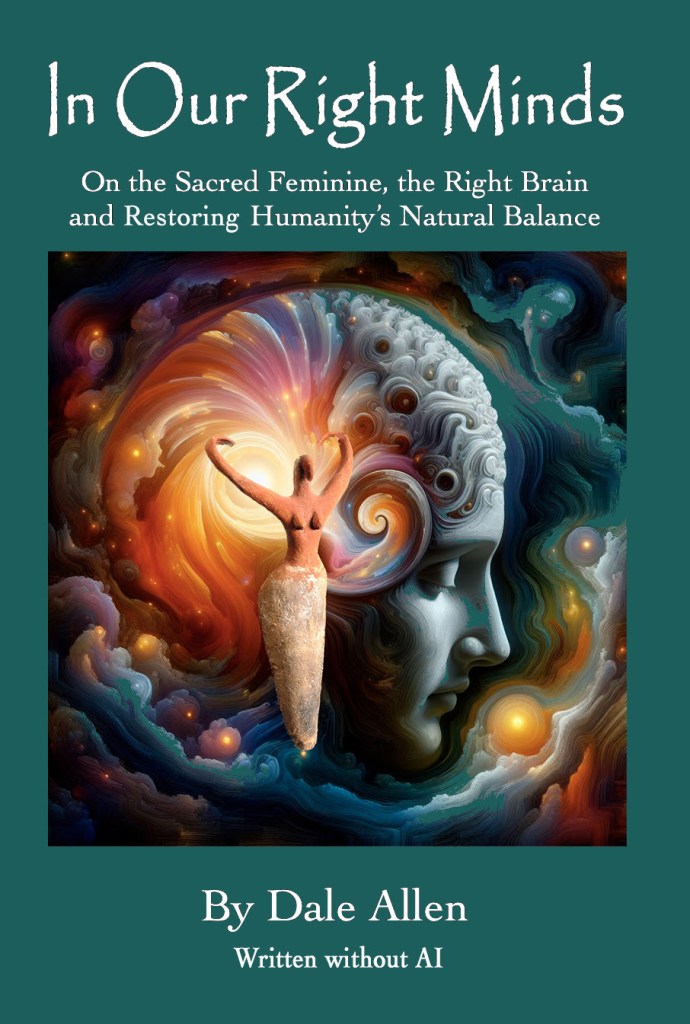
TODAY • BOOK LAUNCH ON AMAZON! Launch Discounts underway now!
There’s something about a book. I make a lot of things: podcasts, videos, a film, a musical production, paintings, lots of articles for publications, but this… this feels huge to me. A book. A book that represents 25 years of my life as a spokesperson and champion of the feminine side of humanity – a part of all us.
Here’s the official Press Release:
Veteran of corporate and commercial communications, host, interviewer, and filmmaker Dale Allen has now released her new book, In Our Right Minds. This new book is an in-depth exploration of the sacred feminine and its power to heal humanity as a whole. Sharing her profound journey of exploring the goddess archetype, the author combines science, art, and history for a transcendent literary journey.
Continue reading “In Our Right Minds: On the Sacred Feminine, the Right Brain and Restoring Humanity’s Natural Balance by Dale Allen”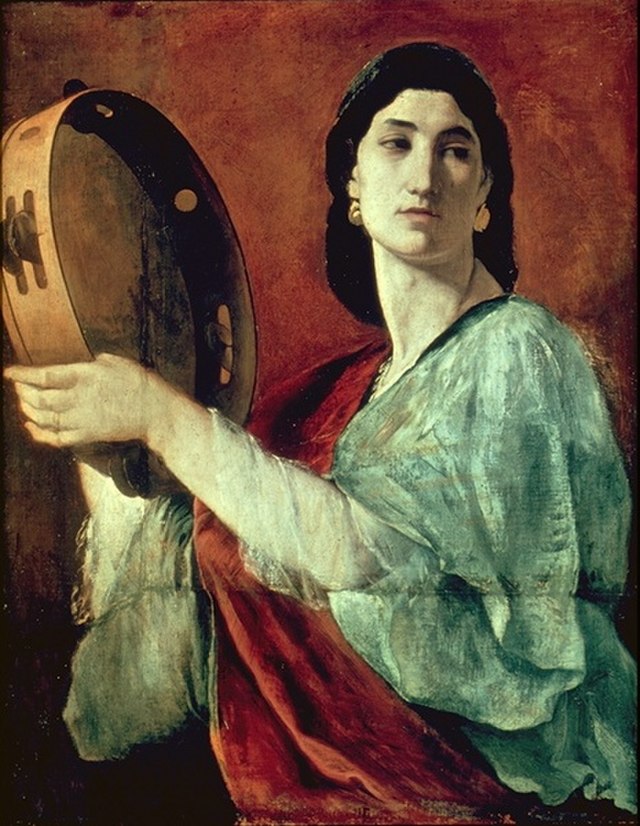
Intro: I have been working on a project inspired by Charlene Spretnak and her book Lost Goddesses of Early Greece. I am writing biblical stories through the eyes and words of the women. The scribes who wrote down the tales of the bible, wrote mostly from men’s point of view. And they had their own which was to destroy evidence of the Goddesses. I tell Noah’s story through Naamah, his wife. Abram and Sarai’s journey to Egypt through the eyes of Sarah. Exodus in Miriam’s voice. In my telling, Miriam went to Midian with Moses and, while there, experienced the Burning Bush and worked with Moses’ wife Zipporah to protect knowledge of the Goddesses. Below is an abridged version of this section of Miriam’s tale.
I look around at your world today. You, yes you, are my descendants. My beloveds. I mourn for what you’ve lost. No, I am angry, how could things have gotten this bad? I dare you, I dare any of you to challenge my work. We did everything we could. It should not have taken this long to find our clues. But then I see the job the scribes did. It was better and more thorough than even we, who saw so much, could have imagined. I look around at this precious earth we bequeathed to you and see how damaged it is.
Continue reading “Miriam Speaks by Janet Maika’i Rudolph”This was originally posted on October 1, 2012
What is a Goddess Pilgrimage and why are so many US, Canadian, and Australian women making pilgrimages to ancient holy places in Europe and Asia? The simple answer is that women are seeking to connect themselves to sources of female spiritual power that they do not find at home.

Traditionally pilgrims leave home in order to journey to a place associated with spiritual power. “Leaving home” means leaving familiar physical spaces, interrupting the routines of work and daily life, and leaving friends and family behind. For the pilgrim, “home” is a place that has provided both comfort and a degree of discomfort that provokes the desire to embark on a journey. The space of pilgrimage is a “liminal” or threshold space in which the supports systems of ordinary life are suspended, as Victor Turner said. A pilgrim chooses to leave the familiar behind in order to open herself to the unfamiliar—in hopes that she will return with new insight into the meaning of her life.
Continue reading “Legacy of Carol P. Christ: Why a Goddess Pilgrimage?”While the Goddess spirituality movement runs alongside the women’s and feminist spirituality movements, I am certain the Goddess herself looks on with wonder and pride at Her creations. I am sure that it pleases Her to see women so devoted to self-sovereignty, and the fierce determination to get out from under the lash of patriarchy, to stand as women together, united in our passion for a better world.
While I know in my heart that we are continually held in the mind of the Goddess, I am called to wonder, how often is She in ours?
Though we make great strides together in our common goal of freedom and peace, some of us seem to be less at peace than ever before; there seems to be an undercurrent of loneliness, of disconnection. Lately, I’ve been thinking, it is at least possible that the thing that keeps us up at night is less about the state of the world, and more about the sometimes tenuous connection with our Mother. We may be so focused on self-empowerment that we have forgotten that there is another power, a “higher power” if you will. And She wants to commune with us.
Continue reading “Making Room for Reverence by Kelly Applegate-Nichols”From the mists of Welsh mythology Celtic Goddess Branwen provides important wisdom for our modern world. Themes of the destructiveness caused by viewing those different from us with distrust and fear are found in her story. Vengeance is revealed as a downward spiral of pain and suffering. She illustrates the healing role empathy, compassion and forgiveness can play in a world gone mad with war. Her story reveals the importance of restorative justice and the many factors at play preventing its application.
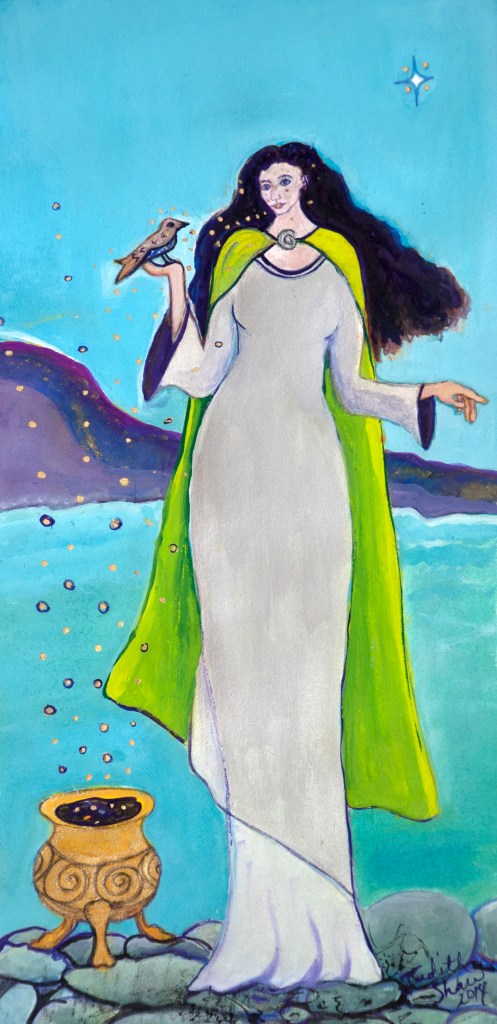
Branwen was the sister of the giant, King Bran of the Isle of the Mighty. She was loved by her people for her gentleness, compassion and beauty. In the tradition of the Old Tribes of the British Isle — most likely a hold-over from the days before kings, when Goddess was supreme — her son would become king upon the death of King Bran.
Continue reading “Celtic Goddess Branwen: A Path to Empathy by Judith Shaw”Today the hawk is back, tail feathers lit gold and black by a bright and welcome sun. It stays only a moment before tilting out of the tree and continuing on its way, but this moment is enough to spark a sense of joy and wonder in my chest, the awake kind of glee that fuels and feeds me, that inspires and holds me. This feels like the Year of the Hawk to me, of clear focus and intentional commitment. I watch it glide away between the trees and take a deep breath of release and freedom. I re-center myself into my body and reconnect to the sacred What Is. I am open to clarity. I am open to trust. I am present with this day’s unfolding.
Continue reading “Listening to Our Landscapes, by Molly Remer”The wheel of the year continues turning and once again we find ourselves at the transition point from winter’s deep sleep to the first awakenings of spring. It is marked by an ancient Celtic festival called Imbolc, also known as Imbolg or Brigid’s day. It is believed to have been celebrated long before the Celts arrived in Ireland and Scotland, probably as far back as Neolithic times.
Continue reading “A Time of Renewal: Brigid Emerges at Imbolc by Judith Shaw” Feminism and Religion