Legacy of Carol P. Christ: Why a Goddess Pilgrimage?

This was originally posted on October 1, 2012

What is a Goddess Pilgrimage and why are so many US, Canadian, and Australian women making pilgrimages to ancient holy places in Europe and Asia?  The simple answer is that women are seeking to connect themselves to sources of female spiritual power that they do not find at home.

Traditionally pilgrims leave home in order to journey to a place associated with spiritual power.  “Leaving home” means leaving familiar physical spaces, interrupting the routines of work and daily life, and leaving friends and family behind.  For the pilgrim, “home” is a place that has provided both comfort and a degree of discomfort that provokes the desire to embark on a journey.  The space of pilgrimage is a “liminal” or threshold space in which the supports systems of ordinary life are suspended, as Victor Turner said.  A pilgrim chooses to leave the familiar behind in order to open herself to the unfamiliar—in hopes that she will return with new insight into the meaning of her life. 

Continue reading “Legacy of Carol P. Christ: Why a Goddess Pilgrimage?”

Making Room for Reverence by Kelly Applegate-Nichols

While the Goddess spirituality movement runs alongside the women’s and feminist spirituality movements, I am certain the Goddess herself looks on with wonder and pride at Her creations. I am sure that it pleases Her to see women so devoted to self-sovereignty, and the fierce determination to get out from under the lash of patriarchy, to stand as women together, united in our passion for a better world.

While I know in my heart that we are continually held in the mind of the Goddess, I am called to wonder, how often is She in ours?

Though we make great strides together in our common goal of freedom and peace, some of us seem to be less at peace than ever before; there seems to be an undercurrent of loneliness, of disconnection. Lately, I’ve been thinking, it is at least possible that the thing that keeps us up at night is less about the state of the world, and more about the sometimes tenuous connection with our Mother. We may be so focused on self-empowerment that we have forgotten that there is another power, a “higher power” if you will. And She wants to commune with us.

Continue reading “Making Room for Reverence by Kelly Applegate-Nichols”

Celtic Goddess Branwen: A Path to Empathy by Judith Shaw

From the mists of Welsh mythology Celtic Goddess Branwen provides important wisdom for our modern world. Themes of the destructiveness caused by viewing those different from us with distrust and fear are found in her story. Vengeance is revealed as a downward spiral of pain and suffering. She illustrates the healing role empathy, compassion and forgiveness can play in a world gone mad with war. Her story reveals the importance of restorative justice and the many factors at play preventing its application. 

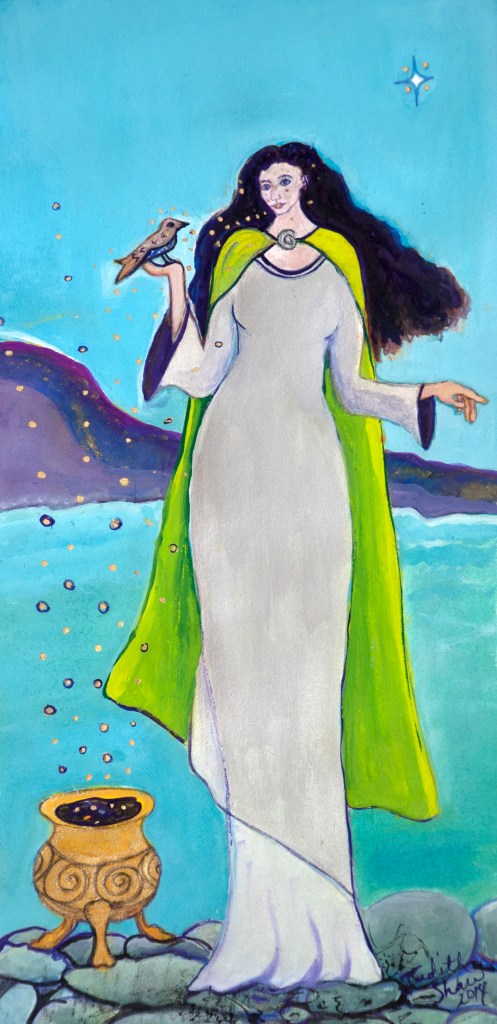
Branwen, Celtic Goddess painting my Judith Shaw

Branwen was the sister of the giant, King Bran of the Isle of the Mighty. She was loved by her people for her gentleness, compassion and beauty. In the tradition of the Old Tribes of the British Isle — most likely a hold-over from the days before kings, when Goddess was supreme — her son would become king upon the death of King Bran.

Continue reading “Celtic Goddess Branwen: A Path to Empathy by Judith Shaw”

Listening to Our Landscapes, by Molly Remer

Today the hawk is back, tail feathers lit gold and black by a bright and welcome sun. It stays only a moment before tilting out of the tree and continuing on its way, but this moment is enough to spark a sense of joy and wonder in my chest, the awake kind of glee that fuels and feeds me, that inspires and holds me. This feels like the Year of the Hawk to me, of clear focus and intentional commitment. I watch it glide away between the trees and take a deep breath of release and freedom. I re-center myself into my body and reconnect to the sacred What Is. I am open to clarity. I am open to trust. I am present with this day’s unfolding. 

Continue reading “Listening to Our Landscapes, by Molly Remer”

A Time of Renewal: Brigid Emerges at Imbolc by Judith Shaw

The wheel of the year continues turning and once again we find ourselves at the transition point from winter’s deep sleep to the first awakenings of spring. It is marked by an ancient Celtic festival called Imbolc, also known as Imbolg or Brigid’s day. It is believed to have been celebrated long before the Celts arrived in Ireland and Scotland, probably as far back as Neolithic times.

Continue reading “A Time of Renewal: Brigid Emerges at Imbolc by Judith Shaw”

Snake Priestesses of Crete as Earthquake Oracles? by Laura Shannon

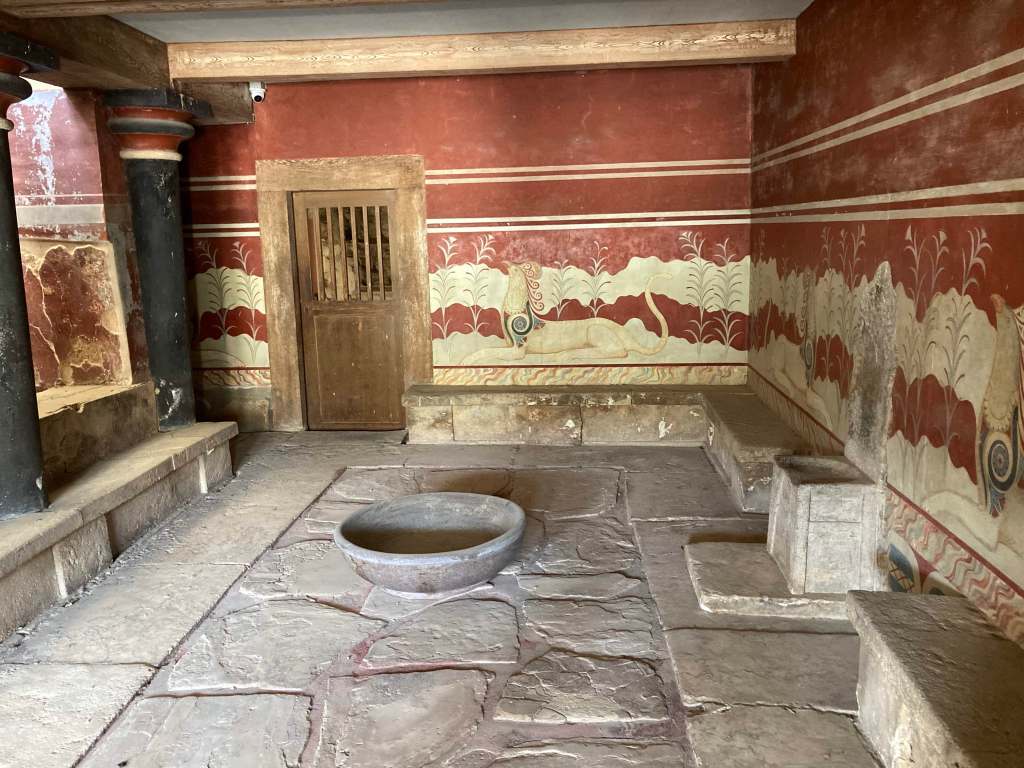
Knossos Throne Room showing edge of lustral basin at left. Photo: Laura Shannon

A few weeks ago I was on Crete, having coffee with an archaeologist friend. She happened to mention something strange. Crete has always been a seismic zone, with lots of earthquakes, yet remarkably, in Minoan times, no one was killed in collapsing buildings; they were never taken by surprise. 

We pondered this – it seems astounding. They must have had some means of warning. Perhaps the serpents sacred to them could have given them some sign? 

Continue reading “Snake Priestesses of Crete as Earthquake Oracles? by Laura Shannon”

On the changing role of the Goddess

Goddess Prominence & Nature Participation through time

Today I reflect on the presence or absence of the goddess in religion and society, and how we view humanity and participate in nature as a result. 

This post is inspired by “The Myth of the Goddess. Evolution of an Image” by Anne Baring and Jules Cashford, and especially by its final chapter “The Sacred Marriage of Goddess and God: the Reunion of Nature and Spirit.” This dance of integration of apparent opposites is essential to my work.

Continue reading “On the changing role of the Goddess”

Meeting the Melissae: The Ancient Greek Bee Priestesses of Demeter by Elizabeth Ashley, Book Review by Carolyn Lee Boyd

The Mysteries at Eleusis, a nine-day festival in ancient Greece based on the myth of Demeter and Persephone, has fascinated and baffled us for millennia. Here thousands of people from all over Greece and beyond came to understand, in the words of Plutarch, “an undoubted truth our soul is incorruptible and immortal” (277). Producing this festival was the task of the Melissae, the bee priestesses of Demeter, powerful and honored women in a society in which women had few rights, famous in their own time but almost unknown in ours.

In Meeting the Melissae: The Ancient Greek Bee Priestesses of Demeter, Elizabeth Ashley offers us not only facts about the Melissae and other ancient Greek priestesses gleaned from archaeology, art and literature from the period, and modern academic research but her own glimmerings of their deepest spiritual life. She explores what is known about the priestesses and their everyday lives, the goddesses whose temples they presided over, and bees themselves. An aromatherapy researcher, she began her journey to discovering the secrets of the Melissae when she kept reading references to them in ancient botanicals about the herb lemon balm (Melissa officinalis) but nothing more. (The connection between lemon balm and bee priestesses? Pheromones. That’s all I’m going to say).

Continue reading “Meeting the Melissae: The Ancient Greek Bee Priestesses of Demeter by Elizabeth Ashley, Book Review by Carolyn Lee Boyd”

Winter’s Wisdom: The Cailleach and Solstice Insights by Judith Shaw

How quickly the wheel of the year turns. Once again we have reached the dark and cold of the Winter Solstice, which occured on December 21st this year. Winter Solstice is an astronomical moment – the exact moment when our hemisphere tilts as far away from the sun as possible. But for the ten days after, the increase in daylight each day is only a few seconds  So I think of this time as the Winter Solstice Season. 

Continue reading “Winter’s Wisdom: The Cailleach and Solstice Insights by Judith Shaw”

Legacy of Carol P. Christ: Solstice Comes But Once A Year, Now It’s Here!

This was originally posted on December 17, 2012

Actually it comes twice, once in midsummer, the longest day of the year, and once in midwinter, the longest night.  Winter Solstice is also known as the first day of winter.

ChristmasTrees20060001

For those of us attuned to the cycles of Mother Earth, Winter Solstice is a time to celebrate the dark and the transformations that come in the dark. Many of the customs associated with Christmas and Hannukah, including candles, Yule logs, and trees decorated with lights were originally associated with Winter Solstice.  The extra pounds put on during winter feasting were insulation against the cold winter nights.

Those who fear that many of the customs of the Christmas season might be pagan are right.  As we learn again to honor our place within the cycles of birth, death, and regeneration, we can return these customs to their roots in the circle of life.

Continue reading “Legacy of Carol P. Christ: Solstice Comes But Once A Year, Now It’s Here!”