Mindfulness of Putting Ourselves Down by Oxana Poberejnaia

oxanaFrom the Buddhist point of view, all phenomena are conditioned, i.e. they arise, carry on, and come to an end because of other phenomena. Buddhism does not look at anything we experience as “things”, but rather as processes.

Confusion arises due to various factors, chief among them : 1) vague sense of “ego”, and 2) language. The vague sense of ego is portrayed in Khemaka Sutta as the last delusion that a monk drops before getting Enlightened, so we won’t worry about it now. Where language is concerned, Buddhism stands on similar positions to those of postmodernism and feminism, i.e. our social world is defined by how we speak about it. One can say that we actually create society by the act of speaking.

Continue reading “Mindfulness of Putting Ourselves Down by Oxana Poberejnaia”

Who is the Church? by Linn Marie Tonstad

Linn Marie TonstadThe headlines blared, “Who am I to judge?” News outlet after news outlet led with the pope’s conciliatory stance toward gays, expressed during an interview aboard the pope-plane as he returned from Brazil. Among the several headers from Fox News (I encourage not clicking!), we find discussions of the pope’s “reaching out” to gays and even one that combines this development with his “urging” of a “greater role” for women. The New York Times story introduced the pope’s comments as follows: “For generations, homosexuality has largely been a taboo topic for the Vatican, ignored altogether or treated as ‘an intrinsic moral evil,’ in the words of the previous pope.” Ignoring the astonishing comment that this has been the case “for generations,” as though homosexuality has historically been the kind of issue for the church it has become in the wake of radical queer movements – see Mark Jordan’s several books on this for the most helpful treatments – the story went on to say that the pope’s comments “resonated throughout the church.” Although the NYT article did a better job than some contextualizing and nuancing the pope’s comments, they were still termed “revolutionary” in an assessment better suited to an opinion page than to a news report. Better-informed commentators, such as James Martin, offered a measured response. Martin said that although the pope’s remarks didn’t really signal a significant change in policy, “in the church, style often proves substantial,” implying that the “pastoral” tone might have effects in the implementation of policy. More significantly, Martin praised the pope’s adherence to Jesus’ injunction not to judge as an instance, first and foremost, of the pope’s commitment to mercy as the hallmark of his pontificate.

My Facebook feed, predictably, lit up with links to and discussions of these comments. While most were thrilled, a few posts noted that, even if Pope Francis is in fact (which is not proven) walking back Benedict XVI’s language of “intrinsically disordered,” the church’s policy has not and will not change in any significant way. What was missing in all but a few instances was attention to the pope’s comments in the same interview on women, and the deep theological problems with the assumptions contained in those comments. And while I, as a queer theologian, would never wish to downplay the struggles of LGBTQI people in the Roman Catholic church, there are rather more women than queers in that church (as elsewhere!). What’s more, it is arguable that it is the sexism and heterosexism of what Marcella Althaus-Reid memorably termed “T-Theology” that underlies condemnation of homosexuality in Roman Catholic theology. Continue reading “Who is the Church? by Linn Marie Tonstad”

Women’s Christian Heritage by Elise M. Edwards

elise-edwardsIt is difficult to carve out time in a course that covers Christianity from the past 2000 years to address material beyond the standard textbooks.  But yet, I must because the visual and material culture, the worship practices, and the daily activities of women and men who have called themselves Christians or followers of Christ throughout history also comprise the story of the Christian heritage.

Over the past several weeks, I have been developing material for a historical and theological survey course called “The Christian Heritage.” In the multiple sections of this course taught at my university, and I imagine similarly at schools across the country, students are assigned a course reader.  The reader we use is a collection of texts that have shaped the Christian faith from the first century to the 21st.  It is a good collection, and I have no objection to using it.  However, for the way I would like to teach the course, I will need to supplement the reader with other material.  I have two interrelated concerns: the reliance on texts as a way of determining theological history and the absence of women in that history before the medieval period (and even then the number of women included is small). Continue reading “Women’s Christian Heritage by Elise M. Edwards”

5 Interesting Facts about Women and Religion by Kile Jones

Kile Jones, atheistPart of my research is focused on how the social sciences relate to “religion” and religious studies.  More specifically, I spend time examining the sociology of religion.  I look at stats, demographics, and polls.  I look at rates of attendance, frequency of prayer, levels of “religiosity,” apostates (or the less religiously-loaded term “exiters”), and political outlooks.  I also look at how bias this area of study is in favor of religion.  One facet of this work that has always interested me, is the differences in “gender” and “sex” as they relate to religious beliefs and observances.  Accepting the fact that there are spectrums of sex, gender, and identity, and the presence of difficult philosophical questions surrounding self-identification and the limits of labels, some really interesting facts and statistics crop up time and time again.  In what follows I will lay out a couple of these interesting facts, along with some thoughts on them: Continue reading “5 Interesting Facts about Women and Religion by Kile Jones”

Blindness of the Gals by Oxana Poberejnaia

Oxana PoberejnaiaWomen (and men) are often blind to women’s inequality. I, as a Buddhist practitioner, have been blind to the reality of women’s second-class status in sacred texts of Buddhism and practice.

In her book “Buddhism After Patriarchy” Rita M. Gross describes how her fellow western Buddhist women completely overlooked the fact that women are not allowed into Rumtek Buddhist monastery in Sikkim, even after watching a video of a woman leaving an offering outside the gate and walking away.

Continue reading “Blindness of the Gals by Oxana Poberejnaia”

Adventures in Churchgoing by Elise M. Edwards

Elise EdwardsI am often greeted by warm smiles and handshakes–and sometimes even hugs–from churchgoers around me.  But I wonder if the friendly people would be so welcoming if they knew that I identify as feminist.

It’s hard being a feminist and visiting a new church.  I’ve recently moved to Texas from California and I’m looking for a church to attend.  There are many things I love about church: corporate worship, talks with people of faith, gatherings where friendships are built, and opportunities to serve and to learn. I also love to sing, and my not-ready-for-primetime voice would love to join a choir with and contribute to other people’s worship experience.

In my past, I’ve been a member (or regular attender) of churches where I felt welcomed and affirmed. Yet, I always feel defensive when I seek out new places to worship.  I question whether a church will be affirming to women and girls as whole selves – as embodied, thinking, feeling beings.  I mentally prepare myself to hear male imagery and language for God and I pray themes of male headship vs. female servanthood are not expressed.  I feel like an investigator seeking out clues to determine our compatibility.  It’s no wonder that I’ve recently heard several people compare visiting churches to dating.

Continue reading “Adventures in Churchgoing by Elise M. Edwards”

To Have and to Hold: Gay Marriage and the Religion Question

If a conservative religious traditions can’t give their mothers or sisters full equality, how can we expect them to give a GLBT individual the time of day?

John Erickson, sports, coming out.Outrage.  Anger.  Fear.  Hatred.  These are just a few of the words that flashed across my Twitter feed as I woke up on that fateful Wednesday, June 26 morning when the Supreme Court of the United States ruled that the Defense of Marriage Act (or DOMA) was unconstitutional and that supporters of Proposition 8, the hotly contested voter initiative in California that banned same-sex marriage, had no standing.   People were mad.  However, it wasn’t just the typical kind of mad that is associated with hatred, it was a type gay_marriage_81102178_620x350of mad that was met with impossible anguish because what I was reading and feeling was a result of one thing: there was nothing more they could do.

What does all this mean?  Questions from friends and family were filling up my inbox and although I wanted to take a moment to just hit “Reply All,” and input the words: Equality, I had to hold back and start to examine the notion that although equality may now be firmly on the proverbial table, there is still a lot of work to be done, specifically for gay marriage and those wanting to marrying inside the traditional church spaces they grew up in and not just the ones that have come out as open and affirming in recent years towards LGBT individuals. Continue reading “To Have and to Hold: Gay Marriage and the Religion Question”

Are Buddhist Women Happy? Part II by Oxana Poberejnaia

oxanaIn Part I of this post I started asking questions about whether Buddhism in the West is part of patriarchy. Today I offer a possible link between practices of men’s Initiation Rites and some of the elements of Buddhism.

Men’s Initiation Rites

When we consider principle practices of Western Buddhists, primarily daily meditation and meditation retreats we might enquire something like this: since monastic practice is a model for our Western lay practice, do Buddhist monasteries constitute an extension and continuation of men’s long houses, places of men’s initiation rites?

Continue reading “Are Buddhist Women Happy? Part II by Oxana Poberejnaia”

(Femen)ism? by Kile Jones

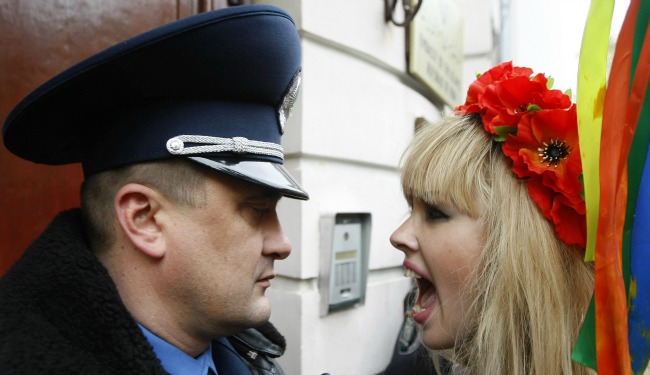
Kile Jones, atheistAs most of us are aware by now, there is a “feminist-sextremist” group from Ukraine called “Femen.”  This group has been very controversial by their public demonstrations of nudity, the words they paint on their bodies, and their explicit condemnations of political structures and organized religions.  They were started by Anna Hutsol in 2008 and have now spread throughout Europe and the Middle East.  The question I pose for this post is: Does Femen harness or hinder the power of the feminist critique?

Image from Konstantin Chernichkin/Reuters

Femen is precisely the kind of movement that pushes us in our understanding of feminism, the means by which it is best expressed, and the issues surrounding moral condemnation and religious sensitivity. Continue reading “(Femen)ism? by Kile Jones”

The Roman Catholic Theology of Womanhood by Ivy Helman

The Vatican has creIvy Helmanated an entire theology of womanhood without the input of a single woman!  Searching the Vatican archives reveals a wide range of documents pertaining to women, some of which mention women tersely only in their capacity as workers needing protection (Rerum novarum, 1891) and others are fully dedicated to describing the status, role and mission of women in the family, society and the world (Mulieris dignitatem, 1988).  Within the documents, as time passes, women become their own category of theological importance.  This is due to the influence of feminism on the status and roles of women across the globe.  Yet, there is vehement anti-feminism in the documents as well.

I searched the documents myself, curious as to what the Vatican had to say about womanhood and wrote a book on the topic published by Orbis in Febrary 2012 entitled, Women and the Vatican: An Explanation of Official Documents.  I would like to lay out that theology now.  Continue reading “The Roman Catholic Theology of Womanhood by Ivy Helman”