 Former Mayor of New York Rudy Giulaini recently questioned the American President’s patriotism when he asked if Obama had been “brought up the way you were brought up and I was brought up, through love of this country.” When Chris Hayes discussed the furor surrounding Guiliani’s statement on MSNBC with James Peterson of Lehigh University, I would say that they both missed the point. Their defense of the President was to insist that he is a dyed in the wool patriot. Should anyone be a dyed in the wool patriot these days? What does and should patriotism mean? These were questions not asked.
Asked to clarify his comments, Giulani opined that Obama speaks from the perspective of “socialism” and “perhaps anti-colonialism” rather than good old American patriotism. Again Hayes and Peterson dropped the ball. They were quick to agree that the American Colonialists should be considered anti-colonialist given that they rebelled against the colonial power of England. What they failed to say was that the American Colonialists were colonialists too. Though they threw England out, they had no compunction in asserting their right to take the land, the resources, and the very lives of earlier inhabitants of what became the American land.
I heard Giuliani’s statement in a different way. When Giuliani spoke of being brought up to love his country, I heard echoes of my own childhood. Like many Americans, Giuliani included, I was taught to love my country right or wrong. Indeed I was taught that my country was never wrong. From the perspective of my current understanding of the world, I now feel that the way I was brought up to love my country was itself wrong.
The American nation has been wrong on many things. First we must consider the idea our forebears held that the American land was theirs for the taking. No matter what degree of relation immigrant Americans had to the Native Americans, they all were taught that the Indians were barbarians who had no right to the land being claimed by civilized Europeans. Next we can ask why slavery was not outlawed and women were denied the vote at the time of the founding of the American nation. If we look at the truth of the matter, there are many reasons not to feel as proud of our country as “we” were taught to do.
And then of course there are the many wars—from the Pequot War to the Iraq and Afghanistan wars. How many, if any of them were just wars? And how many of them should rightly give us reason to temper any patriotism we have with the double eye that sees both the good and the bad that our nation has done?
If Chris Hayes had been interviewing me, I would not have been so quick to defend patriotism and the American nation. Rather I would have asked what patriotism means and whether anyone should defend any nation right or wrong. This would not have extricated Obama from Giuliani’s criticism, but it might have instigated deeper and more complex questioning of Giuliani’s premise.
In recent programs on MSNBC Lawrence O’Donnell opened a complex discussion of religion in general and Islam in particular, following Obama’s (now controversial) assertion that the terrorism of the Islamic State is not “the real” Islam and his statement that Christians were also guilty of atrocities during the crusades.
It was clear to me that the context of Obama’s statements is the feeling of many Americans that “Islam” is to blame for the terrorist activities of jihadists acting in its name, along with the conclusion they draw from this that “Islam” is a violent religion while “Christianity” is not. Obama was trying to make two related points: not all Muslims are violent jihadists; and Christianity is not all good and Islam is not all bad. Obama was immediately attacked for comparing Christianity and Islam for both having violent histories.
O’Donnell (unlike Hayes) resisted any knee-jerk temptation he might have had to defend Obama in any simple way from his critics. Rather O’Donnell (revealing the power of Roman Catholic theological education), began a more complex conversation about what constitutes “the real” Islam and “the real” Christianity.
Not one to mince words, O’Donnell asserted that Catholicism “was once the most murderous force on the face of the earth.” I was more interested in the statement of Asra Q. Nomani, the author of Standing Alone: An American Woman’s Struggle for the Soul of Islam, that the President was wrong to say that Islamic State is beyond the pale of Islam. Rather, she asserted, Islamic State represents, “a very serious interpretation of Islam in the world that is wreaking havoc on all of us.” Though Normani does not agree with Islamic State’s interpretation of Islam, she argues that well-meaning scholars, journalists, and politicans, along with progressive Muslims, are simply burying their heads in the sand if they refuse to recognize that the Islamic State’s understanding of Islam is rooted in Islamic texts and in Islamic history.
This discussion of what is or is not “the real “Islam” and “the real” Christianity reminds me of debates feminists were having a few decades ago about whether or not “the real” Christianity or Judaism are sexist or not. Along with Mary Daly, Rosemary Radford Ruether, Judith Plaskow, and others, I engaged in this debate for a period of time.
In the end, I came to see that the question of what constitutes “the real” Judaism or Christianity is a moot point. Whatever good or bad exists in the past of any group is subject to interpretation by actors and groups of actors in the present: they are the ones who will determine which texts and which history they will consider normative and which parts they will transform or discard. From this perspective we can see that both jihadists and progressive Muslims are engaged in interpretation of Islam in the present, and that they are struggling with each other about which interpretation of Islam will be brought into the future.
It is not easy to initiate complex discussions of complex issues, but these are the very discussions we most need to have—about patriotism and about religion. It is clear that these discussions are related. Guiliani criticized Obama’s patriotism in part because Obama dared to criticize Christianity. Many people on both sides of the discussions about religion and politics are are convinced that their country is right because their God is on their country’s side.
I commend Lawrence O’Donnell and Asra Normani for showing us that complex discussions of religion are possible in public spaces, even when the political stakes are high. I hope this discussion will continue, and that a more complex discussion of patriotism and love of country can be initiated as well. No religion and no country is all good nor is any religion or country all bad. Blind faith in religion or country, on the other hand, is never a good thing.
Carol leads the life-transforming Goddess Pilgrimage to Crete (facebook and twitter)–space available on the spring and fall 2015 tours. Carol’s books include She Who Changes and and Rebirth of the Goddess; with Judith Plaskow, the widely-used anthologies Womanspirit Rising and Weaving the Visions; and forthcoming next year, Goddess and God in the World: Conversations in Embodied Theology. Photo of Carol by Michael Bakas.


 My partner is a lawyer who works with asylum seekers and other immigrants here in the Czech Republic (ČR). She’s amazing at her job and I’m constantly in awe of her passion and commitment along with her righteous anger at systematic injustices. In fact just last week, her workplace, together with a consortium of other immigration organizations in the ČR, helped organize a demonstration in the center of Prague to protest the Czech Republic’s refusal to admit Syrian children and their families into the country. She invited me to attend the event with her. I went.
 Last week, Graeme Wood caused quite a stir with his article
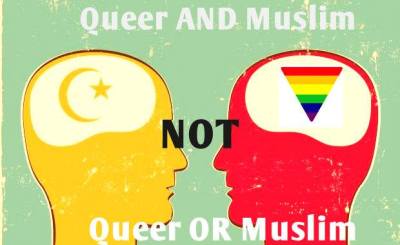

 How much longer do I as a Muslim American female, have to deal with the “gang-buster,” terrorizing, “Satan” worshipers high-jacking my faith for the sake of trying to supposedly ‘preserve’ it? Who are these wackos and why do they seem to represent my faith in mainstream media? Where did they all come from? Which terrorist schools have they all graduated from and what truly is their agenda?
 My father always encouraged us to interpret scripture for ourselves. We read text, learned mainstream interpretations, and then he would ask for our authentic self-generated interpretations delivered in the form of book and chapter reports due to him. Growing up, all prayers and supplications were done in English; my parents wanted us to really understand and synthesize rather than simply memorize Arabic words with a generic sense of what we were reading or reciting.
 My friends make my life difficult. They make me see what I could not see before. Kecia Ali, Aisha Geissinger, Karen Ruffle and Kathleen Self taught me how to read for gender in the classical texts I use for my academic work. It’s a way of doing close readings by paying attention to the way gender shows up in the text. Aisha sat with me one afternoon and walked me through my own sources pointing out references to gender in the sources. She showed me how the sources I was reading used gender to express social norms. She kept asking me, “What work is gender doing in the text?”