The God of Love by amina wadud

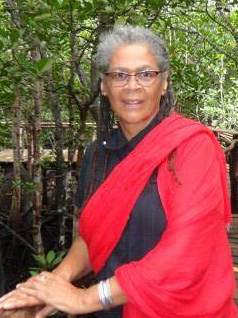
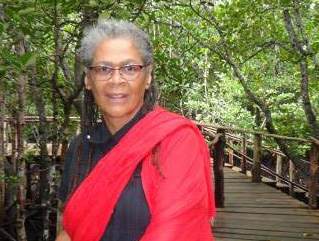
amina 2014 - croppedI admit I had the fortune of loving my father, the late Reverend Teasley, and feeling loved by him.  I also date my fascination with the divine back to my father.  There are many ways this fascination could have taken shape, but for me it led to the experience of religious diversity as an element of the global community of human beings that has never abated.

Like others, you might ask: if I feel so akin to diversity, why am I a devotee to only one of them: Islam? Some question this by way of offense to Islam. Others are genuinely curious. This curiosity takes two forms.  Either they are interested in my personal location within Islam, as in why are you Muslim? Or they are interested in why stop my quest for diversity and get stuck where I am clearly busy detangling the manifestations of Islam from their patriarchal moorings?

My answer is quite simple. Islamic thought brought me peace of mind, especially about the greater workings of the universe and my tiny, tiny part within it.  Islamic thought gave me the language to understand (a/my) reality.  Quite a handy facility if you think about how long humans have pondered the great existential questions: Who am I; Why am I here; and What is the purpose of life? Continue reading “The God of Love by amina wadud”

Get your fatwa off our backs! by amina wadud

amina 2014 - croppedIt’s not so easy any more to control the parameters of Islam and the way it is practiced by those who wish to stuff their opinion down the throats of other Muslim citizens, be they minorities or majorities across the globe.

This past week the Selangor Islamic Religious Counsel in Malaysia, issued a fatwa against Sisters in Islam (SIS), accusing them of being “deviant” because they subscribe to religious liberalism and pluralism.  They called for a ban on all their publications and to silence their social media. They sought to shun their activities and personhood “in the name of Islam.’

The next day SIS held a press conference and went on full counter attack.  This is what it has come down to for many who stand for justice, equality, and human dignity for all, within an Islamic perspective.

Let me step back and explain about a fatwa.  Continue reading “Get your fatwa off our backs! by amina wadud”

ISIS and the Larger Muslim Crisis by Hanadi Riyad

Hanadi Riyad croppedIt is heartening to hear the many condemnations Muslim scholars have issued of ISIS and its methods and actions. One of the latest attempts comes in the form of an open letter addressed by a coalition of one hundred and twenty six Muslim “scholars” from across the world to Abu Bakr al Baghdadi and ISIS followers and supporters. The seventeen page letter is one of the most detailed responses to ISIS I have read. However, just like other responses, it fell short of my expectations as a Muslim woman. I checked the list of the signatories and I could not find any women amongst them.

I am saddened to note that the authors of the letter fall into the same mistake they accuse ISIS of: they quote some Quraanic verses and Hadiths selectively, out of context, and portray them as sufficient rebuttal against ISIS actions, never mind the sources, verses, and Hadiths ISIS has been quoting just as selectively to justify its crimes. The letter explains about the methodology of Islamic legal theory (usul al-fiqh) that it stipulates “to consider everything that has been revealed relating to a particular question in its entirety, without depending on only parts of it, and then to judge if one is qualified based on all available scriptural sources.” There’s no explicit logical explanation for why the parts of the scripture and interpretations quoted by the writers of the letter should be given precedence over the ones quoted by ISIS.

The implicit reason, however, resides in the authors’ assertion of their authority as Sunni “scholars”  and their opinion as “a scholarly opinion.” We should take their word because they have the authority that ISIS does not. The assumption that ISIS cannot count amongst its ranks scholars is neither explained nor defended. The doctrinal connection between ISIS and Wahhabi ideology upheld by many Saudi scholars – like ibn Baz and his disciples— goes unacknowledged. Continue reading “ISIS and the Larger Muslim Crisis by Hanadi Riyad”

The Season of Pilgrimage by amina wadud

amina - featureThis weekend those of us not performing the ritual pilgrimage, or Hajj, will enjoy the Festival of the Sacrifice of Eid al-Adha. Celebrated on the 10th day of the 12th lunar calendar month, it tends to creep up without warning, since we operate on the solar Gregorian calendar. The next day I jump a plane to Southeast Asia so my attention is already diverted.

The sacrifice here refers to Prophet Abraham’s botched contract with God over his first son. Muslims stick with the sheer biology that it was his first son, Ishma’il rather than Sarah’s first biological son, Isaac as recognized in Christianity and Judaism. It’s political, I won’t go there.

Instead I want to focus on this veneration of things masculine across all three Abrahamic faiths with the attention surrounding this particular patriarch. For example, I recall an Eid sermon which dwelt at length on Abraham circumcising himself in full adulthood without anesthesia. All I could think was, WHO should care about that? This particular manhood seems to excel over any reminder of his humanity, or of his devotion to monotheism in a community steeped in Idol worship. Continue reading “The Season of Pilgrimage by amina wadud”

LGBTQI Muslims and International Movements for Empowerment by amina wadud

amina 2014 - croppedI am currently in Cape Town South Africa at a Queer Muslim International Retreat.  Next month I will go to Jakarta Indonesia for a workshop focused on the same agenda: reform in Muslim communities towards the lives of dignity for lesbian, gay, bi-sexual, transgender, Queer and Intersex Muslims.  It has been a long road and the end of the struggle is nowhere in sight. Still, there are important developments worth noting.

I am the fifth of eight children.  My brother, just older than me, is gay. Although we are both in our 60’s now, it was evident that his sexual orientation was not normative heterosexual from very early. My first nephew, son of my older sister is also gay. Now in his mid-40’s his was also not a question of lifestyle choice.  I love these two men and always have. That did not mean I was devoid of homophobic tendencies and subtle acts of discrimination against queer people. I wasn’t against them, but I did not see why I, who lived as a straight heterosexual woman, should have to pay any attention to the particularities of their life struggle.  It was their problem and I could ignore it. So I did.

I was never guilty of vicious acts – teasing, name calling or bullying; I just put it out of my mind. As a Muslim, I would come to encounter a much greater awareness how the convenience of sitting on the fence was inadvertently a tacit approval of gross homophobic violations and that all I believed about a Merciful and Compassionate Creator of Justice required me to support the struggles to establish that divine justice and cosmic harmony and beauty everywhere and for everyone. Continue reading “LGBTQI Muslims and International Movements for Empowerment by amina wadud”

Muslim Separatists and The Idea of an “Islamic” State by amina wadud

amina 2014 - croppedThe other day, someone on twitter said she would not allow ISIS (known as the Islamic State of the Levant) use the name of “her” religion.  In fact, scholars in Egypt had proposed that they be called “the Separatist movement” and take the word “Islam” out of it. This question raised here is: what exactly is “Islamic” about what they are doing and how they are doing it?

I have contended for at least 2 decades that people use the word “Islam” anyway they want to make any point they want.  More importantly, whoever has the power to assert their definition of the word “Islam” controls how it is used. I say the past 2 decades because I used to think I could somehow determine “pure” “Islam”—as opposed to cultural reflections, human imperfections, and intellectual genuflections.  I came instead to see that everyone has a definition of Islam and whose definitions held sway was less a matter of epistemology and more a matter of power.

So, I followed one of my intellectual mentors and agreed that for any discourse about Islam, a definition had to be established, agreed upon, and then consistently maintained. He suggested that a simple criteria referent be applied based on Islam’s two primary sacred sources: the text of the Qur’an and the normative practices of the Prophet Muhammad, called sunnah.  He juxtaposed these to “little traditions” in the multiple ways Muslims experience or live out their understandings of these two.

Part of the methodology of Islamic feminism and reformed Islamic thought has been to demonstrate a direct link to the two primary sources but with a different paradigm about key principles espoused there in- like justice, human dignity, and compassion.  From that point forward, I tend to provide my definition of Islam, give evidence to support that definition from the primary sources and then elaborate how it would work in application to whatever issue is at hand.  Continue reading “Muslim Separatists and The Idea of an “Islamic” State by amina wadud”

Seeing the Humanity in the Inner Child by Jameelah X. Medina

Jameelah Medina

Article 6

1. States Parties recognize that every child has the inherent right to life.
2. States Parties shall ensure to the maximum extent possible the survival and development of the child.

Article 37
States Parties shall ensure that:

(a) No child shall be subjected to torture or other cruel, inhuman or degrading treatment or punishment. Neither capital punishment nor life imprisonment without possibility of release shall be imposed for offences committed by persons below eighteen years of age;

(b) No child shall be deprived of his or her liberty unlawfully or arbitrarily. The arrest, detention or imprisonment of a child shall be in conformity with the law and shall be used only as a measure of last resort and for the shortest appropriate period of time;

(c) Every child deprived of liberty shall be treated with humanity and respect for the inherent dignity of the human person, and in a manner which takes into account the needs of persons of his or her age. In particular, every child deprived of liberty shall be separated from adults unless it is considered in the child’s best interest not to do so and shall have the right to maintain contact with his or her family through correspondence and visits, save in exceptional circumstances;

(d) Every child deprived of his or her liberty shall have the right to prompt access to legal and other appropriate assistance, as well as the right to challenge the legality of the deprivation of his or her liberty before a court or other competent, independent and impartial authority, and to a prompt decision on any such action.*
inner childIslam has taught me so many things over the years. One lesson, in particular, plays in my head throughout the day as a constant and necessary reminder: My soul has rights over my ego. I still remember the first time I read that. Over the years, I have expanded it to include the idea that my body has rights over my mind, my mind has rights over my body, and even that my inner child (she’s six) has rights over me (the 12-year old me and the adult me).

I was crushingly self-critical and dealt with devastating self-loathing for many years, but learning how to be compassionate helped me to be much kinder to others, and eventually, to myself. I had not really thought about making myself a recipient of my own kindness and compassion before. It was so natural to judge that kid in me who just wanted a chocolate chip cookie, to jump in a dirty puddle, to stick my tongue out and make faces at other little kids, and all the other odd things I felt urges to do as an adult. Continue reading “Seeing the Humanity in the Inner Child by Jameelah X. Medina”

Racism from Born Muslim Men is Hurting Latino Muslim Women by Vanessa Rivera de la Fuente

Vanessa Rivera de la Fuente. Racism against Latin WomenOne of the first things a newly Muslim woman convert learns is that Islam makes people equal and the only thing that differentiates a believer from another believer is their level of piety. They also learn that Islam raises the honor of women to levels that no religion has done, that they, as Muslims, have rights, and they are encouraged to get marry since marriage is a half of the Din.

However, when it comes to Latino Muslim women of marriageable age, some have not received respect in terms of their honor, their rights as Muslims, or equal treatment as with other Muslim born women. It seems racism and stereotypes about Latina women are stronger than faith and piety. Continue reading “Racism from Born Muslim Men is Hurting Latino Muslim Women by Vanessa Rivera de la Fuente”

Putting Faith in Interfaith Dialogue by Esther Nelson

esther-nelsonWhy do it?  Sit around a table with people who profess a faith tradition different from our own, drink coffee, nibble on snacks, and talk.  What’s the point?  No doubt the reasons vary depending on the particular people getting together.  Nevertheless, there is the sense that if we “sit down together and talk together about our faiths,” we’ll “break down barriers,” and….then what?  Do we think (or hope) that those on the other side of the table will eventually “come around?”  Is conversion a goal?  Or, perhaps we just want to become more “tolerant” of other faiths.

So, for example, if Muslims share facts with Christians about the history of Prophet Muhammad, the Sunni/Shi’a division, and Shari’a law, will that help Christians tolerate Muslims?  Books on the history of religions abound.  Yet, religion-based violence flares around our globe.  Would learning about doctrinal beliefs–“truths” based on (usually male) interpretation of scriptural narrative–be helpful?  Christians understand Jesus to be God incarnate.  Muslims reject any doctrine that compromises the oneness of God.  Now what?  Are barriers broken down?  Are we more tolerant? Continue reading “Putting Faith in Interfaith Dialogue by Esther Nelson”

No Ramadan Gloom and Doom by amina wadud

amina 2014 - croppedThe first blog I read about Ramadan this year was full of the usual self-righteous pontification that takes this occasion to remind people to do such and such at this or that level. Who is the target audience for such an approach, I wondered? It seemed to operate on the basic idea that Muslims will NOT do the right thing unless someone tells them to. Mostly, though I noticed the gloom and doom of it and I decided then to make my Ramadan focus on joy.

First a quick reminder about the basics: Throughout the 9th lunar month, Muslims are obliged to abstain from food, drink and sexual intercourse during the day. It goes on like this for 29-30 days. There are also points of difference about some details of the fast, like how we determine which day to start. Either we actually cite the new moon, go by advanced calculations of the new moon, or some combination of these two. This leads to healthy chaos at the beginning because no one knows when the first day will, be but must prepare in order to get in that pre-dawn meal, called suhur. I say, healthy chaos, not only because I’m a bit of an anarchist, but also because I like that no one has complete control about such an important decision. Continue reading “No Ramadan Gloom and Doom by amina wadud”