A Celebration of Gender Studies for the First Night of Ḥanukah.

On the 21st of November, I took part in a faculty panel as part of the 20th anniversary celebration of the Gender Studies Master’s Program, the program in which I teach, at the Faculty of Humanities (FHS) at Charles University in Prague, Czech Republic.  The event featured the afore-mentioned faculty panel, a panel of program graduates, and an invited lecture entitled “Care as Taking Part,” by Prof. Estelle Ferrarese of the Institut Universitaire de France, organized in cooperation with CEFRES and CETE-P.  After the formal part of the program, we all enjoyed refreshments and socializing with current and former students, faculty, and staff.

Perhaps the reader of this blog has not heard about the existence of a Gender Studies Master’s Program in the heart of Central Europe.  I would like to take some time in my post this month to explain what we do and why we are, in the spirit of Ḥanukah, bringing more light into the world.

Continue reading “A Celebration of Gender Studies for the First Night of Ḥanukah.”

The Gendered Dimensions of the Water Crisis in Iran: Impacts on Women’s Health, Livelihoods, and Security

Moderator’s Note: This post has been brought to you in cooperation with the NCRI women’s committee. NCRI stands for the National Council of Resistance of Iran. You can learn more information as well as see this original article by clicking this link. A description of their Council can be found at the end of this post.

The water crisis in Iran has moved far beyond a simple environmental issue — it has become a humanitarian, ecological, and economic disaster.

While at first the problem seemed to be the result of drought and declining rainfall, its true causes ran much deeper: entrenched corruption and mismanagement at the heart of the ruling establishment. Until these systemic roots are addressed and removed, Iran’s present — and its future — will only become more precarious.

A significant number of researchers and international observers emphasize that 70 to 80 percent of the current crisis stems from mismanagement, unsustainable policies, lack of transparency, and corruption. As one report notes, “Iran’s water crisis is not a crisis of resources; it is a crisis of decisions—decisions that have made the land thirstier and the future darker. This crisis, alongside the erosion of public trust in governance, is a symptom of structural and managerial failure.” (Newsweek, August 1, 2025; The Times, December 8, 2022; Reuters, April 27, 2021)

Continue reading “The Gendered Dimensions of the Water Crisis in Iran: Impacts on Women’s Health, Livelihoods, and Security”

Let’s Have The Talk – What Does “The Birds and The Bees” Actually Mean: By Zoe Carlin

Recently, I have thought about a common idiom that has been used to refer to sexual reproduction, the birds and the bees. I became curious why animals that appear in most gardens were used as an example to explain where babies come from, until I did some research. It turns out that since the birds lay eggs, that is their representation of the female body and the bees represent the sperm due to pollination. It is a very subtle, overlooked message that can be disguised as being more age-appropriate to young children. However, I decided to dig a bit deeper. Ed Finegan, a USC professor of linguistics and law, has stated that this phrase has existed a lot longer than one might think. There is evidence of it being used in a somewhat sexual context going back to at least two authors, Samuel Coleridge Taylor (1825) and an entry from John Evelyn’s The Evelyn Diary (1644). 

In Work Without Hope, Samuel Coleridge Taylor quotes, “All nature seems at work . . . The bees are stirring, birds are on the wing . . . and I the while, the sole unbusy thing, not honey make, nor pair, nor build, nor sing.” This separation of the birds and bees is indicating the loneliness and sadness of missing out on a potential romantic connection. When going even further back in time to 1644, it was noticed in the Evelyn Diary that there was an entry discussing the interior design of St. Peter’s in Rome: “That stupendous canopy of Corinthian brasse; it consists of 4 wreath’d columns, incircl’d with vines, on which hang little putti [cherubs], birds and bees.” This description is illustrating that there is a possible sensual or sexual meaning of the architecture in St. Peters.

Continue reading “Let’s Have The Talk – What Does “The Birds and The Bees” Actually Mean: By Zoe Carlin”

Archives from the FAR founders: Systemic Violence and the Killing of Michael Brown by Xochitl Alvizo

 This piece was originally posted on August 14, 2014, over ten years ago; add immigrants and Latine where it reads young black men, boys, or women, and it is as if I wrote it for today.

The current U.S. regime gives us more and more to rage and grieve over every single day. It is indeed important to grieve and to give ourselves the time to really feel what is going on under our watch so that we can then move into action with more resolve and efficacy. I invite you then to read, grieve, and then take action. Every day, do at least one thing – make a call to the president, your governor, senators, and representatives; engage in mutual aid; show up to a protest – and choose not to be a bystander. Oppression is systemic, indeed, but it is also a people, it is us.  The system is people and we are the system. 

~~~~~~~~~

Oppression is systemic. Injustice is systemic. It pervades the whole – it seeps into everyday actions and becomes habits and patterns that function as default. As a result, the actions that fall within these patterns hardly need justifying. If anything, the questioning of them is what is put on the defensive. And those who stand against injustice must usually do so in the face of militarized policing, before vast forces that serve to preserve the status quo.

Continue reading “Archives from the FAR founders: Systemic Violence and the Killing of Michael Brown by Xochitl Alvizo”

The John Howard Society: Poetic Justness & Hope by Margot Van Sluytman

COMMUNITY

Unexpected comfort
Permeated raw, cold ache.
Warmth melted sorrow.
Embraced we are.
Once again
Knowing we are loved.
And loving too.

©Margot Van Sluytman

~~~
“Supporting neighbours. Protecting communities. Providing supports. Rebuilding lives.”
Donna De Jong, Executive Director of The John Howard Society, Hamilton-Burlington, Ontario, Canada.
~~~

I think often about why and how community matters. About joy and justice and hope and healing. And indeed, the importance of spaces such as our own here on FAR, this community of poets, writers, artists, activists, advocates, allies, academics. Each whose choice to put pen to page, affords light and life to throb and to thrive.

Continue reading “The John Howard Society: Poetic Justness & Hope by Margot Van Sluytman”

From the Archives: Tree of Life: The Festival of the Trees in an Age of Treefall by Jill Hammer

This was originally posted on January 22, 2019

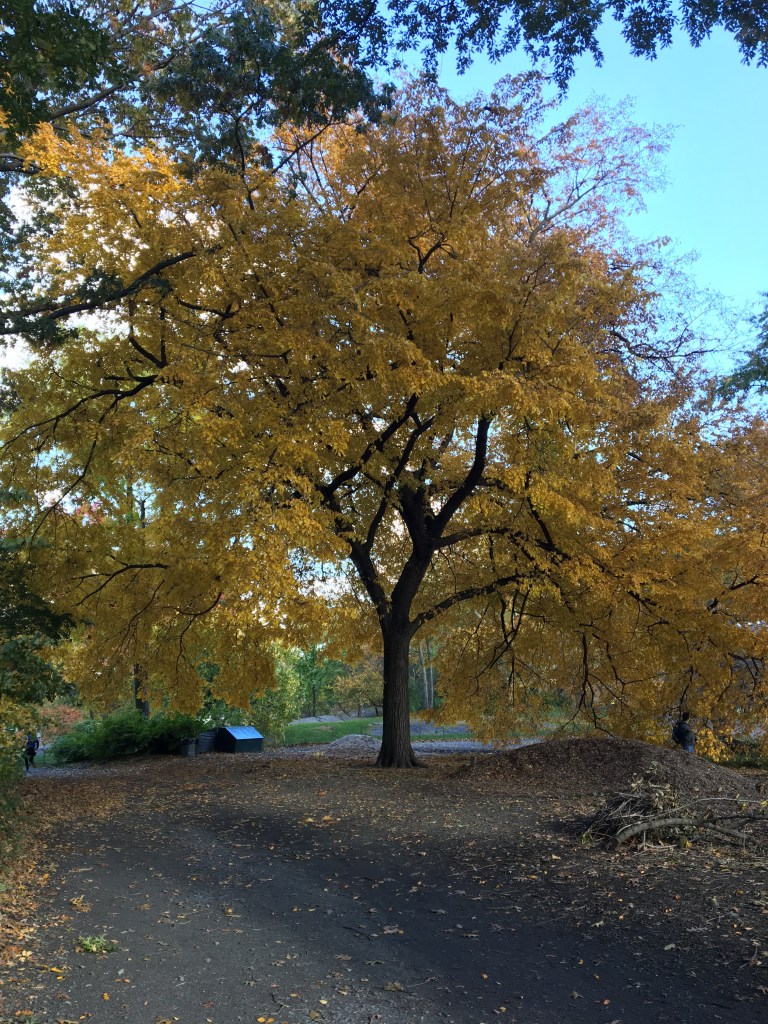
Almost every day, I walk in Central Park.  There are certain trees there I’ve come to know: the gnarled cherry trees by the reservoir, the bending willows and tall bald cypress by the pond, the sycamores that drop their bark each summer, the hawthorn not far from Central Park West.  Lately I’ve been taking photos of the trees to try to capture their essence, their posture in the world.  The trees around me feel like friends, which is what an ancient midrash (interpretation/legend) called Genesis Rabbah says about trees: that they are friends to humankind.  To me, they’ve always been a central manifestation of Mother Earth.

Currently, the national parks in the United States have no staff because of the government shutdown. Some people have taken the opportunity to cut down the rare and endangered Joshua trees in the Joshua Tree National Park—just for fun, I guess, or as a trophy of some kind.  Meanwhile, President Bolsonaro of Brazil recently has indicted that he wants to remove protection for the rainforest, in order to allow development.  It appears that my friends the trees have enemies.  Sometimes the enmity is for personal/corporate gain, and sometimes the enmity seems to have no reason at all.

Continue reading “From the Archives: Tree of Life: The Festival of the Trees in an Age of Treefall by Jill Hammer”

The US Election Results and Justice: What Will You Do? A Jewish Feminist Perspective by Ivy Helman

I met with a new friend/colleague of mine this past week.  We were discussing the election results, and I was discussing the work I do in the field of religion.  Living and teaching in Central Europe, I have quite a lot of experience navigating the study of religion in a place that is quite atheist and/or actually anti-religion.  In fact, it has been somewhat of a struggle to have the study program, Gender Studies, in which I teach, recognize its importance.  Many of my colleagues, I think, are under the impression that religion is personally not important and/or just not that important in general.  Yet, as I have mentioned here, and as my new friend brought up as we sat over coffee, religion underpins so many aspects of our patriarchal society.  

Continue reading “The US Election Results and Justice: What Will You Do? A Jewish Feminist Perspective by Ivy Helman”

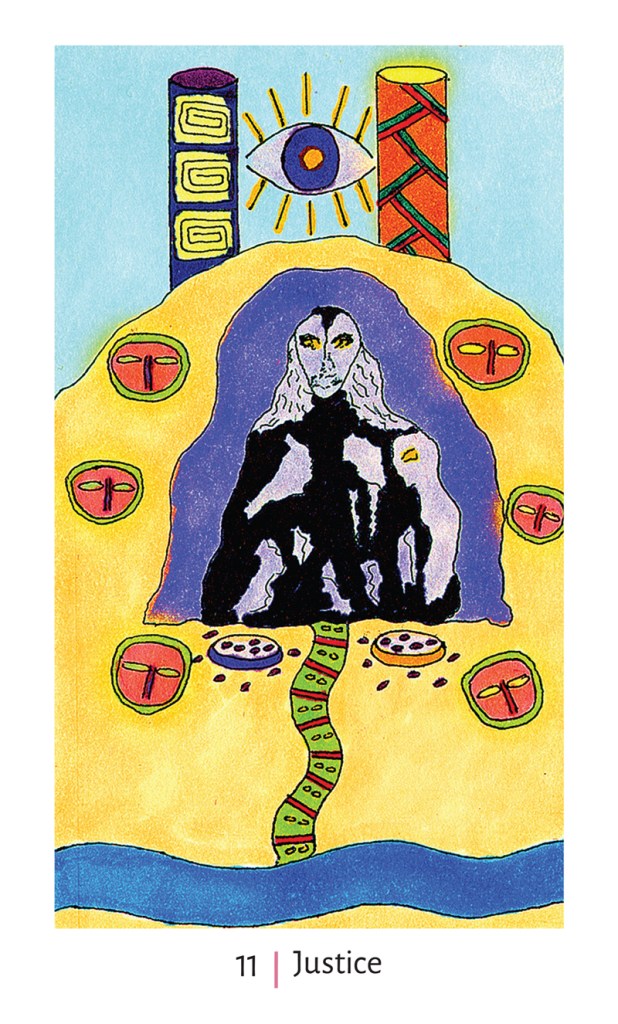
Embracing the Shadow Woman of Justice in Dark Times by Carolyn A. Cushing

Justice/Shadow Woman by Rachel Pollack. From the forthcoming The Shining Tribe Tarot: Definitive Edition

Prayer to Justice  

Justice, we call you into the center of our hearts, our minds, our spirits. 

May the fire of your being inspire us to believe your beauty can shine forth in our world.

May the flow of your being purify and release us from wounds that come from the places where You are violated.

May the breath of your being pass through us and form on the lips of all words of wisdom.

May the endurance of your being aid us to persist in serving You.

May we hear your truth. May we know your balance. May we gather your wisdom.

Justice, guide us.

Justice seems so far away, obscured by terror, purposely ignored in these days of war and season of darkness. How can we invite Her back? What will bring Her renewal? 

Continue reading “Embracing the Shadow Woman of Justice in Dark Times by Carolyn A. Cushing”

War, War and More War – Can Goddess Wisdom Offer a Path to Peace? by Judith Shaw

Branwen, Celtic Goddess painting my Judith Shaw

I was on my way home from a wonderful morning spent with my son when I heard the news of the horrific attack by Hamas on Israeli citizens. We had risen early to witness the mass ascension of balloons at the Albuquerque Balloon Fiesta, joining tens of thousands of people from around the world. For 10 days, a diverse crowd gathers on a vast field, experiencing childlike wonder as they watch brightly colored balloons ascend into the early morning sky. It was a joyful morning.

But then, after all that wonder, the car radio delivered the shocking news of the Hamas attack. My joy was shattered. 

Continue reading “War, War and More War – Can Goddess Wisdom Offer a Path to Peace? by Judith Shaw”

Lilith: Evil Demon or Feminist Role Model?

Today, we celebrate Simchat Torah (the Joy of the Torah) which marks the end of a cycle of Torah readings and the beginning of a new one.  Therefore, the Torah portion for October 14, 2023 is Bereshit (Genesis 1:1-6:8), the first parshah of the Torah.  This parshah is most known for its myths surrounding the beginning of the world, including, within it, two creation stories, the first one running from 1:1 to 2:3 and the second from 2:4 to 2:25.  These accounts of creation are followed by a story about Adam, Eve, a snake, and the Tree of the Knowledge of Good and Evil.  The parshah concludes with the happenings of Cain and Abel, the descendants of Adam and Eve, and Noah, a man who found divine favor.

I wrote briefly about this parshah in the midst of the pandemic.  The writing there mirrors the chaotic and often difficult nature of that time.  Thus, I want to revisit the parshah now.  Interestly, I am drawn to comment on the same topic: Lilith. 

Continue reading “Lilith: Evil Demon or Feminist Role Model?”