


It is often said that every year when you read the same Torah passages, you are in a different place, spiritually and otherwise. Therefore, one will always be learning new meanings and discovering new insights from them. No more is that true than in this week’s Torah parshah Tazria-Metzora.
Tazria-Metzora (Leviticus 12:1- 15:33) is a double parshah containing a list of rules concerning ritual purity and impurity, mostly having to do with leprosy. The parshah begins with the requirement for women a certain number of days after childbirth to immerse in a mikvah as well as offer animals for sacrifice at the temple. Then, it commands the circumcision of a boy child at 8 days of age. The next three chapters discuss an extensive list of what has to be all possible encounters with leprosy, including the infection of a home itself. The parshah prescribes various interactions between lepers, homes with leprosy, and the kohenim. Mostly, the kohenim decide if the skin lesions people or houses have are leprosy, another skin disease or harmless. If diseased or if the lesions are inconclusive, the people and houses enter quarantine. The kohenim also consult on whether a leper or house is healed and how to go about atonement. For atonement, former lepers immerse in the mikvah and pay for the kohenim to offer specific sacrifices at the temple. Homes also undergo a type of ritual purification by the kohenim when they have been healed of leprosy. This double parshah ends with immersion requirements for emissions of semen and menstrual blood.
Historically, there are two considerations, which I have discussed in other posts, to address first. To begin with, there is the ancient world’s understanding of disease as punishment for sin. This sin can either be the sin of the diseased person or punishment from generations past. For more about how this cycle of sin, punishment, repentance and atonement work as well as my thoughts on it, see here.
Continue reading “On Tazria-Metzora and Covid: Saving Lives, Saving Worlds, and Saving the World by Ivy Helman”
 The insurrection in the Capitol on January 6 has dominated the news ever since. Coverage of the Democrats’ victories in the two Senate runoffs in Georgia has been virtually nil. Now that it seems that at least as long as the National Guard is deployed to defend the national and state capitols, the insurrectionists have been stopped, it is time to thank Raphael Warnock and Jon Ossoff–and most of all to Stacey Abrams–for returning control of the Senate to the Democrats.
 As we careen toward ever more terrifying surges in the Covid pandemic, with experts predicting
  We have nine justices usually but one of our most beloved, and notorious,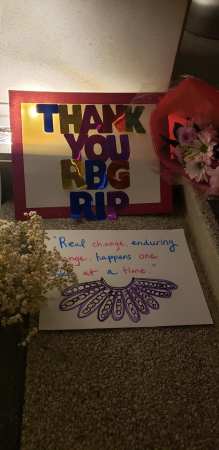


 How to come to terms with the most maligned or vulnerable aspect of ourselves—whether it be race, ethnicity, religion, gender, sexuality, physical ability, or any other trait—remains among the most pressing questions of our time. Should we try to “pass,” identifying with the oppressor and denying or rejecting who we are? Should we assume a militant, defiant stance, wreaking vengeance on those who have harmed us? Or can we find a way to embrace and affirm ourselves, neither denying nor reifying the pain of our individual and collective pasts? Can we love those who have harmed us?
 This month more than most, I feel like I have so much to say that I don’t really know where to begin. It doesn’t help that next door they are remodelling
 I’ve been thinking a lot about something my grandmother would always tell me: “When life hands you lemons, sometimes you have to make applesauce.” I know, it sounds crazy, but life right now appears to be more on the crazy than the sane side.
 A lof of people have been raving about the Superbowl Halftime show, and for good reasons.
 Feminism and Religion