

In prisons in Canada and around the world, a large percentage of criminalized people, who are more often than not, victimized people, Indigenous people make up significant percentages. In a recent *talk I gave, accompanying Indigenous Elder and Artist Philip Cote, we addressed what happens when colonial narratives and patriarchal narratives collide. The result is that our worldviews are shattered. When our worldviews, which are our foundational way of meaning-making, are dismissed, denied, and in the case of
cultural genocide: decimated, our heart health fails. Our bodies, our minds, our souls become disconnected become dissociated. Become imprisoned. Imprisoned in the figurative sense and eventually over time, in the literal sense.
Category: Justice
Radical Joy by Beth Bartlett

On Christmas mornings my brother, sister, and I had to wait patiently upstairs until we heard the music playing. Then, at last, the trumpets and voices singing “Joy to the world!” beckoned us down to the living room, with presents piled high under the brightly lit Christmas tree and stockings filled to the brim hung by the roaring fire. As a child, I experienced Christmas as a most magical and wonderful time of year, but it wasn’t just about getting presents. Strangers greeted each other with good cheer, wishing each other a “Merry Christmas.” Children visited the homes of the elderly and housebound, brought them cookies and sang carols. People were different – kinder, friendlier, more open-hearted, more forgiving. These are the true gifts invoked by the Christmas season, and I often wondered why we couldn’t continue these all year. I still do.
Continue reading “Radical Joy by Beth Bartlett”Legacy of Carol P. Christ: It’s Time to Thank Stacey Abrams Again
This was originally posted on January 18, 2021
The insurrection in the Capitol on January 6 has dominated the news ever since. Coverage of the Democrats’ victories in the two Senate runoffs in Georgia has been virtually nil. Now that it seems that at least as long as the National Guard is deployed to defend the national and state capitols, the insurrectionists have been stopped, it is time to thank Raphael Warnock and Jon Ossoff–and most of all to Stacey Abrams–for returning control of the Senate to the Democrats.
As is well-known to most readers of FAR, Stacey Abrams narrowly lost the election for Governor of Georgia in 2018 due to voter suppression.
Continue reading “Legacy of Carol P. Christ: It’s Time to Thank Stacey Abrams Again”Revisiting Our Sisters’ Feminisms by Xochitl Alvizo
This post draws much from a previous post I wrote back in 2013, which generated great discussion in the comments. I came back to it as I was reflecting on our sisters’ revolution in Iran, Women, Life, Freedom, following the death of Mahsa “Zina” Amini while she was in the custody of the “morality police” in Iran. This woman-led movement has been nonstop for seven weeks. I’m in full support of the women and have continued to learn more about their context and history. The movement is powerful and inspiring, heavy and difficult, but its energy is alive and blazing. There is an impromptu song that has come to represent the movement; the song was created by linking real-time tweets and Instagram posts together – you can hear the song, read the lyrics, and see the screenshots in the video below:
Now the post I’m drawing back to from 2013 – a little different from the original – but one intended to invite us to reflect on our engagement with and support of one another across place and difference. And about the relationship between the local and global, and the need to hold a balance of both.
Continue reading “Revisiting Our Sisters’ Feminisms by Xochitl Alvizo”From the Archives: I Believe Anita! by Marie Cartier
This was originally posted on April 7, 2014
During the past week I attended a Los Angeles premiere of a new documentary Anita: Speaking Truth to Power (Dir: Freida Lee Mock USA, 2013). The screening was sold out and I had great seats saved for me– sitting with a friend who works at Samuel Goldwyn, the distributor of this fine film.
In 1991, Anita Hill provided testimony she hoped would serve to dissemble the nomination of Clarence Thomas as a Supreme Court justice. Although the vote would end up being close (52-48) Hill’s testimony did not serve to dissuade the decision — Clarence Thomas’ nomination was confirmed and he was appointed to a life term on the Supreme Court four days after Hill’s testimony concluded. Here is an outline of the debate.

I remember watching the hearings in 1991 at a friend’s house in Sacramento, CA where I was couch-surfing with another friend while we were in Sacramento from Los Angeles to protest for gay rights—to speak our truth to power. I remember being amazed that she was doing this—and that it was being televised. We were glued to the set before we went off to the protest we were attending.
Continue reading “From the Archives: I Believe Anita! by Marie Cartier”From the Archives: The Story of Juneteenth by Kelly Brown Douglas
This was originally posted June 18, 2013
Tomorrow is a special day for me. It is Juneteenth. On June 19, 1865, news finally reached Galveston, Texas that slavery had been abolished. This was of course two and a half years after Lincoln issued the Emancipation Proclamation. While the actual impact of the emancipation for the enslaved remains a source of historical discussion if not debate, the fact of the matter is that the proclamation of emancipation and the reality of freedom for black women and men did not necessarily coincide. To be sure, for a variety of reasons, the Emancipation Proclamation did not have an immediate impact on the daily lives of enslaved women, men and children. While the “official” historical records marks January 1, 1863 as a day of emancipation, the historical record for the descendants of enslaved men and women marks June 19, 1865 as the day of freedom. For, it was on this day that the last slaves were free
.
Continue reading “From the Archives: The Story of Juneteenth by Kelly Brown Douglas”From the Archives: Preserving the Complete History: Remembering Japanese Internment Camps
This was originally posted on May 28, 2017

A couple of months ago I did a day trip to visit the historical site of one of the 10 internment camps which were formed due to Executive Order 9066 issued on February 19, 1942. Manzanar Relocation Camp is located between the Sierra Nevadas and the Owens Valley. Manzanar held over 11,070 Japanese Americans from 1942–1945. EO 9066 forced 120,000 American citizens to leave everything and become in all accounts prisoners; two-thirds of those were native-born American citizens. This executive order largely focused on people living on the West Coast of the United States to eliminate the possible threat of a secondary attack. They were relocated far inland and the majority of the camps were outside of the West Coast. While this was done in the 1940s, our current climate is looming to make it seem like there are forces in this world that are attempting to perform different forms of subjugation and confinement.
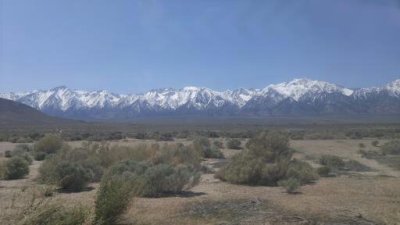

Manzanar, in the middle of nowhere California (and I mean nowhere—it takes over three hours to drive the more than 230 miles from Los Angeles and it is not directly accessible from Central California), is divided by the great Sierra Nevadas. This is one of the things that struck me when I arrived at Manzanar—the stark beauty and ruggedness of the mountains, the immense flat lines of the valley, and the complete isolation. Due to being so close to the Nevadas and the desert valley conditions, the weather can be extreme. Many of the detainees documented the harshness of the weather conditions, from the high winds to the stark cold at night, and the barely adequate buildings to shelter them from it.
Continue reading “From the Archives: Preserving the Complete History: Remembering Japanese Internment Camps”From the Archives: What Would Durga Do? by Barbara Ardinger
Moderator’s note: This marvelous FAR site has been running for 10 years and has had more than 3,600 posts in that time. There are so many treasures that have been posted in this decade that they tend to get lost in the archives. We have created this column so that we can all revisit some of these gems. Today’s blogpost was originally posted August 2, 2015. You can visit it here to see the original comments.

It’s one of my favorite T-shirts. Every time I wear it, people who know who Durga is comment. So do some people who don’t know who the Hindu goddess is.
“What would Durga do?” is of course an echo of the question What would Jesus Do?
I’ve just done a bit of research and learned that this phrase may come from the Middle Ages, that it was famously used in a sermon in about 1891, and that it became very popular among evangelical Christians during the 1990s. What would Jesus do? I think he’d remind us to pay closer attention to the Sermon on the Mount (Matthew 5, 6, 7), especially the Beatitudes and the Golden Rule: “So whatever you wish that others would do to you, do also to them” (Matt.: 7:12). The Golden Rule is of course given in the other major religions, too. WWJD has also been turned into WWBD—“What would Buddha do?” I think the Buddha would tell us to live more mindfully.
Continue reading “From the Archives: What Would Durga Do? by Barbara Ardinger”Women’s Bodies and Texas

I have been so angry about the Texas law that functionally bans abortion, I have not even been able to find the words to write about it. But alas . . . being angry without taking action is too often what we women do. So, I am forcing myself to focus and write this blogpost. I think the worst part of this law (although there are so many it is truly hard to choose), is how it isolates a vulnerable, pregnant woman. Can you imagine having an unwanted pregnancy and not being able to talk to anyone about it? This law puts a whole women’s support system into legal and financial jeopardy; a mother, sister, friend, doctor, staff at the doctor’s office, therapist, random neighbor and on and on. A woman’s only “legal” option is to talk to a crisis pregnancy center which comes with a hefty dose of political agenda. This is manipulation at this most virulent, cruel, and controlling.
Continue reading “Women’s Bodies and Texas”We Are Not Oppressed Because We Remember pt. 3: Sowing Seeds and Braiding Hair by Chasity Jones

Today, once again, I got to touch the earth!
While planting and constructing my indoor container garden, I thought about how my ancestors put seeds into their children’s hair so that in case they were taken away to live and die in chains, they would at least be able to sustain themselves with a piece of the motherland. Rice, okra, yams, watermelon, and so MANY more crops that would go on to make white slaveholding Americans so rich (passing their wealth to their descendants and zero reparations for the descendants of enslaved Africans), that they were willing to fight a war to sustain their evil practices of owning human beings as chattel (Check out High on the Hog Netflix documentary which was adapted from a book by Dr. Jessica B. Harris). Enslaved Africans brought these foods to the new world, a direct result of slavery.
As I wash my daughter’s hair (which for Black women and girls is a PROCESS!!), as I moisturize her hair, and as I braid my hair, I am thankful that no one has a right to my child and that I do not need to fear her enslavement. Instead, I manifest her revolutionary future to carry the torch of our ancestors. A Torch and a commitment to elevate our community and move the community forward. I leave it up to her to choose how she will carry that torch forward!
Continue reading “We Are Not Oppressed Because We Remember pt. 3: Sowing Seeds and Braiding Hair by Chasity Jones”
