“Island living has been a lens through which to examine my own life…I must keep my lens when I go back… I must remember to see with island eyes. The shells will remind me; they must be my island eyes.”
–Anne Morrow Lindbergh, Gift from the Sea
Each winter, we travel with our family to a small island in the Gulf Coast outside of Alabama and spend a month living on the beach. There is something about being on an island that quite literally transports you into another world. The sensation of stepping out, stepping off, and stepping into is palpable as we cross the bridge to the island  and settle into the slow, quiet rhythm of island life, guided by the tides, the moon, and the rising and setting of the sun. Our sleep and waking schedules change. Our priorities shift. Our to-do lists become very short. While we enjoy a creative, home-based life and business at home in Missouri, there is something incredibly freeing, and clarifying, about laying everything aside and having the biggest item on the schedule be a long walk on the beach (we walk from two to five hours each day). We actually bring our business along with us in a travel trailer, so we aren’t truly “off work” during this month, but instead of making everything as we go, we only sell the inventory we’ve already completed and brought with us, which leaves us with many extra hours a day compared to our work at home.
As I shed layers of myself at the beach, watching dolphins, running with my children, picking up shells, walking hand in hand with my husband into the setting sun, life feels simple, and what I need and want feels very clean and very  clear. My intense self-motivation and drive softens, my itch to get more done and to make more lists fades away, and I am left with the core of myself and discover, anew, how very much I like her.
This year, the morning after we arrived at the island, my husband and I headed to our favorite part of the beach where the beachcombing is the best and the shells are the biggest. We were stopped on the road at a little guard tower and told we could not continue. When we inquired why, the sour-faced man told us with the smirk that the beach was “gone” and it had been destroyed in a hurricane last fall. He clearly took delight in breaking the news to us and very much enjoyed the act of turning us away.
We returned to our beach house in a state of confusion and shock. Our long walks on the beach, our hopes for the new treasures we would discover, the part of the island we so love and have so many happy memories of, all swept away. We walked on a different part of the island feeling a genuine sense of distress and grief. How could the beach just be gone? Does the island now just abruptly drop away into the sea? We feel a sensation that something had died. As we walk, we decide that the “gift” in this disappointment is that we will  now explore and learn from different parts of the island than we are used to and that we can find new things to do and love while here, that we need to release our attachment to past visits and the ways things used to be and enjoy discovering what is right here, right now. But, then I say that I do not want to rush to “make it all better,” but instead I would like to just sit with and acknowledge the grief, and loss, and disappointment, rather than hurrying to turn everything into a lesson.
We walk in silence for a time and then realization dawns. There is no way the beach we long for can actually be “gone.” There is still a road visible headed in that direction and many dump trucks and earth-moving equipment driving back and forth. That part of the beach is damaged, we realize, but the facts we can see with our own eyes do not point to the total erasure of it as suggested by our power hungry little friend in his road blocking shed.
Back in the beach house we google to discover that yes, the beach sustained significant hurricane damage in the fall and restoration efforts are underway. The correct description from the guard should have been that the beach is “closed for restoration” and not “gone.” We continue to try to accept our “gift” of making new discoveries in the face of disappointment, but a few days later we decide to ask at the rental company if there is a way we can still go to the closed part of the island. They are able to give us a pass to enter it, and so, in fact, we are able to walk on our favorite part of the beach after all. The parking lot is damaged, but the beach itself is still very much there and very much alive.
This is a new gift, I muse. Rather than accepting our initial grief and disappointment, we tried again. Sometimes, you do not actually need to accept no for an answer, but you can push a little more and get what you want. What if we had just turned away in grim acceptance and “gone with the flow” instead of twisting a little harder and asking for what we want? I try to reconcile the two lessons—the letting go and the pushing, our refusal to let go. And then, a third lesson: not everything has to be a lesson, sometimes things just are.
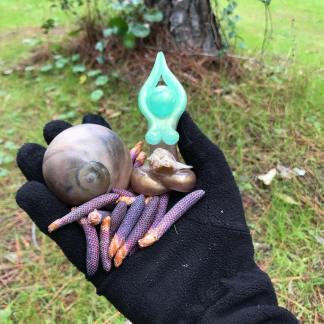
My favorite shell in the world is from a moon snail. Round, smooth, and beautiful, curling in a wave to a perfect tiny spiral in the center, with colors ranging from brown to pale blue, many of the moon shells we find are small, the size  of a quarter or smaller. My holy grail (holy snail) is a palm-sized moon shell that will fill my hand. In the morning as we walk on the previously forbidden part of the beach, I stop to take a photo of one of my goddesses on a piece of faded green driftwood. I am in that state of total presence that I experience often in our island walks, the complete immersion in the moment, stripped of all other purpose or task, but simply myself, walking on the beach. It is a type of what I call: “stepping through,” like I have stepped out of myself, out of reality, and into a different plane of relationship with the natural world. We find several fighting conch shells fairly close together and I say to my husband: “what we really need to do is find where the moon snails come up.” I turn away from the driftwood to continue walking and just as his foot begins to come down on the sand I see it…right below where his foot is poised to step, the distinctive curve of a huge moon snail shell, half-buried in the sand. I grab his arm and pull him back, making an indistinct babbling sort of squeal in my throat. I dig it up and there it is, a sun-bleached moon snail shell that exactly fills the palm of my hand. I laugh with joy and exhilaration and nearly cry in my delight. I tell my husband I feel as excited and happy and full of wild euphoria as if I’ve just given birth to another child. This is one of the best moments of my life! I crow, laughing semi-hysterically, this ranks right up there with the time we saw the otters at the river!
Then, realizing what I have said, I laugh some more. Is it sad, perhaps even pathetic, that some of the best moments of my life have been seeing wild otters and finding perfect shells? No, I decide, I adore being the kind of person who sees with island eyes and who discovers the best moments of her life simply by paying attention to what is happening on the shore.
Molly has been “gathering the women” to circle, sing, celebrate, and share since 2008. She plans and  facilitates women’s circles, seasonal retreats and rituals, mother-daughter circles, family ceremonies, and red tent circles in rural Missouri and teaches online courses in Red Tent facilitation and Practical Priestessing. She is a priestess who holds MSW, M.Div, and D.Min degrees and finished her dissertation about contemporary priestessing in the U.S. Molly and her husband Mark co-create Story Goddesses, original goddess sculptures, ceremony kits, and jewelry at Brigid’s Grove. Molly is the author of Womanrunes, Earthprayer, and The Red Tent Resource Kit and she writes about thealogy, nature, practical priestessing, and the goddess at Brigid’s Grove.


 to be remembered


 A ‘Nicho‘, is a three-dimensional or recessed area used to honor an important figure, saint, or loved one. Nichos originated as an adaptation of the Roman Catholic ‘
 I was in graduate school when I first read
  A few days ago, at the
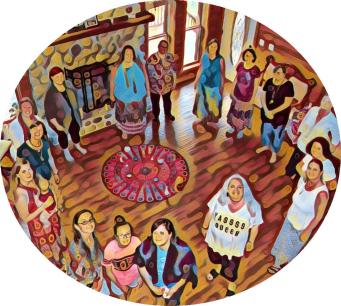 tapestries, their faces are turned towards me, waiting expectantly. We are here for our first overnight Red Tent Retreat, our women’s circle’s second only overnight ceremony in ten years. We are preparing to go on a pilgrimage. I tell them a synopsis version of Inanna’s descent into the underworld, her passage through seven gates and the requirement that at each gate she lie down something of herself, to give up or sacrifice something she holds dear, until she arrives naked and shaking in the depths of the underworld, with nothing left to offer, but her life.
 Feminism and Religion