

Whale, a bridge between the spirit world and the physical world, breathes air but dives deep into the sea, reminding us to embrace duality while seeking balance and our highest truth.
Continue reading “Whale – Lord of the Sea by Judith Shaw – Part 2”Category: Mother Earth
The Magic of the Labyrinth by Janet Maika’i Rudolph

Labyrinths are magical. I’ve always been drawn to them. About two years ago, a local Episcopalian Church rebuilt their beautiful outdoor labyrinth and opened it to the public. In concert with them, I have been delighted and honored to offer guided walks there. Doing these walks, both in leading them and in walking myself, have given me the opportunity to reflect deeply on what they mean from many perspectives: historical, personal, spiritual, philosophical, experiential.
When I walk a labyrinth, it feels like I am mirroring the universe while expanding my internal journey. Teresa of Avila agrees with me (or, more accurately, I with her). She wrote, “If we learn to love the earth, we will find labyrinths, gardens, fountains and precious jewels! A whole new world will open itself to us. We will discover what it means to be truly alive.”
Continue reading “The Magic of the Labyrinth by Janet Maika’i Rudolph”
The Callanais (Callanish) Stones and the Cailleach by Judith Shaw
I felt compelled to visit Scotland without truly understanding why. I said I was called by my studies of Celtic mythology and by images I had seen of the land. I told people in Scotland I was on an artist’s journey. But now I see that Mother Earth wanted my attention – and in Scotland, particularly in the Highlands, Earth energy is strongly present. From the start, a major part of that calling was the ancient Callanais Stones – pronounced like the English translation “Callanish” – located on the remote Isle of Lewis.
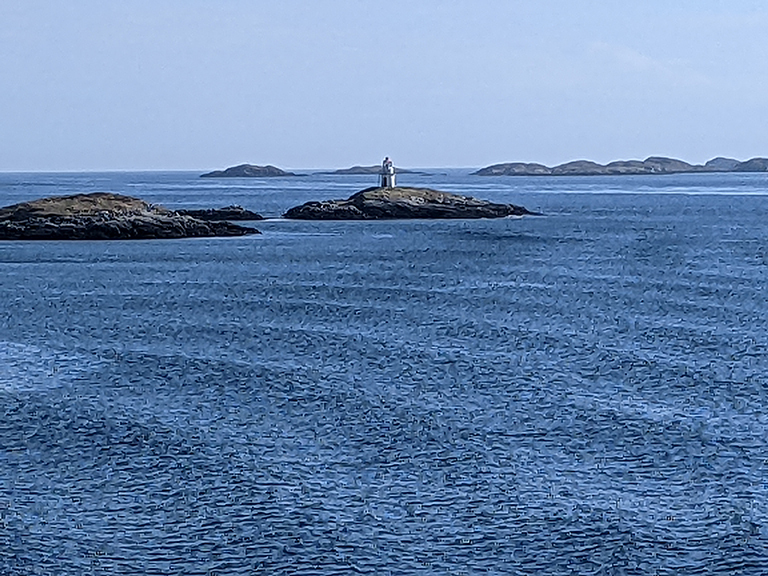
Getting around the Hebrides and the Highlands was difficult without a car as bus access is very limited. Though a little restricting, it kept me connected to Earth as I walked and I walked. With every step I felt the call of Earth – from even before the human family began.
It was a glorious sunny afternoon when I arrived by ferry on the Isle of Lewis/Harris. Next was a bus ride north to Stornoway, my base for exploring Callanais. Here I first learned of the Stones connection to the Cailleich, an ancient goddess whose origins are unknown. Her name literally means “the Veiled One” but has come to mean “Old Woman or Wife.” Yet she was all powerful and ageless.
An elder man spoke about Callanias and the Stones’ connection to the nearby mountain – “Cailleach na Mointeach” – Gaelic for “The Old Woman of the Moors” or affectionately called “Sleeping Beauty” as the mountain looks like a woman lying on her back with bent knees. He said you could see this mountain through the stones. His storytelling got me searching for more info on the Cailleach’s connection to the Stones.
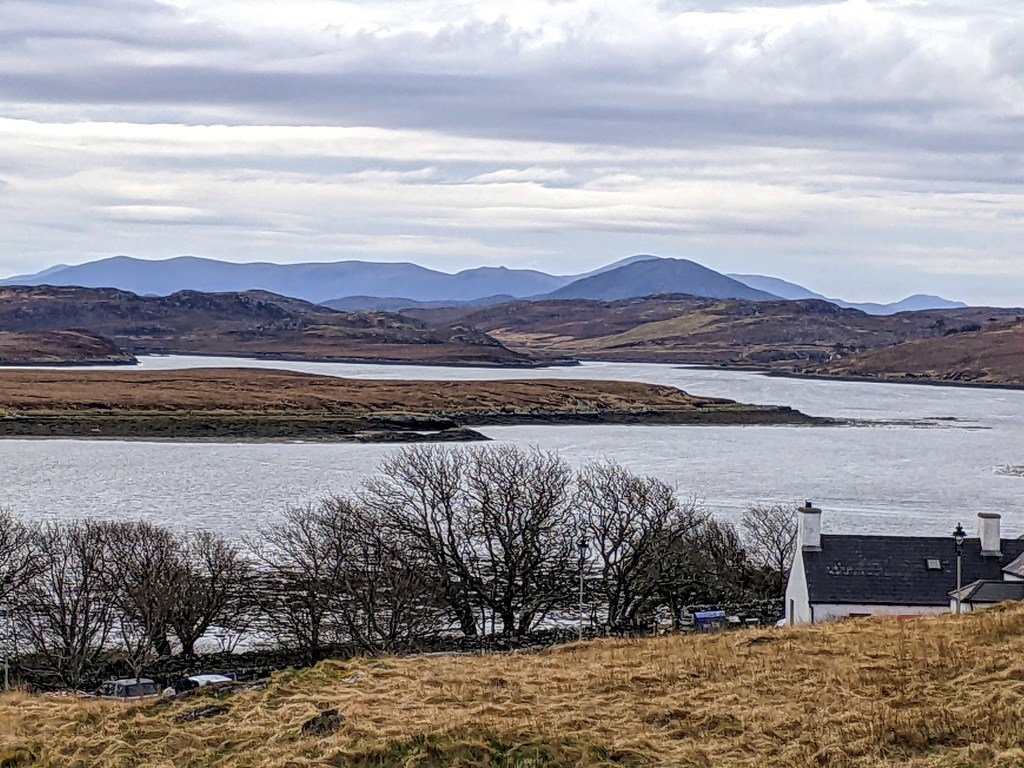
First, I learned of the extreme age of the islands and of the stones that make up the land. The Callanais Stones date back to 3500 BC but the rocks that created Scotland come from an inconceivable 3 billion years ago as the landmasses of Earth were created from out of the waters.
Around 450 million years ago, at the beginning of the Caledonian Orogeny, Scotland, Scandinavia and North America were one continent with the now, non-existent Iapetu Ocean separating them from England, which was joined with the rest of northern Europe. This was a long geological period of continental collision and mountain building, that turned Iapetu Ocean into land and fused Scotland and England together.
Quieter conditions occurred for several millennia, covering Scotland with layers of sediment forming various sedimentary rocks until 60 million years ago when Earth moved again and the continent split apart forming the North Atlantic Ocean with volcanoes erupting all along Scotland’s new western edge.
These are the creation stories the science of geology tells us. But our ancient ancestors told a different story of the creation of Scotland and the other Celtic lands. Long, long before the Celts arrived in Ireland and Scotland, the indigenous people worshipped The Cailleach, as both the goddess of creation and the goddess of destruction. She became Calleach Bheur to the Scots. “Bheur” means sharp and she was credited with creating the sharp and biting winter weather, which helped to shape Scotland.
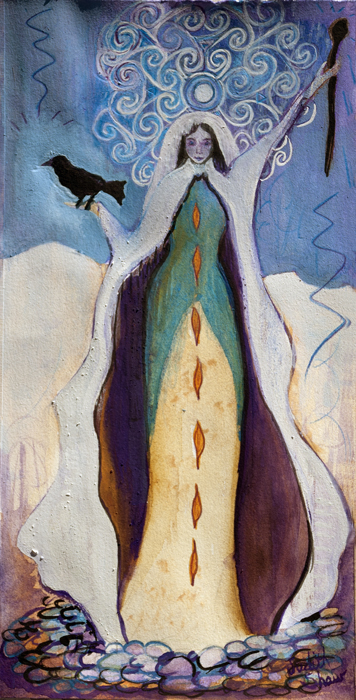
The Cailleach, a Dark Goddess of nature, is one with the land. Sometimes depicted with one eye, she sees beyond duality peering into the Oneness of all Being. She is the embodiment of winter, clothing the land with snow. Sacred Stones are her special places.
She leapt from mountaintop to mountaintop, dropping rocks to create hills, mountains and islands. She carried a slachdam – the Druidic rod, or a hammer with which she wielded power over the seasons and weather.
She is the guardian of the life force, finding and nourishing the seeds, commanding the power of life and death. The Cailleach personifies death and the transformative power of darkness, leading us through death to rebirth.
Our ancestors believed that the rocks on the Isle of Lewis used to create the Callanais Stone Circle were gifts from the Cailleach – from her acts of Earth building. These metamorphic gneiss rocks are among the oldest in Europe and are embedded with various types of crystal such as quartz, feldspar and hornblende. Perhaps these crystals in the ancient rocks create the energy field I felt so strongly on my visit – all coming from the hand of the Cailleach, a personification of the power of Mother Earth.
Archeologists theorize that the 5,000 year old Callanais Stones were a sacred site created for ritual and prayer, in particular from which to mark the 18.6 year lunar cycle – similar and yet more complicated than the yearly Sun cycle of Summer and Winter Solstices.
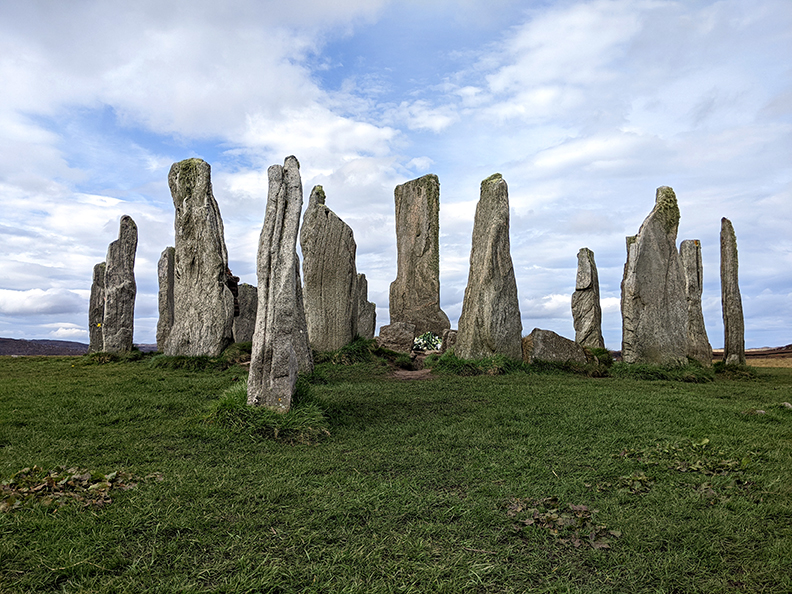
Every 18.6 years, this moon cycle reaches Major Lunar Standstill with the full moon nearest the Summer Solstice. It is viewed through the Callanais Stones rising out of Cailleach na Mointeach – our Earth Mother. Being so far north it only skims the horizon then appears to set among the stones.
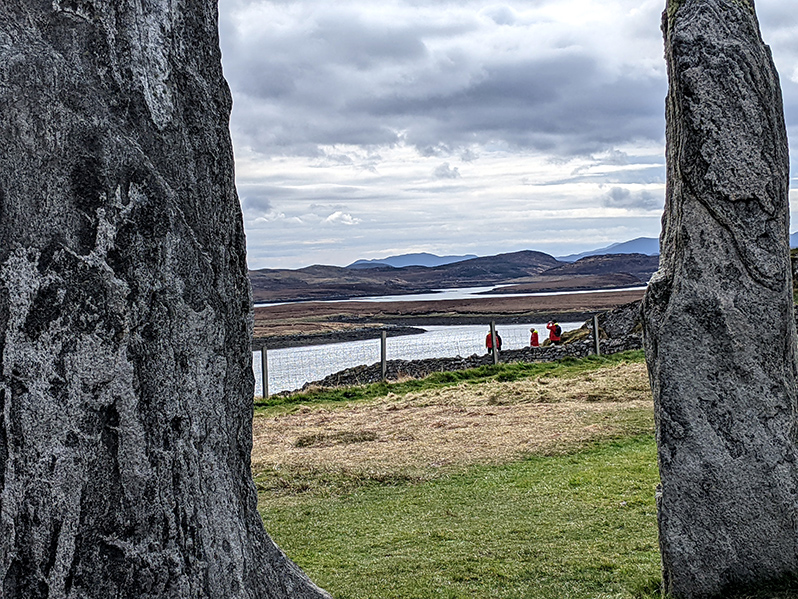
It is hard for our modern minds to understand the awe these ancient people must have felt at the beauty and terror of nature during the Megalithic Era – when the human family was first beginning to settle in one place though had not yet discovered agriculture.
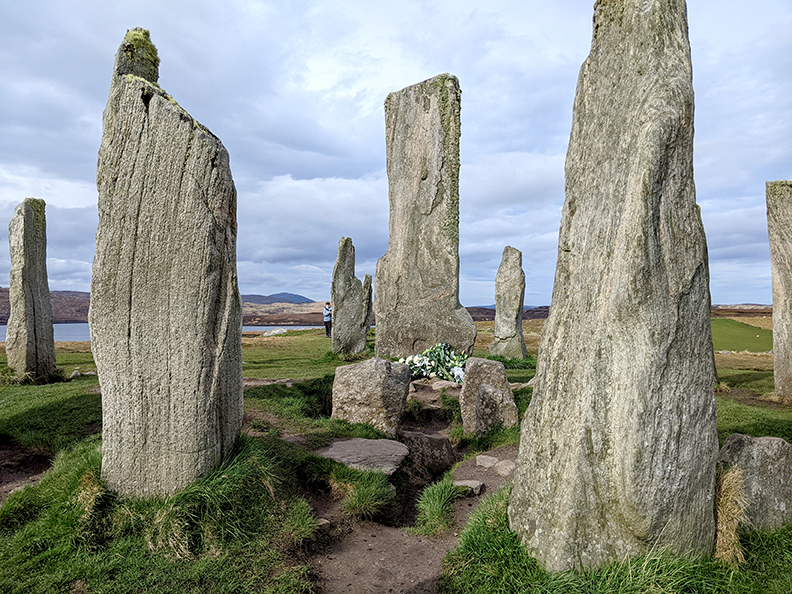
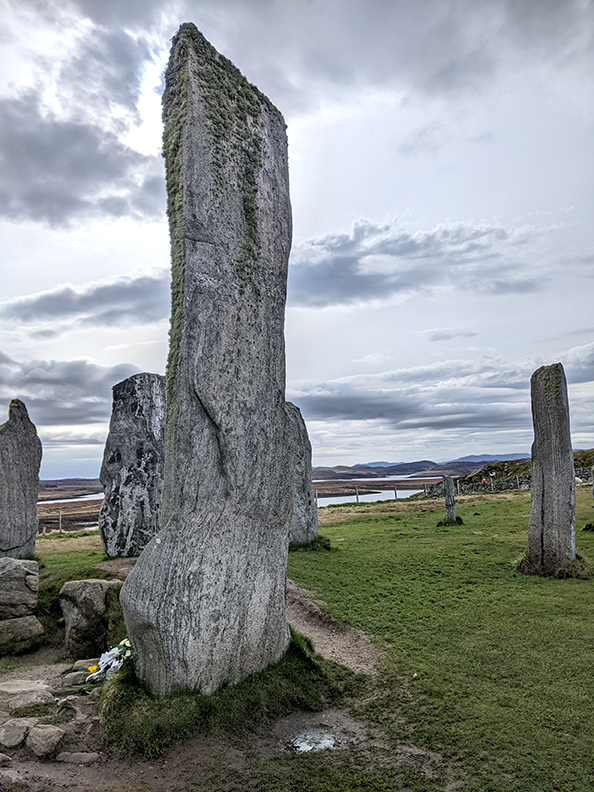
Perhaps the ceremonies held at Callanais helped hold the terror at bay. Closing my eyes I can imagine being there on this short night, near mid-summer, for the ritual marking of the passing of winter – I and my tribe had survived the season of long, dark nights. This was the special time that our tribal shaman knew how to mark. We all understood the precariousness of life and that marking the circuits of Earth and Sky provided invaluable knowledge for our survival. I can imagine feeling immense gratitude witnessing the cycles of life unfold as Earth and Sky and human minds interacted and the full moon rose out of our Earth Mother – Cailleach na Mointeach – and then set within the Sacred Stone Circle.
Further illustrating Callanais’ connection to Goddess, its original construction was comprised of 13 stones arranged in a circle – both number and shape are symbols of Moon and Goddess. At some point an even-armed cross was added around the perimeter – symbolic of the sun and of the meeting place of the divine and the mundane.
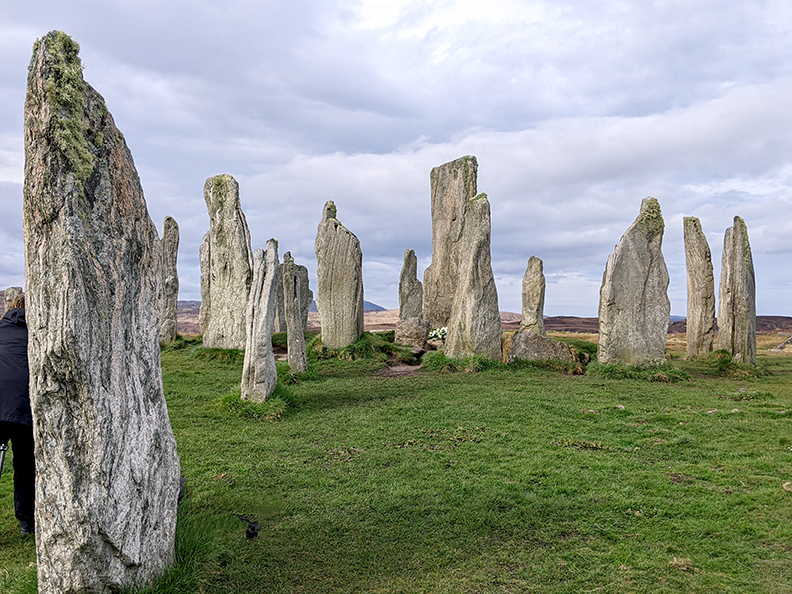
It seems unlikely that such a magnificent structure was created for use only once every 18.6 years. Of course these people left no written account of their actions, but local legend and lore suggests the Callanais Stones were seen as a fertility power spot. Given the Stones connection to Moon and Goddess that is not surprising. An old legend claims that Callanais is a promising spot to consummate a marriage or become engaged. In fact I overheard a couple of visitors while I was there claiming to have become engaged at Callanais.
But what does a site like the Callanais Stones hold for us today? Can Mother Earth still speak to us there?
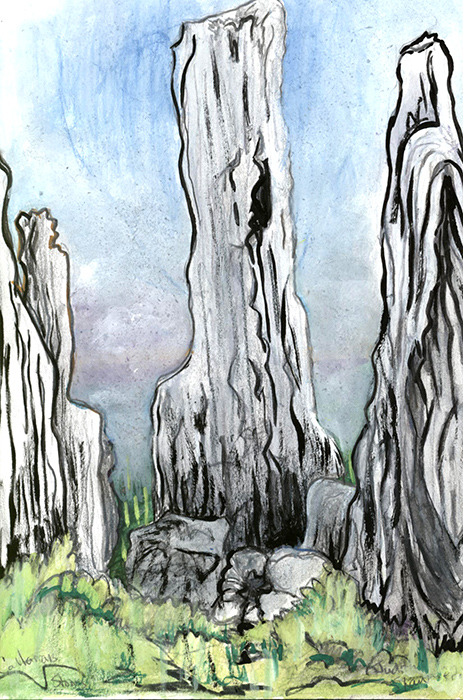
After a bit of a wander through and around the Stones, I sat and sketched. Slowly through that act of eye to hand to pencil to paper I began to feel the deep connection that always comes in when I attempt to translate 3D reality onto a 2D piece of paper.
Time passed and soon the only return bus would arrive so I stopped and just sat quietly, listening to the wind and feeling the energy. I felt strongly a sacred presence in this spot where long, long ago ceremonies for Goddess had been held. I heard the Cailleach’s calling – to an acceptance of our modern world and the difficult days of transformation the 21st century offers up. The winds carried her message – a glimmer of hope that we can find our way back to living in balance with her natural rhythms of creation, destruction and creation. I felt her reassurance that though the geography of Earth changes and the epochs of humankind and the flesh and bones of all creatures pass away, the magnificence of life continues. The Cailleach touched my heart there at her Sacred Stone circle, reminding me that, though pain and suffering has been and will always be with us, life is a gift to be cherished.
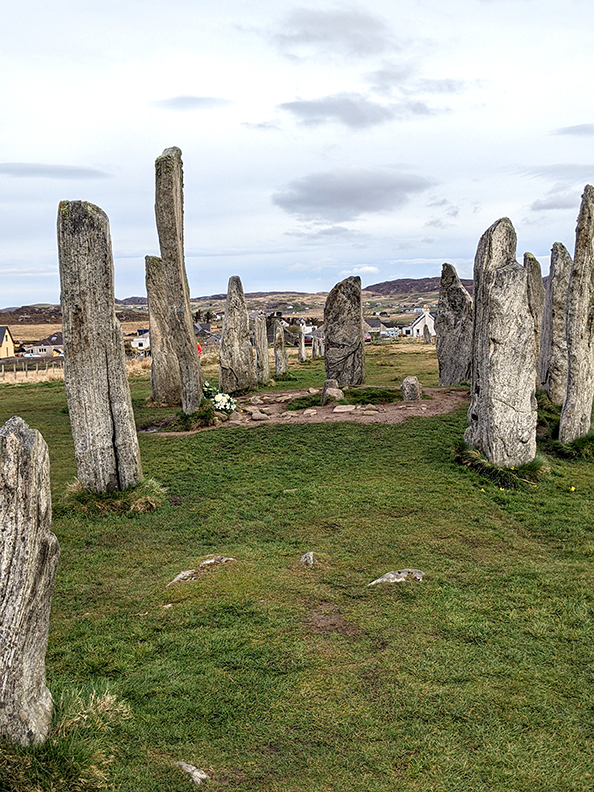
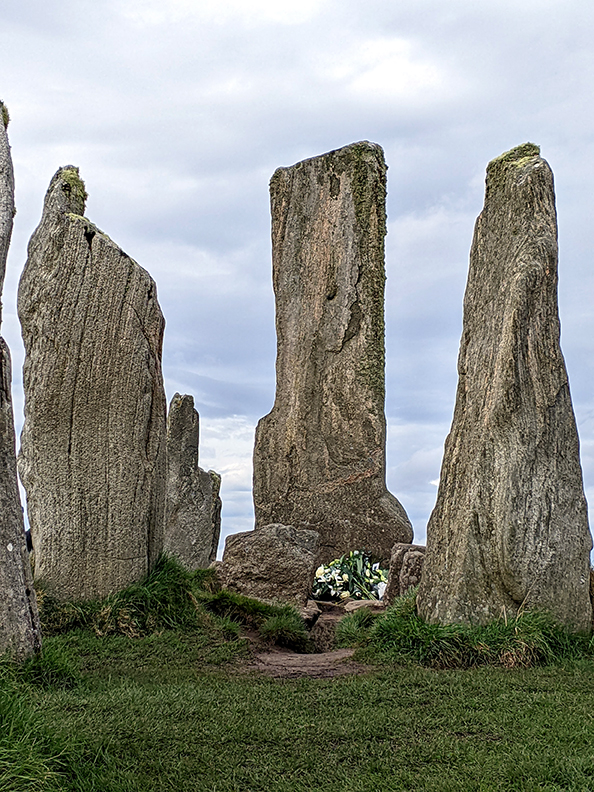
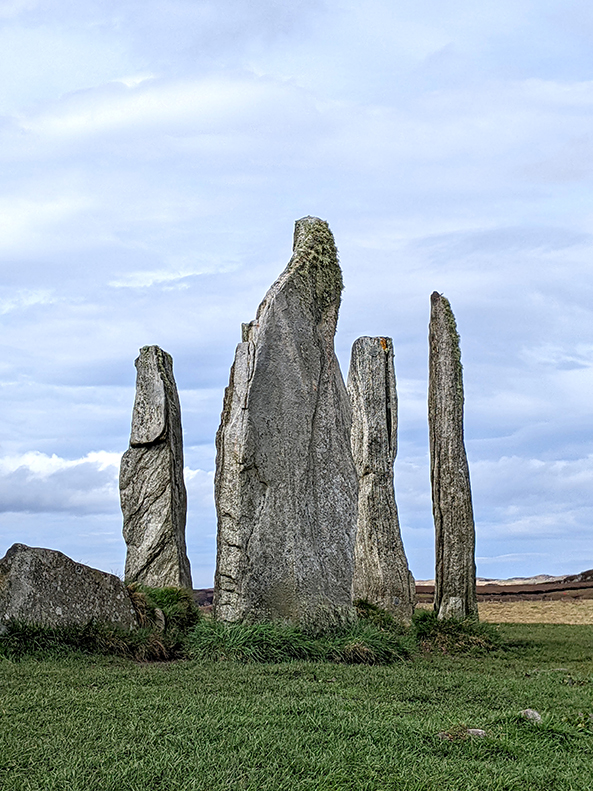
Here are a few more photos of the Callanais Stones
Judith’s Celtic Goddess Oracle & Animal Wisdom Oracle decks are available here.
Post Script – If you are interested in learning more about the 18.6 year moon cycle be sure to read “Moon Teachings for the Masses” by Dr. Judith S. Young.
Sources: Moon Teachings for the Masses, Callanish, Isle of Lewis, Eye of the Psychic, Edinburgh Geological Society,
Judith Shaw, a graduate of the San Francisco Art Institute, has been interested in myth, culture and mystical studies all her life. Not long after graduating from SFAI, while living in Greece, Judith began exploring the Goddess in her art. She continues to be inspired by the Goddess in all of Her manifestations. Originally from New Orleans, Judith makes her home in New Mexico where she paints as much as time allows and sells real estate part-time. Give yourself the gift of one of Judith’s prints or paintings.
Legacy of Carol P. Christ: What Does Mother’s Day Mean in a Patriarchal and Matricidal Culture?
This was originally posted on May 9, 2016
When we seek immortality or spiritual “rebirth,” are we not saying that there is something wrong with the “birth” that was given to us through the body of our mothers? In She Who Changes and in “Reading Plato’s Allegory of the Cave as Matricide and Theacide,” I asserted that our culture is “matricidal” because it is based on the assumption that life in the body in this world “just isn’t good enough.”
What is so wrong with the life that our mothers gave us that we must reject it in the name of a “higher” spiritual life? The answer of course death.
Can we love life without accepting death?
Can we love our mothers if we do not accept a life that ends in death?
Jesus was said to have encouraged his disciples to leave their wives and families in order to follow him. When he was told that his mother and brothers were outside and waiting to speak to him, he is said to have said:
Continue reading “Legacy of Carol P. Christ: What Does Mother’s Day Mean in a Patriarchal and Matricidal Culture?”“Who is my mother, and who are my brothers?” And stretching out his hand toward his disciples, he said, “Here are my mother and my brothers! For whoever does the will of my Father in heaven is my brother, and sister, and mother. (Matt. 12:48-50)
From the Archives: A Tiny Life by Barbara Ardinger
When I first wrote this post in 2014, I said the news was getting me down. A terrorist gang in Nigeria had kidnapped, raped, and “married” two hundred schoolgirls. Kids were even then taking guns to school. What’s better as I rewrite this in March 2022? Not much. The pandemic and idiots still refusing to be vaccinated. Putin’s invasion of a former soviet satellite country. (I think Putin thinks he’s the tsar and wants to rebuilt “his” empire.) Road rage, hate crimes, kids still taking guns to school. I think we can all agree that the news is still awful. The following is what I wrote in 2014.
A couple Saturdays ago, I heard an enormous noise of cawing and shrieking and wings flapping outside my window. It went on for several minutes, so I finally set my book aside (I was trying to ignore Eyewitless News), got up, and looked out into the courtyard. Two huge, noisy crows were chasing a smaller bird. I think it might have been a scrub jay. I have no idea what the jay’s crime had been in the crows’ eyes, but they were chasing it back and forth and up and down until one of them finally speared it with its beak. The jay fell. The crows landed on the roof of the building across the courtyard and strutted back and forth for several minutes. One of them went down for a closer look at the fallen jay. Then they flew away.
Continue reading “From the Archives: A Tiny Life by Barbara Ardinger”The Darkness by Annelinde Metzner

As a composer and poet, I’m interested in cultural perceptions and assumptions that influence beliefs. In monotheistic religions as well in some types of more recent spiritual thought, the assumption has been to equate Darkness with evil and Light with good. “Love and light!” we hear often, or maybe “I’m surrounding you in light.” But this assumption feeds a form of prejudice that infuses all of society. The mind hears “darkness” and associates it negatively with Earth, female, skin color, dirt.
Continue reading “The Darkness by Annelinde Metzner”Carol P. Christ’s Legacy: Women And Weeding, The First 10,000 Years* by Carol P. Christ
Moderator’s Note: We here at FAR have been so fortunate to work along side Carol Christ for many years. She died from cancer in July, 2021. Her work continues through her non-profit foundation, the Ariadne Institute for the Study of Myth and Ritual and the Goddess Pilgrimage to Crete. To honor her legacy, as well as allow as many people as possible to read her thought-provoking and important blogs, we are pleased to offer this new column to highlight her work. We will be picking out special blogs for reposting. This blog was originally posted February 10, 2014. You can read it long with its original comments here.
Mary, Mary, quite contrary, how does your garden grow? With silver bells and cockle shells, and pretty little maids all in a row.
From the beginning of horticulture about 8000 BCE or earlier to the present day, weeding has been women’s work. Women, who were the gatherers and preparers of food in traditional nomadic societies, no doubt were the first to discover that seeds dropped at a campsite one year sometimes sprung up as plants the next year. When this discovery was systematized, agriculture was invented, and human beings began to settle down in the first villages and towns.
Continue reading “Carol P. Christ’s Legacy: Women And Weeding, The First 10,000 Years* by Carol P. Christ”Winter Stories by Sara Wright
Every November I begin to create stories inside. Except for going into the woods to tip balsam and making wreaths I never know what else I might decide to do, but by the time I have finished I know what the images are saying! This is a poem about the stories I created this year. With the silence of winter soothing me I begin this kind of play without awareness and without a goal…I love this idea of story being told through image.

The Door by Sara Wright
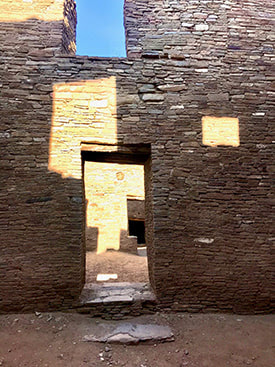
Doors
are thresholds that
if opened, become
Gates to the Unknown.
If invited in
for further instruction.
by kindly Spirits
we tread lightly,
always listening
Symbols and signs
Continue reading “The Door by Sara Wright”The Blessing of the Elders by Rachel Thomas
, elders are people who have illuminated my path, inspired me to see my own potential. To open my eyes, all my senses, even those I did not know I had. Elders show bravery and model for us how to be strong.
What is an Elder?
The word elder comes from an Old English word which also meant ancestor or chief. A lot can change in a thousand years and many of us no longer honor older people or seek out them out for advice.
In my experience, elders are people who have illuminated my path, inspired me to see my own potential. To open my eyes, all my senses, even those I did not know I had. Elders show bravery and model for us how to be strong.
My first wise woman teachings came from my family. My mother, and her mother, taught me to be myself, to love being outdoors and the importance of having a garden. Feeling the joy of flowers, cooking with fresh herbs, planting a tree to honor the dead. These are a few ancient traditions of my ancestors that have survived even in a modernized and urban setting.
Continue reading “The Blessing of the Elders by Rachel Thomas”As I rediscover my connection with the earth, my eco-consciousness inspires me to transform. As I go back to nature, I re-awaken my ancient cellular memories of living in harmony with the earth. I feel called to dance barefoot, play drums, make offerings, bathe in moonlight, harvest with my own hands. As I move forward on a path which is both new and old, it is my beloved elders who have shown me how to find my way.
What is an Elder?
The word elder comes from an Old English word which also meant ancestor or chief. A lot can change in a thousand years and many of us no longer honor older people or seek out them out for advice.
In my experience, elders are people who have illuminated my path, inspired me to see my own potential. To open my eyes, all my senses, even those I did not know I had. Elders show bravery and model for us how to be strong.
My first wise woman teachings came from my family. My mother, and her mother, taught me to be myself, to love being outdoors and the importance of having a garden. Feeling the joy of flowers, cooking with fresh herbs, planting a tree to honor the dead. These are a few ancient traditions of my ancestors that have survived even in a modernized and urban setting.
Continue reading “The Blessing of the Elders by Rachel Thomas”
