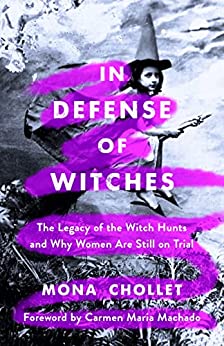
In this article I reframe my understanding of feminism through the lens of Mona Chollet’s In Defence of Witches, and reflect on how my psyche as a woman today is still deeply influenced by the effects of the witch hunts in mediaeval times.
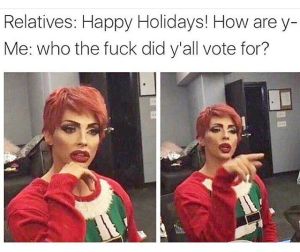
Sitting around the tree watching the kids open presents. Attempting to enjoy a holiday meal with extended and immediate family that you may or may not have traveled thousands of miles to see. Trying with every fiber of your being to not talk about the elephant, or red hat, in the room.
I get it. It is hard to not go home for the holidays. It’s also hard to sit at home and watch every one of your friends post online about their dinners, get-togethers, and other joyous events while you sit at home. I also understand that many of us, as a result of our sexual and/or gender identity, or maybe our political preference, don’t feel comfortable going home or, can’t go home. This is not ok and that is why it is so important that we all have our chosen families to be with during these times of communal gathering or more importantly, ways to cope while we are at home in these uncomfortable situations to make sure we take care of ourselves and make it out the other end.
I am a great evangelist. I used to evangelize in Pentecostal settings until I was 22. Then, I left my church to evangelize about feminist issues to every woman that crossed my path. Rhetoric is a gift I received when I was a kid and that I inherited from my grandpa and my dad. But during the COVID lockdowns, it was hard to socialize, and my evangelization skills turned toward making my friends and family join the privileged fan base of Ru Paul’s Drag Race. One by one, I convinced my sister, cousins, neighbors, and best friends to watch the reality show, and they did with astonishing devotion. Every week, two or three of us gather in someone’s living room wearing masks to watch episode after episode after episode. Our debates about the queens in the show could last all night long. Who had the best performance? Did you like their lip-synching? “That elimination was so fair/unfair!”
Tomorrow is a special day for me. It is Juneteenth. On June 19, 1865, news finally reached Galveston, Texas that slavery had been abolished. This was of course two and a half years after Lincoln issued the Emancipation Proclamation. While the actual impact of the emancipation for the enslaved remains a source of historical discussion if not debate, the fact of the matter is that the proclamation of emancipation and the reality of freedom for black women and men did not necessarily coincide. To be sure, for a variety of reasons, the Emancipation Proclamation did not have an immediate impact on the daily lives of enslaved women, men and children. While the “official” historical records marks January 1, 1863 as a day of emancipation, the historical record for the descendants of enslaved men and women marks June 19, 1865 as the day of freedom. For, it was on this day that the last slaves were free
To be transparent, these last four weeks have unintentionally flown by and have been filled with great pain, sorrow, depression, loss, and grief to be honest. I can feel my own spirit at the beginning of a long healing process and have a feeling that these words kept between you and I will be a tremendous part of my healing. Healing in itself is an essential aspect of Womanism and how I found my way to it. I have been privileged to develop spiritual practices that encourage and assist with healing in emotional, physical, mental, and wisdom ways!
Today, I acknowledge the Africana Womanism (Clenora Hudson-Weems) characteristic of strength. I must admit I have a strained relationship with the word as a Black woman. I was raised by strong women to be strong in an environment in which we will always have to strong. As a result, being soft is interpreted as weak. I mourn that Black women rarely find spaces in which they can turn off their survival mode- fight or flight nervous system responses and relax while being soft. It is so foreign. At this point in my life softness is so inconvenient and also something that I don’t even know how to maintain consistently.
(Note: This post briefly references genocide and brothels.)
Every year we can, we go visit my amazing Korean parents in law, Halmeoni and Harabeoji (‘Grandmother’ and ‘Grandfather’). Now in their 80s, they consistently embody the kind of radical trust that I’m trying to build. Their lives tell like a movie script, one dramatic, heartbreaking story after another, interwoven with incredible courage, faithfulness, and generosity. Hunger and genocide, robbery and abandonment, occupation and persecution – and, unexpected, powerful sources of support and inspiration.
Against all odds, their journeys brought them together; then across the world to Germany, a haven to raise their children and minister to lonely Korean workers, far from kin and homeland. Then, uprooted again to chilly Alberta, to learn yet another language and culture, ecosystem and way.
Recently the variation of this sentiment that’s making the rounds is, “The hardest thing is showing up.”
While many people I respect have used this phrase at some time or other, I think it’s perhaps bandied about too much. It’s become an all purpose way of blaming ourselves when things aren’t going the right way–we’re told we just need to show up and things will get better. We will succeed. We might even end up running the world!
However, I’ve reached the point in my life where every easy, feel-good cliché needs to be unpacked and re-examined.
Don’t get me wrong.
I’m actually pretty good at showing up. It’s the path of least resistance, thus helping me avoid the guilt of not showing up. When I commit to something, I COMMIT! Without commitment, I wouldn’t have written eight novels. I wouldn’t have been married for 32 happy years and counting.
On February 1st, a successful military coup took place in South Asia. The national military of Myanmar arrested top non-military officials and seized all power. While this February coup happened in South Asia, it could have happened on our very shores. Myanmar’s successful military coup d’état took place almost a month after the unsuccessful January 6th attack on the US Capitol.
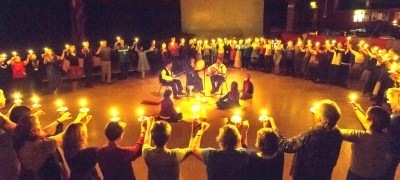
Armenian Candle Dance with Laura Shannon, Findhorn 2015 (photo: Hugo Klip)
When I first began researching traditional circle dances in the mid-1980s, I was amazed to find that the peoples who have suffered the worst of human experience – oppression, exile, genocide, war – also produce the most vibrant and joyful music and dance. Armenian, Jewish, Kurdish, and Romani (Gypsy) dances, in particular, were passionate affirmations of life, despite the horrors these peoples have gone through in their history. The dances seemed to hold clues to the mystery of moving on with life after trauma.
This was something I was desperate to learn how to do. Barely 20 at the time, I was struggling to keep my dignity and optimism while growing up female in a woman-hating world. The trauma of a violent rape on my 18th birthday had robbed me of my joy for life – but I could experience joy again in those dances.
Early on in my research and teaching, therefore, alongside the women’s dances which were always my main interest, I began to focus on the traditional dances of persecuted peoples, which I called Dances of Exile and Homecoming. These songs and dances seemed to have an inherently therapeutic potential, profoundly moving for people from any background and any culture.





 Feminism and Religion