The Life-Changing Magic of NOT Showing Up by Mary Sharratt

Feel motivated now?

“Showing up is 80 percent of life.” This oft-repeated maxim, attributed to the now disgraced Woody Allen, has become a modern cliché.

Recently the variation of this sentiment that’s making the rounds is, “The hardest thing is showing up.”

While many people I respect have used this phrase at some time or other, I think it’s perhaps bandied about too much. It’s become an all purpose way of blaming ourselves when things aren’t going the right way–we’re told we just need to show up and things will get better. We will succeed. We might even end up running the world!

However, I’ve reached the point in my life where every easy, feel-good cliché needs to be unpacked and re-examined.

Don’t get me wrong.

I’m actually pretty good at showing up. It’s the path of least resistance, thus helping me avoid the guilt of not showing up. When I commit to something, I COMMIT! Without commitment, I wouldn’t have written eight novels. I wouldn’t have been married for 32 happy years and counting.

Continue reading “The Life-Changing Magic of NOT Showing Up by Mary Sharratt”

Myanmar’s Dangerous Military Coup by Anjeanette LeBoeuf

On February 1st, a successful military coup took place in South Asia. The national military of Myanmar arrested top non-military officials and seized all power. While this February coup happened in South Asia, it could have happened on our very shores. Myanmar’s successful military coup d’état took place almost a month after the unsuccessful January 6th attack on the US Capitol.

Continue reading “Myanmar’s Dangerous Military Coup by Anjeanette LeBoeuf”

Dancing for Forgiveness and Reconciliation – Part One By Laura Shannon

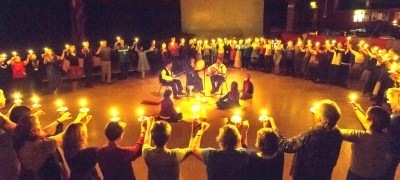
Armenian Candle Dance with Laura Shannon, Findhorn 2015 (photo: Hugo Klip)

When I first began researching traditional circle dances in the mid-1980s, I was amazed to find that the peoples who have suffered the worst of human experience – oppression, exile, genocide, war – also produce the most vibrant and joyful music and dance. Armenian, Jewish, Kurdish, and Romani (Gypsy) dances, in particular, were passionate affirmations of life, despite the horrors these peoples have gone through in their history. The dances seemed to hold clues to the mystery of moving on with life after trauma.
This was something I was desperate to learn how to do. Barely 20 at the time, I was struggling to keep my dignity and optimism while growing up female in a woman-hating world. The trauma of a violent rape on my 18th birthday had robbed me of my joy for life – but I could experience joy again in those dances.
Early on in my research and teaching, therefore, alongside the women’s dances which were always my main interest, I began to focus on the traditional dances of persecuted peoples, which I called Dances of Exile and Homecoming. These songs and dances seemed to have an inherently therapeutic potential, profoundly moving for people from any background and any culture.

Continue reading “Dancing for Forgiveness and Reconciliation – Part One By Laura Shannon”

From Military Wife to Peacebuilder – Learning from the Greenham Common Peace Women by Karen Leslie Hernandez


There’s a pinnacle moment, I believe, when everyone’s path is laid before them. The funny thing about that, is that we usually don’t see that moment, until many years later. It is then, at that sudden moment of clarity, in that epiphany, that it all comes together.

My former husband was in the United States Air Force and from 1990-1992, we were stationed at RAF Greenham Common, in the United Kingdom. When we first received our orders, not even ten minutes after, other service members started to inform us: “You’re going to where all those crazy ass bitches are.” “You’re gonna have to deal with those dike peaceniks.” “Wait until you get a load of those nasty, dirty women. They live at the base, camp out there, never shower, stop the convoys – they’re disgusting pigs.” Continue reading “From Military Wife to Peacebuilder – Learning from the Greenham Common Peace Women by Karen Leslie Hernandez”

I Hope “This Changes Everything” by Elise M. Edwards

elise-edwardsLast week, I attended a film festival in Waco, Texas that showed the 2019 documentary This Changes Everything. Spending Friday evening at a film festival seemed like an enjoyable and appropriate way to kick off a weekend that would culminate with the Academy Awards (the Oscars).  I had no idea that this film would inform the way I viewed the movie industry and its most celebrated awards show.  It did change everything for me.

This Changes Everything is about the representation of women in film, particularly their underrepresentation and misrepresentation on screen and in the film- and television-making process.  It is not the first time this theme has been explored in a documentary. What struck me at this viewing, though, was the way the film portrayed patterns that resonated with my experiences in academia and in religious communities.  There are parallels between the way sexism manifests in entertainment and  I, along with other members in the (predominantly female) audience, couldn’t help but see parallels in Hollywood’s patterns of exclusion and the discriminatory conditions we confront in numerous other industries and professions.  What were these patterns?

Continue reading “I Hope “This Changes Everything” by Elise M. Edwards”

Coming to Terms with Privilege: A Personal Reflection by Elise M. Edwards

elise-edwardsIn my two previous posts, I shared my recent experience talking about privilege at a church near me.  Today, I will wrap up this short series with a more personal reflection about privilege from a Christian perspective.  Last month, I was thinking theologically about what those of us who have privilege should do with it.  But, as feminists and womanists, acknowledging our privilege can be complicated.  Most of us in this FAR community do possess some forms of privilege while, at the same time, we lack other forms of privilege.  Each of us remains the same person wherever we go, yet our status can change when we switch contexts.  As a black woman, I do not have white privilege or male privilege.  But I am privileged when it comes to education and class and physical ability.  I am a Christian who works at a Christian university in a part of Texas that is culturally predominantly Christian. So that’s a form of privilege.  Although as a single woman without children, I don’t fit the cultural norm where I live, my sexual orientation and cis-gendered identity afford me some privilege, too.

Continue reading “Coming to Terms with Privilege: A Personal Reflection by Elise M. Edwards”

What Can We Do to Weaken Privilege? by Elise M. Edwards

elise-edwardsIn my previous post, I talked about discussing the concept of privilege (male privilege, white privilege, and class privilege) with nuance.  Earlier that week, I had led a workshop at a local church on “Fine-tuning Privilege,” using Peggy McIntosh’s 1989 essay “White Privilege: Unpacking the Invisible Knapsack” as a resource.  (If you are unfamiliar with it, take a few minutes to read it and reflect upon it.)  Part of my talk was about naming and understanding privilege.  Discussion and comprehension are not enough, though.  We must counter it.

One strategy for fighting privilege is making it visible. The recipients of privilege are often unaware that they have to systemic advantage over others. Privilege, used in the context of racism, sexism, heterosexism, classism, and religious dominance, is not something earned on merit alone. In the essay linked above, McIntosh describes it like this: “I have come to see white privilege as an invisible package of unearned assets which I can count on cashing in each day, but about which I was meant to remain oblivious.” These are conditions built into our culture that some groups receive which benefit them to the detriment of others. Making privilege visible means naming it and calling it out. Wage gaps, digital divides, and racial profiling practices exist; ignoring them perpetrates the problems.

Continue reading “What Can We Do to Weaken Privilege? by Elise M. Edwards”

Talking about Privilege with Nuance by Elise M. Edwards

elise-edwardsYesterday evening, I led a seminar at a local church as part of their series on “Unpacking Privilege.” Once before, I’d been invited to this church, Lake Shore Baptist Church, to speak about intersectional feminism with one of my colleagues, so I expected them to be open-minded and welcoming.  They were.  Although the attendees were overwhelmingly white and older than me, they were attentive and engaged.  We had an enriching time together diving into topics like male privilege, white privilege, and class privilege with Peggy McIntosh’s 1989 essay “White Privilege: Unpacking the Invisible Knapsack” as a resource.  (If you are unfamiliar with it, I recommend taking a few minutes to read it and reflect.)

In the essay, McIntosh writes about becoming critical of male privilege and men’s obliviousness to it through her work in Women’s Studies, which then led her to see her own race privilege (as a white woman) and her obliviousness to it.  The essay does not offer a precise definition of white privilege, but the entire piece is a reflection about it.  She explains:

“I have come to see white privilege as an invisible package of unearned assets which I can count on cashing in each day, but about which I was ‘meant’ to remain oblivious. White privilege is like an invisible weightless knapsack of special provisions, maps, passports, codebooks, visas, clothes, tools and blank checks.”

Continue reading “Talking about Privilege with Nuance by Elise M. Edwards”

Christmastime for the Self by John Erickson

We’ve all been there.

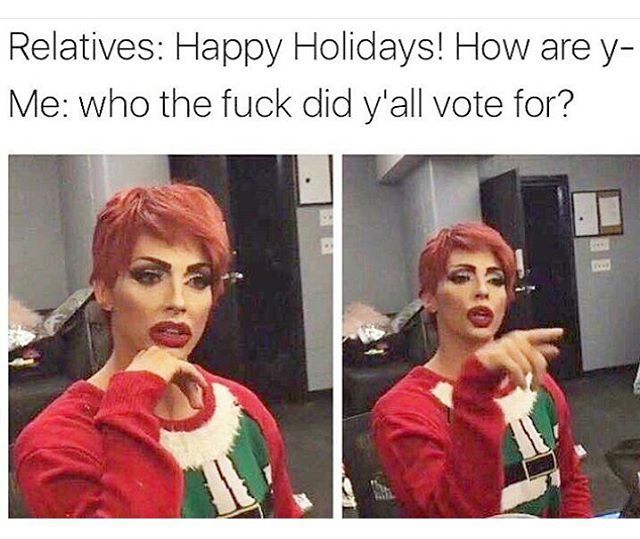
Sitting around the tree watching the kids open presents.  Attempting to enjoy a holiday meal with extended and immediate family that you may or may not have traveled thousands of miles to see.  Trying with every fiber of your being to not talk about the elephant, or red hat, in the room.
We’ve all been there.
Sitting around the tree watching the kids open presents.  Attempting to enjoy a holiday meal with extended and immediate family that you may or may not have traveled thousands of miles to see.  Trying with every fiber of your being to not talk about the elephant, or red hat, in the room.

Alyssa Edwards

I get it.  It is hard to not go home for the holidays. It’s also hard to sit at home and watch every one of your friends post online about their dinners, get-togethers, and other joyous events while you sit at home.  I also understand that many of us, as a result of our sexual and/or gender identity, or maybe our political preference, don’t feel comfortable going home or, can’t go home.  This is not ok and that is why it is so important that we all have our chosen families to be with during these times of communal gathering or more importantly, ways to cope while we are at home in these uncomfortable situations to make sure we take care of ourselves and make it out the other end.
Because this blog comes out on Christmas Day, I wanted to give you a few tips that I do to self-care in these situations.  Remember, there is no right or wrong thing to do.  I encourage you all to make your own list.  The only thing that matters is you take care of yourself!
John’s Top 5 Tips for Dealing with “Those” People
  1. Your car is your friend – Seriously, I cannot count the # of times that I have found myself driving around for that extra 5 minutes to just collect my thoughts or calm myself down.  If you need to, jump out to your car and sit back and relax for a second or drive to a gas station (Kwik Trip in Wisconsin is my go-to) and pick up a soda to drink.
  2. Drink (if you can)  – look, I know not everyone drinks (or is from Wisconsin) but sometimes you just need to make yourself a cocktail (responsibly).  However, if you are going to drink, remember that old adage: loose lips sink ships.  If you get too loose, you may say something you regret (or didn’t plan on saying; I’ve been there).
  3. Bathroom Sanctuary – Sometimes you may not need to use the restroom but you need a place to go and just lock the door, check Facebook, call a friend, or simply breath.  The bathroom is the perfect place to do that.  Find it.  Use it (even if you don’t have to).
  4. Dinner Conversation – Before I go anywhere, I always brush up on a few facts.  How are the Packers doing? How about the Milwaukee Bucks?  Can you believe they STILL haven’t finished that construction?  No matter if you’re traveling somewhere near or far, if you think you need to make sure you can participate in dinner conversation without bringing up the two forbidden topics (Politics and Religion), then do so!
  5. Push Back – Ok, sometimes it is ok to engage.  I mean, how are we ever going to get out of this great divide if we don’t talk to each other.  Now, that doesn’t mean it will go over or there will be some type of magical aha moment but it is ok to say something, especially when your crazy Aunt/Uncle/Cousin/Second Cousin/Random Friend of Cousin who no one invited starts spouting off some nonsense (like Mexico 1nlYpaying for Trump’s wall because that just isn’t going to happen).  If you feel safe enough to push back and say something, especially when someone if being completely and totally rude and inappropriate, always make sure you have an exit strategy. That is either a friend you can call, a room you can go to, or a nap you suddenly want to take.  No matter what, if you do choose to engage always remember to a.) Speak calmly and slowly at all times (Republicans are triggered when you yell and provide them with too many facts too fast); b.)  Make direct eye contact; c.) Make sure you always have something to take a long sip from afterward to prove you made your point.

I have to admit, I am quite lucky.  I know I have written a lot on this site about what has happened to my family since the election of the Fascist-in-Chief.  Luckily for me, I surround myself during these times with people who openly love me, my views (for the most part), and allow me to be myself, or simply, we just don’t talk about “it” because they clearly know now that we were right about Trump and his cronies. I don’t have to use these tips because the people they apply to, don’t really come around our holiday gatherings.
However, if there is one thing that I learned, it is that this election has cost us each something.  Whether that was a friend, family member, or a part of yourself that you never think you’ll be able to get back, we need to respect these losses and the pain that comes with them.  I promise you that it will get better (heck, better starts on January 3, 2019).  We have a long way to go until 2020 (I mean, a LONG way to go) but I know we will all get there together, one way or another because there are better Christmas and holidays to come where we won’t have to use these tips and tricks to survive anymore.
So, from my family to yours, Merry Christmas and Happy Holidays!  I’m thankful for each and every one of you this holiday season (unless you voted for Trump).

2155509_1

John Erickson is a Ph.D. Candidate in American Religious History and holds two MA’s from Claremont Graduate University. John serves as a commissioner on the California Commission on the Status of Women. He is President of the Hollywood Chapter for the National Organization for Women, a boardmember for the City of West Hollywood’s Lesbian and Gay Advisory Board, a board member for the ACLU of Southern California, the Legislative Action Chair for Stonewall Democratic Club, and a board member for the National Organization for Women.

A Better World is Impossible Today (#WETOO) by Adam F. Braun

At the end of the second Matrix film (Reloaded), Neo (the messianic figure, “The One”) is told by the Architect of the Matrix, itself a program in the system, that Neo was in fact the sixth iteration of messianic figures that the Matrix had itself created.  In such a case, what hope is there when the System creates messiahs in order to produce a hope it allows—a hope it allows for the sake of reproducing itself through the exploited labor of others, who are able “to get by” because they have this same hope.  A hope that a better world is possible.

In the midst of the young #metoo movement in Japan, this story emerges from one of its medical schools:

Japan’s government urged a medical university to promptly disclose the results of an investigation into its admissions process Friday after reports alleged it had altered the test scores of female applicants for years to deny them entry and ensure fewer women became doctors. Continue reading “A Better World is Impossible Today (#WETOO) by Adam F. Braun”