Lust in the Heart by Linn Marie Tonstad

Linn Marie TonstadLove the sinner, hate the sin. We are all familiar with the bludgeon this statement represents in Christian circles. It functions as a way to maintain one’s goodness and Christlikeness (supposedly!), while simultaneously condemning and persecuting those who find themselves drawn to live lives outside the constraints of heteronormativity in all its variations. The statement hardly needs to be deconstructed – it proves its own emptiness in relation to the way sexuality is understood as identity in the contemporary context. (There are Foucaultian reasons to be unhappy with this understanding of sexuality – one of the disciplinary functions of power on his account is the desire to find a name that will express one’s true identity – but we’ll save that for another day.)

Instead, I think we should consider a much more fundamental contradiction in the way Christian churches today speak and think about sexuality. In many mainline congregations in the US-European context, the debate has been framed around celibacy versus “practice” for persons identifying as gay and lesbian. Excluding the fringe ex-gay movement and its horrors, there are three typical positions that churches take up. One, celibate gays and lesbians may participate fully in church life. Two, married and monogamous gays and lesbians may participate fully in church life. Three, neither marriage nor monogamy are required for gays and lesbians (or anyone else) – the latter is perhaps not a frequent position for churches to take, at least officially, other than in the MCC. For most mainline denominations, the fault line lies between those who assert the ‘vocation’ of celibacy for gay and lesbian persons, and those who permit marriage. Continue reading “Lust in the Heart by Linn Marie Tonstad”

(Femen)ism? by Kile Jones

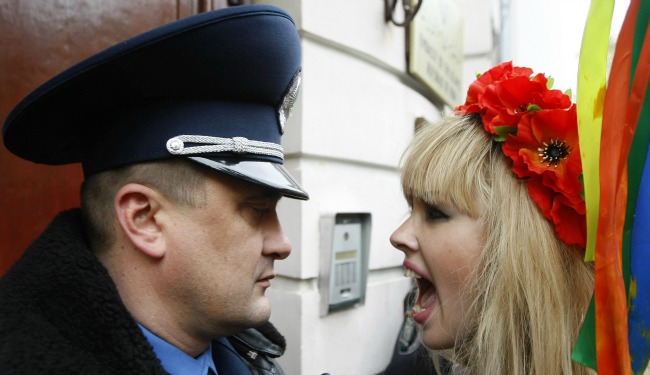
Kile Jones, atheistAs most of us are aware by now, there is a “feminist-sextremist” group from Ukraine called “Femen.”  This group has been very controversial by their public demonstrations of nudity, the words they paint on their bodies, and their explicit condemnations of political structures and organized religions.  They were started by Anna Hutsol in 2008 and have now spread throughout Europe and the Middle East.  The question I pose for this post is: Does Femen harness or hinder the power of the feminist critique?

Image from Konstantin Chernichkin/Reuters

Femen is precisely the kind of movement that pushes us in our understanding of feminism, the means by which it is best expressed, and the issues surrounding moral condemnation and religious sensitivity. Continue reading “(Femen)ism? by Kile Jones”

Marriage as a Commodity (Satisfaction Guaranteed) by Michele Stopera Freyhauf

Freyhauf, Feminism, Religion, Durham, Old Testament, Blogger, Bible, Gender, Violence, Ursuline, John CarrollThis Saturday I will be presenting a paper about Cyberbrides at the United Nations Commission on the Status of Women.  While my focus for that paper is the impact on mothers and families, my research also revealed how some Cyberbrides (or Mail-Order Brides) are selected from internet catalogues with “satisfaction guaranteed” and how “International Marriage Broker” may be a cloak hiding the agencies’ involvement with human trafficking.

Cyberbrides are essentially mail-order brides, but like pen pals, they can chat and exchange pictures on the Internet and interact through video or instant chat.  There are almost 2.9 million website matches that turn up when Google-ing “Mail-Order Brides” within 19 seconds of pressing the “return” button. With the low cost of social media, a new venue to market and display this “commodity” is available.  Presently,  about 30 Facebook sites exist that advertise “Mail-OrderBrides. Continue reading “Marriage as a Commodity (Satisfaction Guaranteed) by Michele Stopera Freyhauf”

Second Class Rape Victims: Rape Hierarchy and Gender Conflict

Deconstructing masculinity isn’t the key to solving social, sexual, and domestic violence across the world but it is a step worth taking when attempting to engage men in affecting change to stop these violent actions since men, statistically are the perpetrators of such crimes that both cause such outcry as well as perpetual silence.

johnThe most disturbing part of the 2006 documentary Deliver Us from Evil isn’t the fact that Father Oliver O’Grady is rewarded by the Catholic Church with a new congregation in Ireland after his short stint in prison for the rape of dozens of children in the 1970s, but rather the hierarchy of gendered victimization which is often created throughout the various rape cases that are both reported and unreported throughout history.

I am often troubled by the ways in which rape cases are discussed and deconstructed via mediums such as blogs, online communities, social media networks, the news, and popular culture.  No series of events troubled me more than the Jerry Sandusky trial, but more importantly, the ways in which the young boys and adult men who were subjected to Sandusky’s abuse quickly overshadowed the other rape cases that are reported on a daily basis, specifically those involving young girls and women. Continue reading “Second Class Rape Victims: Rape Hierarchy and Gender Conflict”

Monthly Highlight: Emilie M. Townes


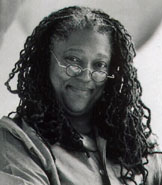
Emilie M. Townes

“In my teaching I want to get students excited about that notion of, you know, you’re not just here to get a Yale degree and have it on your diploma and be able to hang it on your wall…You should be here thinking about what kind of contributions can I make to society….What are you doing that helps enhance the lives of all of us, as opposed to (our) own little idiosyncratic research interests.”  – – Emilie M. Townes

Emilie Townes is a pivotal person in the field of Womanist and Christian ethics as well as a foremother and pioneer in Womanist theology. Cornel West of Princeton University said:

“Emilie Townes is the towering womanist ethicist of our time….In this ice age of indifference and evasion, her powerful voice and viewpoint summon us. And we thank her for her vision and courage.”

At an opening address at the Convocation in 2005, Townes stated that there is a need to live in a “deep walking hope” that shapes lives “in ways that are not always predictable, not always safe, rarely conventional” and protests “with prophetic fury the sins of a world, and sometimes theological world views, that encourage us to separate our bodies from our spirits, our minds from our hearts, our beliefs from our actions.” Continue reading “Monthly Highlight: Emilie M. Townes”

The Impact of Excommunication in the 21st Century (Part I) – Spiritual Redemption or Hegemonic Power by Michele Stopera Freyhauf

The Lord loves everyone and died for everyone, and He wants all to be saved…the best lesson that can be learned from everything that has happened is that one finds happiness, joy and satisfaction in obedience to the Church.”Bishop Bruskewitz

One of the most misunderstood concepts in the Catholic Church is excommunication.  Many believe that excommunication is a complete termination or separation from the Catholic Church.  To say this another way, if excommunicated, you are no longer Catholic or part (a member) of the Catholic Church.  None of these statements are true.  By baptism, you are a member of the Catholic Church and no one can take that away.

Much of the misunderstanding stems from the way excommunication was used in the Middle Ages; a means of coercion to control kings and other high ranking officials.  Obedience to the Church meant that you will spend eternal life in heaven.  Disobedience to the Church meant a complete separation from the Church; a ban against  receiving Eucharist, a banishment of your soul to the eternal flames of hell.  Excommunication was the highest form of punishment and the most meaningful (and effective) tools of control.  When a person was excommunicated, there was even a public ceremony –  a bell tolled for the excommunicant, as a bell that would chime for the dead, the Gospels were closed, and a (baptismal) candle would be extinguished.  This ceremony signified eternal darkness and death. Continue reading “The Impact of Excommunication in the 21st Century (Part I) – Spiritual Redemption or Hegemonic Power by Michele Stopera Freyhauf”

Confessions of a Former Sex Worker by Anonymous

Empowered?  I thought so.  At least sometimes.  I was barely an adult when I entered the sex industry at the young age of eighteen.  I had little life experience, was high school drop out, and was forced out on my own a year earlier.  I quickly found that the fast food industry offered me little chance of survival.  After working seven days a week (with 3-4 of those days being double shifts), barely making my bills, and living off of a tub of expired granola I took from work (and the one meal a day I was provided on the job), I could not help but be enticed by the idea of making hundreds of dollars a day for simply taking off my clothes.

It was a woman I worked with who introduced me to the idea.  Her sister was a “stripper” and dating the manager of a local club and she suggested I audition to be a dancer.  The wages were more than I had ever imagined earning and I was tempted on many levels to take her advice. Being able to support myself comfortably seemed the answer to my problems, even if it meant violating my moral code. Continue reading “Confessions of a Former Sex Worker by Anonymous”

Please Excuse Me for Having a Penis: Taking a Back Seat to Privilege and Power by John Erickson

Male feminists must be aware that we not only engage in an ongoing struggle against sexual and gender inequality, but more importantly an ongoing fight with ourselves.

I have often struggled with that little voice, call it my conscience if you will, that speaks to me during times of distress.  Although I consider myself a proud feminist, I still struggle with aspects of what I call, internalized misogyny, or more aptly defined as a male born characteristic trait that imparts the idea that men are not only dominant but also more powerful than the other 50% of the species.

For many reasons, I believe religion is one of the main culprits of this growing evil, one that we all witnessed throughout this last election cycle.  However, instead of placing blame solely on religion and images of the male Godhead we have to begin deconstructing the sociological consequences these subconscious social, sexual, religious, and gendered norms have on men but more importantly men who identify as feminists. Continue reading “Please Excuse Me for Having a Penis: Taking a Back Seat to Privilege and Power by John Erickson”

Is the Republican Party Platform Truly Pro-Life? by Michele Stopera Freyhauf

As many feminists invest their life fighting for women’s rights to be the center of attention – no one could predict the occurrences of this election year.  In my previous post “Rape is Not a Political Platform – Rape is a Violent Crime!” Carol P. Christ made a comment about women’s issues and politics:

 “I have been waiting all my life for women’s issues to become central in an election campaign, but I guess I should have been more specific in my wish: this is not the format I imagined…”

Christ’s reaction is like so many others in the election; no one could have imagined such a bizarre and backwards slide being lobbied against women’s rights.   Issues being bantered around continue to be rooted in a purported pro-life stance.  This ranges from trans-vaginal ultrasounds, definitions of “legitimate” rape, and now using an Ob/Gyn’s “best guess” to define the gestational age of a baby from the time of a woman’s last period.  This is not a game – this is semantics, this is politics, this rhetoric, and frankly, this needs to stop. Continue reading “Is the Republican Party Platform Truly Pro-Life? by Michele Stopera Freyhauf”

The Need for Asexuality in Theological Discourse by Elisabeth Schilling

Beach
Asexuality is an orientation that is misunderstood and marginalized. That is, if it is allowed a presence at all. I consider myself to be sensual, loving to receive and give pleasure, affectionate and romantic, and longing for a relationship that respects my bodily boundaries which happens, for me, to mean physical touch that does not include genital sex.

The recognition of asexuality into our theological and theoretical discussions can offer another way of understanding agency and the erotic in our lives. It can help us access the sacred narratives we long to have deeper connections with. In addition, when we allow a more holistic and generous understanding of asexuality as it is actually experienced by those who self-identify as such, it creates a livable space for us to exist, to imagine in midrash, perhaps, among the abstinence narratives which can be problematic in theological literature, our sacred presence.

Consider Mary, the “Virgin Mary” who was told she would have a child in a very queer way. Continue reading “The Need for Asexuality in Theological Discourse by Elisabeth Schilling”