The church occasioned one of my first conscious experiences with inequality — Sunday school to be exact. I was nine and bedecked in black platform shoes and a bright pink polyester suit. It was the 70s, a moment in fashion history never to be revisited. My Sunday school teacher, a spiritually angelic woman, was explaining the demise of the Woman Caught in Adultery. According to the story, the leaders of law and religion wanted to stone the woman to death for having intercourse with a man that was not her husband. Although she was vulnerable to the death penalty, the man was not exposed to any punishment. This lopsided sanctioning plagued my young mind. Little did I know, I would spend my legal career, as a federal sex trafficking prosecutor and as a legal scholar, trying to vindicate the Woman Caught in Adultery.
During my last months in Cape Town I have been facilitating a series of workshops on Rape, Gender Justice and Culture of Consent. I am blissful for the opportunity to teach and learn with a group of people with whom we have navigated in the approach of Rape and Sexual Assault in their different perspectives, from the socio-political to the intimate tenets.
This has been an exciting journey of healing and soul blooming. I have realized the critical role that Cape Town has played in pushing me towards empowerment and thriving, enhancing my taking back ownership of my body and all the experiences happening through it.
This journey started few years ago when I decided to come out of the closet as a rape survivor. I wrote about it on Feminism and Religion. This was the first step of my breakthrough. Little by little I became confident and shameless about saying: “Yes, I was raped”.
Last weekend was a special one for me. After many years of study and dedication I graduated with my Ph.D. and am now, officially, Dr. Katie Deaver. The weekend was filled with celebrations to mark the completion of a milestone that I have spent years working toward. The amazing outpourings of love, support, and care that I have experienced throughout the last few days is quite humbling. The happiness and pure joy of my family, friends, professors, mentors, and multiple church communities have left me in awe. As I reflect on this love and support it helps to heal the wounds and scars that have accumulated throughout the process of earning this degree.
The undertaking of a Ph.D. program is significantly more difficult than anyone tells you. This difficultly lies not necessarily in the course work or the dedication to constant reading, writing, and learning but rather in the personal growth and vocational affirmation that takes place within the process. My dissertation explored the primary understandings of the doctrine of atonement and addressed how this doctrine can, and has, been used in ways that perpetuate, and in some cases even encourage, domestic violence.
My own fascination with the topic of atonement and its links to domestic violence was brought about at the suggestion of one of my undergraduate professors at Luther College, Dr. Jim Martin-Schramm. From the moment that Dr. Martin-Schramm explained the links between theologies of the cross and domestic violence I knew that I had found my new passion. Writing a dissertation on the topics of domestic violence, theology and women of faith was an extremely personal, and intimate experience for me. This topic forced me to accept my own lived experience. To claim myself… out loud… as a survivor of domestic violence. As a result the writing of my dissertation was particularly personal, and painful, as well as extremely life giving.
In her 1975 manifesto, “The Laugh of the Medusa,” French feminist Hélène Cixous urges women to write: “Writing is for you, you are for you; your body is yours, take it. . . . Women must write through their bodies, they must invent the impregnable language that will wreck partitions, classes, and rhetorics, regulations and codes . . .”
“The Laugh of the Medusa” remains a thrilling essay, challenging and inspiring women to “return to the body” and to language. “Woman must write woman,” Cixous insists, “for, with a few rare exceptions there has not yet been any writing that inscribes femininity.”
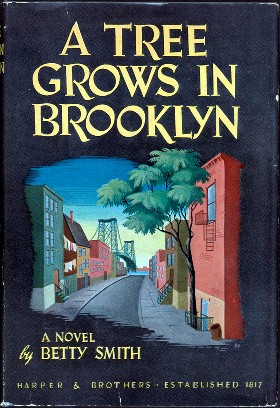
Although Cixous may not have been aware of it, Betty Smith’s beloved, perennially popular 1943 novel, A Tree Grows in Brooklyn is one of those “rare exceptions” that “inscribes femininity” in precisely the way she advocates. This autobiographical novel, so often dismissed as sentimental or as a children’s book, is actually written through the female body—which may explain its lasting popularity and power. Continue reading “Writing Through the Body: Betty Smith’s A TREE GROWS IN BROOKLYN by Joyce Zonana”
In March of 2011, at a symposium on trauma, healing, and spirituality in Belfast, Ireland, I spoke about shame in the context of war, addressing the experiences of women survivors of rape during the Rwandan genocide, US soldiers returning from war with PTSD symptoms, and cultures, such as those in Belfast and Bosnia, steeped in war and violence. While discussing how theology has a responsibility to examine how the church talks about shame, guilt, and sin to help survivors of war trauma heal, I recognized A. Denise Starkey in the audience, a woman whose work was instrumental in the crafting of my own. Her book, The Shame that Lingers: A Survivor-Centered Critique of Catholic Sin Talk, published two years prior, provided a critical backdrop for my presentation, and would be foundational to my dissertation and subsequent book: Affect Theory, Shame, and Christian Formation.
So, when they see a woman, the body overcomes the mind. If you have to rape, you rape. I have heard it many times, the same argument to justify cheating. “I am a man, I can’t control it, I HAD to do it, I DID NOT KNOW what I was doing”. Sure, they can control themselves. Sure, they DO KNOW what they are doing. Because they control themselves with other men. They can and know how to maintain alliances with other men so none of them will reveal their secrets. Secrets called women abuse. They are so updated in what they do, that if you call their machismo out, they organize a cold strategy to silence you. They will have a Masters in mind games and gaslighting to leave you full of bumps without touching you, and you will have to put up with the wall of silence from his friends defending the abuser. Continue reading “Why Is The Abuser Still Among Us? by Vanessa Rivera de la Fuente”
In my previous post, I mentioned a book I am writing about how theological and ethical considerations in architectural design can define good architecture. In that post and in ones to follow, I am acknowledging the feminists and womanists and mujeristas who have influenced me while also opening up the dialogue to the feminists in this community who continue to inspire and guide me to do my best work.
But today, instead of talking about creativity or architecture, I want to discuss how I arrived at the conviction that community decisions about how we ought to live—whether those are decisions about laws, institutional policies, religious practices or architectural buildings—need to include the voices of the diverse people they directly and indirectly influence. Continue reading “What Traci West Taught Me about Dominant and Excluded Voices by Elise M. Edwards”
On Monday, the picture was on my Facebook feed again: The picture of a girl lying face down in the grass under a police officer pressing his knee in her back. It was from the video of an African-American teenager being pinned to the ground by Eric Casebolt, the police officer in McKinney, Texas who was responding to calls about a pool party. When I saw the picture this time, it was in a screenshot with these words below it:
“Funny how a 14 year old bikini-clad black girl being publicly assaulted by an adult male does not accrue mainstream feminist outrage.” – Yohanna
The screenshot was taken of a post to Yohanna’s Twitter account (@maarnayeri). I don’t know her, but she troubled me.
If you haven’t seen the images we’re talking about, you can view the video here with a description of what is concurring or below from YouTube. I was reluctant to watch the video. It seems voyeuristic to view this young woman’s suffering and screaming. And, if I am honest with myself, it also seems useless. Viewing this from my computer screen, I’m in no position to help her. I hear her cries and it make me cry too. But I can’t push him off of her. When other teens tried to come to her defense, Casebolt pulled a gun on them and chased them. I don’t even have the power to get him fired from his position of authority immediately. No, we must have the investigations and inquiries and due process that seems so indiscriminately afforded to the privileged. Casebolt was put on administrative leave on Friday, and on Tuesday June 9, he resigned.
So how should I respond?
I had a conversation with one of my closest friends a couple days ago that provoked me to reflect on what to do when I’m conflicted about how to respond. Her background is in acting and theatre, and now she is a pastor and artistic director of a Christian church and arts initiative who believes in supporting arts, imagination and creativity. In our conversation about discerning the next steps in our lives, she was reminded of a book by Samuel Wells that proposes “theatrical improvisation as a model for Christian ethics.” That reminded me of books I’ve read that talk about musical improvisation or call-and-response as model for living, and some pieces I’ve written about that. Inspired by ethicists and theologians including Emilie M. Townes and H. Richard Niebuhr, I believe that to answer the question of how I should respond, I must first answer ‘What’s going on?” An improvised response or a fitting response is the response to what is already occurring. We must look at the situation critically to respond appropriately.
What’s going on in this video and the controversy surrounding it? I am certainly not an impartial or all-knowing observer, but here’s what I see:
A white man forcibly throws an unarmed, African-American teenager to the ground yelling “On your face!” We can see that she is unarmed because she is wearing a bikini.
The man is a police officer. He is upset that his authority is being challenged. Other officers are present and seem to be asking questions, but the violent one seems out of control and frantic, running around and yelling. He escalates the situation when he throws the girl to the sidewalk, which causes an outcry in the crowd.
As the video went viral, there were many protests and online statements against this violent event, but also statements of support for the officer. And sadly, I agree with Yohanna’s assessment. I may have missed it (and I hope I did), but I didn’t see a broad, mainstream feminist response against this violence.
I’m a feminist. I’m a black feminist. I’m a Christian feminist. I may not be a mainstream feminist (depending on your definition), but I’ll express my outrage anyway. It is sickening to watch his treatment of this teenage girl. This man’s mistreatment of a young black girl’s body is chilling. It is wrong and he should be held accountable for it.
I don’t think outrage is enough. But outrage does express that our moral sensibilities have been awakened and that we recognize that something profoundly wrong has occurred. In the face of comments that say she deserved this treatment, we as feminists must insist on the officer’s wrongdoing. “She had it coming.” “She incited him.” As feminists, we know that these kinds of statements are used in cases of rape and intimate partner violence to explain away violent actions and to shift the guilt from perpetrator to victim. The backlash against feminists and others who oppose these explanations argues that we ignore the victim’s responsibility or agency.
Bloggers and social media users know all too well the horrific statements that often appear in the comments section of online posts, videos, and articles. One comment I saw about the McKinney video says that the girl was “sassing back” at the police and that “if she wants to talk like adult then she’s going to be treated like an adult.” This kind of justification makes my blood boil! Sassing back is speaking up and saying something to an authority figure when you are expected to be silent. While the term sassing back doesn’t exclusively apply to women and girls, it is nonetheless a phrase with gendered connotations. How many boys are called “sassy”? Is it that no one had the right to say anything to this officer running around yelling at black teen boys to sit on the ground, or is it that this black female should have kept quiet? Regardless, throwing an unarmed person to the sidewalk for supposedly saying something disrespectful is not justifiable behavior to adults or children.
I wish I knew more about what’s going on and how to respond to the violence I see in the world. I know these perennial questions subvert easy answers. I only have a partial response. I am responding with outrage and questioning and take this to my feminist community and into my spiritual practice. “What’s going on?” and “How should I respond?” are questions I ask God. I pray for justice. I pray for God’s presence in the outrage and in the investigations, and in the lives of those children who were violated.
Elise M. Edwards, PhD is a Lecturer in Christian Ethics at Baylor University and a graduate of Claremont Graduate University. She is also a registered architect in the State of Florida. Her interdisciplinary work examines issues of civic engagement and how beliefs and commitments are expressed publicly. As a black feminist, she primarily focuses on cultural expressions by, for, and about women and marginalized communities. Follow her on twitter, google+ or academia.edu.
In a repetitive culture of abuse and silence, is it really shocking to find out that an individual who preached such hate and discontent for others actually perpetuated other forms of heinous abuse against others?
In 2013, I wrote an article about the then latest reality TV scandal featuring A&E’s Duck Dynasty’s Phil Robertson and his rampant foot-in-mouth disease that caused him to express, in the pages of GQ, his true distaste for the LGBT community and specifically for the sexual proclivities of gay men.
Now, two years later in another reality TV show, TLC’s ’19 Kids and Counting’, it isn’t star Josh Duggar’s anti-LGBT statements getting him into trouble but rather his sexual assault and molestation of 5 girls, including two of his sisters. However, while the Internet explodes with attacks against Josh Duggar and his Quiverfull background, it is vital to remember that the silence that he and his family inflicted upon his victims since 2006 has not only been ongoing since then but is also being reemphasized today with each keystroke focusing on the assailant rather than the victims. Continue reading “The Religiosity of Silence by John Erickson”
Whenever the epidemic of rape in Egypt makes the news, I am destined to think of Joyce Carol Oates.
Last summer, the author took to twitter to question whether Islam was responsible for the widespread incidence of sexual assault in Egypt, an argument people continue to make today. As a Muslim woman, I desperately wanted to respond to Ms. Oates’ tweets. I held my cursor over the “reply” button countless times. But I’ve been silent about the things I would have said, about why I follow Dennis Rodman on twitter, and why Pearl Jam is my favorite band, and how my heart shattered for women in Syria who felt like they had to be silent, too.




 In her 1975 manifesto, “
 In March of 2011, at a symposium on trauma, healing, and spirituality in Belfast, Ireland, I spoke about shame in the context of war, addressing the experiences of women survivors of rape during the Rwandan genocide, US soldiers returning from war with PTSD symptoms, and cultures, such as those in Belfast and Bosnia, steeped in war and violence. While discussing how theology has a responsibility to examine how the church talks about shame, guilt, and sin to help survivors of war trauma heal, I recognized A. Denise Starkey in the audience, a woman whose work was instrumental in the crafting of my own. Her book,

 In 2013, I wrote an
 Feminism and Religion