The invisible war of sexual assault of female and male military personnel by their fellow soldiers, sailors, airmen and marines continues even as the U.S. Senate holds hearings and presses for substantive changes in the way cases of sexual assault are handled. The Academy Award nominated documentary tells the story of survivors of rape and of an institution long on rhetoric and short on change.
In 2012, there were 26,000 reported rapes in the military which is a 35% increase over the previous year. Since 1991, it is estimated that 500,000 women have been raped in the U.S. military. Half a million. At least 20% of women who serve have been assaulted while serving. This gives new meaning to “friendly fire.” One commentator compares it to incest: a military unit has a family dimension. You should be able to trust the members of your unit to have your back and your commander to protect you as needed. Continue reading ““The Invisible War” Goes On by Marie Fortune”
Rape culture, as has been noted on Feminism and Religion in multiple articles (see Carol Christ’s post this week), permeates every aspect of our society, every aspect of our lives. Something that I believe warrants serious attention is Elizabeth Smart’s recent comment about abstinence only education. In her talk at John Hopkins University about her own harrowing ordeal, she well demonstrates the many ways rape culture plays itself out in our society and also shares why we must continue to explore options beyond abstinence only education.
As you may recall, Elizabeth Smart’s name became well known across the US when she was abducted at the age of 14 and then found alive 9 months later. During her captivity Smart was forced into a polygamous marriage and repeatedly raped (rape culture). When she was found walking down the street with her captors, many wondered why she hadn’t tried to escape or ask for help (rape culture). According to Smart, the question she is asked most often is “Why didn’t you run? Why didn’t you scream?” (rape culture). Smart responded to that question during her talk and her answer included abstinence only education (rape culture). Continue reading “Rape Culture and Abstinence Only Education by Gina Messina-Dysert”
Her name was Tricia Meili. Their names were Yusef Salaam, Raymond Santana, Antron McCray, Korey Wise and Kevin Richardson. On April 19, 1989 all of their lives were irrevocably changed. They would never meet, but their lives would become forever linked. When they entered into Central Park on that night, did they know that they were stepping into a haunting history of dismembered bodies? Tragically, their bodies would become another story to be told in that history.
On that April day in history some 34 years ago one white female body went into Central Park for her routine jog. Five black and brown male teenage bodies went into Central Park to hang out, but soon became a part of a crowd engaged in mischievous if not dangerous and out-of-control harassment of other park visitors. As the night wore on, police were called and arrests were made. It would later be discovered that Tricia was brutally and sadistically raped, but not by Yusef, Raymond, Antron, Korey or Kevin. Yet, the five young teenagers were badgered into confessions, charged with the rape and sentenced to prison. Continue reading “Betraying Bodies by Kelly Brown Douglas”
Recently I had the great pleasure of presenting on the WATER Teleconference Series and dialoguing with women from around the world about how to promote healing in a rape culture. Likewise, in a previous post I discussed rape culture in the Church and its impact on victims of sexual violence and the greater community. Within a rape culture, those who experience sexual victimization endure physical, emotional, and spiritual wounding. It is a victimization unlike any other, and one that we must continue to discuss in search of healing.
This topic is important to me for obvious reasons. As a woman, mother, and social justice activist, I am passionate about eradicating gender based violence. This said, I also have direct experience with this brutality that plagues our society. Having worked with rape survivors for more than a decade, I have witnessed the suffering endured as a result of such violence. My own mother died prematurely as a result of sexual and domestic violence; having come to learn of the horrors she lived through has greatly impacted my understanding of the deep spiritual wounding experienced due to our culture of shaming and blaming – our rape culture.
Cosplay is often a deliberate, interpretive and self-chosen performance of gender and power. Like drag performers, cosplayers put on a show of the characters they represent; and in my experience, they often do so within diverse, supportive and principally, inclusive communities.
This week my husband sent me a great blog post he found about cosplay and one woman’s determination that she would no longer tolerate being demeaned, objectified or trivialized because of what she chooses to wear. Blogger Megan Marie’s post, entitled “What would you do if you weren’t afraid,” inspires me. She points out and refuses the trappings of rape culture: victim blaming, assumed male control over female sexuality and shame; and claims her right to be who she is. I, as fellow (what is the female equivalent for fellow???) cosplayer, was also moved by her defense of this creative art. I have been cosplaying a long time, but I have been too afraid to speak much about this or to directly protest the rejection of these fantasy images within some feminist communities. So to answer Megan Marie’s question* in her own words, “What would you do if you weren’t afraid? My answer. I’d write this blog.”
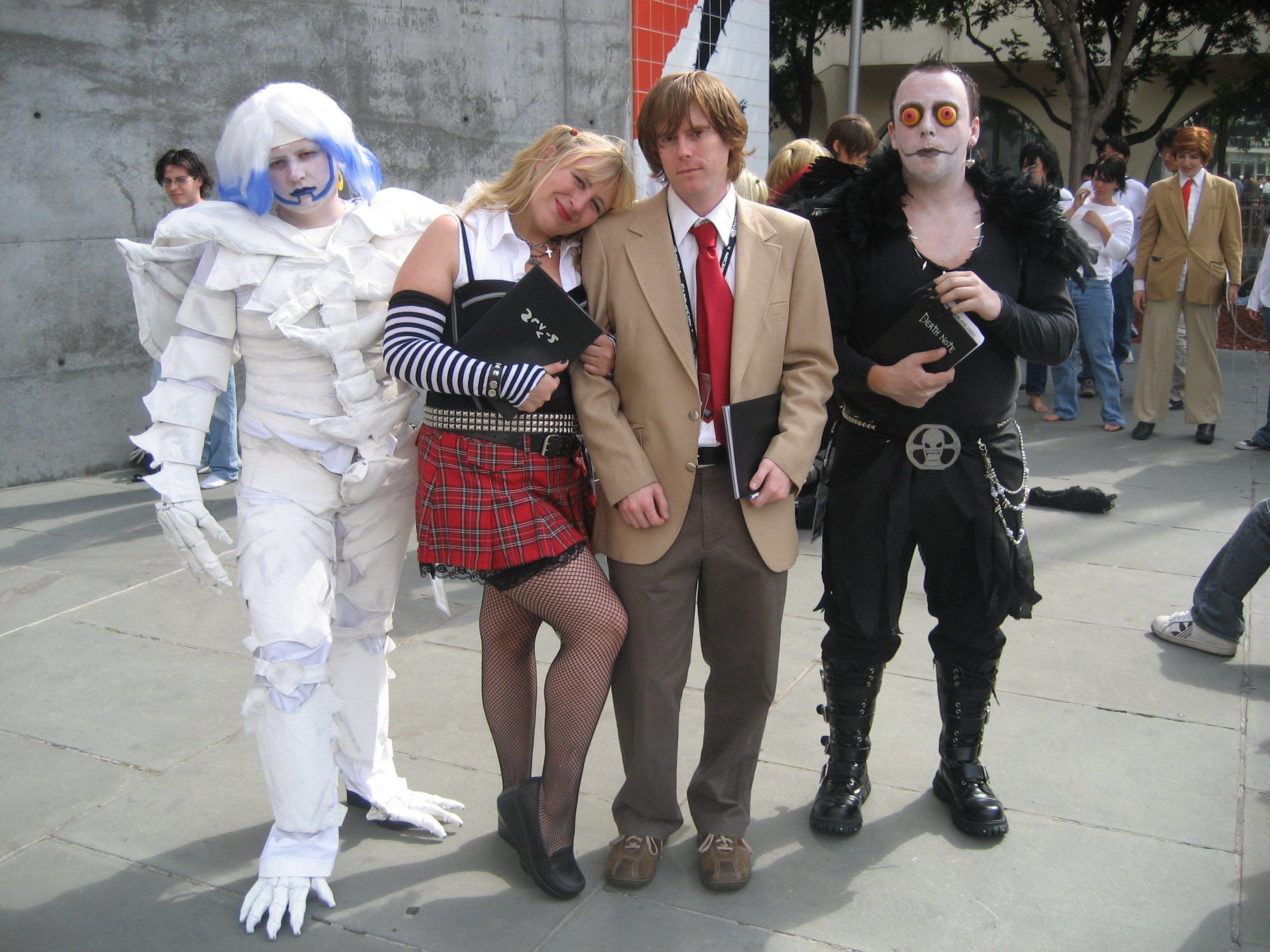
Coplay = costume + play! It is the recreation of popular characters from video games, comic books, anime, scifi series, fantasy literature or the like. Cosplayers do this for the fun of it, the craft involved, to express one’s fandom and sometimes, professionally, usually within an arena where fans can enjoy one another’s recreations. The attempt to embody these characters involves a great deal of work and artistic expression. Many conventions, like Fanime Con in San Jose, CA, host panels in which fans can learn cosplay skills, such as armor construction, wig making and costume design. I have cosplayed the following characters: Sailor Star Healer, Eudial and Sailor Iron Mouse from the anime Sailor Moon, Misa
Death Note Cosplay: Misa and Light are in the center, flanked by their respective “Shinigami,” or the death gods they are working with
Sachiel from Neon Genesis Evangelion: I am trying on my almost finished costume here!
I am currently planning a to make a Metroid out of an umbrella and to cosplay Nyan-kitty at the May conference that my husband (who will be playing Tac-nyan), my sister and many of my friends attend.
The nation has watched over these last several months as the rape case in Steubenville, Ohio has unfolded in the media. On March 17, 2013 the verdict was announced and the two teenage boys accused of raping a 16 year old girl were found guilty on all counts. Although the verdict was just, all other circumstances surrounding the case, including the sentence, support the existence of a rape culture. What we have learned from Steubenville is that the humanity of women and girls continues to be of little importance in today’s society.
To begin, the assault itself was horrific. While two teenage boys took turns raping and abusing the body of Jane Doe, the other boys present took great pleasure in watching, taking pictures, texting, tweeting, facebooking, and video recording the brutality. It was a scene out of The Accused (the film that recounted the real life rape of a woman while a crowd watched a cheered) all over again–this time with the “benefit” of modern technology. Not only were those in the room witnesses to this gruesome attack, the entire world became voyeurs as video, pictures, and text went viral. Continue reading “What We’ve Learned from Steubenville by Gina Messina-Dysert”
Deconstructing masculinity isn’t the key to solving social, sexual, and domestic violence across the world but it is a step worth taking when attempting to engage men in affecting change to stop these violent actions since men, statistically are the perpetrators of such crimes that both cause such outcry as well as perpetual silence.
The most disturbing part of the 2006 documentary Deliver Us from Evil isn’t the fact that Father Oliver O’Grady is rewarded by the Catholic Church with a new congregation in Ireland after his short stint in prison for the rape of dozens of children in the 1970s, but rather the hierarchy of gendered victimization which is often created throughout the various rape cases that are both reported and unreported throughout history.
I am often troubled by the ways in which rape cases are discussed and deconstructed via mediums such as blogs, online communities, social media networks, the news, and popular culture. No series of events troubled me more than the Jerry Sandusky trial, but more importantly, the ways in which the young boys and adult men who were subjected to Sandusky’s abuse quickly overshadowed the other rape cases that are reported on a daily basis, specifically those involving young girls and women. Continue reading “Second Class Rape Victims: Rape Hierarchy and Gender Conflict”
Upon the recommendation of several friends and colleagues I decided to see the film Les Miserables. It is rare these days that I make it to the movies. My life is generally over scheduled and spare time is nonexistent. So with just a few days left until the start of the semester and with a pile of work on my desk, I decided to throw caution to the wind and head to the theater last-minute to see Victor Hugo’s masterpiece on the big screen.
First, can I say what a brilliant surprise the film itself was? I wondered if Hollywood could do justice to Hugo; from the moment of the opening scene I was in absolute awe. I left the theater experiencing a momentary resurrection.
While the entire film was amazing, I would have seen it for nothing else but Anne Hathaway’s performance as Fantine. I felt her suffering in the depths of my soul and wept along with her. In Fantine we see the suffering of Everywoman. She represents the thin line between those virtuous and those fallen and mirrors women’s imprisonment within this dichotomy. Continue reading “Les Miserables’ Fantine, Women’s Suffering, and Female Migrant Labor by Gina Messina-Dysert”
“The Lord loves everyone and died for everyone, and He wants all to be saved…the best lesson that can be learned from everything that has happened is that one finds happiness, joy and satisfaction in obedience to the Church.” – Bishop Bruskewitz
One of the most misunderstood concepts in the Catholic Church is excommunication. Many believe that excommunication is a complete termination or separation from the Catholic Church. To say this another way, if excommunicated, you are no longer Catholic or part (a member) of the Catholic Church. None of these statements are true. By baptism, you are a member of the Catholic Church and no one can take that away.
Much of the misunderstanding stems from the way excommunication was used in the Middle Ages; a means of coercion to control kings and other high ranking officials. Obedience to the Church meant that you will spend eternal life in heaven. Disobedience to the Church meant a complete separation from the Church; a ban against receiving Eucharist, a banishment of your soul to the eternal flames of hell. Excommunication was the highest form of punishment and the most meaningful (and effective) tools of control. When a person was excommunicated, there was even a public ceremony – a bell tolled for the excommunicant, as a bell that would chime for the dead, the Gospels were closed, and a (baptismal) candle would be extinguished. This ceremony signified eternal darkness and death. Continue reading “The Impact of Excommunication in the 21st Century (Part I) – Spiritual Redemption or Hegemonic Power by Michele Stopera Freyhauf”
Empowered? I thought so. At least sometimes. I was barely an adult when I entered the sex industry at the young age of eighteen. I had little life experience, was high school drop out, and was forced out on my own a year earlier. I quickly found that the fast food industry offered me little chance of survival. After working seven days a week (with 3-4 of those days being double shifts), barely making my bills, and living off of a tub of expired granola I took from work (and the one meal a day I was provided on the job), I could not help but be enticed by the idea of making hundreds of dollars a day for simply taking off my clothes.
It was a woman I worked with who introduced me to the idea. Her sister was a “stripper” and dating the manager of a local club and she suggested I audition to be a dancer. The wages were more than I had ever imagined earning and I was tempted on many levels to take her advice. Being able to support myself comfortably seemed the answer to my problems, even if it meant violating my moral code. Continue reading “Confessions of a Former Sex Worker by Anonymous”


 The invisible war of sexual assault of female and male military personnel by their fellow soldiers, sailors, airmen and marines continues even as the U.S. Senate holds hearings and presses for substantive changes in the way cases of sexual assault are handled. The Academy Award nominated documentary tells the story of survivors of rape and of an institution long on rhetoric and short on change.





 Feminism and Religion