Kintsugi for the Soul – Part I – by Vanessa Rivera de la Fuente

Kintsugi2

Kintsugi is a Japanese art technique that consists of repairing broken porcelain or pottery with resin varnish dusted or mixed with gold, silver or platinum powder. It is the art of fixing what has been broken with a precious metal that gives a greater value than that which the piece originally had. Kintsugi makes objects become a testimony of a particular journey.

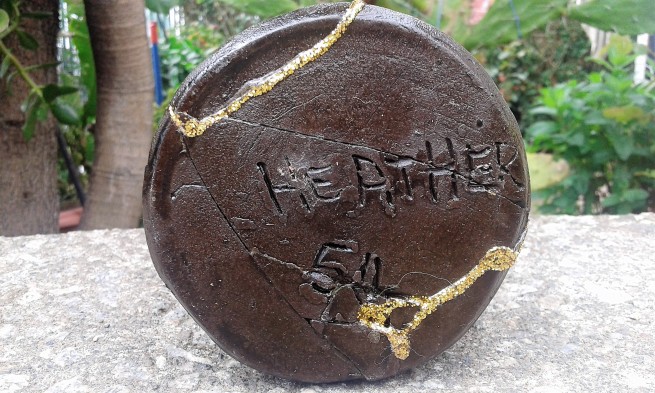
In September 2015, in Cape Town, my fiance and I went to have lunch and listen to a concert at the Waterfront. Walking through the artisan market, we were struck by a stand where simple mugs of clay and pottery were displayed. Each one of them had been made by a woman survivor of some type of violence or trauma, which put her name and the imprint of her hands. Mugs had no handle, the way to take it was to put your hands in the hands of the woman. So, she connected with you and became part of your daily journey. Moved by the deep transcendence of the initiative, we got a pair. Mine was made by Heather, 54 years old. Continue reading “Kintsugi for the Soul – Part I – by Vanessa Rivera de la Fuente”

The Authentic Self? No-Self by Elisabeth Schilling

IMG_0617When I was in high school, I remember being preoccupied with being my “authentic” self. I am quite sure I had little idea of what that meant because I think it was akin to knowing the content of my ego, my likes and dislikes, and simply being honest about them. For someone who avoids confrontation and tends to hide or lie about the truth far too often with the more persistent people in her life, this might not have been a bad ethics to practice; although, if that was what I was aiming for, I didn’t achieve my goal then and still have not. Continue reading “The Authentic Self? No-Self by Elisabeth Schilling”
Sacred Water by Molly Remer

“Drinking the water, I thought how earth and sky are generous with their gifts and how good it is to receive them. Most of us are taught, somehow, about giving and accepting human gifts, but not about opening ourselves and our bodies to welcome the sun, the land, the visions of sky and dreaming, not about standing in the rain ecstatic with what is offered.”

–Linda Hogan in Sisters of the Earth

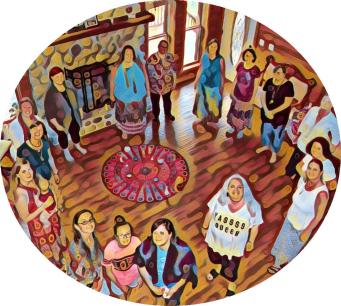
The women have gathered in a large open living room, under high ceilings and banisters draped with goddess tapestries, their faces are turned towards me, waiting expectantly. We are here for our first overnight Red Tent Retreat, our women’s circle’s second only overnight ceremony in ten years. We are preparing to go on a pilgrimage. I tell them a synopsis version of Inanna’s descent into the underworld, her passage through seven gates and the requirement that at each gate she lie down something of herself, to give up or sacrifice something she holds dear, until she arrives naked and shaking in the depths of the underworld, with nothing left to offer, but her life.

In our own lives, I explain, we face Innana’s descents of our own. They may be as difficult as the death of an adult child, the loss of a baby, the diagnosis of significant illness, or a destroyed relationship. They may be as beautiful and yet soul-wrenchingly difficult as journeying through childbirth and walking through the underworld of postpartum with our newborns. They may be as seemingly every day as returning to school after a long absence. There is value in seeing our lives through this mythopoetic lens. When we story our realities, we find a connection to the experiences and courage of others, we find a pattern of our own lives, and we find a strength of purpose to go on. Continue reading “Sacred Water by Molly Remer”

Mulling over Movies: Moana, Pt. 2 by Elise M. Edwards

elise-edwardsEvery summer in the US, movie theatres show their newest big budget films, hoping to draw in large audiences. While I appreciate an air-conditioned theatre on a hot day, I love the opportunity to go to an outdoor movie screening.  These screenings are usually community-oriented opportunities for social gathering.  In my previous post, I talked about Moana, a Disney film I saw at an outdoor screening earlier this summer.  I enjoyed watching this movie with my friends and their families and I was delighted by the story itself.  It has several religious and spiritual themes and strong female characters. Previously, I spoke of the significance of myths in this movie.  Today, I’m focused on depictions of nature in Moana and their remarkable beauty.

Many feminist and womanist theologians and religion scholars have raised concerns about the interrelated dominations of women and nature, as well as the disproportionate hardships women and children are exposed to with increasing climate change and environmental degradation.  Our changing environment affects all life on the planet, but it is the people who are most vulnerable (physically, economically, politically) who at most at risk.  Obviously, animals and plants are endangered, too. Ethicists like me are interested in finding ways to address these concerns because we are committed the preservation of life.  As feminists, there’s more to it, though.  We recognize the way nature itself is often feminized (“Mother Nature”), which makes it even more troubling when it is cultivated without respect for the wellbeing of existing ecosystems and the life forces dependent upon them.

Continue reading “Mulling over Movies: Moana, Pt. 2 by Elise M. Edwards”

Internal Strife – External Conflict by Oxana Poberejnaia

As Po said in “Kung Fu Panda”: “I’m gonna get myself some Inner Peace… Inner piece of what?”

This basically lays out a path of spiritual work for most of us. We aim for peace, yet somehow we feel that we must do something in order to achieve it – rather than just be peaceful.

Another joke that captures this paradox perfectly is:
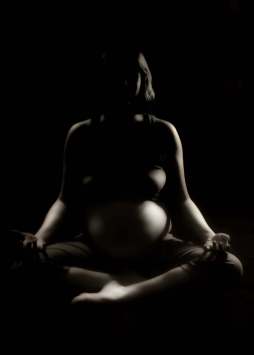
“My son started doing meditation. Well, that’s something. At least he’s not sitting around doing nothing.”

Sitting around doing nothing seems to be the worst sin in our society. Buddhism is quite radical in this regard. The path to Enlightenment leads through sitting around and doing nothing. Anything and everything else that we do to keep ourselves busy is determined by society, hence impermanent, hence not the truth. Continue reading “Internal Strife – External Conflict by Oxana Poberejnaia”

What If…She’s Stronger than She Knows…by Molly Remer

“When I dare to be powerful–to use my strength in the service of my vision–then it becomes less and less important whether I am afraid.”

Audre Lorde

“The purpose of life is not to maintain personal comfort; it’s to grow the soul.”

–Christina Baldwin

When teaching childbirth classes, I would speak to my clients about shifting the common fear-based “what if” cultural dialog of birth to “positive” anticipation rather than fears, encouraging them to ask themselves questions like: “what if I give birth and it is one of the most powerful, thrilling moments of my life?” While I stand by this practice, I also think about the what ifs that crawl out of our dark places and lodge in our hearts. The what ifs that snake around the edges of our consciousness in the early hours of the morning. The what ifs we try to push down, down, down and away. The what ifs that stalk us. The what ifs so very awful that we fear in giving voice to them, we might give life to them as well.
We may feel guilty, ashamed, negative, and apologetic about our deepest “what ifs.” We worry that if we speak of them, they might come true. We worry that in voicing them, we might make ourselves, our families, our communities, our work, or philosophies, our faiths, or whatever look bad. We want to be positive. We want to be blissfully empowered, confident, and courageous. And, guess what? We are. Sometimes that courage comes from looking the “what ifs” right in the eye. Sometimes it comes from living through them. My most powerful gift from my pregnancy with my daughter, my pregnancy-after-loss baby, was to watch myself feel the fear and do it anyway. I was brave. And, it changed me to learn that.

What if we can learn more from our shadows than we ever thought possible? There is power in thinking what if I can’t do this and then discovering that you CAN.

Continue reading “What If…She’s Stronger than She Knows…by Molly Remer”

Mulling over Movies: Moana, Pt. 1 by Elise M. Edwards

elise-edwardsI love going to outdoor movie screenings.  Sitting outdoors on a summer evening with good company brings me joy.  Last week, I went to an screening of Moana, the Disney movie about a teenager who goes on a quest through the Pacific Ocean with the demi-god Maui.  Moana goes on this journey to help her people.  The movie came out last year, but I didn’t see it.  I have to admit that I wasn’t even interested in it until Simone Biles performed a dance to one of Moana’s songs on Dancing with the Stars. It was then that I realized that the movie has an empowering message.  I asked my friend Natalie, who is also a feminist religion scholar, about Moana.  She has three young daughters, so I trusted her to be more current than I am.  Her enthusiastic response sold me, as did her remark, “There’s not even a love story in it!”

Ah, Disney princesses and their love stories!  I’m old enough that I didn’t grow up with the Disney culture that children in the past few decades have, but I haven’t been immune to the Disney princess phenomenon.  I childhood pre-dated DVDs and digital downloads, but I still knew and cherished the Disney characterizations of Snow White, Cinderella, and Sleeping Beauty. These young women were kind and virtuous and beautiful (according to Eurocentric standards), but their stories culminate with marriage to a charming prince.  It’s also problematic that so often, the villains in these movies were older women—wicked stepmothers or evil witches—who were motivated by jealousy and hate.

Continue reading “Mulling over Movies: Moana, Pt. 1 by Elise M. Edwards”

Making Space for the Joy and the Grief by Chris Ash

Christy CroftLast week, I made a day trip on short notice to fly with a friend to Orlando. As we said our goodbyes, my friend encouraged me to try to catch an earlier flight to avoid arriving home too late in the evening. I briefly considered it, but instead grabbed a late lunch in the Orlando airport, sat down with a journal, and spent some time writing. It had been a stressful few weeks, and I relished the opportunity to put my heart to paper, to allow the pen to help me sort out the mix of emotions that were rolling over me.
Later that evening, during a two-hour layover in Baltimore, my friend called. “Are you home yet?” they asked, hopeful. Continue reading “Making Space for the Joy and the Grief by Chris Ash”

Stories vs. What Is by Oxana Poberejnaia

I have recently watched one of these real life entertainment documentaries. This one was on plastic surgery. A woman went under the knife to enlarge her breasts. The female presenter, wearing sterile white, peeped into the operation theatre and, facing the camera, said excitedly: “This operation might be life-changing!”

I thought: “Yes, precisely.” The money that the patient spent on breast implants could have bought – what? A trip to a strange land. A course for her to improve her employment prospects or to broaden her horizons. Art supplies for her to create something. A water pump to provide clean water in a village somewhere in the world where children die from preventable diseases caused by dirty water. Part of a salary for a teacher who works in a school for girls somewhere in the world where girls need extra help getting education.

Life-changing.

What we choose to spend money, or indeed any resources (time, energy) on depends on our story of life. What is life for us: a race to the unattainable ideal of glossy magazine covers or a spiritual journey we share with every other creature on earth? Continue reading “Stories vs. What Is by Oxana Poberejnaia”

Making Our Stand by Molly Remer

“You may not remember, may-2016-103
but let me tell you this,
someone in some future time

will think of us.”

Sappho

I put on my boots and jeans, grab my priestess robe, pack a basket of ritual supplies, and meet four close friends in a nearby cave. We feel a little nervous about holding ritual on unfamiliar land, but we decide to push our boundaries and do it anyway. The land needs us, says my friend. The other people who come here are meth-heads and vandals.

We take our drums and climb to the top of the cave, singing as we find our way up the steep hillside. On top, looking out across the country, we sing: cauldron of changes, feather on the bone, arc of eternity, ring around the stone. We laugh and practice some more songs, some hearty, some tentative and new. We tie up small bundles of our symbolic burdens with stones and let them down over the edge
may-2016-051using handspun wool yarn until the yarn releases, taking our burdens with them. Suddenly, we hear the sound of tires on the gravel. Slamming doors. The sound of loud men’s voices. The smell of cigarette smoke. A ripple of uncertainty passes through us. We are once again tentative and we feel a current of unease. What should we do? we whisper to one another. The voices draw nearer, there are calls and hoots. My friend looks at me and says: this is where we make our standWe hold hands in a line at the edge of the cave roof, gazing out into the horizon. A hawk wheels overhead. We sing. The approaching voices quiet. We sing louder.

I am a strong woman, I am a story woman, I am a healer, my soul will never die.

We project our voices and yell: we are the witches, back from the dead!

The voices stop. We wait. We hear doors slamming. The sound of tires on gravel. We are alone once more.

We descend into the cave singing a song composed on the spot: Deeper, deeper. We’re going deeper. Deeper, deeper. Deeper still.

We strike a pose based on the carvings described in the classic book, When the Drummers were Women. Archaeologists described may-2016-099carvings of priestesses carrying drums as, “women carrying cakes to their husbands.”

We shout: “we’re not carrying cakes!”

I stand on a rock in the center of the cave and sing: she’s been waiting, waiting, she’s been waiting so long, she’s been waiting for her children to remember to return. My friends join the song and we move deep into the darkness where we face the “birth canal” at the back of the cave, listening to the small stream within trickle, laugh, and bubble as it emerges from the dark spaces deep within the heart of the earth. We begin to sing:

Ancient mother we hear you calling. Ancient mother, we hear your song. Ancient mother, we hear your laughter…

Just as we sing the words, ancient mother, we taste your tears, droplets of cave water fall on our faces, splashing our eyelids.

It might seem simple on the surface, but gathering the women and calling the circle is a radical and subversive act. A revolutionary act. In my work with women’s circles and priestessing, I am repeatedly reminded that gathering with other women in a circle for ritual and ceremony is deeply important even though it might just look like people having fun or even being frivolous, it is actually a microcosm of the macrocosm—a miniature version of the world we’d like to see and that we want to make possible.

In the book, Casting the Circle, Diane Stein observes that women’s rituals, “…create a microcosm, a ‘little universe’ may-2016-062within which women try out what they want the macrocosm, the ‘big universe’ or real world to be. Within the safety and protected space of the cast circle, women create their idea of what the world would be like to live in under matriarchal/Goddess women’s values…The woman who in the safety of the cast circle designs the world as she would like it to be takes that memory of creation and success out into daily life…By empowering women through the microcosm of the ritual’s cast circle, change becomes possible in the macrocosm real world.” (p. 2-3)

It starts with these private ritual and personal connections and then, as Stein explains, “A group of five such like-minded women will then set out to clean up a stream bed or park in their neighborhood; a group of twenty-five will join a protest march for women’s reproductive rights; a group of a hundred will set up a peace encampment. The numbers grow, the women elect officials to government who speak for their values and concerns. Apartheid crumbles and totalitarian regimes in Eastern Europe end, disarmament begins, and laws to control polluters are enforced. Homes, foods, and jobs are opened to the world’s homeless, and often begins in the microcosm of the Women’s Spirituality ritual circle” (p. 3)

“Feminism catches fire when it draws upon its inherent spirituality. When it does not, it is just one more form of politics, and politics never fed our deepest hungers.”

–Carol Lee Flinders (in The Millionth Circle)

january-2017-038Molly has been “gathering the women” to circle, sing, celebrate, and share since 2008. She plans and facilitates
women’s circles, seasonal retreats and rituals, mother-daughter circles, family ceremonies, and red tent circles in rural Missouri and teaches online courses in
Red Tent facilitation and Practical Priestessing. She is a priestess who holds MSW, M.Div, and D.Min degrees and finished her dissertation about contemporary priestessing in the U.S. Molly and her husband Mark co-create Story Goddesses, original goddess sculptures, ceremony kits, and jewelry at Brigid’s Grove. Molly is the author of Womanrunes, Earthprayer, and The Red Tent Resource Kit and she writes about thealogy, nature, practical priestessing, and the goddess at Brigid’s Grove