Goddesses of Mindfulness for a New Year Feminism and Religion by Angela Yarber

I’ll be honest. For me, 2017 royally sucked. Though “feminism” was dubbed the “word of the year” by Merriam-Webster’s—as evidenced by the Women’s March, the Handmaid’s Tale, Wonder Woman, and the Me Too Movement—the reason feminists thrust our fed-up fists into the air in protest so frequently was because of the way women are routinely unjustly treated.

In the midst of this global, political, national fury, I experienced personal struggles in 2017 with the death of my brother and my mother’s cancer diagnosis. There was beauty and goodness that filled the year, to be sure, but you can believe me when I say that I am welcoming 2018 with open arms. As I entered into conversation with myriad feminists across the gender spectrum around the world, it seems that many echo these sentiments. We could not wait to bid 2017 farewell. Yet, I knew that I did not want to enter the year filled only with bitterness and resentment. Rather, I wanted to mindfully move forward with radical gratitude, hope, and intentions set on creating a more beautiful 2018. Enter the goddess. Continue reading “Goddesses of Mindfulness for a New Year Feminism and Religion by Angela Yarber”

Hope for the New Year by Katie M. Deaver

I have never been one to set major resolutions at the beginning of the new year, but this year feels different somehow.  I can’t say that I am sad to see the end of 2017.  This year has felt like an unpredictable roller coaster both on a national and personal level.  The highs of finishing a doctoral program and building a relationship with my boyfriend’s six year-old daughter were met with the complications of job searching, concern over losing access to affordable health care, and my feeble attempts to balance appropriate and timely responses to the constant onslaught of ridiculous, or often downright appalling, headlines with my need to remain at least somewhat sane.  All in all I am ready for 2018 to begin and I feel a new drive to find ways to make this a better year for myself and for those around me.

How do I go about accomplishing this? I don’t want my new goals to go the way of so many resolutions… given up on or discarded by mid-January or perhaps February if I’m lucky.  Rather I want to find ways to dedicate myself to small changes that I can sustain long-term, small changes that help me feel as though I am having an impact.  In addition, I want to find ways to rejuvenate and reinvigorate myself and my actions on a regular basis… to make 2018 feel more like an enjoyable walk in lightly falling snow and less like slogging through five feet of that snow while carrying a heavy burden on my back.

Continue reading “Hope for the New Year by Katie M. Deaver”

Another Season of Reflection and Review by Elise M. Edwards

elise-edwardsI turn inward and become reflective at this time of year.  It’s the Advent season in the Christian liturgical year, which encourages practices of piety focused on preparation, examination, and hopeful longing.  It’s the end of a semester and a calendar year, which provokes review of the months before.  In the northern hemisphere, it’s a time of darker days and longer nights, which suggest a retreat indoors, in silence or in stillness.

During this time of year, I’m typically exhausted, and so I seem to enact annual rituals with a recurring sense of ambivalence.   I really love the celebration of Christmas, but preparing for it takes a lot of energy.  So I do some decorating, but not as much as I planned.  I attend some parties and celebrations, but end up missing or cancelling others.  I start a new devotional book, only to set it aside within a week or so.  I want this time of year to be both reflective and celebratory.  I want it to be spiritual and religious.  I want to be sociable with friends and family and also find time to rest and recover in solitude.  At some point, those goals seem too contradictory to be realizable and then I start practical negotiations:  How much decorating will I do? What kind of time will I set aside for solitude and self-care?  Will I have enough energy to be joyful and present with my family and friends?

“Some, but not enough” is the answer I seem to come to every year.

Some decorating, but not enough.  Some time for solitude and self-care, but not enough.  Some energy for social occasions, but not enough.  This year, I want to let go of that voice that says it’s not enough.  That voice that says I am not enough.

To help myself let go of the guilt and self-deprecation, while retaining the reflective focus of the season that may be life-affirming, I reviewed my previous years’ December writings on this blog.  What might I discern from this pattern of yearly reflection?

In 2012, I wrote about why women might be tempted to cancel Christmas.  I was in my final year of the Ph.D. program when I wrote that, and was prompted to do so when I heard that friends and colleagues were planning to skip Christmas preparations or scale them back dramatically.  That year, I sought to maintain “religious and social rituals associated with Christmas” so that I could be “spiritually grounded, emotionally provoked, mentally rested, and physically fed.” I don’t have a vivid memory of that year’s holidays, but as I read it again, I wonder if I was carrying a sense of religious obligation rather than release.  Did I feel free or beholden to social custom? I’ve learned that I will only be able to let that “not enough” voice go when I let go of the expectation that Advent and Christmas should look a certain way or I should be present to it in a certain way.  I’m more willing this year to let peace and joy ebb and flow  in celebrations and moments of sadness and mourning that accompany the season, too.

In 2014 and 2016, my Advent reflections were more focused on justice and peace at the societal level than in the household.  They were mournful.  In December 2014, I was trying to stave off despair after Michael Brown’s killer was not indicted by a grand jury.  The police officer would not stand trial for killing the black teen.  That year, I was mourning Michael Brown and Trayvon Martin and the loss of my own naivete as I became more conscientized about racial violence. I had a similar wake-up call last year when Hillary Rodham Clinton lost the US presidential election and I working through the anger and dread I felt at 45’s approaching presidency.  This year, the struggle continues as we anticipate changes to the tax code and DACA.  But at least Roy Moore lost.  We do continue to work for progress and systemic change, and sometimes, it works.

Feminists have long asserted that the personal is political and that the political is personal.  I’m acknowledging this holiday season that my perpetual weariness during Advent and Christmas is legitimate, as it emerges from personal and political struggle.  I am frustrated with the injustices and hardships I encounter at home, work, and the broader community.  I would not be weary if I was not awakened to the suffering.  This year, I accept that the exhaustion is part of the cost of my work and my calling.  The weariness will ebb and flow, as will joy and peace. Being able to teach and write is a blessing that allows me to help others become more aware of injustice and more involved in addressing it.  This year, I’m acknowledging that I’ve done what I can do.  I’m resisting the impulse to assess whether it was enough.  In previous years, I’ve been trying to hold on to hope; this year I’m resting in God’s grace.

As Christmas approaches, I’m embracing the Christian teaching that the divine meets humanity where we are.  The beauty of the Incarnation is that the eternal meets the temporal and that God unites with human to bring light to a suffering world.  That’s a gift for me this year, a comfort to be able to shift the focus from my own action and being to divine action and being.

I can see the sacred work and presence in this online community and other communities of faith.  Holiday blessings to you all.

Elise M. Edwards, PhD is a Lecturer in Christian Ethics at Baylor University and a graduate of Claremont Graduate University. She is also a registered architect in the State of Florida. Her interdisciplinary work examines issues of civic engagement and how beliefs and commitments are expressed publicly. As a black feminist, she primarily focuses on cultural expressions by, for, and about women and marginalized communities. Follow her on twitter, google+ or academia.edu.

Kintsugi for the Soul – Part I – by Vanessa Rivera de la Fuente

Kintsugi2

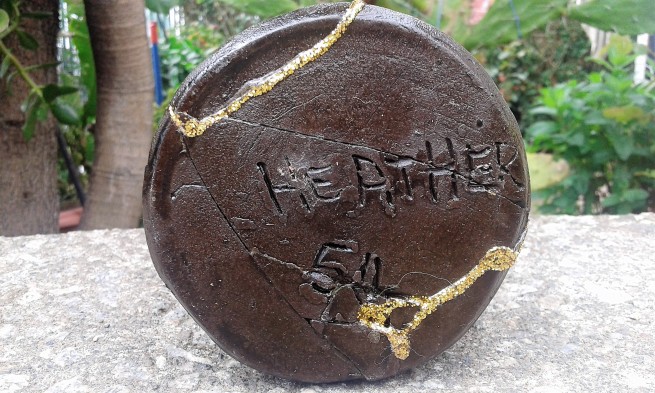
Kintsugi is a Japanese art technique that consists of repairing broken porcelain or pottery with resin varnish dusted or mixed with gold, silver or platinum powder. It is the art of fixing what has been broken with a precious metal that gives a greater value than that which the piece originally had. Kintsugi makes objects become a testimony of a particular journey.

In September 2015, in Cape Town, my fiance and I went to have lunch and listen to a concert at the Waterfront. Walking through the artisan market, we were struck by a stand where simple mugs of clay and pottery were displayed. Each one of them had been made by a woman survivor of some type of violence or trauma, which put her name and the imprint of her hands. Mugs had no handle, the way to take it was to put your hands in the hands of the woman. So, she connected with you and became part of your daily journey. Moved by the deep transcendence of the initiative, we got a pair. Mine was made by Heather, 54 years old. Continue reading “Kintsugi for the Soul – Part I – by Vanessa Rivera de la Fuente”

Holy Women Icons Bearing the Light of Advent by Angela Yarber

There’s nothing like the holiday season to bring out everyone’s least feminist self. In one of the courses that I teach—Gender, Food, and the Body in Popular Culture—students are assigned to examine gender roles throughout the holiday season through the lens intersectional ecofeminism. Inevitably, almost every student returns from holiday break with the same assessment: mom, grandma, and a kitchen full of women prepare, cook, and clean every family meal; women do the holiday shopping; men in the family watch sports. Of course, this isn’t true of everyone. There are plenty of families who subvert and dismantle stereotypical gender roles, but the holidays seem to heighten these roles, undergirding them with some kind of nostalgic and theological weight that claims that if mama doesn’t arduously prepare her famed casserole, the season will be ruined. Otherwise committed feminists find themselves singing carols filled with sexist language and participating in holiday rituals that they would critique any other time of the year. Subversion be damned because we want our traditional family holiday!

I’ve long struggled with creative ways to subversively approach the holidays as a queer clergywoman, parent, artist, and author. People like their nostalgic and heart-warming traditions, even when they sometimes smack of patriarchy, racism, and heteronormativity. I’ve confronted this as a preacher and worship planner, often to raised eyebrows or angry phone calls from congregants who just want to sing the carols without the preacher changing the words, or dismissing the notion of a virgin birth, or hanging enormous paintings of pregnant women all over the sanctuary.

Continue reading “Holy Women Icons Bearing the Light of Advent by Angela Yarber”

Season of Change – Transformation by Judith Shaw

judith shaw photoFall is here, the leaves are changing color, the days are shortening and our ongoing natural cycle of change and transformation now moves toward the dark, quiet days of winter. Both the idea and the process of transformation have fascinated me my whole life. Blame it on my Scorpio rising. Scorpio is ruled by Pluto, the planet of transformation and regeneration. Diving deep and surfacing has always been my mode.

Continue reading “Season of Change – Transformation by Judith Shaw”

“Queen Sugar:” Must-See Ecowomanist TV by Elise M. Edwards

elise-edwardsHave you been watching “Queen Sugar”?  It is a thoughtful, compelling, and gorgeous TV show that evokes ecowomanist sensibilities.

“Queen Sugar” is a television drama in its second season on OWN, Oprah Winfrey’s network. It was created by celebrated filmmaker Ava DuVernay, who is also the show’s executive producer.  The show has an all-female directing team and an inclusive crew.  Like many of the original series on OWN, “Queen Sugar” features a predominately African-American cast, and like many other programs on the network, it delivers content intended to stir the viewer’s soul.  But notably, “Queen Sugar”’s soulful messages are not mediated by the cadre of life coaches and inspirational leaders often seen on Oprah’s network.  Instead, it is the fictional Bordelon family who invites us to reflect on their world and ours. The series’ three main characters, Nova, Charley, and Ralph Angel, are siblings who take over their father’s sugar cane farm in Louisiana after his death. Their narrative and the lush cinematography that captures it offers viewers the opportunity to consider the complexity, joy, and hardship of African-American characters who are rarely depicted on screen.  The show’s themes and aesthetics are expressive of ecowomanist spirituality.

Continue reading ““Queen Sugar:” Must-See Ecowomanist TV by Elise M. Edwards”

Badb, Goddess of Life and Death by Judith Shaw

judith shaw photoWith the ongoing occurrence of huge hurricanes, floods, mudslides, earthquakes, possible nuclear war and more in both the US and worldwide it seems that the wrath of the Goddess has been awakened. I felt the need to revisit the Celtic Triple War Goddess, The Morrigan. One of Her aspects is Badb, which translates as “Hooded Crow” and “One Who Boils.” She signifies fury, rage and violence. She brings war, death, chaos but also enlightenment, life, and wisdom.  Continue reading “Badb, Goddess of Life and Death by Judith Shaw”

What I Believe (Post-2016) by John Erickson

Ever since the election of You-Know-Who, I have been doing a lot of creative writing.

Ever since the election of You-Know-Who, I have been doing a lot of creative writing. Unlike academic publications, policy reports, or my dissertation, creative writing, much like my mentor Dr. Marie Cartier has written about, provided me with a needed escape from a world that seems to grow darker with each passing day.  In college, I served as Poetry Editor for the Wisconsin Review, the oldest literary journal in Wisconsin. Continue reading “What I Believe (Post-2016) by John Erickson”

The Spirit and Jarena Lee: Inspiration to Break Boundaries by Elise M. Edwards

elise-edwardsI am so frustrated that we are still fighting to affirm women’s place in leadership.  I’ve been thinking about this struggle in the context of church ministries (especially preaching) and social activism, seeing a stark contrast between the way institutional churches and universities promote and subvert women’s authority and the ways movements like Black Lives Matter do.

Particularly, I’ve been struck by the ways that more radical movements employ language and practices that are based in spirit more than hierarchical authority.  I have found a theme emphasizing equality in humanity’s access to spirit in both historical and contemporary movements and writings about religious experience.  I’m certainly not the first one to notice or discuss how appeals to Spirit have empowered those excluded from dominant systems of power to challenge constrictive social structures, but I would like to share how this dynamic has become more visible to me so that, together, we might find encouragement, inspiration, and food for thought.

Continue reading “The Spirit and Jarena Lee: Inspiration to Break Boundaries by Elise M. Edwards”