Seeing Death and Resurrection by Linn Marie Tonstad

Linn Marie TonstadYesterday, I visited the Capuchin catacombs in Palermo, Sicily. In a grotto about a mile or so from the center of the modern city are found the preserved remains of about 2,000 people who paid the monks to preserve their bodies after death, dress them in their finest clothing, and put them on display. Each of them is placed in its own niche along the wall, held up by iron bands, and has a tag around its neck with its name and date of death. The bodies are not displayed in random order: they are sorted (to some extent) by sex, profession, and familial status. In one large recess, a number of children’s skeletons are on display, many of them in heartbreakingly tiny coffins. In another corridor, friar after friar hangs in his robes, some with cords around their necks signifying their adherence to a Franciscan order. Almost indistinguishable from the cords are the braids still hanging from the heads of some of the women’s bodies. Some families are arranged together; in another corridor doctors and lawyers are segregated and in yet another female virgins are gathered together. The oldest body I saw dated from 1599 – high on a wall hangs the body of a monk whose name was almost illegible but who hailed from the Umbrian hill town of Gubbio.

Some of the skeletons presented death’s heads; others had skin dried to a leathery tightness over remaining bony protuberances. Some of their outfits are well preserved; others have disintegrated under the relentless assault of the years. The practice became illegal around 1880, but until then, people chose – or perhaps their relatives chose for them – to be preserved in this seemingly macabre manner. Continue reading “Seeing Death and Resurrection by Linn Marie Tonstad”

“THE DIVINE MYSTERY”? by Carol P. Christ

carol-christ“The mystery of God in feminist theological discourse” is the subtitle of Elizabeth Johnson’s widely read She Who Is. The notion that God is “a mystery” is rarely questioned in feminist theologies. But maybe it should be.

Although it is true that the finite cannot encompass the infinite, and that all knowledge is rooted in particular standpoints, I do not agree that the first and last thing to be said about the divine power is that it is “a mystery.” Indeed as I will argue here, speaking about God as “a mystery” obscures more than it “reveals.”

christina's loveThe notion that Goddess or God is “a mystery” is rooted in notions of “a God out there” that most spiritual feminists reject. Goddess or God “in” the world is, I suggest, not unknown, but known, not hidden, but revealed–in the beauty of the world and in ordinary acts of love and generosity.

The notion that God is “a mystery” is a well-worn trope in Roman Catholic theology. Protestants make similar claims when they speak of  the hiddenness of God Continue reading ““THE DIVINE MYSTERY”? by Carol P. Christ”

Liberations of Immigrant Women in Western Religious Conversion by Andreea Nica

Andreea Nica, pentecostalismThe prolonged debate around feminist subjectivity and religious participation continues to evoke much compelling discussion in academia, political arenas, and public space. There have been a number of academic studies around the intersection of gender, religion, and migration, specifically on how gender and immigration assimilation is constructed and managed within western religious systems.

I am currently researching the trajectories of immigrant assimilation and conversion, and how gender relations and religious identities are managed within these processes to further develop my proposal for doctoral study. I find this area of research fascinating as it’s so diverse and pertinent to the progression of gender equity amongst religious participants. Continue reading “Liberations of Immigrant Women in Western Religious Conversion by Andreea Nica”

Truths My Mother Taught Me by John Erickson

I never gave much credence to religion but through my mother, I met G-d, and through her I understood that I’m not a feminist because of the books I’ve read but rather because of the woman I call mom.

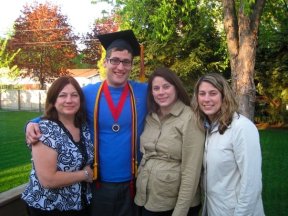
Graduation PhotoThe first question I always get asked when I’m in feminist spaces is: “What inspired you to become a feminist?”  Although I could go into the various histories revolving around men’s involvement in the early stages of the women’s movement to the similarities between the LGBTQ and women’s movements, my simple answer has always relied on one person: my mother.

I’ll be the first to admit (as well as many other people who will join me in the same chorus) that my mother deserves Sainthood for having put up with all the shenanigans I have, and still continue to, put her through. From running away from our local Catholic church the moment she dropped me off at Sunday School, to swearing like a sailor on leave at a very early age in front of Father Schmidt (who still fondly remembers me and the list I brought in with me to the confessional booth). Continue reading “Truths My Mother Taught Me by John Erickson”

On Reading, Not Reading, and Disagreeing by Linn Marie Tonstad

Linn Marie TonstadThe theology blogosphere in all its glory has been alive in recent days with furor sparked by a blog post from Janice Rees at Women In Theology, where she discusses not reading Karl Barth, the heavyweight German 20th-century Protestant theologian, as an act of resistance against his dominance in the theological academy and his status as a litmus test for serious scholarship. Reminding myself repeatedly of the great xkcd comic, I’ve resisted my urge to comment on this and a number of other recent debates. (See here for a list of links if you wish to catch up on the discussion, however.) So this is not a post on whether to read Karl Barth.* Rather, the debate made me take a look at some of my own reading practices, and the visions of theological discussion that they encode. It also brought me back to the question of feminist disagreement, which continues to lurk in the back of my mind as I pursue disagreements with some prominent feminist theologians in my current book project.

I’ve written here before about reading authors that I disagree with, and indeed working on theologians I think are wrong about certain issues. On the simplest level, as a feminist and queer theologian, many of the theologians I work on would have questioned or outright resisted my participation in the discipline to begin with – although we cannot always know whether and how they would have done so today (since many of them are dead – yes, the dreaded dead white European males). But I often – not always – find projects that I sincerely disagree with utterly fascinating. From what perspective does the system being developed in such a project make sense? Where would one have to stand to see what that author sees? What do I come to understand about my current context, or the author’s context, from the perspective of the debates and decisions that the author finds pressing? One fairly trivial example: any interest I might once have had in historical Jesus debates was settled forever by reading Albert Schweitzer as an undergraduate. I simply do not find such debates compelling in themselves. (That does not mean I think they are valueless, of course!) But reading theologians who were engaged in such debates teaches me a great deal about how the commonsense assumptions many of us today operate with came to be. And seeing how such debates accompany disagreement over right social relations, over the nature of transmission of Christian traditions, and over what counts as scholarship in theology and religious studies is simply fascinating. Continue reading “On Reading, Not Reading, and Disagreeing by Linn Marie Tonstad”

Neo-Orthodoxy: The Apotheosis* of Power as Power Over by Carol P. Christ

carol-christRecently I have been thinking about Neo-Orthodoxy, the leading  Protestant theological movement of the twentieth century, as a deification of male power as power over.  In the language of the schoolyard, this translates as “mine is bigger than yours.”  Or more precisely:  “God’s is bigger than yours.” 

Neo-Orthodoxy dominated Protestant theology in Europe and America in the mid-twentieth century and structured my theological education at Yale in the late 1960s and early 1970s.  Yale may have been “the bastion” of Neo-Orthodoxy, but Neo-Orthodox perspectives reigned in all the Protestant seminaries and were even celebrated in the media.  Neo-Orthodoxy may have some commonalities with fundamentalism but it was by no means an anti-intellectualist approach to theology.

A reaction to the perceived “impotence” of German Protestantism in the face of Hitler, Protestant Neo-Orthodoxy asserted “the commanding power of God” over against reason and culture.  Its leading advocates included the Swiss theologian Karl Barth, the German New Testament scholar Rudolf Bultmann, and the German theologians teaching in the United States, Reinhold and Richard Neibuhr, and Paul Tillich.  For all of them in different ways, the “Word of God” was a dynamic force that imploded into history challenging individuals and communities to turn away from egotism and “idolatry” defined as worship of something less than God–for example, self, nation, or wealth. Continue reading “Neo-Orthodoxy: The Apotheosis* of Power as Power Over by Carol P. Christ”

Losing my Mother and Realizing her Resurrection by Gina Messina-Dysert

Gina and momFive years ago today I buried my mother.  Violence took her life; however because of this patriarchal culture we live in, there was no prosecution in her death.  Violence against women is of little consequence in our society.

She died at the very young age of 56 on June 29, 2008, the same day I was moving to California.  I was just about to get into our moving truck when I got the call.  I will never forget the moment I heard the words, “your mom passed away last night.”  It was as if I felt her dying in that moment, as if my heart was falling from my body.  I cried out so violently and fell to the floor.  How could this be real?  How could my mom be gone?  The day before we had stood in my kitchen, danced, sang, laughed, embraced.  She was so alive, but in a moment, she was gone.  I begged and pleaded with God, I thought it was a mistake, Continue reading “Losing my Mother and Realizing her Resurrection by Gina Messina-Dysert”

God Doesn’t Live Here Anymore: Gay Bars and the Growing Divide Between Sexuality and Spirituality by John Erickson

oes God exist within the LGBTQ community anymore or has the community itself abandoned God for all-night raves, dance clubs, alcohol, and hypersexualized and over commoditized fetishized forms of femininity and masculinity? Oftentimes, I find myself answering yes to the above questions. After surviving hate crime after hate crime and endless batches of newly elected conservative politicians hell bent on ignoring medical and social epidemic plaguing the very country they were elected to serve and protect, why would a community, oftentimes linked to sin itself, believe in a holy entity?

John Erickson, sports, coming out.My good friend and fellow Feminism and Religion Contributor Marie Cartier’s forthcoming book, Baby You Are My Religion: Women, Gay Bars, and Theology Before Stonewall argues that American butch-femme bar culture of the mid-20th Century should be interpreted as a sacred space.  Specifically, gay bars served as both communal and spiritual gathering spaces where butch-femme women were able to discover and explore not only their sexuality but also their spirituality.  An opus of an academic accomplishment based off of the amount of in-depth interviews she conducted, Professor Cartier explores lived religion in an area that has become all too common within the LGBTQ community: the bar

The Palms, the last local and only lesbian bar to be found in city of West Hollywood, CA is closing its doors and I can’t help but wonder where its patrons or parishioners will now go? Continue reading “God Doesn’t Live Here Anymore: Gay Bars and the Growing Divide Between Sexuality and Spirituality by John Erickson”

Lust in the Heart by Linn Marie Tonstad

Linn Marie TonstadLove the sinner, hate the sin. We are all familiar with the bludgeon this statement represents in Christian circles. It functions as a way to maintain one’s goodness and Christlikeness (supposedly!), while simultaneously condemning and persecuting those who find themselves drawn to live lives outside the constraints of heteronormativity in all its variations. The statement hardly needs to be deconstructed – it proves its own emptiness in relation to the way sexuality is understood as identity in the contemporary context. (There are Foucaultian reasons to be unhappy with this understanding of sexuality – one of the disciplinary functions of power on his account is the desire to find a name that will express one’s true identity – but we’ll save that for another day.)

Instead, I think we should consider a much more fundamental contradiction in the way Christian churches today speak and think about sexuality. In many mainline congregations in the US-European context, the debate has been framed around celibacy versus “practice” for persons identifying as gay and lesbian. Excluding the fringe ex-gay movement and its horrors, there are three typical positions that churches take up. One, celibate gays and lesbians may participate fully in church life. Two, married and monogamous gays and lesbians may participate fully in church life. Three, neither marriage nor monogamy are required for gays and lesbians (or anyone else) – the latter is perhaps not a frequent position for churches to take, at least officially, other than in the MCC. For most mainline denominations, the fault line lies between those who assert the ‘vocation’ of celibacy for gay and lesbian persons, and those who permit marriage. Continue reading “Lust in the Heart by Linn Marie Tonstad”

Orientations: Body, Space, Authority by Linn Marie Tonstad

Linn Marie TonstadIn her book Queer Phenomenology, Sara Ahmed investigates how we orient ourselves in space with respect to tables – the tables around which we sit, at which we eat with friends and families of choice and birth, and at which we write. She describes moving into a new place and arranging the furniture. “After the kitchen, the room I hope to inhabit is always the study. Or the place that I have decided is the place where I will write. There, that will be my desk. Or it could just be the writing table. It is here that I will gather my thoughts. It is here that I will write, and even write about writing. … Making a place feel like home, or becoming at home in a space, is for me about being at my table. I think fondly of Virginia Woolf’s A Room of One’s Own. How important it is, especially for women, to claim that space, to take up that space through what one does with one’s body. And so when I am at my table, I am also claiming that space, I am becoming a writer by taking up that space.” (11) Ahmed goes on to discuss how certain possibilities are opened up, and others foreclosed, by the way we orient ourselves (or find ourselves oriented) to others and to objects. She describes the bodily postures that result from orienting oneself to the writing table – the way one might hunch over one’s computer, or find oneself with ink-stained fingers.

In a very different context, the queer theologian Marcella Althaus-Reid describes a scene from her childhood in Argentina. She kneels in front of a priest for confession. But instead of kneeling to the side, aslant, as she ‘ought’ to have done, being a girl, she kneels directly in front of the priest, as if she were a boy. Kneeling here too is a form of orientation, a form of direction, a bodily habit of becoming. “Kneeling is troublesome and it has a theological referent in the church’s also troubled waters of sexuality and power. A whole symbolic sexual order is obviously manifested in kneelings as positions of subordination and sites of possible homo- and hetero- seductions, because these are theologically distributed around the axis of the priesthood’s male genitalia. The priest’s penis carries the sacred connotations of the phallus as a transcendental signifier of the theological discourses to everyday Christianity, and kneeling is a liturgical positing designed to centralise and highlight this.” (The Queer God, 11) To kneel in the right (gendered) position in relation to the priest is also to kneel in the right relation to God. Continue reading “Orientations: Body, Space, Authority by Linn Marie Tonstad”