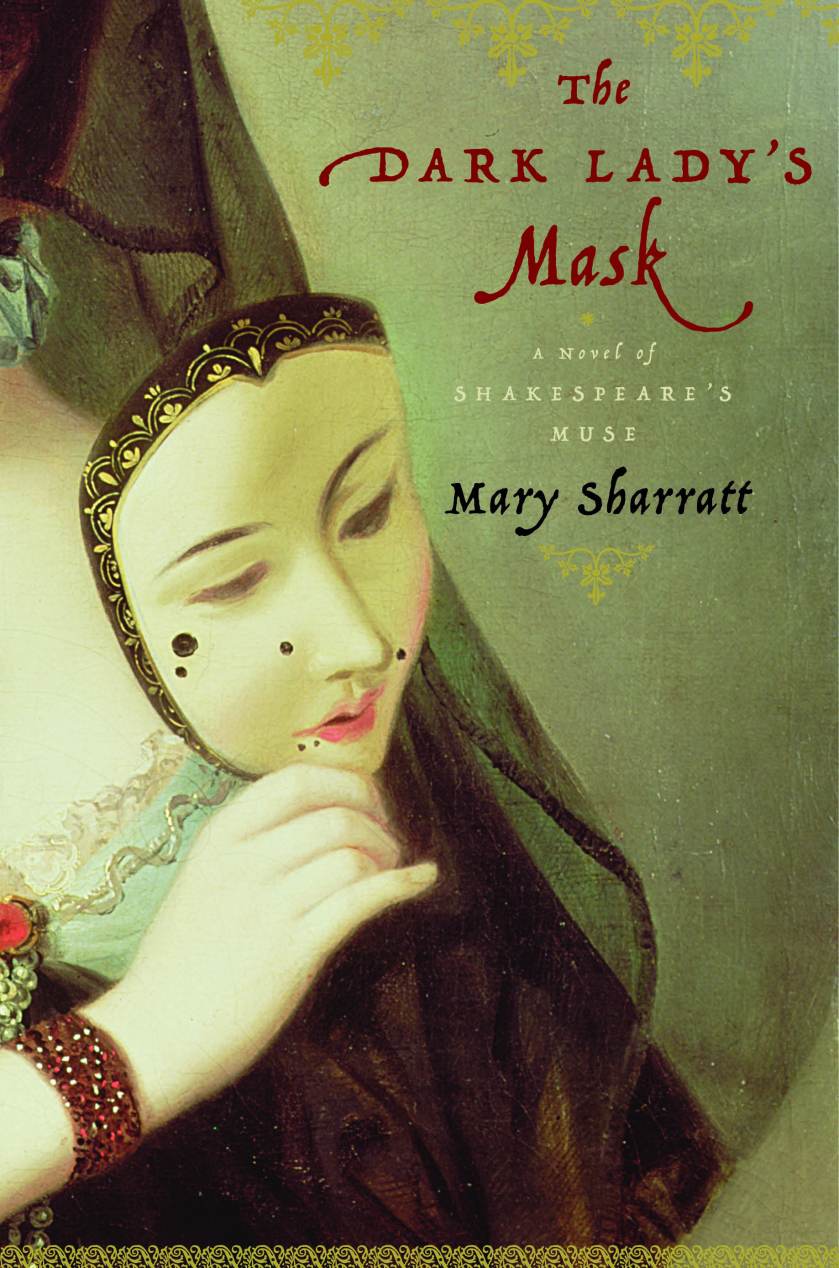
Aemilia Bassano Lanier (also spelled Lanyer) is the heroine of my new novel The Dark Lady’s Mask. Born in 1569, she was the highly educated daughter of an Italian court musician—a man thought to have been a Marrano, a secret Jew living under the guise of a Christian convert. She may have also been the mysterious, musical Dark Lady of Shakespeare’s sonnets, although most academic scholars dispute this. What we do know for a fact and what really matters is that she was the first woman in England to pursue a career as a published poet.
In Italy women such as Isabella Andreini published plays and poetry on a wide variety of secular subjects, but in England Lanier effectively had only one option—to write devotional Protestant verse. Her English literary predecessors, Anne Locke and Mary Sidney, wrote poetic meditations on the Psalms.
But Lanier turned this tradition of women’s religious poetry on its head. Published in 1611, her Salve Deus Rex Judaeorum (Hail God, King of the Jews) is a radical, ground-breaking tour de force, a searing vindication of the rights of women—and of herself as a woman writer.
In this epic narrative poem, Lanier describes the passion of Christ from the viewpoint of the women in the Gospels. In comparing the sufferings of women in male-dominated culture to the sufferings of Christ, she upholds women as Christ’s true imitators.
Most significantly Salve Deus is dedicated and addressed exclusively to women, and is prefaced by nine praise poems dedicated to the royal and aristocratic women whose patronage Lanier sought. She also included a dedication in praise of all women.
Having thus established her female audience, Lanier attacks the theological roots of male domination, namely the blame attached to Eve—and by extension all women—for humanity’s fall from grace. In “Eve’s Apology in Defence of Women,” Lanier argues that the original sin was actually Adam’s for accepting the forbidden fruit. For he, unlike Eve, was fully aware of the consequences. Out of selfishness and desire for power, Adam let Eve take the fall.
If Eve did err, it was for knowledge sake,
The fruit being fair persuaded him to fall:
No subtle serpent’s falsehood did betray him,
If he would eat it, who had the power to stay him?
Not Eve, whose fault was only too much love.
Lanier contends that male culpability in crucifying Christ far exceeds Eve’s tragic misunderstanding. Therefore there is no moral or divine cause to justify women’s subjugation. Here Lanier explicitly champions women’s rights and freedoms:
Let us have our Liberty again,
And challenge to yourselves no Sovereignty,
You came not into the world without our pain,
Make that a bar against your cruelty;
Your fault being greater, why should you disdain
Our being your equals, free from tyranny?
If one weak woman simply did offend,
This sin of yours hath no excuse, nor end.
Lanier’s poetry lays claim to women’s God-given call to rise up against male arrogance, just as the strong women of the Old Testament rose up against their oppressors. While wooing her highborn female patrons, Lanier uses the scriptures to assert a sense of social egalitarianism that foreshadows the Levellers and the Quaker religious movement that emerged a few decades after her poetry’s publication. “God makes both even, the cottage with the throne,” Lanier writes in her dedicatory poem to her former pupil, Lady Anne Clifford. (Clifford was herself a feminist firebrand who fought long and hard to regain her properties after her father disinherited her because of her sex. Anne Clifford was an ancestor of Vita Sackville West and the historical inspiration for Virginia Woolf’s novel, Orlando.)
Lanier’s book ends with “A Description of Cookham,” an elegiac ode to the country house where she lived for a time with Anne Clifford and her mother Margaret, who was Lanier’s greatest patron. Cookham was the blessed refuge where Lanier received both her spiritual epiphany and the confirmation of her vocation as a poet.
Farewell (sweet Cookham) where I first obtained
Grace from the Grace where perfect Grace remained,
And where the Muses gave their full consent,
I should have the power the virtuous to content.
Salve Deus Rex Judaeorum is a corpus of poetry celebrating female and divine goodness, penned by a poet who found her own sense of salvation in a community of women who supported her and believed in her.
Mary Sharratt’s book Illuminations: A Novel of Hildegard von Bingen, won the 2013 Nautilus Gold Award, Better Books for a Better World. Her forthcoming novel, The Dark Lady’s Mask, will be published by Houghton Mifflin Harcourt in April 2016. Visit Mary’s website.


 In my previous post, I mentioned a book I am writing about how theological and ethical considerations in architectural design can define good architecture. In that post and in ones to follow, I am acknowledging the feminists and womanists and mujeristas who have influenced me while also opening up the dialogue to the feminists in this community who continue to inspire and guide me to do my best work.
 As a teenager, I grew up wondering where exactly I belonged. Aside from the confusion resulting from straddling two entirely different, perhaps even opposing, cultures, my main concern seemed to center on which country was I from – India or Zambia? Or was I inherently British because of an education and upbringing enveloped by things English – values, books, magazines, not to mention people? Was I American because I grew up on TV shows like Charlie’s Angles, Wonder Woman, Six Million Dollar Man and Dallas that played a major role in fashioning my idea of the world around me? Perhaps I was Zambian because I had been living in that part of the world since the age of one. Or maybe I was from India because that was after all the land of my birth, to where I returned as an utterly confused and disjointed teenager who believed she now had to be “Indian” even though I could not relate so much as an iota to my immediate surroundings.
 Mary, Mary, quite contrary,
 I’m going to do something I’d never thought I’d do: fill your newsfeed with yet another article pertaining to the 2016 United States Presidential election and yes, I’m going to talk about former Secretary of State Hillary Clinton (hint: I’m emphatically supporting her and I’m unapologetic about it.)
 The most recent
  In 1985, four months before I was supposed to graduate from high school, I awoke one morning, made a hasty decision to escape my harsh reality, and by the end of the day, I was a high school drop-out.
 Last month I came face-to-face with a fisher.
 The elevation difference brought us face-to-face. I found myself staring into a fierce, furry-brown, teddy bear face. It exuded a stout confidence and an instinctual danger thumped. Eye-to-eye, neither of us moved. What was this thing? Suddenly from the reservoir of memory a recognition emerged—it looked like a wolverine. But wolverines aren’t in these woods, right? Fifteen unflinching seconds passed and then it leapt back into the woods. I stood mesmerized by the beauty and surprise of it—this was not something ordinary.
  I have never understood the logic behind sexism. Why is half (or so) of the human race better than the other half? Of course, patriarchy and patriarchal religious traditions offer various seemingly logical reasons, sometimes even divine explanations for the inequality between the sexes. Still, the –isms of patriarchy, whatever their “reasons” or perhaps better excuses, puzzle me.
