

 Continued from Part 1. As I sought to uncover the bones of the cunning woman Mother Demdike’s story, I was drawn into a new world of mystery and magic. It was as though Pendle Hill had opened up like an enchanted mountain to reveal the treasures hidden within. Every stereotype I’d held of historical witches and cunning folk was dashed to pieces. Continue reading “Mother Demdike, Ancestor of My Heart, Part 2 by Mary Sharratt”
Lotus in the Mud: A Metaphor for Humanity on our Darkest Days by Elisabeth Schilling
 There are days I find myself so overwhelmed with sadness concerning the state of our world that I break down crying. Last week, I saw an episode of Mars, a scripted documentary shown on the National Geographic channel about human colonization of the red planet in 2033. One of the astronauts “interviewed” prior to leaving was asked why she was taking such a risk to inhabit Mars. She said something like, “We will give everything for this.” Why not give everything for Earth?
If we would give everything for the planet we evolved on, then we might immediately transition to a life where we would be self-sustainable, build greenhouses in our backyards, give up our carbon-emission- producing cars, and abandon all the unnecessary businesses that are only there to fill our loneliness and boredom. The idea on the psuedo-documentary was that humans are putting this planet in danger, so it might be smart to have a backup. Isn’t that insanity’s way: trash one place and then find another place to live? The insurmountable amount of money we spend on space expeditions could be spent healing our own world. This is not the time for luxuries. Continue reading “Lotus in the Mud: A Metaphor for Humanity on our Darkest Days by Elisabeth Schilling”
Sacred Marriage or Unholy Cover-up? by Carol P. Christ
 Many women are drawn to the image of the Sacred Marriage—perhaps especially those raised in Roman Catholic or Protestant traditions where sex is viewed as necessary for procreation but nothing more, and who learn that the naked female body as symbolized by Eve is the source of sin and evil. In this context, the positive valuing of sexuality and the female body found in symbols of the Sacred Marriage can feel and even be liberating.
Jungians have claimed that the Sacred Marriage is an archetype of the wedding between the “masculine” and the “feminine.” Many women have been attracted to this idea as well. It “softens” the radical feminist critique of patriarchy and male dominance. Rather than “castrating” the “phallocracy” as Mary Daly urged, we can think in terms of the “marriage” of qualities traditionally associated with male and female roles. Women, it is said, can use a good dose of ego and assertiveness traditionally associated with the masculine, while men need to have their dominating rational egos tempered by feminine qualities like care and compassion. Continue reading “Sacred Marriage or Unholy Cover-up? by Carol P. Christ”
A “Wicked Witch” Discovers Gratitude by Barbara Ardinger
Once upon a time there lived a youngish woman and her husband on a tiny farm outside the capital city. Their life was satisfactory. But when el presidente declared war on another country, the husband was press-ganged into the army, leaving his wife alone on the farm. Well, alone with a milk cow, a sow, a rooster, a dozen hens, and, on one side of the house, seven tiny graves holding stillborn babies.
The woman was devastated. “What am I going to do?” she asked herself over and over again. “The land here is poor and infertile. I’m poor and infertile.” She was so unhappy, all she could do was mope around. The animals went untended and soon began foraging for food. The seven tiny graves went unweeded. Their one good field went unplowed. The woman stopped taking care of herself.
The war went on and on. She could still hear explosions in the capital city, and now there were people traveling along the road at the edge of her field. Telling herself the explosions and the refugees from the city were none of her business, she just sat inside, feeling sorry for herself.
Time went by, and one morning when the youngish woman happened to look in the mirror (which was cracked), she was both surprised and not surprised by what she saw. Her hair was gray and ragged and dirty. Her face was wrinkled and dirty. Her clothes were wrinkled and dirty.
 “My goodness!” she said. “I look like an old wicked witch!” She gave this some thought. “Well,” she finally said, “why not? I’m alone and friendless. I have barely enough to eat. I remember hearing about other old women who lived alone. People thought they were wicked witches. Hunh! I guess that’s what I’ll do now. Go into the wicked witch business.” She thought some more. “Well, maybe semi-wicked. My grandmother taught me stuff her grandmother taught her—how to mix potions to heal or kill. How to read the cards. All I need to do is remember those lessons. Then I can go into the wicked witch business.” Continue reading “A “Wicked Witch” Discovers Gratitude by Barbara Ardinger”
Feminism and Religion Project Intern – Job Description
 Project Summary
:
Project Summary
:
Feminism and Religion (FAR), feminismandreligion.com, is a project that brings together multiple feminist voices from around the world to dialogue about the “f-word” in religion and the intersection between scholarship, activism, and community. It was established in the hope that feminist scholars of religion — and all who are interested in these issues — would utilize this forum to share their ideas, insights, and experiences, so that the community of thinkers would be nurtured as diverse and new directions are explored. The project has been incredibly successful in offering such a space and continues to act as a medium for feminist community.
Position Overview:
Feminism and Religion is seeking a creative, industrious, responsible, and highly-organized intern interested in working for a community-oriented collaborative online feminist project. Strong knowledge of the field of feminism and religion, excellent writing and editing skills, and the ability to engage WordPress and other forms of social media is desired. Responsibilities may include website support, reviewing, editing and uploading posts, responding to comments and submission inquiries, recruiting new contributions, and sharing content.
This is an unpaid internship designed to be a learning opportunity for the intern. FAR co-founders will work closely with the intern to help provide a positive learning experience. This internship is a 6 month position, with the option to renew, and will require approximately 10 hours per week.
Values and Expectations:
We work to create and maintain a positive, encouraging, and collaborative environment for Feminism and Religion and its broader community. A FAR intern is expected to value:
- diversity
- dialogue
- collaboration
- community building
- gender justice
To Apply:
Please e-mail FAR co-directors at (feminismandreligionblog@gmail.com) with:
- Your resume, including 2 references who can speak to your reliability, diligence, organizational style, and responsibility (these can be professional, academic, or scholastic).
- A cover letter indicating the reasons you are interested in working with FAR. Please highlight your interest and background in feminism, religion, gender justice issues, and/or gender/race/sexuality issues in religion.
- A writing sample between 1000-2500 words – a blog post is ideal.
Applications are due December 15th, 2016. Candidates will be contacted for more information and to schedule interviews in January.
For more information, contact Xochitl Alvizo or Gina Messina: feminismandreligionblog@gmail.com
Turning One by Sara Frykenberg
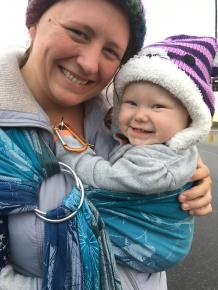 This month I turn one as a mother. My daughter, consequently, is also turning one—a first birthday I am excitedly planning. Specifically, I want to make Hazel a rainbow cake with lots of colored layers and white frosting. I’m not even sure she’ll be able to eat the cake (avoiding lots of sugar for a one-year-old and all), but among those family pictures I treasure, my mother held a cake for her little ones. I want to be like my mother. I am going to make a cake.
But planning my daughter’s party, I realized that I am also going to have a kind of birth-day anniversary. Other moms have told me that it takes a year to really process the experience of giving birth. While I did consider the significance of my “birthing community,” in a blog last fall, I realized a couple of weeks ago that I wasn’t done understanding what I, what mothers, and what life givers of all kinds go through to bring life into the world. Continue reading “Turning One by Sara Frykenberg”
Mother Demdike, Ancestor of My Heart, Part 1 by Mary Sharratt

Pendle Hill, seen from the back of my house, in May.
 The Soul of Gaia is the numinous earth beneath my feet, her soil cradling the bones and the stories of the ancestors who have died into the land and become part of the ever-living spirit of the place.
An expat writer, my home is everywhere and nowhere. A wanderer, I have lived in many different places, from Minnesota, my birthplace, with its rustling marshes haunted by the cries of redwing blackbirds, to Bavaria with its dark forests and dazzling meadows and pure streams where otter still live. But I don’t know if any place has touched me as deeply as Lancashire, England, my home for the past fifteen years. Continue reading “Mother Demdike, Ancestor of My Heart, Part 1 by Mary Sharratt”
The Real World Series by Natalie Weaver
 I live in Cleveland, and I am writing at the end of the World Series. I don’t know how it will conclude, but like most of the people in my city, I’m holding my breath. As I write, I literally just left the cardiac ward of one of the Cleveland Clinic hospitals, where patients’ lives actually seemed to hang in the balance of the game, according to one of the nurses who was monitoring heart rates from a central station in the hallway.
I, who never cared about baseball and avoided Cleveland sports, am more than a little surprised at myself. For, I have grown to care about the outcome of these games. Why so, I ask myself. Why am I sitting with my mom in the hospital, watching a game, when she’s ill, and neither of us has ever cared about sports? I’ve been thinking about this recently, and believe I have landed on the right answer.
You see, when you are from Cleveland, it is not uncommon to have this precise conversation or some permutation thereof:
Self: Hi.
Stranger: Hello there. Nice to meet you.
Self: Where are you from?
Stranger: Denver
Self: Denver is a lovely city. I visited for my friend’s wedding once.
Stranger: Yes. We love it out there. Great weather; friendly people. What about you… where are you from?
Self: Cleveland
Stranger: (chuckling) I’m sorry. Mistake on the Lake. River’s on Fire. Etc.
Clevelanders are made to feel shame about our city, whereas, by contrast, Chicago is heralded for its architecture, food, and skyline, and so one. Now, I have lived in Chicago. It is beautiful and all that, and, more importantly, Chicago is not what I am writing about. What I have come to observe about myself is that I actually love Cleveland for what it has to offer, which primarily includes people. Hard workers, brilliantly talented musicians, artists, actors, educators, physicians, architects, and more.
I have grown to appreciate the people and stories that built the city’s heritage, culture, ethnic churches, diverse neighborhoods, beautified lakefront, museums, international airports, colleges and universities, rivers, parks, gardens, and on and on. There is persistent and nearly inevitable derision that is glibly tossed our way here in the Two-One-Six. I realize, it has worn me down over the years.
And, especially when I travel for academic conferences and chat over drinks at the receptions, I am tired of playing Justin Martyr to the city, in large measure to defend my own merit as a scholar and educator. Continue reading “The Real World Series by Natalie Weaver”
Intellectual Circles, Authenticity, Legibility, and Working Class Roots by Chris Ash
 In my other writing for Feminism and Religion, I’ve discussed how a key focus of my spiritual path involves dancing within the tension of opposites, finding ways to move mindfully and freely inside the orbit of sacred circularities in which every curve leads into and out of its inverse, with infinite shades in between. Two areas of my life in which this tension has informed my lived experience are socioeconomic class and education. I’m only two generations away from factory workers and electricians, and three generations removed from a long line of poor farmers. Both of my grandparents on my mom’s side – with whom I lived as a child and whose influence on my life is felt every day – dropped out of school to work on their families’ farms.
And yet I was the little nerd in the gifted program, in two grades at once, through most of my childhood, even as my parents worked multiple jobs to make ends meet. By the time I left for college, I’d worked hard to rid myself of my Southern accent, not wanting to be flagged as uneducated or backwoods.
Whatever the markers for “poor” or working class in any given region – accent or dress or dialect – they frequently are coded as less intelligent. The impacts of these assumptions are felt early, as children from low-income or minority families are often overlooked for and underrepresented in gifted education programs, and the impacts are later reflected in graduation rates and college attendance statistics by demographic. Even as colleges work to provide opportunities for lower-income kids to attend, the dialogue typically focuses on how access to a specific, Western model of education can raise up underprivileged kids, and not on how getting smart kids from a diversity of backgrounds into the university system can expand the very boundaries of how a field understands itself and the framework within which it conducts its research. Continue reading “Intellectual Circles, Authenticity, Legibility, and Working Class Roots by Chris Ash”
Shared Leadership: The Hidden Treasure of Women’s Ritual Dance by Laura Shannon

From The dance: Historic Illustrations of Dancing from 3300 B.C. to 1911 A.D. London, 1911
Traditional women’s dances of Greece, the Balkans and the Near East come from cultures which have survived countless periods of upheaval, and teach skills which can help us through difficult times. I see their gifts as a precious inheritance from the ancestors, passed down through many generations. One particularly valuable skill which the dances emphasizes is that of mutual support and shared leadership among women.
Leadership in traditional dance is not limited to a few who have garnered social rank and power. Dance leadership is shared according to the occasion, and everyone must be prepared to lead dances at important events in their lifetime.
On Greek islands such as Lesvos, a small parea or group of women will typically dance the Syrtós together in a short line or open circle. The first dancer may express herself through turns and graceful flourishes of her free hand, varying her handhold and body position to dynamically interact with the other dancers. The women continually change places in the circle, encouraging one another to take the first position so that everyone eventually has a chance to lead. Continue reading “Shared Leadership: The Hidden Treasure of Women’s Ritual Dance by Laura Shannon”

