 The Pope’s call for a new study of the possibility of ordaining women as deacons in the Roman Catholic Church and the impasse in the United Methodist Church over homosexuality and abortion, once again ask us to recognize that theories about interpretation and interpretations underlie each of these hotly contested issues. It is not only that individual texts and traditions are subject to conflicting interpretations about their meaning in their own times or in ours. The decision to cite a particular text or tradition, is itself based on an interpretation about which texts and traditions are important or reliable enough to be cited.
The Pope may be convinced that Jesus chose only twelve male disciples, and he may cite certain texts in the Bible, centuries of tradition, and recent church decisions. But others would counter that there is evidence that Jesus had many more than twelve disciples, and that Mary Magdalene was among them. Those arguing that United Methodists should not ordain homosexuals as clergy or permit the sanctifying of homosexual marriage may feel they are on firm ground when they cite Leviticus 18:22 in support of their view that the practice of homosexuality is contrary to Christian teaching. But those on the other side ask why this particular passage is held to be binding on today’s Christian communities, while (for example) the many others affirming a man’s right to have more than one wife are not.
When traditionalists cite the Bible or traditional church teachings as definitive, others may counter that their alternative reading is the “true” interpretation of these same texts or traditions. What is often lost is the fact that all interpretations of texts and traditions are situated. Although it may not be easy to convince traditionalists that the widely accepted theory of situated interpretation is true, at minimum, we should not forget it as feminists.
Thus, if we hope to change inherited traditions, feminists have two tasks. One is to bring forward texts, traditions, and interpretations that have been ignored by those who support traditional (male dominant, anti-homosexual, anti-abortion) positions. But, in doing so, we should not succumb to the temptation to conclude that our new interpretations are unequivocally “true.”
To do so would be to ignore the feminist “first principle” that all interpretations of texts and traditions are situated. If we wish to argue that traditional teachings on the priesthood, abortion, and homosexuality are situated in standpoints we might call “patriarchal” or “anti-queer,” then we must also acknowledge the relativity of our own positions as well.
When this is recognized the ground beneath us shifts. We are no longer arguing about the “true” meaning of inherited traditions. We are no longer asking: “What does the Bible say?” or “What does God say?” Instead we are asking a more nuanced question that begins with the recognition that there is not only more than one interpretation of the meaning of a text, but also more than one interpretation of which texts should be considered central to the meaning of a particular tradition. It is in recognition of the principle that every interpretation is situated that Biblical scholar Elisabeth Schüssler Fiorenza always insists that the idea that Mary Magdalene was among the disciples of Jesus is true from the perspective of women (or wo/men) seeking liberation.
When we recognize the relativity of all standpoints including our own, we recognize that the right question is not “what God has revealed,” but rather, what kind of communities we wish to create and transmit to future generations. It is our responsibility, individually, and as communities, to answer this question. If we wish to create communities that are more inclusive than those we have inherited, then we can choose as “true from our perspective” and even as “divinely inspired in our experience and understanding” those interpretations of texts and traditions that support the kinds of inclusive communities we believe Goddess or God calls us to create.
As feminists, we must present new interpretations of texts and traditions. But this is the beginning not the end of the task before us. We must also insist loudly and clearly that all interpretations are situated. The interpretations we advocate are not any more “objectively true” than the interpretations of our adversaries. We cannot avoid naming and examining our standpoints and justifying our interpretations in relation to them.
Recognizing that all interpretations are situated does not mean that all interpretations are equal. We can and must justify our interpretations on linguistic and historical and other grounds. We can and must reflect upon our standpoints, asking what kind of communities and worlds are justified and envisioned from the perspectives of our own standpoints and those of others. And we can and must discuss contested questions about the meaning of traditions and the nature of divinity.
Though I have been speaking about interpretations of Christian tradition, the principles discussed here apply to every religion, including those newly discovered or created. Recently I have been noticing a tendency among some contemporary Neo-pagans to assume that mythic traditions are “true” and to make definitive statements that begin with the phrase “our tradition teaches.” But there is no reason to believe that pagan traditions are inevitably true–especially since many of them reflect patriarchal points of view–or that they are not subject to a variety of interpretations. While we can learn from traditions, we inevitably interpret them from our own standpoints. We can and must take responsibility for our standpoints and for our interpretations of every tradition.


 Blodeuwedd, also known as the Ninefold Goddess of the Western Isles of Paradise, was a Goddess like no other in the manner of her birth. She is one of the main figures in the Mabinogion, the Welsh cycle of stories of the early Celtic Goddesses and Gods. But to understand Blodeuwedd, her short life, her actions, and her death we must look back to the story of Arianrhod, Celtic Sky Goddess.
 I’ve been asked by both academics and Pagans what inspired me to pursue doctoral research on the British Goddess movement: of the many ways that people first
  a girl, the women in the neighborhood looked out for each other, and my mother had a wide circle of women friends. My grandmother lived nearby, and she and my mother spoke on the telephone nearly every day. My mother and I had a close relationship cemented by caring together for my baby brother.
 My
My  In the TV film about American suffragists “
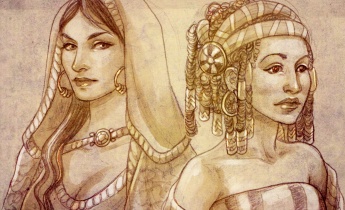 One story that has marked my life as a feminist is that of Sarah and Hagar. This is a story of pain and enmity among women under patriarchy that despite its age, is still relevant to illustrate the negative effects of the androcentric socialization. But it can also hold an inspirational feminist reading that leads us towards a reflection on the amazing possibilities of a shift in the way we women look at each other.
 If Jesus ran for president, what would his campaign look like? Where would he stand on social policy? Who would be his running mate? Who would (not) vote for him? With our current political dialogue dominated by supposed Christian views and a nation that overwhelmingly claims the teachings of Jesus as the basis for its morality, what would the response be if we came face to face with the (unintentional) founder of the tradition? How would we really respond to Jesus’ teachings in contemporary society? And maybe more frightening, how would Jesus respond to us?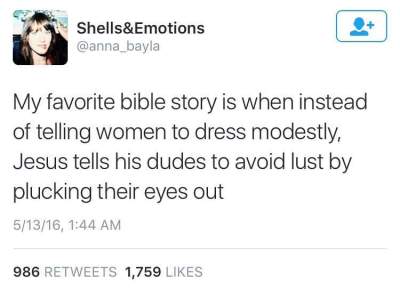

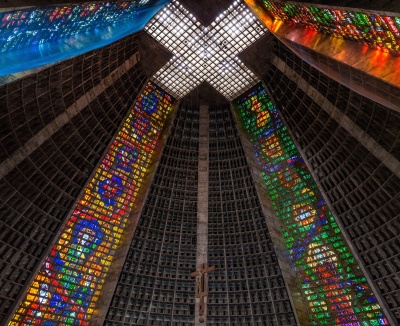
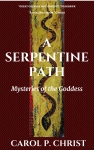 A Serpentine Path: Mysteries of the Goddess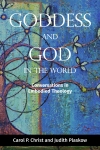
 Feminism and Religion