
Painting Herstory: Our Lady of Silver Lake by Angela Yarber

angelaIt has become my new routine during the first phase of my queer little family’s year-long journey. After completing my chores, I run along the trails surrounding Silver Lake and once I’m thoroughly drenched in sweat, I grab a book and push our enormous 15-foot canoe into the frigid waters of the little lake we’re calling home for three months. With a smile that has yet to wipe off my face, I paddle fiercely. I’m typically the only person on the lake.

It’s a steep mile hike from the trailhead, and we’re the only ones “living” here for the summer, so my giant green canoe ripples the silvery waters in solitude. Once I find the right spot, I stuff my life vest behind my head and cozy down into the belly of the canoe, book in hand, goofy grin still spread across my flushed face. In the warmth of the sun, I read. In the belly of the canoe, I drift into the history of the lake, the unwritten annals lapping alongside my rocking boat, the portions on record filling the book in my sun-warmed hands.

The author who wrote the history of Silver Lake, William Powers, hiked up with several autographed copies in his rucksack several days after our arrival. He’s a nice man who wrote a nice book. There’s nothing like reading about the history of a place while in the place. Hear me say this clearly: there’s nothing wrong with the nice book this nice man wrote. The stories of Frank Chandler feeling a call from God to build a place for religious camp meetings along Silver Lake’s shores are fascinating, an interesting part of the history of camp meetings that filled the Awakenings throughout the United States. But as I read about Frank Chandler and the various men who the logged roads hikers now hike and built the buildings that haven’t existed for years due to fire, I couldn’t help but notice who was missing. Continue reading “Painting Herstory: Our Lady of Silver Lake by Angela Yarber”
The Guessing Game by Vibha Shetiya

VibaMy husband, who is American, first introduced me to the word “negging.” Although I hadn’t come across it before setting foot in America, I soon came to realize it was a concept that knew few cultural bounds. The Urban Dictionary (UD) defines negging as “[when] you use remarks to tap into female insecurity; shake their confidence…neg is a negative remark wrapped in a back-handed compliment.” In the West, as I have learned, negging tends to target a woman’s physical attributes, often as a pick up line. Thus, as the UD again illustrates: “You are nearly as tall as me. I like tall girls (LIFT). Are those heels 4 or 5 inches (DROP)?”[1]

I’m from India and thought I’d provide an example of negging to illustrate its varied and glorious forms. Back when I was growing up, dating wasn’t socially acceptable in my culture – it often had to be done on the sly which probably explains why negging as a pick up line wasn’t the smartest choice. But we South Asians had and continue to have our own cultural equivalents of underhand methods specifically designed to erode a woman’s sense of self.   Continue reading “The Guessing Game by Vibha Shetiya”

E Pluribus Unum and The Unrecognized Black Goddess of Rome by Stuart Dean

Stuart WordPress photoE pluribus unum (‘EPU’), which first began to be used by the U.S. in the 18th century, comes from a poem entitled Moretum that until well into the 19th century was generally attributed to Vergil.  During those centuries Latin would have been studied from what was the equivalent of today’s elementary school through at least high school.  Because Vergil is to the study of Latin what Shakespeare is to the study of English, Moretum would have been read by anyone lucky enough to receive formal education in those centuries–mostly boys–including the white sons of slave owners.

Those boys, however, would have been motivated not just to read, but to memorize Moretum.  That is because Moretum, through a variety of clues, encourages allegorical interpretations, one of which is that it celebrates the sexual intercourse of a single white farmer and his sole companion, his black female slave.  Such an interpretation requires ignoring the clues that the author thinks of such sex as rape (as anyone other than a male slave owner would); those clues lead me to think the author may have been a woman.

Illustration of Moertum (1558 Edition of Vergil's works)

Illustration of Moretum from a 1558 edition of the works of Vergil available here.

Continue reading “E Pluribus Unum and The Unrecognized Black Goddess of Rome by Stuart Dean”

A Cornucopia Sometimes Curiously Stuffed With Nothing by Natalie Weaver

Natalie Weaver editedThe summer is getting late. School supplies are coming in, and it is time to try on the uniform pants in order to get them hemmed before the first day. I always feel a little funny at this time of year, almost queasy from my mixture of nostalgia for waning days at the pool and excitement for crisp plaids and fresh notebooks. I continually miss the scents of summer skin, chlorine and suntan lotion, even while I look forward to the autumnal fragrances of newly sharpened pencils, cinnamon sticks, and rubbery Halloween costumes. Time, at this transitional time, is always pregnant with the promises of both bounty and loss, so I am not surprised by my wistfulness as we turn to fall. I am, however, taken by its depth for me this year. For, this transition has been a little heavier than usual as I ask myself, “Where did it go?” and “What did I do?”

You see, I wanted to travel more with the kids, but I became sick, or rather, a sickness I already had presented itself unmistakably and irrevocably just as the summer was getting under way. So, I slept a lot, but it was not the sleep of rest and recovery; it was lost time. I felt bad about my crankiness and limitations, so I tried to make up the time by adding more play to the times of day when I felt good. The kids weren’t playing along though, and I just felt more exhausted. I was a broken record, as I kept asking what anyone wanted to do. And, I felt like I was failing when we couldn’t arrive at activities, or menus, or destinations. Continue reading “A Cornucopia Sometimes Curiously Stuffed With Nothing by Natalie Weaver”

Taking leave: How did you do it and how did it go? Sara Frykenberg

Image sourced from here.

As I mentioned in my last post, I have been preoccupied this summer with many questions regarding pregnancy, becoming a mother, and how to mother while doing my “work” as a feminist. But next to my constantly changing physical reality and the anticipation of a new family member, the question of what to do about my actual work, aka, my occupation, has been most pressing—perhaps, because taking leave from my job is something I feel that I can (and must) do something about in a long list of factors that I cannot control. Despite the imperative to act, however, I had a great deal of trouble figuring out where to begin.

As a professor in Los Angeles, I know that I have the same legal rights as other Californian women. I am allowed to take (unpaid) leave. My employer cannot fire me for exercising this right. I cannot be denied employment, legally speaking, because of a pregnancy. And… yup, that’s about all I knew when I started considering what to do about work… which is to say, I had no idea, practically speaking, how to exercise my rights. Continue reading “Taking leave: How did you do it and how did it go? Sara Frykenberg”

ALTERNATIVE IMAGES OF GOD BY CAROL CHRIST AND EMMA TROUT

Carol P. Christ at Alverno College 1
Carol Christ at the Conference of Women Theologians

Today I am publishing an early work on female language for God that I wrote with Emma Trout at the first Conference of Women Theologians in 1971. Highly contested at the conference, this essay is a foreshadowing of my subsequent work on the need for female imagery for divinity.

Rereading this essay more than four decades later, I am gratified to see that though we began our essay with the image of God giving birth (which I still view as an important image), Emma and I were aware of the danger that female imagery for God could reinforce “a false sexual polarity.” We insisted then that female imagery for God must not repeat sex role stereotypes, but rather must shatter them. Continue reading “ALTERNATIVE IMAGES OF GOD BY CAROL CHRIST AND EMMA TROUT”

What Would Durga Do? by Barbara Ardinger

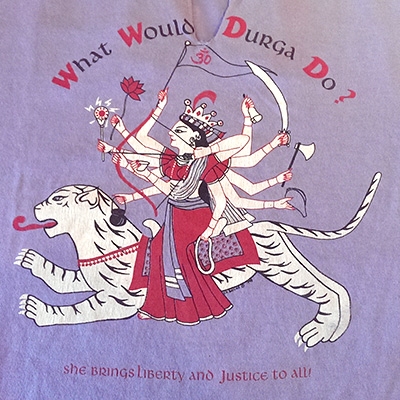
durga1_4inIt’s one of my favorite T-shirts. Every time I wear it, people who know who Durga is comment. So do some people who don’t know who the Hindu goddess is.


“What would Durga do?” is of course an echo of the question What would Jesus Do?

I’ve just done a bit of research and learned that this phrase may come from the Middle Ages, that it was famously used in a sermon in about 1891, and that it became very popular among evangelical Christians during the 1990s. What would Jesus do? I think he’d remind us to pay closer attention to the Sermon on the Mount (Matthew 5, 6, 7), especially the Beatitudes and the Golden Rule: “So whatever you wish that others would do to you, do also to them” (Matt.: 7:12). The Golden Rule is of course given in the other major religions, too. WWJD has also been turned into WWBD—“What would Buddha do?” I think the Buddha would tell us to live more mindfully.

But who, you may be asking, is Durga? Why does she have all those arms? Why is she carrying all those weapons? Why is she riding on a tiger? I’ll answer with reference to Patricia Monaghan’s New Book of Goddesses and Heroines (Llewellyn, 1997). While all the Hindu goddesses are ultimately one goddess with the collective name Devi (“goddess”), Monaghan writes, the goddess appears in different forms. “One of the fiercest of Devi’s forms is Durga … [who is] also the eldest.” She appeared during the “primordial war between gods and antigods” and is the “first manifestation of goddess energy” (p. 106). Continue reading “What Would Durga Do? by Barbara Ardinger”

The Unelected and Unaccountable Men Who Decide Our Fate by Laura Shannon

Bas relief of Atropos, shears in hand, cutting the thread of life

In Greek myth, the Fates, the Moirai, are three sisters – Clotho, Lachesis, and Atropos –  who spin, measure and cut the thread of life for every person born. Their rule is law; even the gods, so the legend has it, have no power to bargain with the one who cuts the thread and ends the life. Her name, Atropos, means ‘she who cannot be turned’.

In Greece today, others are making the life-or-death decisions. It is not the three sisters of ancient folklore, but a bunch of men in suits now wielding the power to uplift or cast down an entire nation and its millions of citizens. I would like to shine a little light on just two of these groups of (mainly) men who have had the most impact on the recent decisions to bring Greece to the brink of bankruptcy, default and catastrophe. Continue reading “The Unelected and Unaccountable Men Who Decide Our Fate by Laura Shannon”

The Wonder that is Being Born: How to Live Out Loud? Sacrilegious or Evolution? by Karen Moon

Karen 2006Yesterday, I went to a Women’s Circle, the description follows:

Our next circle will honor this journey of Venus or Innana as she was known by the ancient Sumerians. We will gather on Sunday, July 26th at 3 PM at my house. We will celebrate the divine feminine energy of Innana/Venus through meditation, song and dance. I encourage you to dress as your inner goddess, embracing your personal divine feminine energy. We will have our usual potluck munchies afterward.

I had spoken to the host on the phone previously and know her via Social Media.  My husband gave his helpful advice to be sure that it was not a “cult,” and yes, I do think any time you find things via social media, a big dose of common sense is needed.  Continue reading “The Wonder that is Being Born: How to Live Out Loud? Sacrilegious or Evolution? by Karen Moon”

Offering My First Khutba: On Imaan & The Divine Presence by Vanessa Rivera de la Fuente

Vanessa Rivera First KhutbaFor the last 6 weeks, I’ve been living in Cape Town, South Africa. This has been a blessed opportunity to grow, to gain more knowledge, and to reach outcomes that are beneficial both for my work as an activist and for my life as individual. One of the challenges I took up, on Friday, July 24th, was to offer my first Khutba ever: the text of which I share with you:

Invocation

I thank God for this day. I praise Allah for the paths I had to walk that led me to its light and the present day. I ask the protection of the Divine that lives in the essence of everything. and I invite my female ancestors to walk with me in this journey.

On Imaan and The Divine Presence

Allah speaks about Imaan (Faith) in the Holy Qur’an in Surat number 2 verses 1 to 5, which some scholars call “The verses of faith and belief.” I like especially ayat 2 that says:

“That is the book. There is NO DOUBT in it, a guidance to those who are truly conscious.” Another translation says, “Sure, without doubt, a guidance for those who are God-fearing.”

Let’s think a moment about this:

1.- Allah tells us that the Holy Qur’an is, without doubt, surely, with complete certainty, a guide. There Is No Doubt, that we can put our faith and trust in it, and we won’t be deceived. That’s a beautiful aspect of Faith. We can trust in the promise of Allah that the Qur’an is… without doubt… a guide, a path of spiritual growth and happiness in this world and in the hereafter.

2.- A guide to whom? Allah says in the Qur’an “For those who are truly conscious and God-fearing.” Reflect on this. What kind of Imaan is that? Being “truly conscious” is being aware, and this is to be awakened, alert, attentive,and  in possession of knowledge with our senses and reasoning functioning properly. Then, this is not a blind Faith, but a conscious Faith, an Imaan over which we have direct and personal accountability. Then, the Qur’an is certainly a guide to those who are God-fearing, meaning those who are aware and accountable for their faith; for those who have come to certainty after an effort of conscious reflection, because, as God says in the Qur’an: “Truly in that there are signs for a folk who reflect” (45:13). There is no Imaan without a personal Jihad in matters of belief. Continue reading “Offering My First Khutba: On Imaan & The Divine Presence by Vanessa Rivera de la Fuente”