

 Read Part One of this story here.
The two men nodded in mutual respect, and the priest pointed at the old woman, who was now sitting on a three-legged stool. “Your Grace, the Pythoness herself is in attendance today. The Eldest One. Because of your … ah … great generosity to the holy precinct of the College of Lord God Apollo, we—I, myself, I went down … down in the darkness … went down to fetch her. Under the command of the Lord God Himself. All has been explained to you?” As the general nodded, the priest hurried on. “You understand, then, that Lord God Apollo has received your inquiry? The Pythoness will reply. That is, she will convey the Lord God’s words, which I myself will translate. You understand that old women often speak gibberish that common men—that … ah … august personages such as yourself—do not … er … comprehend.” The general frowned. “It’s part of the mystery! It is as Lord God Apollo permits.” The general nodded again. “If Your Grace will kindly excuse me, I must prepare myself. Ordinarily, the younger priests carry out these duties … for the questions of common men … that is to say—”
“Get on with it, man. I’m waiting. My army is waiting. The enemy is waiting.”
The high priest bowed. “Yes. Of course. Waiting.” He bowed again, backed away, and walked with fussy dignity to his station, a pavilion just outside the shed where the veiled woman sat waiting. The pavilion had been especially constructed for this occasion. Gold and white cloths were draped across ebony poles to shade a wide ivory chair for the head priest and a low table for the stenographer, a skinny brown man who emerged from one of the marble outbuildings and stumbled down the slope.
Continue reading “Fragment. From Delphi. Part Two by Barbara Ardinger”
 How much longer do I as a Muslim American female, have to deal with the “gang-buster,” terrorizing, “Satan” worshipers high-jacking my faith for the sake of trying to supposedly ‘preserve’ it? Who are these wackos and why do they seem to represent my faith in mainstream media? Where did they all come from? Which terrorist schools have they all graduated from and what truly is their agenda?
 Feeling safe again is often the healing and elusive aspiration of a person like me.
 The wasp nest dwells at the edge of my vision waiting for me to notice what it has to show me. In my mind, I have come to this beloved circle of earth beneath the embracing branches of this tree to ponder because the need is urgent for all the world’s women to have lives of peace, safety, equality, opportunity, and enough prosperity to guarantee necessities, and to save our planet from ecological disaster. I seek new ways of thinking about my life and actions and those of the global community of women to inspire more effective means of progress.
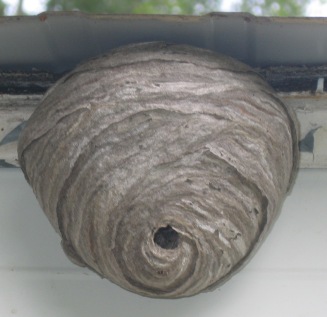 I finally spy the wasp nest. I follow its spiral shape, beginning at one point and then expanding in circles ever-outward and upward. I wonder, what if, in addition to perceiving my life as the more traditional journey or age-defined stages, I imagined it as a spiral like the galaxy, flowers, ancient sea creatures caught forever in fossils, swirling water, and so much else of nature? What if at my birth I was like a spiral’s central point, perhaps me at my most essential or as an infinite potential, and then, over time, I spiraled endlessly into the cosmos?
 My father always encouraged us to interpret scripture for ourselves. We read text, learned mainstream interpretations, and then he would ask for our authentic self-generated interpretations delivered in the form of book and chapter reports due to him. Growing up, all prayers and supplications were done in English; my parents wanted us to really understand and synthesize rather than simply memorize Arabic words with a generic sense of what we were reading or reciting.
 My mother-in-law is currently in hospice and expected to cross over any time now. My wife is with her. Those two sentences alone—since I am a woman writing this blog—signify historic/herstoric change. I am a woman and I am writing about my mother in law and I am writing that my wife is with her. We are in a sea change regarding gay marriage. I will be allowed bereavement to go with my wife, when the time comes, for the services.
