The Language of Flowers by Barbara Ardinger

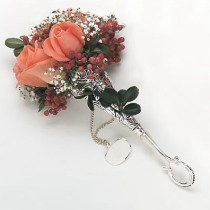
Instead of sending a billet-doux to your honey, present a tussie-mussie, a small bouquet wrapped in a lace doily or a fancier holder. Say you have a friend having a birthday and he already has too many neckties and she already has too many kitchen gadgets. Give them flowers or potted plants. The white camellia signifies “unpretending excellence.” Ivy, “with its clinging habit, is a feminine symbol” (sic., p. 53). The lily means purity. The peony symbolizes abundance. The primrose is a token of affection and respect. Get the idea? Your friends will be delighted by the flowery language.
William Shakespeare, The Winter’s Tale
A fancy tussie-mussie

     Here’s flowers for you:
Hot lavender, mints, savory, marjoram,
The marigold, that goes to bed wi’ the sun,
And with him rises weeping: these are flowers
Of middle summer….
          —William Shakespeare, The Winter’s Tale Continue reading “The Language of Flowers by Barbara Ardinger”

(Femen)ism? by Kile Jones

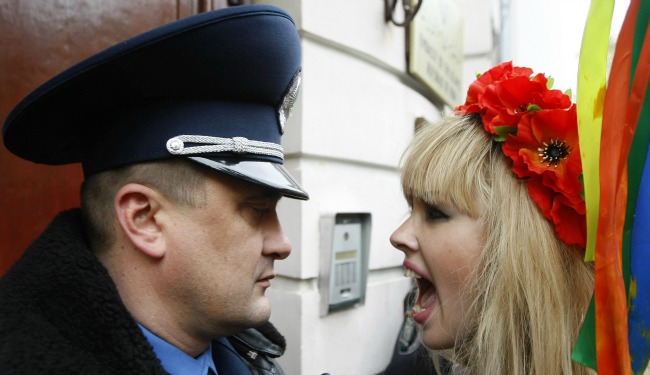
Kile Jones, atheistAs most of us are aware by now, there is a “feminist-sextremist” group from Ukraine called “Femen.”  This group has been very controversial by their public demonstrations of nudity, the words they paint on their bodies, and their explicit condemnations of political structures and organized religions.  They were started by Anna Hutsol in 2008 and have now spread throughout Europe and the Middle East.  The question I pose for this post is: Does Femen harness or hinder the power of the feminist critique?

Image from Konstantin Chernichkin/Reuters

Femen is precisely the kind of movement that pushes us in our understanding of feminism, the means by which it is best expressed, and the issues surrounding moral condemnation and religious sensitivity. Continue reading “(Femen)ism? by Kile Jones”

For the Love of Gaia by Jassy Watson

For the Love of Gaia Jassy WatsonOn January 26, 2013 a rare, devastating tornado hit our community in Queensland, Australia, a coastal town on this sub-tropical coast. My family experienced nature’s elemental force firsthand and hopefully will never again. The tornado viciously shattered houses, peeled away roofs, uplifted cars and trees, and took down power lines, tearing apart everything in its path. With absolutely no warning, literally out of the blue, it formed over the churning sea, rapidly intensifying before striking land, awakening the vulnerability and fragility of all life in its midst.

When it struck, our four kids and I were waiting in our car while my husband ducked into a mate’s house to borrow a tool. We heard the sound of a roaring jet plane overhead, as my husband came running, screaming at us to get out of the car. Turning to my left, in a vision imprinted forever, a spiral of debris flew toward us. Scrambling, we got the kids out of their harnesses and safely indoors. I lagged behind, taking care of the children first, and fell out of the side door of the van with the wind’s impact. As I got up to run, a large piece of roofing tin flew straight for my head. I dove, seeking safety under the front of our running car. My life flashed before my eyes. All of us in a state of shock, the tornado was gone as quickly as it had come, we were unscathed except for a few minor cuts and bruises. It was only a few moments before the immediate danger passed. We ventured outside to inspect the damage, destruction surrounded us. Continue reading “For the Love of Gaia by Jassy Watson”

Protecting our Families: How the U.S. Falls Short in Protecting New Mothers (and Fathers) by Michele Stopera Freyhauf

Freyhauf, Feminism, Religion, Durham, Old Testament, Blogger, Bible, Gender, Violence, Ursuline, John CarrollLast weekend, I had the privilege of speaking at the National Convention for American Mothers, Inc. about motherhood in the 21st Century.  Because this is such a vital issue for mothers that live in the U.S. (since a large majority of families have two full-time wage earners), I thought it would be appropriate to share my speech here.  With the understanding that this a forum for feminism, I believe that this topic fits this forum because it continues to show how unequal the treatment is between the sexes – whether it is pay, position in employment, healthcare, education, or simply balancing the responsibilities of family/career.  For those that live in the United States, there is often a sense of exceptionalism, and as I clearly demonstrate in this speech, we are certainly a far cry from being role models that when it comes to protecting mothers (whether by birth or adoption) and families.

As a side note:  One topic that was not explored, due to lack of data, is how maternity/paternity leave impacts same sex couples who become new parents – I have to believe that this is a topic to also examine (and I am would encourage any feedback here).  

Recently the United States ranked 25 out of 165 countries for being the best place to live if you are a mother.  This number is up from 31 a year ago and places us between Belarus and the Czech Republic.

You may be asking yourself, Why isn’t the United States in the top five or even in the top ten? The answer to that question becomes evident once we examine how that determination is made. The categories examined are:

  • Mother’s education;
  • Child’s Health;
  • Economic status;
  • The Election of women to government office;
  • Breast feeding programs.  In the United States 75% of mothers breastfeed their babies, 35% continue to breastfeed after six weeks. The number shrinks because mothers usually return to work and find it difficult to to pump at the office;
  • Maternal death rate is another factor, which stunned me when I found out that the US has the highest maternal death rate of any industrialized nation. Approximately 1 in 2,100 women are at risk of dying during child birth;
  • Infant death rates is another category.  Infant deaths are estimated to be 8 per 1000 births – a number that throws us behind 40 other countries;

Taking Back the Caliphate: The Role of Muslim Women as Agents of Social Justice by Vanessa Rivera de la Fuente

Vanessa Rivera de la Fuente. Muslim Women as Caliphs.Whenever we talk of Muslim women, two dominant discourses reach our ears. The first is about women of the past who may serve as role models, such as Aisha, Fatima, and Khadija (ra). This perspective, which I call the historical approach, presents an ideal woman with qualities we should strive to develop, values that make life possible with more comfort and a deepening of our imam (faith). These values include wisdom, loyalty, courage, justice, perseverance, faith, independence, and generosity.

The second discourse is based on stereotypes and presents Muslim women as passive and without initiative. I call this the objectification approach, which says that Muslim women are oppressed and sees us as objects without voice or power, subject to the tyranny of the hijab (headscarf), and in need of someone to save us from the bondage of religion and from men, who, incidentally, are all terrorists. Continue reading “Taking Back the Caliphate: The Role of Muslim Women as Agents of Social Justice by Vanessa Rivera de la Fuente”

Feminism and Football By Marcia W. Mount Shoop

Marcia headshot“How did race and privilege affect the NCAA investigation of the football program at University of North Carolina?”

This was the question a student posed to me recently when I gave a Skype lecture to a Sports Ethics class at the University of Washington’s Center for Leadership in Athletics

I am going to take a wild guess (and I may be wrong), and assume that most readers of the FAR blog don’t know much about the NCAA investigation of the UNC football program.   I have outed myself on this blog before—I am more than just a feminist theologian; I am also a football coach’s wife.  Lots of people wonder how I manage to pull that off and still look at myself in the mirror.  That’s a complicated question.  I am finding that the challenges presented by our experience at UNC are creating more and more space for the feminist and the coach’s wife to find a common purpose.  Which brings us back to the question at hand—race and privilege and how it played into the football investigation at UNC.

You may want to investigate the many details of this investigation, but I would like to invite this feminist community to see what you think about this question of privilege in particular.   I will provide just a few factual statements for you all.  You tell me if you can think of ways that race and privilege may have been at work to the detriment of certain groups in this situation.  Continue reading “Feminism and Football By Marcia W. Mount Shoop”

Deciding To Leave the Religion of Your Birth–Or Not by Carol P. Christ

carol p. christ 2002 colorWhat factors are most important in the decisions of spiritual feminists to leave or to stay affiliated with traditional religions? My friend Jewish feminist theologian Judith Plaskow and I discuss these questions in our forthcoming book, Goddess and God in the World. In this excerpt I speak to Judith about our different choices.

For me no longer identifying with Christian tradition had a great deal to do with belief. At some point I came to the conclusion that I did not believe in Christianity’s “core doctrines” of Trinity, incarnation, and salvation through Christ. Yet these doctrines are expressed in the Nicene Creed, which is accepted by all Christians. In an interview at a Christian seminary early on in my career, I was asked to define and defend my Christology or theory of salvation through Jesus Christ. My answer that feminism had put a question mark over all doctrines for me was not considered acceptable.

Judaism, on the other hand, is not a religion that stresses belief. Indeed your husband Robert used to love to shock me and other Christians by saying that for a Jew belief in God was not required as long as he or she followed the law. Understanding this difference between Judaism and Christianity helped me to understand that the question of belief in “core doctrines” simply was not as central for you as a Jewish theologian as it would necessarily be for me as a Christian theologian.

However, my reasons for leaving Christianity did not only have to do with my lack of belief in its core doctrines. For me the issue I call the power of “core symbols” was equally if not more important. Once I began to understand the way in which the “core symbols” of the Bible had influenced people and cultures, “I” simply could not ally “myself” with traditions that continued to promote them in liturgies. Continue reading “Deciding To Leave the Religion of Your Birth–Or Not by Carol P. Christ”

Creiddylad, Welsh Goddess of Flowers and Love by Judith Shaw

judith Shaw photo

May Day/Beltane (Calan Mai to the ancient Celts) is almost here and our hearts turn to thoughts of love, flowers and the bounty of our Mother Earth. Both Beltane and Halloween/Samhain (Calan Gaeaf) were liminal or threshold days, considered to be outside of normal time. These sacred, mystic days were more important than the solstices in the Celtic world view.

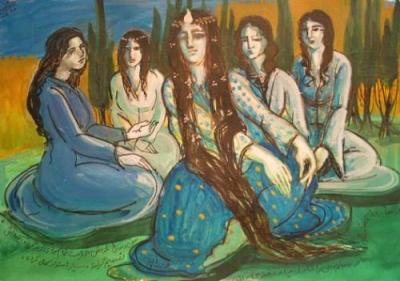
Creiddylad painting by Judith Shaw

Creiddylad, Welsh Goddess of Flowers and Love, is celebrated at this time. (Her name is pronounced cree-THIL-ahd)  She is the eternal May Queen, always seeking peace and stability.  She remains eternally constant in the face of all change.  She is the promise of love, golden glowing moon-flowing love, enduring through all hardship and despair.  Creiddylad also shows us the necessity of self-love. Only by truly loving ourselves can we love another.

Creiddylad is mentioned only briefly in The Mabinogion but her symbolism reveals that she is surely an ancient and important Goddess, whose original stories have been lost to the mists of time.

Creiddylad, the daughter of Lludd Silver-hand, was promised in marriage to her heart’s desire, Gwythyr ap Greidawl. But before the marriage could be consummated she was abducted by Gwyn ap Nudd, who possessed many dark aspects akin to the Lord of the Underworld.

Gwythyr gathered together his warriors and set out to rescue his love, Creiddylad, from Gwyn.  A fierce battle ensued, during which Gwyn, who emerged as the victor, committed horrendous acts of brutality and butchery.

Continue reading “Creiddylad, Welsh Goddess of Flowers and Love by Judith Shaw”

Liminal Time and Space by Deanne Quarrie

Deanne Quarrie

The word liminal comes from the Latin word limen, meaning “a threshold.” The word threshold has several definitions.  It can be the sill of a doorway or the entrance of a building.  Ultimately, it means any place of point of entering or beginning. In psychology the term limen means the point at which a stimulus is of sufficient intensity to begin to produce an effect.

Liminal time therefore, is that moment when something changes from one state to another.  Examples would be dawn, the morning sun rising high enough in the sky to bring daylight.  Another is dusk, the evening sun sinking into the horizon bringing nightfall. Continue reading “Liminal Time and Space by Deanne Quarrie”

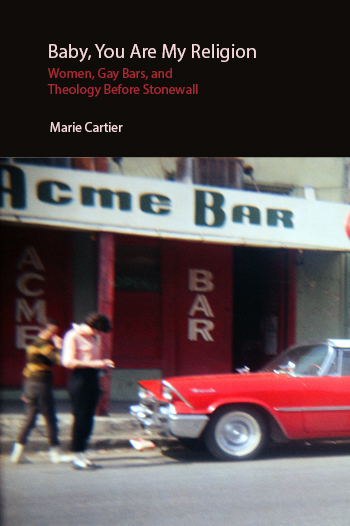
Birth Announcement: Baby, You Are My Religion by Marie Cartier

I want to proudly (not shamelessly) announce the upcoming birth of my book! Baby, You Are My Religion: Women, Gay Bars and Theology Before Stonewall will be published by Acumen Press, fall 2013 (October). However, it will not have the cover that is on the book as it is advertised now. I had problems with this cover as it depicts gay contemporary women in a country setting, not pre-Stonewall women in an urban setting, or identity. The photo below is the proposed (and accepted) new cover image, designed by my wife Kimberly Esslinger. And while we don’t know if the book cover will look exactly like this, the publishers are excited about this cover choice image.

 I realized as I advocated for another cover—that my book is my baby. As I sought out another image and worked to negotiate and obtain the rights for it, I realized how protective I was of my book/my baby. I am giving birth to the projects I’ve stored inside myself—I, who never gave birth to biological children, give birth now to this book. I want to have this baby and I want to protect it and set it free to do its work in the world; nurture it and cheer it on as it sets forth to do great things; hold it close and watch it fly.
New Proposed Book Cover: Carolyn Weathers in front of the ACME bar, gay bar in San Antonio, Texas, 1961.

I realized as I advocated for another cover that my book is my baby. As I sought out another image and worked to negotiate and obtain the rights for it, I realized how protective I was of my book/my baby. I am giving birth to the projects I’ve stored inside myself—I, who never gave birth to biological children, give birth now to this book. I want to have this baby and I want to protect it and set it free to do its work in the world; nurture it and cheer it on as it sets forth to do great things; hold it close and watch it fly.  Continue reading “Birth Announcement: Baby, You Are My Religion by Marie Cartier”