The Book Is Finished, Now On to Publicizing It by Carol P. Christ

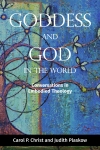
Carol in Crete turquoiseGoddess and God in the World: Conversations in Embodied Theology by Carol P. Christ and Judith Plaskow, forthcoming from Fortress Press in 2016.

In Goddess and God in the World, two leading theologians model a new method of embodied theology, rooted in experience and tested in dialogue. Christ and Plaskow agree that the God who is dead in our time is the transcendent and omnipotent male God of traditional theology. They believe that we must create new understandings of divinity because theologies not only help us to make sense of the world, but also provide guidance as we face the urgent social, political, and environmental issues of our time. In contrast to traditional views, Plaskow and Christ situate divinity in the world and place responsibility for the fate of the world firmly in human hands. They argue for an inclusive monotheism that affirms the unity of being through a plurality of images celebrating diversity and difference. Carol believes Goddess is the intelligent embodied love that is in all being, a personal presence that can inspire us to love the world more deeply. Judith understands God as an impersonal power of creativity, the ground of being that includes both good and evil. Their intense questioning of each other’s views provides an exciting model for theological conversation across difference.
Continue reading “The Book Is Finished, Now On to Publicizing It by Carol P. Christ”

The Dog Days of Summer by Carol P. Christ

Sirius in the Sky


Sirius rises late in the dark, liquid sky
On summer nights, star of stars,
Orion’s Dog they call it, brightest
Of all, but an evil portent, bringing heat
And fevers to suffering humanity. –Homer, The Iliad


The dog days of summer are associated with the reappearance of the brightest star in the sky, the “dog star,” also known as Sirius, just before dawn from July 23 until August 23. This star heralds the days of the most intense summer heat. Though this is the time of the summer harvest in Mediterranean cultures, it a time of death. Energy wanes. The grasses have dried out on the hillsides, plants in gardens will die too unless they are watered. The healthy “sit out” the heat of the day with closed shutters, while those who are old or very ill often give up the ghost. They say that this is also a time when babies are conceived during long and languid afternoon naps.

The Greater Mysteries of Demeter and Persephone were celebrated at the end of this period, and the Greek Orthodox festival of the Dormition (Death) and Assumption (Rebirth) of the Panagia (the Virgin Mary) echoes an ancient rhythm.

This year I have spent most of the dog days in air-conditioned rooms, feeling little inclination to brave the heat of the day even for a refreshing swim in the sea. During this time, Judith Plaskow and I completed the final draft of the manuscript of Goddess and God in the World and submitted it to our publisher: a midsummer harvest!

To be truthful, I also spent many of the dog days days glued to my computer watching reruns of D.C. Banks and Blue Murder. These days of rest were good for the knee I had injured earlier in the summer, which now is almost healed. They must have been good for my spirit as well, for a friend who had not seen me since late spring told me that I looked refreshed and renewed.

In nature, the death days of late summer are followed by rebirth. At the very time when the sun is at its most intense, the days become shorter—first imperceptibly, and then quickly. While sun “stands still” for several months, setting at more or less the same time before and after the Summer Solstice, all of a sudden (or so it seems), the sun sets half an hour earlier. From then on, it sets several minutes earlier each day: a clear indication that fall is on its way. Before long, the rains come and the hillsides become green again.

beachttime in anaxos by Andrea Saris

For me, August 14, celebrated in Greece as the day of the Dormition of the Panagia, marks the beginning of the end of the intense heat of midsummer. Yesterday, on this day, with some trepidation, I packed my dogs into a hot car and headed for the sea. Our favorite tavern was empty and a light breeze coming from the sea tempered the heat. A friend arrived unexpectedly, and—joined by my intrepid miniature schnauzer—we enjoyed a swim so refreshing we didn’t come out of the water until our fingers became wrinkled. Just before sunset my friend and I met again to ascend the stairs to the shrine Church of the Panagia on the Rock to light candles for Rebirth and Renewal, ending our day with dinner by the sea.

As I write the next morning, I feel poised on the edge of rebirth and regeneration. I don’t yet have new ideas in my mind, nor do I have the fullness of energy I know will continue to return as the heat wanes. I look forward to the coming of fall and await new green shoots of inspiration in my life and my work.

carol mitzi sarah

Carol P. Christ leads the life-transforming Goddess Pilgrimage to Crete (facebook and twitter).  Carol’s books include She Who Changes and and Rebirth of the Goddess; with Judith Plaskow, the widely-used anthologies Womanspirit Rising and Weaving the Visions and forthcoming in 2016 from Fortress Press, Goddess and God in the World: Conversations in Embodied Theology. Explore Carol’s writing. Photo of Carol by Shanti Jones. Photos of beach at Anaxos by Andrea Sarris.

No Longer Moved … by Symbols that Once Moved Me Profoundly by Carol P. Christ

Carol in Crete croppedThis week Judith Plaskow and I submitted the final version of our new book Goddess and God in the World to our publisher at Fortress Press. Just before completion, I added a shorter version of the following passage to my final chapter. In it I tried to describe the odd feeling of not being moved any longer by a religion that once moved me profoundly. Our book, which explores an embodied theological method, will be out in the summer of 2016.

I have never regretted my decision to leave Christianity. Although I have a sentimental attachment to Christmas trees, Christmas dinners, Christmas carols, and some hymns, I miss little else about Christianity. At a distance of several decades, I find that I quite simply have no feeling for the Christian edifice of doctrines and rituals based on the life and death of a single individual. Jesus was a visionary, but there have been many others like him—including Martin Luther King, Elizabeth Cady Stanton, and Gandhi, all of them flawed, as Jesus must have been as well.

A few years ago, I decided to participate in the Greek Orthodox Easter week services, because they are attended by so many of my neighbors. But while enjoying the company of the women who decorated the epitaphios (tomb for Jesus), the procession through the streets of our town on Friday night, and the lighting of candles at midnight on Saturday, I came to a clear understanding that the Easter drama is no longer my drama. During the Thursday night services, I realized that many of the women were openly grieving the death of Jesus. Though intellectually I could understand that the Easter drama allowed my friends to release pent-up and repressed feelings, I found their deeply emotional response to the re-enactment of the death of Jesus bizarre.

P6115475
Idean Cave

In leaving Christianity, I had gained the freedom to name the sacred in my own experience, confirmed my deep inner knowing about the human connection to nature, and found the power to create and participate in rituals that have meaning in my life. For me now, the rituals on the Goddess Pilgrimage to Crete are at the center of my spiritual life. To listen to Alice Walker’s words, “We have a beautiful/mother/Her green lap/immense/Her brown embrace/eternal/Her blue body/everything we know”* on a mountaintop or to repeat Ntozake Shange’s cry, “we need a god who bleeds now/whose wounds are not the end of anything”** at the mouth of a cave, moves me more than any passage from the Bible.

Singing “Light and Darkness” in the depths of caves is an embodied act of reclaiming the womb as a symbol of creation and the darkness as a place of transformation. I still enjoy singing the Doxology (Hymn of Praise)—and doing so connects me to my history. But I now sing it in front of altars laden with summer fruits or winter vegetables and with words that express my spirituality: “Praise Her from whom all blessings flow/Praise Her all creatures here below/Praise Her above in wings of flight/Praise Her in darkness and in light.”***

*Alice Walker, “We Have a Beautiful Mother,” Her Blue Body Everything We Know: Earthling Poems 1965-1990 (New York City and Orlando, FL: Harcourt Books, 1991), 459-460.
**Ntozake Shange, “we need a god who bleeds now,” A Daughter’s Geography (New York: St. Martin’s, 1983), 51.
***See Carol P. Christ, She Who Changes: Re-imagining God in the World (New York: Palgrave Macmillian, 2003), 238, for a discussion of the meaning of the new words.

Carol P. Christ leads the life-transforming Goddess Pilgrimage to Crete (facebook and twitter).  Carol’s books include She Who Changes and and Rebirth of the Goddess; with Judith Plaskow, the widely-used anthologies Womanspirit Rising and Weaving the Visions and forthcoming in 2016 from Fortress Press, Goddess and God in the World: Conversations in Embodied Theology. Explore Carol’s writing. Photo of Carol by Maureen Murphy. Photo of Idean Cave by PJ Livingstone.

ALTERNATIVE IMAGES OF GOD BY CAROL CHRIST AND EMMA TROUT

Carol P. Christ at Alverno College 1
Carol Christ at the Conference of Women Theologians

Today I am publishing an early work on female language for God that I wrote with Emma Trout at the first Conference of Women Theologians in 1971. Highly contested at the conference, this essay is a foreshadowing of my subsequent work on the need for female imagery for divinity.

Rereading this essay more than four decades later, I am gratified to see that though we began our essay with the image of God giving birth (which I still view as an important image), Emma and I were aware of the danger that female imagery for God could reinforce “a false sexual polarity.” We insisted then that female imagery for God must not repeat sex role stereotypes, but rather must shatter them. Continue reading “ALTERNATIVE IMAGES OF GOD BY CAROL CHRIST AND EMMA TROUT”

If You Don’t Believe Women Are Fully Human, Can You Be a Great Pope? by Carol P. Christ

In recent weeks I have felt compelled to respond to a series of “Great Pope” photos and stories praising Pope Francis for his stands on poverty and climate change appearing on my facebook page. In every case I added something like: “Let’s not go overboard about a pope who does not believe women are fully human.”

I am referring of course to Pope Francis’s reiteration of the Church’s prohibition of women in the priesthood. But just as important–and perhaps more important–is the role the Roman Catholic Church has played and continues to play to prevent women from having access to contraception and abortion.

Control over our own bodies is a fundamental right that undergirds every struggle for women’s equality and liberation. But the pope does not want women to have the right to use contraception to prevent unwanted pregnancies, nor does he want us to have the right to abortion if contraception is unavailable or fails—not even in cases of rape or incest. Continue reading “If You Don’t Believe Women Are Fully Human, Can You Be a Great Pope? by Carol P. Christ”

Changing the American Story? by Carol P. Christ

Carol in Crete croppedIn a moving part of Goddess and God in the World, the book Judith Plaskow and I are writing together, Judith describes how the Sabra and Shatila massacre  forced her to confront the fact that “her people” are just as capable of perpetrating evil as any other group. Growing up in the shadow of the Holocaust and the pogroms that had scattered her people across the world, Judith was taught to think of the Jewish people as the victims of history rather than as the perpetrators of evil. The willingness of the Israeli army to countenance the outright massacre of up to 3500 people told another story: when in power, Jews too were capable of great evil.

I tell this story because I believe the lesson Judith learned is a lesson that Americans as a group still need to learn. I am thinking about this in the days following the heated debate that led to the removal of the Confederate flag from the Capitol of North Carolina.

In a brave and impassioned speech, Jenny Horne explained that though she is a descendant of Jefferson Davis, she was speaking against the display of the Confederate flag because it is a symbol of the harm that has been done and continues to be done to slaves and descendants of slaves in her state. Jenny Horne was rejecting the story she had been told about what it is to be an American in South Carolina. Continue reading “Changing the American Story? by Carol P. Christ”

Referendum in Greece: One Small Victory for the 99% by Carol P. Christ

Yesterday the Greek people voted by an unexpectedly large margin of 6l.31% against the austerity programs insisted upon by the European creditors–despite threats from the creditors that Greece would be expelled from the European Union. This was a victory for democracy and for the 99% against the 1%. The blog I wrote on the eve of the referendum explains the situation.

Here in Greece, we are in a state of suspended animation and have been for the past 5 ½ months, since the new government of Alexis Tsipras began to negotiate with the European Commission, the European Central Bank, and the International Monetary Fund, popularly known as the Troika, regarding the Greek national debt. Each week we have heard: “a few days more and the crisis will be resolved.” We hold our breath and wait. Holding your breath for that long takes a toll on your health. Right now our banks are closed, and no one knows what the future will be.

Prime Minister Alexis Tsipras and Minister of Finance Yiannis Varoufakis have been negotiating on the assumption that representatives of the Troika are rational and moral actors—or can be convinced to be. Continue reading “Referendum in Greece: One Small Victory for the 99% by Carol P. Christ”

Texts of Terror in the Humanities Curriculum by Carol P. Christ

Carol in Crete croppedWhen I began to study Latin in my freshman year in high school, one of the first texts we were asked to translate concerned the “rape” of the Sabine women. Even though the Latin text used a word that looked and sounded like it should be translated as “rape,” we were told that the Romans “abducted” the Sabine women and that the word should be translated as “seized.” Not long afterward, we read a story from Ovid in which a nymph named Daphne was turned into a tree in order to escape being raped by a God. I found both of these stories puzzling.

I had not heard the term “rape culture” which was coined much later, but the fact that I can still visualize the words “virgines” and “raptae sunt,” as well as the pictures that accompanied both stories, suggests that I was aware that something was wrong in these texts and in the way they were being taught.

When, as part of my first full-time teaching job, I was asked to teach the Iliad as the foundational text in the required Humanities course at Columbia University, I was able to find words to criticize it. I understood that even if Homer mourned the “tragedy” of war, he also celebrated it, and seemed to view war as an inevitable part of “heroic” culture.

I was also able to see that the central human drama of the epic, Achilles’s “metaphysical dilemma “ of whether to choose to stay and fight in a war in which he would be killed yet immortalized in memory, or to choose to return home and live a long, yet uneventful life, was set in the context of his quarrel with Agamemnon over a woman my colleagues referred to as a “spear captive.” In fact, Briseis, like the Sabine women, was a “spoil” of war, a captured and captive woman, who might more accurately have been called a “raped captive.”

When I tried to discuss the moral failings of a work that celebrated rape and war in the seminar for teachers of the course, I was told that I had missed the point of a beautiful and complex text that was at the heart of “civilization.”

This spring at Columbia University, student members of the Multicultural Affairs Advisory Board posted an op-ed titled “Our Identities Matter in Core Classrooms” in the campus newspaper Columbia Spectator stating that: Continue reading “Texts of Terror in the Humanities Curriculum by Carol P. Christ”

THE REFUGEE CRISIS IN GREECE: A TEST OF OUR COMMON HUMANITY by Michael Bakas, translated by Carol P. Christ

Note from Carol Christ: I returned home from the Goddess Pilgrimage to Crete a week ago to find my island, Lesbos, and my village, Molivos, overwhelmed with a refugee crisis of enormous proportions. We are a town of about 1000 permanent residents, and I would estimate that 10,000 or more refugees from the wars in Syria and Afghanistan have passed through our village in recent months. Local authorities and volunteers are exhausted, and there is an urgent need for help from the European Union. This week instead of my own blog, I am offering my translation of a moving plea for help from my dear friend and colleague in the Green Party, Michael Bakas, who by the way is himself a feminist.

Refugees in Mytiline 1914-1918There is nothing new about refugees fleeing from war. At the beginning of World War I, more than 50,000 people arrived in Lesbos from the nearby shores of what is now Turkey. At the end of the war many of these refugees returned to Asia Minor, but after the Greek army invaded and was driven back, the Asia Minor Catastrophe of 1922 sent nearly a million refugees to Greece.

Faced with an ocean of refugees flooding the island, the local population was dumbfounded, fearful, and tied up in knots. They shut their doors and averted their eyes: “it was as if a dark cloud of death had descended on their minds, and so they felt nothing. They did not want to see anything or to hear anything that was happening on the other side of their doors.” The end of this story is well-known: with courage and a great will to live, the refugees put down roots and found their way.

In the first decade of the 21st century Lesbos again experienced a wave of refugees who came via Asia Minor. This group, mainly from Afghanistan, came to the island with the hope of putting war behind them. Most of them were held for a year or more in cramped conditions near the capital of Lesbos. This center was closed in 2009 due to the efforts of local volunteers who had alerted European groups to the problem.

But the Greek debt crisis soon followed. For several years, the flow of refugees lessened. When it began to increase at the end of 2012, volunteers from all over the island came together without any government support to provide help. Thousands of refugees were housed in a former campground for children’s holidays, where they were offered clean clothing, blankets, and food, as well as love and compassion.

Lesbos became known as an all-European model for solidarity. Resisting the xenophobia that was growing in Greece and in Europe as a whole, the citizens of Lesbos reached out to the refugees, refusing to listen to those who were promoting hate. The neo-fascist anti-immigrant party known as Golden Dawn gained less support in recent elections in Lesbos than in most of the rest of Greece.

refugee children in LesbosThe good will of the people of Lesbos is currently being tested by the wave of migrants now arriving on our shores. Estimates are that more than 20,000 refugees have arrived in our island alone in the first five months of 2015. There are no systems in place to deal with them. Yes, the European Community has dedicated resources to the “refugee problem,” but most of that has gone into patrolling the borders in hopes of stemming the flood of refugees—not to helping those who arrive on European shores.

Those who arrive in northern Lesbos are being welcomed and fed by volunteers, but the Coast Guard does not have the resources to transport them to the capital city for processing. Thus they are being told—mothers and babies among them—that they must walk 60 kilometers on mountainous roads in summer heat to reach their next destination.

Once they arrive in the capital city, the Coast Guard is not able to accept and process all of them, because the reception center cannot cope with the numbers. Thus, thousands of refugees sit in the harbor, hoping the authorities will arrest them and thus be forced to process them.

The residents of Lesbos are once again beginning to become afraid of the influx of refugees. In the touristic village of Molivos, at the same time that both locals and foreigners are helping the new arrivals, others are saying that “it spoils the vacations of tourists to be faced with seeing so many refugees.”

The situation seems to be more than government officials can cope with. The mayor of the island has been trying to find a place where the refugees can stay while they are being processed. The regional government has not yet lifted its hand. The Minister of Immigration visited the island, but no interventions followed. The European Community has yet to act. The UN and international aid groups have not arrived.

This state of affairs plays right into the hands of the racists and xenophobes. Rumors are spreading about the refugees—lies about diseases they are carrying and threats they pose to local and tourist women. People who in the past have been sympathetic to the refugees and the volunteers are getting fed up. Their pent up anger could lead to violence within our own communities or against the migrants.

At the same time more and more refugees are arriving, sleeping in the streets, relieving themselves without toilets–among them pregnant women, babies and old people, and even disabled individuals—all trying to save themselves from violence in their own countries.

Instead of fighting each other, it is time to get serious about finding a solution to a humanitarian crisis of vast proportions. Lesbos—along with other islands of the Aegean—must be declared an “Emergency Zone.” The Greek government, the European Community, and international organizations must provide resources.
We need arrival centers in northern Lesbos, where the immediate needs of the migrants can be met—including shelter from the sun, food, toilets, blankets, and a place to sleep if necessary. Processing centers adequate to the numbers of refugees need to be opened in the island’s capital. Transport to these centers must be provided. Trained Greek or EU officials must be sent to staff them.* We also need a plan for August when the ferryboats being used to transport the refugees to Athens will be full, and if no alternate plans are made, large numbers of migrants will be forced to stay on the streets or in already crowded centers in the worst of summer’s heat.

It is time for us to move forward–Greeks, Europeans, and migrants together–in the name of our common humanity and in concern for the lives of all human beings on our planet. We also need to work to end the wars and the violence that drives people from their homes and homelands.

*We have just learned that the EU is planning to send a team of officials to assist with processing the refugees.


michael bakas2Michael Bakas is a leader of the Green Party in Lesbos, Greece and has been working for many years with its committee on Human Rights. This call to action was originally published in longer form in Greek on June 16, 2015 on Apolotaria.gr., and was published in English in Green European Journal on June 19, 2015, the International Day of the Refugee.


timothy jay smithTimothy Jay Smith  has been working closely with volunteers in Molyvos and Mytilini to provide for the refugees. If you wish to contribute to these efforts, you can donate through Tim’s account at PayPal: kosmosfilms@gmail.com or send a personal check to Timothy Jay Smith in U.S. dollars or Euros (French banks only). Also see his “Mister, They’re Coming Anyway.”


Carol P. Christ leads the life-transforming Goddess Pilgrimage to Crete (facebook and twitter).  Carol’s books include She Who Changes and and Rebirth of the Goddess; with Judith Plaskow, the widely-used anthologies Womanspirit Rising and Weaving the Visions and forthcoming next year, Goddess and God in the World: Conversations in Embodied Theology. Explore Carol’s writing.


The Reason to Hope by Carol P. Christ

Carol in Crete croppedRecently, Valentina Khan touched many of us when she wrote a blog entitled The Powers of Evil are Well at Work and I’ve Lost My Spirit. Valentina spoke of the weariness and despair many of us feel when we think about the problems the world is facing today. She said that “right now it just seems like my voice of peace is lost to the voice of fanatics who get more media attention than I ever will.”

Last week I met a young man who has recently begun to try to save a large wetland pool on the island of Lesbos. He told me he feels frustrated that “no one else” is doing anything to save the important and fragile ecosystem of our island. I explained to him that there are many of us who have been working to save the wetlands of Lesbos for fifteen years, but with few or no results.

Refugees awaiting transport
Refugees awaiting transport in Molivos, Lesbos

In the past month—since the weather turned to spring—thousands of refugees have arrived on the shores of Lesbos. Most of them are fleeing war Continue reading “The Reason to Hope by Carol P. Christ”