Letting Go by Deanne Quarrie, D. Min.

Deanne Quarrie, D.Min.For the last year, I have been scheduled and planning a trip to Brazil, having been invited to speak, plus do a workshop at a conference in Sao Paulo and then two workshops in Brasilia. Four weeks ago, and three days after a Pertussis vaccine (needed before I could see my new great-granddaughter), I was hit with bronchitis which exacerbated an acute flare of my asthma. I was in the ER three weeks ago, but went home trusting that the steroids would work. They did not. So Sunday (the 15th), I once more bit the bullet and headed to the ER, now in a panic, unable to breathe. Continue reading “Letting Go by Deanne Quarrie, D. Min.”

Reflections on Researching the Goddess Movement in Britain by Kavita Maya

KavitaMayaI’ve been asked by both academics and Pagans what inspired me to pursue doctoral research on the British Goddess movement: of the many ways that people first click with feminist politics, a story entwined with a ‘spiritual’ impulse might seem unusual, given the slow-to-change secular assumptions of mainstream feminism.

When I reflect on my history, two threads at the core of my early feminist identity leap out: one, the value of thinking and asking questions; the other, ‘feminist spirituality’, which for me describes a profound emotional, intellectual and creative investment in the struggle for a fairer, more inclusive world. Two early ‘click’ moments: as a child, asking persistent questions about the sexist gender roles modeled by those around me (and being told “You’ll understand when you’re older,” which I now recall with a grim irony), and—perhaps unusually—coming across the concepts of patriarchy, feminism and the Goddess by way of 1990s teen fiction about witches. Continue reading “Reflections on Researching the Goddess Movement in Britain by Kavita Maya”

Sisterhood is . . . (Well) Complicated by Carol P. Christ

When I wasCarol Molivos by Andrea Sarris 2 a girl, the women in the neighborhood looked out for each other, and my mother had a wide circle of women friends. My grandmother lived nearby, and she and my mother spoke on the telephone nearly every day. My mother and I had a close relationship cemented by caring together for my baby brother.

In graduate school when I was one of a few women in a male-dominated field in a hostile environment, I discovered that “sisterhood is powerful” when I joined a group of women who came together to share experiences and change our lives. Having grown up in a community in which women supported each other, I found it relatively easy to support and seek support from women in a feminist environment.

At the same time, my newfound feminist identity deepened a rift that had opened in my relationship with my mother when I decided to go to graduate school. Continue reading “Sisterhood is . . . (Well) Complicated by Carol P. Christ”

Feministing Sarah and Hagar by Vanessa Rivera de la Fuente

sarah_hagarOne story that has marked my life as a feminist is that of Sarah and Hagar. This is a story of pain and enmity among women under patriarchy that despite its age, is still relevant to illustrate the negative effects of the androcentric socialization. But it can also hold an inspirational feminist reading that leads us towards a reflection on the amazing possibilities of a shift in the way we women look at each other.

Feminism is a political practice, an ethics for living based in an option for women. It is not or should not be a Diploma, a chair where to work from 9:00am to 5:00pm, or an excuse to act from our own privileges against other women. In private and in public, in academia or in the street, in sexual, cultural, intellectual and religious affairs, a feminist is a feminist, without excuses or regrets.

This year I was part of the anthology “Jesus, Muhammad and The Goddess” with an essay called “The Wounded Goddess: The History of Sarah and Hagar From a Feminist Outlook” from which I want to share some excerpts with you, as follows: Continue reading “Feministing Sarah and Hagar by Vanessa Rivera de la Fuente”

What Dorothee Soelle Taught Me about Creativity by Elise M. Edwards

Elise EdwardsI’m currently developing a book that considers how theological and ethical considerations in architectural design can define good architecture.  My book discusses five virtues related to the architectural design process that promote human participation in bringing out God’s intention of flourishing for humanity and creation.  Those five virtues (or values) are: empathy, creativity, discernment, beauty, and sustainability.  In the book, I’ll explain how these virtues orient design tasks to the social and ethical aims of architecture.

In this virtual space, I want to have a discussion about what these virtues mean from a feminist standpoint.  In my writing, I draw from theological ethics, architectural theory, and feminist theory to emphasize community discernment and participation.  It’s fitting, then, to claim opportunities in my work to acknowledge the feminists who have influenced me while also opening up the dialogue to the feminists in this community who continue to inspire and guide me to do my best work. Continue reading “What Dorothee Soelle Taught Me about Creativity by Elise M. Edwards”

Interpretations, Interpretations, Interpretation by Carol P. Christ

Carol Molivos by Andrea Sarris 1The Pope’s call for a new study of the possibility of ordaining women as deacons in the Roman Catholic Church and the impasse in the United Methodist Church over homosexuality and abortion, once again ask us to recognize that theories about interpretation and interpretations underlie each of these hotly contested issues. It is not only that individual texts and traditions are subject to conflicting interpretations about their meaning in their own times or in ours. The decision to cite a particular text or tradition, is itself based on an interpretation about which texts and traditions are important or reliable enough to be cited.

The Pope may be convinced that Jesus chose only twelve male disciples, and he may cite certain texts in the Bible, centuries of tradition, and recent church decisions. But others would counter that there is evidence that Jesus had many more than twelve disciples, and that Mary Magdalene was among them. Those arguing that United Methodists should not ordain homosexuals as clergy or permit the sanctifying of homosexual marriage may feel they are on firm ground when they cite Leviticus 18:22 in support of their view that the practice of homosexuality is contrary to Christian teaching. But those on the other side ask why this particular passage is held to be binding on today’s Christian communities, while (for example) the many others affirming a man’s right to have more than one wife are not.

When traditionalists cite the Bible or traditional church teachings as definitive, others may counter that their alternative reading is the “true” interpretation of these same texts or traditions. What is often lost is the fact that all interpretations of texts and traditions are situated. Although it may not be easy to convince traditionalists that the widely accepted theory of situated interpretation is true, at minimum, we should not forget it as feminists.

Thus, if we hope to change inherited traditions, feminists have two tasks. One is to bring forward texts, traditions, and interpretations that have been ignored by those who support traditional (male dominant, anti-homosexual, anti-abortion) positions. But, in doing so, we should not succumb to the temptation to conclude that our new interpretations are unequivocally “true.”

To do so would be to ignore the feminist “first principle” that all interpretations of texts and traditions are situated. If we wish to argue that traditional teachings on the priesthood, abortion, and homosexuality are situated in standpoints we might call “patriarchal” or “anti-queer,” then we must also acknowledge the relativity of our own positions as well.

When this is recognized the ground beneath us shifts. We are no longer arguing about the “true” meaning of inherited traditions. We are no longer asking: “What does the Bible say?” or “What does God say?” Instead we are asking a more nuanced question that begins with the recognition that there is not only more than one interpretation of the meaning of a text, but also more than one interpretation of which texts should be considered central to the meaning of a particular tradition. It is in recognition of the principle that every interpretation is situated that Biblical scholar Elisabeth Schüssler Fiorenza always insists that the idea that Mary Magdalene was among the disciples of Jesus is true from the perspective of women (or wo/men) seeking liberation.

When we recognize the relativity of all standpoints including our own, we recognize that the right question is not “what God has revealed,” but rather, what kind of communities we wish to create and transmit to future generations.  It is our responsibility, individually, and as communities, to answer this question.  If we wish to create communities that are more inclusive than those we have inherited, then we can choose as “true from our perspective” and even as “divinely inspired in our experience and understanding” those interpretations of texts and traditions that support the kinds of inclusive communities we believe Goddess or God calls us to create.

As feminists, we must present new interpretations of texts and traditions. But this is the beginning not the end of the task before us. We must also insist loudly and clearly that all interpretations are situated. The interpretations we advocate are not any more “objectively true” than the interpretations of our adversaries. We cannot avoid naming and examining our standpoints and justifying our interpretations in relation to them.

Recognizing that all interpretations are situated does not mean that all interpretations are equal. We can and must justify our interpretations on linguistic and historical and other grounds. We can and must reflect upon our standpoints, asking what kind of communities and worlds are justified and envisioned from the perspectives of our own standpoints and those of others. And we can and must discuss contested questions about the meaning of traditions and the nature of divinity.

Though I have been speaking about interpretations of Christian tradition, the principles discussed here apply to every religion, including those newly discovered or created. Recently I have been noticing a tendency among some contemporary Neo-pagans to assume that mythic traditions are “true” and to make definitive statements that begin with the phrase “our tradition teaches.”  But there is no reason to believe that pagan traditions are inevitably true–especially since many of them reflect patriarchal points of view–or that they are not subject to a variety of interpretations. While we can learn from traditions, we inevitably interpret them from our own standpoints. We can and must take responsibility for our standpoints and for our interpretations of every tradition.

Carol P. Christ is author or editor of eight books in Women and Religion and is one of the Foremothers of the Women’s Spirituality Movement. She leads the Goddess Pilgrimage to Crete in Spring and Fall: Sign up now for spring tour and save $100. Follow Carol on Twitter @CarolP.Christ, Facebook Goddess Pilgrimage, and Facebook Carol P. Christ.  Carol speaks in depth about the Goddess Pilgrimage to Crete in an illustrated interview with Kaalii Cargill. Photo of Carol by Andrea Sarris.

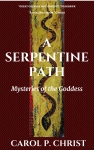
A Serpentine Path Cover with snakeskin backgroundA Serpentine Path: Mysteries of the GoddessGoddess and God in the World final cover design will be published by Far Press in 2016. A journey from despair to the joy of life.
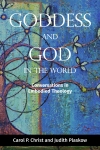
Goddess and God in the World: Conversations in Embodied Theology with Judith Plaskow will be published by Fortress Press in August 2016. Exploring the connections of theology and autobiography and alternatives to the transcendent, omnipotent male God.

What Does Mother’s Day Mean in a Patriarchal and Matricidal Culture? by Carol P. Christ

Carol Molivos by Andrea Sarris 2When we seek immortality or spiritual “rebirth,” are we not saying that there is something wrong with the “birth” that was given to us through the body of our mothers? In She Who Changes and in “Reading Plato’s Allegory of the Cave as Matricide and Theacide,” I asserted that our culture is “matricidal” because it is based on the assumption that life in the body in this world “just isn’t good enough.”

What is so wrong with the life that our mothers gave us that we must reject it in the name of a “higher” spiritual life? The answer of course death.

Can we love life without accepting death?

Can we love our mothers if we do not accept a life that ends in death? Continue reading “What Does Mother’s Day Mean in a Patriarchal and Matricidal Culture? by Carol P. Christ”

A Tale of Two Sisters and a Daughter and Niece by Carol P. Christ

This continues the story I began last week. Catherina is my 2x great-grandmother; Agnes is my 2x great-aunt; Johanetta is my first cousin, 3x removed, and my step-2x great-grandmother; Henry is my 2x great-grandfather. It is true that Henry had eighteen children with two wives. It is also true that Henry and Johanetta married and had a child soon after Catherina’s death. Some of the other details came in waking trance as I allowed the ancestors to tell their stories through me.

Agnes Lattauer Sweitzer: I thought the day Catherina left for America would be the worst day of my life. I did not know I would see Catherina again. I did not know I would outlive my two little sisters and both of my brothers. I did not know what my daughter would do. I read Catherina’s letters from America through my tears. How I wanted to be with her on her wedding day. How I wished she had been with us when we buried our sister Johanetta. My heart nearly burst when Catherina wrote that she longed to take my hand when she gave birth to her first child. My mind contorted itself trying to envision her living in a big city, in a big building, climbing up and down stairs, her feet never touching the earth, her hands never working the soil. What kind of life was that?

Catherina Lattauer Iloff

Catherina Lattauer Iloff: I left home a girl. Because I was not yet engaged, Mother and Agnes never told me about married life. What to expect. What to do. I loved Heinrich, or Henry, as he wanted to be called after he became a citizen of the United States. I was not prepared. Henry was so insistent. I was soon pregnant. First Henry, named for Henry’s father Heinrich, then Elisabeth, named for Mother. I had to care for them on my own. Henry was busy with his work during the days. In the evenings he went to the German beer garden to meet his friends. Growing up with my mother and sisters, I had never been alone. There were other women around, but they were busy with their own lives. Some of them were kind, some of them were not, but nobody cared about me the way Mother and Agnes did. One night Henry came home and told me he had been talking with his friends. There was land available in a place called Cherry Ridge, Pennsylvania, a  day’s journey from New York City. He said it was his dream come true. We would build our own house. There was plenty of land to farm—not like back home where there were never enough fields to go around. I held my tongue. I did not tell him that I suspected I was pregnant again.

The Iloff farm house

Agnes Lattauer Sweitzer: Catherina and Henry have been to Cherry Ridge. Catherina says there is land for us there too. I don’t know what my Heinrich will say. Life is difficult for us here, but we have two young daughters, Elisabeth and Johanetta, and the baby, Peter. There is Mother to consider. Well, you could have blown me over with a feather. Heinrich said we should grab the opportunity before it is too late. Mother said she would come with us, because she wants to see Catherina and Rudolph again before she dies. She is an old lady. I wonder how she will manage the journey. But I couldn’t say no. The two of us cannot contain our joy. We will see our beloved Catherina again.

Catherina Lattauer Iloff: My life is complete. Mother and Agnes and the dear little children arrived. Mother immediately took Henry and Elisabeth in her arms. Agnes comforted me about the loss of Baby John. I could finally allow myself to cry, knowing that Mother and Agnes would be there to wipe away my tears.

Agnes Lattauer Sweitzer: Our first years in Cherry Ridge were difficult. There were houses to be built, fields to be plowed, cows to be bought and milked. I had two more children, Henry, who died as a boy, and John.  My little sister outdid me. She had nine children in all: Henry, Elisabeth, John who died, John who lived, George, Catherine, Mary, Frank, and Barbara. Giving birth to so many children took its toll on her. After the last one, she was never well. I think she may have been pregnant again several times, but she never spoke about it, not even to me. Finally, she took to her bed.

Catherina Lattauer Iloff: I had nine children. I never told anyone about the babies I lost before I began to show. Mother and Agnes worried that I was having too many children. But what could I do? I loved Henry, and I loved every one of my children. Mother died a few years after she came to Cherry Ridge. She always said she was so happy she had undertaken such a great adventure. She was pleased to know that Agnes and I were settled and happy. I miss her every day. Agnes is always by my side.  I was forty-two when Barbara, my last baby was born. I bled a lot. After that, I never carried another child to term. I was never myself again. Agnes is my rock. Johanetta helps with the little ones. Henry is still strong as an ox, busy in the fields or with the cattle. I see that Johanetta hangs on his every word. I dismiss such thoughts from my mind. I do not know how much longer I have.

Agnes Lattauer Sweitzer: Catherina died yesterday. She was only  forty-six (I am now fifty-six), and she had not been well for several years.  I told her to stay away from Henry, but she was powerless to do so. Sometimes I blame him for her death. I worry about Johanetta now. Wild horses will not keep her away from Henry. I see the way she looks at him, and I see the old goat looking right  back at her. She is twenty-six, a full grown woman.

hannah johanna nettie switzer
Johanetta displaying her engagement ring

Johanetta Sweitzer: I can’t believe it! Henry asked me to marry him. Mother is furious. Father says he should have whipped me a long time ago. But they can’t say no. I told them I am pregnant with Henry’s child. The older children are shocked that their cousin is marrying their father. The younger ones are thrilled. They have always viewed me as a second mother as well as an aunt. I have been looking after all of them these last years what with Aunt Catherina being so ill. I love those children.

Agnes Lattauer Sweitzer: I had to forgive Johanetta, but I will never forgive Henry. I smile when I see him to keep the peace, but my heart is cold. Peter was her first-born. After that she had Agnes and Emma, who died of some of those diseases children get. I could not help wondering if that was God’s punishment.

Johanetta Sweitzer Iloff: Henry and I were married  for twenty years. Except for losing Agnes and Emma, those were the happiest years of my life. In all, we had nine children: first Peter, Agnes, and Emma, and then, Anna, Lawrence, Charles, Robert, Otto, and Phillip. Henry was a good man. He worked hard all of his life to support his family. We lost the second John a few years ago, but there were fourteen living children to mourn Henry’s death. The little ones are still with me, some of the others are scattered to the winds, and quite a few are settled around here, raising families of their own. While he was still strong and able, Henry was elected Commissioner of Wayne County. He served his fellow countrymen proudly for years. I wish Mother had been alive to see that. Maybe then she would have understood what a wonderful man he was.

Henry and Johanetta, second row, center right, with some of Hnery's children and grandchildren
Henry and Johanetta, second row, center right with some of Henry’s children and grandchildren


Carol Molivos by Andrea Sarris 2Carol P. Christ is author or editor of eight books in Women and Religion and is one of the Foremothers of the Women’s Spirituality Movement. She leads the Goddess Pilgrimage to Crete in Spring and Fall: Sign up now for spring tour and save $100. Follow Carol on Twitter @CarolP.Christ, Facebook Goddess Pilgrimage, and Facebook Carol P. Christ.  Carol speaks in depth about the Goddess Pilgrimage to Crete in an illustrated interview with Kaalii Cargill. Photo of Carol by Andrea Sarris.

A Serpentine Path Cover with snakeskin backgroundA Serpentine Path: Mysteries of the GoddessGoddess and God in the World final cover design will be published by Far Press in 2016. A journey from despair to the joy of life.

Goddess and God in the World: Conversations in Embodied Theology with Judith Plaskow will be published by Fortress Press in August 2016. Exploring the connections of theology and autobiography and alternatives to the transcendent, omnipotent male God.


A New Covenant by Joyce Zonana

4
“The Seder Table” by Lynne Feldman

As the Jewish High Holiday of Passover draws to a close, I have been reflecting on this seasonal ritual so central to collective Jewish identity and so significant to me personally.

The Haggadah, the script for the Seder gathering, enjoins all Jews to experience the Exodus—the liberation of the ancient Hebrews from slavery in Egypt —as if it were happening to each of us in our own time.  Because I was born in Cairo to an Arab Jewish family that left Egypt when I was two, I always felt Passover to be mine.  No need for “as if”: our Exodus was all too real. Yet, from my parents’ accounts, life in Egypt had been delightful. I could not reconcile the Haggadah’s dreadful representation of ancient Egypt with my family’s treasured memories of contemporary Cairo: I could not understand why we celebrated deliverance from an Egypt we loved.

Continue reading “A New Covenant by Joyce Zonana”

A Tale of Two Sisters by Carol P. Christ

When I first returned from my ancestor quest in Germany, I fell ill with a bad cold and cough and had little physical energy. For two weeks I lived in the dreamtime, communicating with the ancestors and trying to make sense of the information about their lives I had discovered. After I got better, I had difficulty returning to daily life. The ancestors wanted to speak through me. Their stories, based on facts, come to me in waking trance.

A happy moment in the life of girl like Agnes
Feeding the ducks

Agnes Lattauer Sweitzer : I was born in Ober-Floerscheim (Hessen Darmstadt) on July 9, 1812. I was the first in a family of five children. Four years after me came Jakob, named after Father, and three years later, Rudolph. It was nice to have brothers, but my dream of a sister came true when Catherina was born a month and a day after my tenth birthday. My mother was busy with Jakob and Rudolph, so I became a second mother to Catherina. I could not nurse her, but I could sing to her and rock her to sleep. I changed her diapers and gave her a bath. It was so wonderful to have a baby to take care of. Three years later little Johanetta was born two days after my thirteenth birthday. Another baby for me and Mother bring up together.  I was in heaven. I was both mother and sister to the little girls. When they got older, I took my little sisters to play by the stream, where they giggled and cooed as we fed the ducks and the geese. In the summer, Mother and I brought them with us to the fields where we hoed and planted, weeded and harvested. They tried to pull weeds with their little fingers. It was my job to keep them from pulling up the plants too. Continue reading “A Tale of Two Sisters by Carol P. Christ”