The Spirit of Capitalism vs. the Spirit of Traditional Rural Life by Carol P. Christ

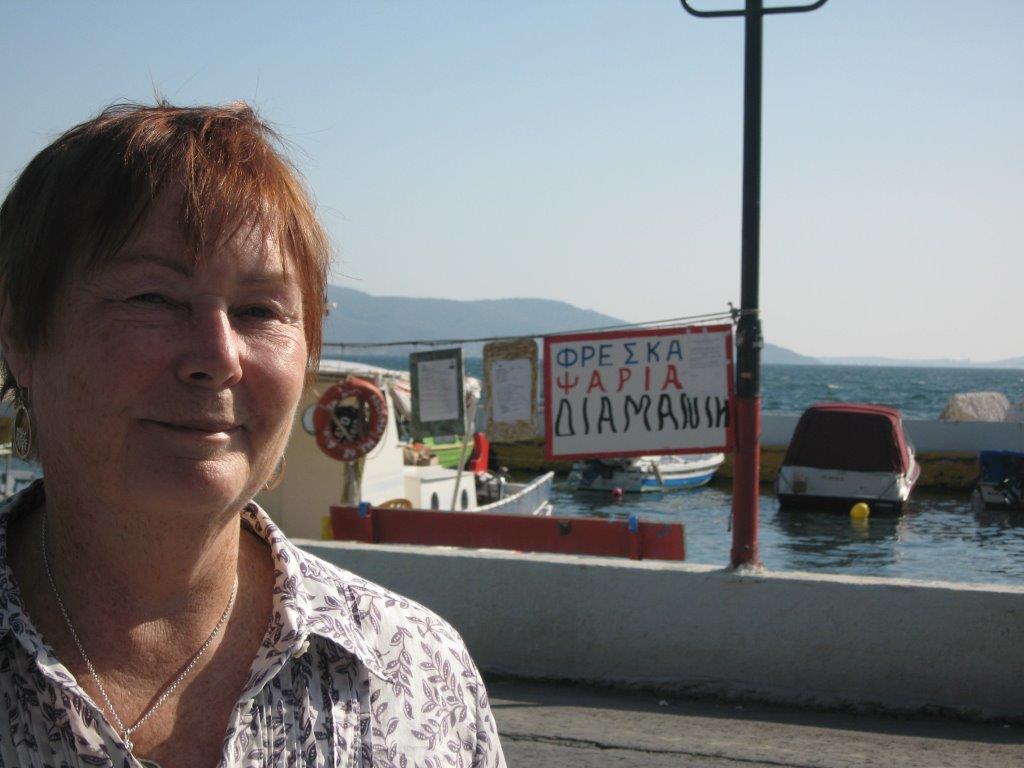
marika's rakiIn this picture, Marika from Skoteino Crete toasts our group and downs a glass of her homemade raki. Marika, who is best friends with Christina who makes lunch for us, has just returned from her home next door with her gift of a glass of raki for each of us.

Marika, who has little, is eager to give to us. Hers is but one of many gifts from the heart we receive on the Goddess Pilgrimage to Crete. Why is it that we who have so much do not give as spontaneously?

One answer is that capitalist individualism has taught us to count our worth by how much we have and to fear for the day when we will have nothing.

These words may be a cliché, but they hold a profound truth nonetheless.

Heide Goettner-Abendroth tells us that in matriarchal societies with small-scale sustainable agricultural economies, people did not hoard or save for a rainy day. With the labors of their bodies and minds, they took only what they needed from the land. When there was a surplus, they gave parties, sharing what they had with others. Even with the coming of patriarchy, ancient matriarchal customs of generosity survived among rural farmers. Continue reading “The Spirit of Capitalism vs. the Spirit of Traditional Rural Life by Carol P. Christ”

A Message from the Ancestors by Carol P. Christ

carol at green party 2014 croppedIn recent weeks and even months I have not been my usual cheerful self. After returning from sharing companionship and spiritual vision with a group of wonderful women on the Goddess Pilgrimage to Crete, I have been feeling lonely. This feeling came to a head on December 7 when it was cold and grey here in Lesbos, as had it been for weeks.

Feeling particularly sad that morning, I realized that December 7 was my mother’s Yahrzeit, the twenty-third anniversary of her death. The fact that I must use a Yiddish word to speak of this important day reflects the fact that we do not have a word (let alone a ritual) in the English language, in our versions of the Christian tradition, or in Goddess feminism to recognize the day a loved one died. As we Americans all know, we are supposed to get on with it and not dwell on death and dying.

A friend called that day to let me know that she was planning to visit me for few days during the holiday season, adding that she was looking forward to enjoying my tree and holiday decorations. “Oh,” I said, “my (live) Christmas tree is so heavy and hard to get into the house, I was thinking of not even bringing it in this year.”

That afternoon, I girded my loins and knocked on a neighbor’s door to ask for help. Of course one of the reasons that I was feeling sad is that as I live alone, I have no one to help me move a heavy tree. The neighbor’s shy son was more than willing to help, and we were lucky that we got the tree in a day before the pounding rains that would have doubled the weight of the soil in its pot.
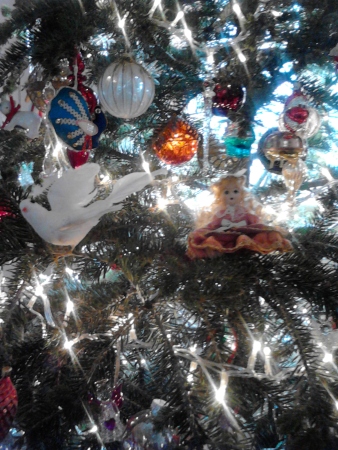
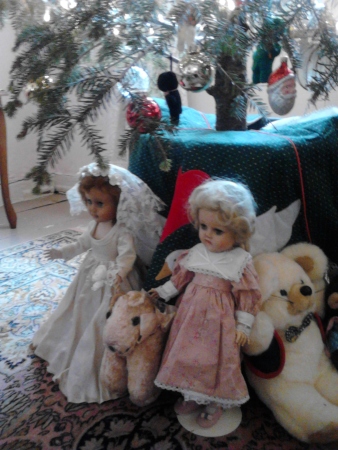
001dec 2014 232As I decorated my tree over the next two days, memories of my mother flooded into my mind. How I miss my mommy. “Do you still think of your mother?” I asked an older friend shortly after my mother died. “Yes,” she replied, “Every day.” Me too, I thought, as I unwrapped the Christmas tree skirt, one of the last gifts Mom had given to me, and the dolls and pink doggie she had saved for me.

The ritual of decorating my tree for Christmas is my memorial to my mother’s love. How much fun we had choosing what was usually a scrawny tree—the largest we could afford, but not the smaller prettier one my mother would have preferred. How I remember baking and decorating cookie cutter cookies—eating the raw dough, licking the sugar icing from our fingers, and always putting what Mom said were too many red hots and silver dots onto the cookies.

My mother’s memories of Christmas were not all happy. But my Mom tried her best not to dwell on sadness. Shortly before she died, I found my mother baking cookies for a man who also had cancer. “I was feeling sorry for myself,” she said, “so I decided to do something for someone else.” I could hear my mother’s mother speaking through her in that moment.

My grandmother’s attitude, which was Midwestern, Christian, and deeply female, was nearly lost to me, for I come from the generation that discovered therapy. In the process of dealing with our feelings, we criticized our ancestors for not doing the same. As Christmas approaches this year, I wonder: were my Mom and my Grammy right? Is there a profound truth in their knowledge, transmitted through the generations, that the best way to deal with one’s own sorrows is to do something for others?

***

011If so, then I guess it is time to plan my winter solstice birthday party (which I was also thinking of cancelling this year)–pick up the phone and start inviting friends over to enjoy my home, my tree, and my food, the gift of life shared with others.

Happy Winter Solstice to all and to all a good night!

***

Carol leads the life-transforming Goddess Pilgrimage to Crete (facebook and twitter) spring and fall–early bird discount available now on the 2015 tours.  Carol can be heard in interviews on Voices of the Sacred Feminine, Goddess Alive Radio, and Voices of Women.  Her books include She Who Changes and Rebirth of the Goddess and with Judith Plaskow, the widely-used anthologies Womanspirit Rising and Weaving the Visions and the forthcoming Turning to the World: Goddess and God in Our Time. Photo of Carol by Michael Bakas.

Dance of the Bees: Reading the Language of the Goddess by Carol P. Christ

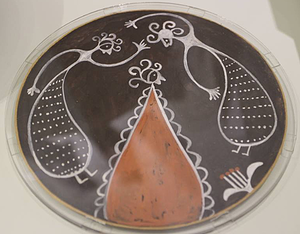
bee women dancing croppedThe image from an ancient Cretan bowl (c.1700 BCE) from the Sacred Center of Phaistos pictured here has often been interpreted as an early depiction of Persephone’s descent or rising. But are clues from later Greek mythology pointing in the right direction in this case?

Recently, my colleague Mika Scott posted the Phaistos bowl image on our Goddess Pilgrimage Facebook site in conjunction with the bee pendant from Mallia. This juxtaposition led me to think again about the importance of bees and pollination in agricultural societies and to offer an alternative reading of the symbolism on the bowl. Continue reading “Dance of the Bees: Reading the Language of the Goddess by Carol P. Christ”

BARBARA LEE SPEAKS FOR ME by Carol P. Christ

carol christWhile I was in Crete on the Goddess Pilgrimage teaching about and experiencing a Society of Peace where violence and domination were neither celebrated nor encouraged, another war broke out in Iraq, breaking my heart, breaking all of our hearts—yet again. When will we ever learn, oh when will we ever learn?

Barbara Lee was the only member of Congress to vote against the US war powers authorized after 9/11 which were used to launch war in Afghanistan; she also voted against authorization for the Iraq war in 2002. Hillary Clinton voted for the Iraq war, despite clear indications that the US administration was lying about weapons of mass destruction—which were never found in Iraq. I voted for Barack Obama because he opposed this war. Then he listened to General Petraeus and expanded the war in Iraq. Barbara Lee speaks for me. Hillary Clinton and Barack Obama do not.

The Iraqi people are once again living in fear of their lives as reports surface that armies and militias are engaging in mass executions of their so-called “rivals.” Is there any cause that could justify this? Continue reading “BARBARA LEE SPEAKS FOR ME by Carol P. Christ”

Inner and Outer Darkness in the Skoteino Cave by Coleen Clare

Coleen ClaireLast fall I undertook the Ariadne Goddess Pilgrimage to Crete and saw many wonders. Foremost for me was our descent into the Skoteino Cave, following in the footsteps of ancient Cretans who understood the cave to be the Source of Life, the womb of the Goddess, and a place of transformation. I ventured down tentatively taking very wary steps, protecting my two new hip replacements, determined to join our sacred ritual in the cave with my sisters. My hips called a stop to my descent half-way down. I perched perilously on a small rock ledge and there I confronted inner and outer darkness. It was indeed a profound transformation. Continue reading “Inner and Outer Darkness in the Skoteino Cave by Coleen Clare”

GIVING BACK TO THE MOTHER by Carol P. Christ

carol-christOne of the inspirations for the Goddess Pilgrimage to Crete was the spiritual power and energy I felt at the monastery of Paliani with its Sacred Myrtle Tree.  The Panagia, She Who Is All Holy, is said to live in the tree, and the nuns who tend the tree follow customs far older than Christianity.  When I first visited Paliani, I asked Her to heal my broken heart and help me find my true love.

panagia palianiOver the years, I have offered many other prayers:  for my books and tours, for health, for citizenship that would enable me to stay in Greece.   I tell other pilgrims that the Panagia of Paliani has performed many miracles and repeat the story of the doctors who desperately wanted to have a child, who had tried everything, and who had a son a year to the day after making a prayer at Paliani. I point to the many “tamas,” including gifts of precious jewelry, crutches and body braces that have been given in honor of the power of the Panagia of Paliani.

In the fall of 2012 one of our members prayed that a heavy flow of menstrual blood that often lasted for more than half of every month be stopped so that she would have the strength to participate fully in the pilgrimage. She had been bleeding for 5 weeks when she came on the tour, and her bleeding stopped the moment she touched the tree.  Continue reading “GIVING BACK TO THE MOTHER by Carol P. Christ”

IS THE SPIRIT OF GREAT GENEROSITY IN CRETE A SURVIVAL OF ANCIENT MATRIARCHAL VALUES? by Carol P. Christ

carol-christAt a coffee shop in Agios Thomas, Crete last month a perfect stranger offered to pay for the coffees and sodas of the 16 women on the Goddess Pilgrimage to Crete. This spirit of great generosity is rarely experienced in the United States or other parts of Europe, but it is still common in rural Crete and some parts of Greece.

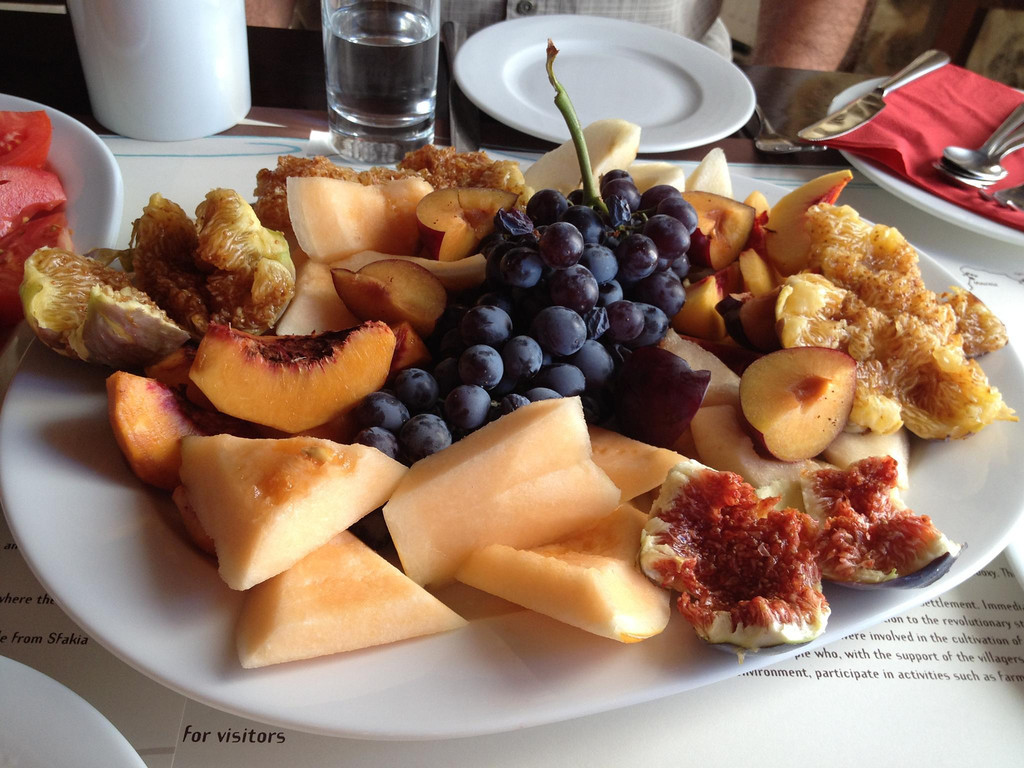
 In fact our group was in Agios Thomas because our bus driver Babis, also in a spirit of great generosity, insisted on stopping to show us his village when we were passing nearby. He guided us to see Roman rock cut tombs and arranged for the early Byzantine church to be opened. At the end of the our pilgrimage, Babis stopped the bus at a wooded glen beside a small church where he offered us his own homemake raki, wine, and olives, accompanied by local sheep cheese he had purchased while we were climbing a mountain. After every meal that we ate in local tavernas, we were offered bottles of cold raki, fruit, and sweets.

crete fruitsThis spirit of great generosity has long been commented on by travelers in Greece, who often speak of it as unexpected (for them) hospitality to the stranger or traveler. That it is, of course. Through the work of Heidi Goettner-Abendroth, I now understand that the famous Greek hospitality to the stranger has deep roots in matriarchal cultures. According to Goettner-Abendroth, equality of wealth is assured through the widely-practiced custom of gift-giving in matriarchal cultures. Continue reading “IS THE SPIRIT OF GREAT GENEROSITY IN CRETE A SURVIVAL OF ANCIENT MATRIARCHAL VALUES? by Carol P. Christ”

She Who Has Faith in the Unknown by Jassy Watson

Jassy_Agora1-150x150I am sharing the following story, that with a few recent alterations, I wrote as a university paper last year in a course on Ancient Religions. It is significant for me presently because it is a year almost to the day that I embarked on Carol Christ’s Goddess Pilgrimage to Crete. Seeds of transformation were planted on Greece, therefore naturally I have been reflecting and reminiscing not only on my Odyssey, but also on the full circle I have come since.

Today, from my hometown of Delphi, I will make pilgrimage to the Temple of Apollo. I will make this journey alone for I seek answers to questions of a personal nature. I have waited patiently through the cold and barren days of winter, even coming summer and autumn past, failing to see the Pythia with each visit, for during these times of uncertainty the Temple has been busy with representatives from many cities. All recognise the importance of Apollo as a mediator of disputes and a champion of law and stability. Everyday concerns like mine are least important compared to those matters of war and men. I come however, not seeking answers from Apollo, but rather from our great mother Gaia, for all know that it is she who has resided here since the beginning. I feel it in my heart that I will be heard today, for spring has arrived, and concerns over battle have been put aside for the festival ‘Theophania’, a celebration of Apollo’s return. The countryside is bursting with new life, the sky is clear and the womb of the great mother is abundant; I sense blessings for a brighter future. Continue reading “She Who Has Faith in the Unknown by Jassy Watson”

THE LABRYS: A RIVER OF BIRDS IN MIGRATION by Carol P. Christ

carol-christ“There’s a river of birds in migration, a nation of women with wings.” —Goddess chant, Libanalabrys seal ring

On the Goddess Pilgrimage to Crete, I explain that many of the names given to “Minoan” (c. 3000-1450 BCE) Cretan artifacts and architecture are products of patriarchal and Eurocentric imaginations, and as such, are misleading.  For example the name “Minoan” was given to the culture of Bronze Age Crete in honor of “King Minos,” who was said to have ruled in Crete a few generations before the Trojan War–several hundred years after the end of the culture to which his name was attached.  In fact, despite his eagerness to find evidence that King Minos ruled at Knossos, the excavator Sir Arthur Evans finally had to concede that the best he could do was to produce a fresco of a “Prince of the Lilies” which he identifed as the image of the male ruler of the culture he called “Minoan.”  Evans’ Prince had white skin, a fact that Evans conveniently overlooked–because according to his own interpretation of “Minoan” iconography, white skin would mark the figure as female.  Mark Cameron, who reviewed Evans’ reconstruction of the fresco, suggested that the Prince is more likely to be a young woman who is perhaps leading a bull to take part in the bull-leaping games.  He also stated that the “crown” belonged to another fresco altogether.

Evans’ failure to find evidence of a King or for that matter a Queen at the complex of buildings he called “The Palace of Knossos” calls into question his idea that these structures were palaces.  Nanno Marinatos argued that the “palace” was instead a ritual center for the surrounding village, as well as a community gathering place, a place for storing grain, wine, and oil in a sacred way, and a place where ritual objects were fashioned of clay, bronze, stone, and gold.  Following her lead, I renamed the “Palaces” “Sacred Centers.” In this blog I will experiment with renaming the “Minoan” culture “Ariadnian,” after the pre-Greek name Ariadne, which may be one of the names of the Goddess of Bronze Age Crete.

One of the most pervasive–and many would say–most enigmatic symbols of the Ariadnian culture is the labrys.  Continue reading “THE LABRYS: A RIVER OF BIRDS IN MIGRATION by Carol P. Christ”

A Gift Economy: Could It Be Better To Give Than To Receive? by Carol P. Christ

carol p. christ 2002 colorIn a gift economy inequalities are balanced out by the cultural practice of gift-giving. If you have more, then you give more, if you have little, you still feel it is better to give than to receive.  A person who hoards wealth is not viewed positively.

The worldview of a gift-giving economy is so far from our own that we can barely comprehend it.

marika's rakiIn Skoteino, Crete, eighty-seven year old Marika awaits eagerly for the arrival of our group. She does not come empty-handed to join us after we have finished a meal lovingly prepared by Christina.  Marika brings a bottle of raki and urges us all to join her in downing a small glass of her homemade moonshine.  Often she offers us nuts she has cracked or raisins she has prepared as well .  She has almost nothing and lives without many modern conveniences, but she would not consider joining us without bringing a gift.

In Zaros, we arrive at our favorite hotel only to be told that the taverna that serves fresh trout is closed because the owner’s son will be getting married in the evening. When I complain that we have come to eat the special trout, our whole group is invited to the wedding.  Outside the taverna the grandmothers light fires under massive copper pots where they prepare the food. Over 600 people have been invited to the wedding. We are first served macaroni with virgin olive oil and goat cheese, then lamb, then goat, and salad. When the wine runs out, bottles of raki are brought to the tables. We dance all night long in a kind of a frenzy. Continue reading “A Gift Economy: Could It Be Better To Give Than To Receive? by Carol P. Christ”