Epona – Goddess of the Land by Deanne Quarrie

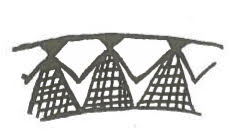
celtic-horseDeanne QuarrieThis week I bought a pendant that caught my attention.  It is Celtic knot work of horses, meant to represent Epona.  This triggered my interest in Epona and off I went to learn more.

Epona is a goddess from Gaul.  Sadly, any information about her from those early days of worship are lost to us. This is the case of the most ancient deities from that region and time in history. It is thought that she was picked up in Gaul by the conscripted soldiers of the Roman Army who saw a depiction of her upon her horse and they adopted her. Since this army rode across the land on horseback, she was the perfect deity to pay homage to and so, she traveled with them. She soon made it to Rome and is one of only a few deities, not originally Roman, to be worshiped in the Roman Empire. Continue reading “Epona – Goddess of the Land by Deanne Quarrie”

Our Ladies of Sea, Earth, and Sky by Joyce Zonana

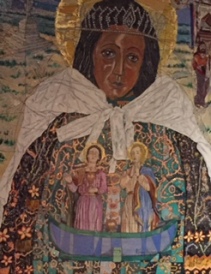
Sara and the Marys
Sainte Sara encompassing Sainte Marie-Salome and Sainte Marie-Jacobe

O Sainte Marie-Jacobe, priez pour nous.

O Sainte Marie-Salome, priez pour nous.

O gardeures de la Provence, priez pour nous.

The priest intoned the words in deep, liquid accents, his voice echoing from the ancient stone church in the remote village of Les Saintes-Maries-de-la-Mer, in the Camargue region of Southern France, where the waters of the Rhone River meet the Mediterranean Sea in a wild, wide, flat expanse populated by black bulls, pink flamingos, and white horses.

“O, Saint Mary-Jacobe, pray for us.”
“O, Saint Mary-Salome, pray for us.”
“O, guardians of the gates of Provence, pray for us.”

I could feel the words resonating through me, bringing sudden, hot tears. The people gathered in the small village square repeated the priest’s chant, their voices rising above the low, white-washed houses into the sunlit sky, out towards the shimmering sea where legend tells us the two Marys had drifted two thousand years ago in a boat without rudder or sail.

Continue reading “Our Ladies of Sea, Earth, and Sky by Joyce Zonana”

She Changes Everything She Touches by Deanne Quarrie

Deanne QuarrieShe Changes Everything She Touches and …
Everything She Touches Changes….

As a way of entry to this post, I wish to let readers know that this is not a typical kind of post for this blog. It is however, the work of an accomplished priestess and about how she has been reminded of what she knows about manifesting wants and needs in her life. It is personal and it is real. In my professional life I was big on accountability and know that it applies to my magical life as well. This post therefore witnesses my intentions!

I have been feeling horribly scattered lately, almost as though I have acquired ADHD in my old age. Each day is incredibly busy and yet at the end of the day, when I reflect on how busy, I realize I have not gotten anything productive done! I have a lot of irons in the fire and recently have added even more. I added them because they seem important, as they might prove helpful to me for accomplishing some of my goals.

So, I was talking to my friend and fellow Priestess, Letecia Layson, on the phone the other day, lamenting about this as well as other things that I wish to develop in my life that have to do with family and friend connections and spending more time with in-person relationships.

At the end of our conversation, in which my friend used her skills at listening, she remarked, “Bendis, you are a remarkable woman and have accomplished so much in your life. You have shared marvelous things with your students, but in listening to you, I can clearly see that, right now, you are not using what you teach in your own life.” Continue reading “She Changes Everything She Touches by Deanne Quarrie”

Four Reasons We Need To Reclaim The Power of the Divine Feminine Now by Mary Petiet

Mary Petiet photo(Spoiler alert:  She’s already here)

The power of the divine feminine taps into the power of life. The power is accessible to everyone as the equal opportunity energy surrounding and connecting all living things. The power is ancient, and meditative practices such as yoga, which in Sanskrit means linking to the divine, can connect us to this power. When we make the connection, we find the balance we need to realize our highest selves, and through that balance we can realize the highest self of the larger society.  To reclaim the divine feminine, we need only remember, and as more and more of us remember, we heal first ourselves, and ultimately the planet.

1. She is the route back to the self.

In her mother aspect the divine feminine offers a route back to the self and She is all-inclusive. She embraces all of creation, men, women and nature, and we find Her when we reach back far enough into history and our own consciousness. She was there from our very beginning, through the Paleolithic and the Neolithic, when we celebrated her in carved figurines. She was there when we made the shift to agriculture, clear as the full moon, the goddess with her circular all encompassing worldview, birth, life, death and birth again. The goddess as mother, the goddess whose body is the earth which nurtures us all. She is there now in your deepest consciousness, you need only remember, and when you do, She will guide you back to yourself.

Continue reading “Four Reasons We Need To Reclaim The Power of the Divine Feminine Now by Mary Petiet”

A Crone’s Life, an Embodied Experience by Deanne Quarrie 

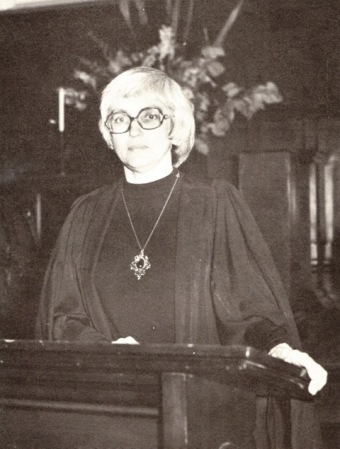
Deanne Quarrie, D.Min.In January of 2013, I wrote an article here for FAR called Embody the Sacred. In it I wrote,

“If we are to fully embrace living a magical life it is important to remember how to live in our bodies comfortably and safely. If we re-awaken all of our senses, our awareness is expanded and our perceptions clarify and develop. Without this, our magical life will not develop as it could. Our enjoyment of all that is Sacred will be impeded, as if walled in and separated from all that is possible.”

I would like to rephrase this statement just a bit to reflect where I am in my thinking now.

If we are to fully embrace living, it is important to remember how to live in our bodies comfortably and safely. If we re-awaken all of our senses, our awareness is expanded and our perceptions clarify and develop. Without this, our lives will not develop as they could. Our enjoyment of all that is Sacred will be impeded, as if walled in and separated from all that is possible. Continue reading “A Crone’s Life, an Embodied Experience by Deanne Quarrie “

How the Outdoors Got on Us by Barbara Ardinger

Barbara ArdingerI read some wonderful posts last spring and summer about the beauties of the outdoors. One that especially inspired me was by Molly MeadeIf you missed Molly’s description of how she goes out to the “priestess rocks,” read it now.

But as much as I admire people who like to spend time outdoors in gardens or the wilderness or national parks or anywhere else without kitchens and bathrooms…well, I just don’t like to get the outdoors on me. Most Pagans I know like to camp and hold grand outdoor rituals. Not me. I get lost. I trip over tree roots and get allergic in some large gardens. I don’t like to climb or hike and I stay away from the beach because it’s got all that icky, dirty sand all over it. Although I send money to the Wilderness Society and Friends of the Earth, the wilderness does not need my footprints in it.

So here’s another of my weird little stories. This one’s a fable I wrote several years ago for a friend who was holding regular ceremonies at Joshua Tree National Park in the SoCal desert. (I went to some of those ceremonies. My friends were very proud of me.)

Continue reading “How the Outdoors Got on Us by Barbara Ardinger”

More Than Just an Image by Jassy Watson

jassyI spent 2015 teaching an Intentional Creativity program ‘Wisdom of the Goddess” to an intimate tribe of women creatives from our local community. In December we held an end of Year Art Gala displaying a portion of the work which saw over 100 paintings of Goddesses created over a 10-moon period.

The program was divided into the cycles of Creation, Transformation and Celebration, as inspired by Hallie Inglehard’s book “The Heart of the Goddess”. Each month, through ritual, visioning and painting, we explored a Goddess that represented these cycles; Eve, Anjea, Demeter, Cerridwen, Kali, Persephone, Aphrodite, Ochun and finally, our Inner Goddess.

It took great courage for the artists to display their paintings in public. It is often hard to explain this work because it requires such deep and thoughtful exploration of one’s inner world along with a commitment to a creative practice that favours personal growth and discovery over outcome. It can be difficult finding the language to elucidate on this process that is not just about the act of painting.

It is painting to grow and heal.

It is sacred.

It honours and empowers women.

It inspires authentic creative expression.

It unites one with self.

It connects one back to the earth.

It transforms.

It reveals.

The show was a great success. A gallery full of Goddesses was surely a sight to behold! It was a humbling experience to be out and proud about our creative work in our regional, agricultural, largely conservative community. I feel it is imperative for the restoration of female empowerment to be remembering and re-imagining the Goddess by way of image and it was through Her that these astounding women artists found the courage to put their heart and soul on the wall for all to see.

The influence that image has is far-reaching and cannot be under-estimated. Image is a universal language that evokes emotion and can go as far as mobilising the masses and even change the course of history. The famous photo of ‘Phan Thi Kim Phuc’ running naked down a road after a napalm attack during the Vietnam War is but one outstanding example.

As I reflected on the years work however, I was reminded that while these paintings carry with them incredible insights and powerful messages of change, growth, discovery and transformation, the Goddess is so much more than just an image; and certainly more than just an image to mass-produce and sell. While “the strength and independence of female power can be intuited by contemplating ancient and modern images of the Goddess” (Carol P. Christ in ‘Why Women Need the Goddess’), it cannot be forgotten that She is the sacred made immanent in the natural world, expressed in the diversity of all forms of life and death. We seek Her, sometimes even travelling to the ends of the earth to find Her, forgetting that She is everywhere. She is you and me and Her sacred sites are found in our own backyards.

With this in mind I recently returned to some creative investigations I had begun a few years ago exploring woman in nature and the Goddess as the body of the earth through paint. The earth speaks and I am listening to Her stories and bringing them to the canvas to re-affirm my sense of wonder and respect for nature. My aim is to awaken an ancient memory of the sacred relationship between human and nature, for now, more than ever, it is critical that this relationship be restored. In doing so, the earth may once again be seen and valued as a living, breathing body that sustains and nourishes all life rather than being merely a commodity to be devastated and destroyed in the name of capitalism and greed. Further, these images are reminders of the interconnectedness of all life; we are not separate from the earth, but part of its’ intricate web.

The following image was inspired in part by Terry Tempest Williams ‘When Women Were Birds’ but is also an image born from a revelation I had many, many years ago when I first starting seeing woman in nature, especially in the body of trees.
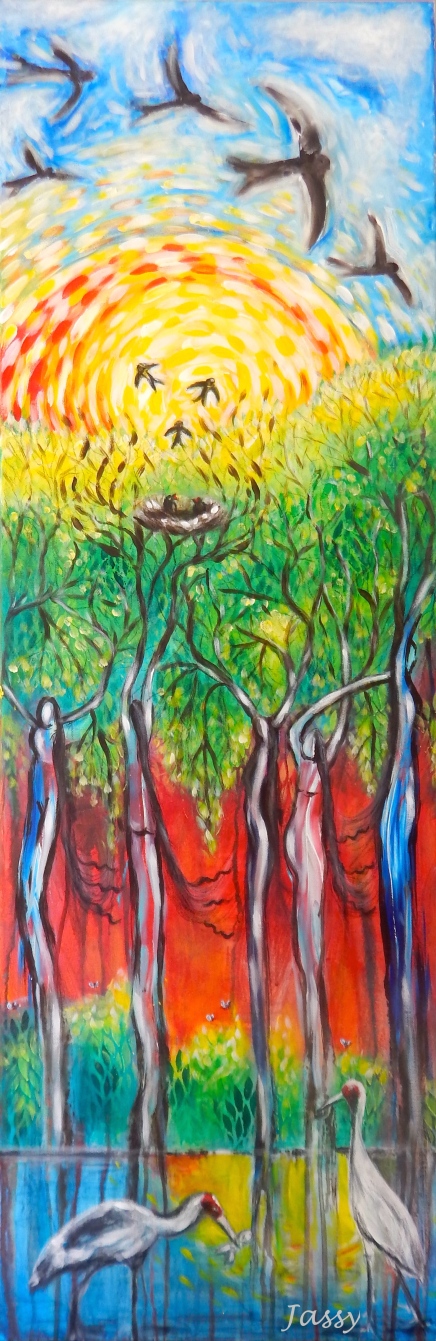
When women were birds FINAL


“We are the birds eggs. Birds eggs, flowers, butterflies, rabbits, cows, sheep; we are caterpillars; we are leaves of ivy and sprigs of wallflower. We are women. We rise from the wave. We are gazelle and doe, elephant and whale, lilies and roses and peach, we are air, we are flame, we are oyster and pearl, we are girls. We are woman and nature. And he says he cannot hear us speak.

 But we hear.”

 Susan Griffin, Woman and Nature: The Roaring Inside Her

Jassy Watson, who lives on the sub-tropical coast of Queensland Australia, is a Mother of four, passionate organic gardener, Intuitive/Visionary Artist, Intentional Creativity Coach and a student of Ancient History and Religion at Macquarie University, Sydney. She is the Creatress of Goddesses Garden Studio & Gallery; a small school for the Sacred Creative Arts. Jassy teaches regular painting workshops in person, nationally, internationally, and online based around themes that explore myth, history, earth connection and the Goddess. Her latest SOULSCAPES (TM) exploring woman in nature will be on show at ‘Dreaming Into Being’, Percolator Gallery, Paddington, Brisbane April 5th-11th. You can see her work at http://www.goddessesgardenandstudio.co

Inspiration From a Sea Goddess in the Desert by Kayla Bonnin

KaylaBonninStanding as a stark and graceful contrast to the corruptions of freedom of religion, expression, and human rights we hear about every day, there was a grand display of feminine empowerment and beauty at the most recent Burning Man festival, an event in Black Rock City, Nevada. It was a magnificent temple created for Mazu—the Chinese Goddess of the Sea. Her temple and its towering lotus flower were built, and soon thereafter ritualistically burnt, in the simplistic beauty of the desert.

An aesthetically calming temple honoring her came about by the collaboration of Project Manager Nathan Parker and Taiwanese arts foundation, the Dream Community. When I arrived at Burning Man and first saw the temple, I was in awe. The open, octagonal building created from bamboo was rustically elegant. It was designed to be indicative of a structure floating in water. Two piers stretched outwards on either side, while an eye-catching arbor framed the path to the entrance. Blue LED lights flickered on the ground in wave patterns around the temple to create the essence of water encircling the goddess’s temple. A towering 40-foot pink lotus flower sat atop the structure, while fire breathing dragon statues flanked the four corners. Once inside, a center pillar held burning incense, notebooks and pens for reflections, and small strips of papers inscribed with prayers for people to take.

Mazu


Continue reading “Inspiration From a Sea Goddess in the Desert by Kayla Bonnin”

The Sacred Feminine or Goddess Feminism? by Carol P. Christ

In recent yCarol Molivos by Andrea Sarris 2ears “the Sacred Feminine” has become interchangeable with (for some) and preferable to (for others) “Goddess” and “Goddess feminism.” The terms Goddess and feminism, it is sometimes argued, raise hackles: Is Goddess to replace God? And if so why? Does feminism imply an aggressive stance? And if so, against whom or what?

In contrast, the term “sacred feminine” (with or without caps) feels warm and fuzzy, implying love, care, and concern without invoking the G word or even the M(other) word–about which some people have mixed feelings. Advocates of the sacred feminine stand against no one, for men have their “sacred feminine” sides, while women have their “sacred masculine” sides as well.

Nothing lost, and much to be gained. Right? Wrong.

Perseus with the Head of Medusa: Sacred Masculine?
Perseus with the Head of Medusa: Sacred Masculine and Sacred Feminine?

When Goddess feminism emerged onto the scene early in the feminist movement, it had a political edge. It was about women affirming, as Meg Christian crooned in “Ode to a Gym Teacher,” that “being female means you still can be strong.” Goddess feminism arose in clear opposition to patriarchy and patriarchal religions. It was born of an explicit critique of societies organized around male domination, violence, and war; and of the male God or Gods of patriarchal religions as justifying domination, violence, and war. In this context, “the sacred masculine” was not understood to be a neutral or positive concept. To the contrary, the male Gods of patriarchy were understood to be at the center of symbol systems that justify domination.

The terms “the masculine” and “the feminine” were floating around and sometimes evoked in early feminist discussions, but when examined more closely, they were rejected by most feminists as mired in sex role stereotypes. The psychologist Carl Jung, for example, associated the masculine with the ego and rationality and the feminine with the unconscious. True, he argued that modern western society had developed too far in the direction of the masculine and needed a fresh infusion of the feminine in order to achieve “wholeness.” This sounded good, but when feminists looked further, they discovered that Jung and his followers harbored a fear of the uncontrolled feminine.

Jungians consider the unconscious to be the repository of undisciplined desires, fears, and aggressive feelings that require the rational control of the ego. Though strong and intelligent women were among Jung’s most important followers, Jung and his male companions retained a fear of independent women, speaking of women who developed their rational sides fully enough to argue with men and male authorities as “animus-ridden,” a term not meant as a compliment.

Hades Abducting Persephone: Marriage of Sacred Masculine and Sacred Feminine?

Jungians, following Erich Neumann, understand the progress of history through an evolutionary model in which humanity began in a matriarchal stage in which the unconscious reigned. This period of culture, which spawned the image of the Great and Terrible Mother, was primitive and irrational. Matriarchy was naturally superseded by patriarchy, in which the individual, the ego, and rationality emerged. In the patriarchal stage of culture, male Gods and heroes were the primary symbols, and rationality reigned supreme.

The patriarchal stage of culture had its limitations, which were revealed in the two World Wars of the twentieth century and the nuclear and environmental crises that followed. Rational man, Jungians argued, had come to the point where he needed to reconnect with his feminine side. The unconscious feminine was now understood to be a nurturing matrix that included the body, nature, and feeling, from which rational man should and could never fully separate himself.

The great archaeologist Marija Gimbutas also spoke of two cultures within Europe, an earlier matrifocal one she called Old Europe and a later patriarchal one. The Jungian Joseph Campbell endorsed Gimbutas’ work, leading some to assume that Gimbutas and Jungians hold similar theories of human history. In fact they do not: Gimbutas did not subscribe to an evolutionary theory of culture. She would never have said that the earlier matrifocal culture “had to be superseded” by the later patriarchal culture “in order for civilization to advance.” The clear conclusion to be drawn from Gimbutas’ work is that the patriarchal culture was in almost every way inferior to the one it replaced.

For Gimbutas, the agricultural societies of Neolithic Old Europe were peaceful, egalitarian, sedentary, highly artistic, matrifocal and probably matrilineal, worshiping the Goddess as the powers of birth, death, and regeneration. These societies did not evolve into a higher stage of culture, but were violently overthrown by Indo-European invaders. The culture the Indo-Europeans introduced into Europe was nomadic, patriarchal, patrilineal, warlike, horse-riding, not artistic, worshiping the shining Gods of the sun as reflected in their bronze weapons. Gimbutas did not look forward to a new “marriage” of matrifocal and patriarchal cultures. Rather she hoped for the re-emergence of the values of the earlier culture. Her theories had a critical edge: she did not approve of cultures organized around domination, violence, and war.

This critical edge is exactly what is lost when we begin to substitute the terms “sacred feminine” for “the Goddess” or “Goddess feminism” and “sacred masculine” for “patriarchy” and “patriarchal Gods.” When we allege that we all have our “masculine and feminine sides,” and that it is important “to reunite the masculine and the feminine,” it is easy to forget that in our history, the so-called sacred masculine has been associated with domination, violence, and war.

If we hope to create societies without domination, violence, and war, then we must transform the distorted images of masculinity and femininity that have been developed in patriarchy. We must insist that domination, violence, and war are no more part of masculinity or male nature than passivity and lack of consciousness are part of femininity or female nature. It may feel good to speak of reuniting the masculine and the feminine, but feeling good will not help us to transform cultures built on domination, violence, and war.

Carol P. Christ is author or editor of eight books in Women and Religion and is one of the Foremothers of the Women’s Spirituality Movement. She leads the Goddess Pilgrimage to Crete in Spring and Fall: Early Bird Special until February 15. Follow Carol on Twitter @CarolP.Christ, Facebook Goddess Pilgrimage, and Facebook Carol P. Christ.  Photo of Carol by Andrea Sarris.

A Serpentine Path Cover with snakeskin backgroundA Serpentine Path: Mysteries of the Goddess will be published by Far Press in the spring of 2016. A journey from despair to the joy of life.

Goddess and God in the World: Conversations in Embodied Theology with Judith Plaskow will be published by Fortress Press in June 2016. Exploring the connections of theology and autobiography and alternatives to the transcendent, omnipotent male God.

To Know Her Is to Love Her by Joyce Zonana

“As my mother passed from this life, she was surrounded by a great matrix of love. As she died I began to understand that I too am surrounded by love and always have been. This knowledge is a great mystery.”— Carol P. Christ, A Serpentine Path: Mysteries of the Goddess (forthcoming, FAR Press, 2016)
Joyce Zonana head shot

It has taken me 66 years—my entire life—to learn to love my mother, and, even more importantly, to accept her love for me.

When I was younger, I could not distinguish that love from control, and I felt smothered by her constant attention, care, and what I took to be criticism. I felt overwhelmed, stifled. I resisted, fighting to assert my autonomy and freedom, my difference. Our relationship become one of painful, sometimes ugly conflict, extending well beyond my adolescence and into my adulthood. For too many years, it was almost impossible for me to be in the same room with her.

Today, I happily sit on the floor at her feet, holding her hand, basking in the glow of her love, offering what I can of my own. Continue reading “To Know Her Is to Love Her by Joyce Zonana”