Learning Gratitude for the Gifts of Life on the Goddess Pilgrimage to Crete by Carol P. Christ

In Crete we are always being given gifts—fresh cherries, ice cold bottles of raki, yogurt swimming in honey, and so much more. Over the years it finally hit me that this spirit of great generosity is a living remnant of the ancient Cretan egalitarian matriarchal tradition of gift-giving.

In egalitarian matriarchal cultures gift-giving is not something reserved for birthdays and holidays. It is a way of life rooted in the primary understanding that life is a gift that is meant to be shared.

Our lives are a gift from our mothers. Our individual lives have are not something we create or created for ourselves. We all emerged from the body of a mother. We were all given the gift of care and feeding by a mother or others. Our mothers did not create themselves. They emerged from the bodies of mothers and were cared for and fed by mothers or others. And so on back to the original mother of the human race, known as the African Eve.

Continue reading “Learning Gratitude for the Gifts of Life on the Goddess Pilgrimage to Crete by Carol P. Christ”

SHEELA-NA-GIG by Carol P. Christ

On a trip to Ireland several years ago, I was fortunate to have been able to see the Sheela-na-gigs in the National Museum of Dublin.  Two of these Sheelas including the one removed from the Seir Kieran Church of County Offaly, pictured below, are currently on display.  They stand at the doorway of a room dedicated to items from the medieval period and easily missed.  As there was little interest in them and they are not in cases, I was able to silently commune without interruption.
Continue reading “SHEELA-NA-GIG by Carol P. Christ”

Embodying Gaia by Christy Sim

Rosemary Radford Ruether wrote a classic text: “Gaia and God: An Ecofeminist Theology of Earth Healing.” Ever since I laid eyes on this amazing book and was convinced of the genius Ruether offered within these pages, I adored images of Gaia.

The great goddess is usually pictured holding the world as her womb, a loving representation of compassionately pulling all the hurt and agony to her abdomen for healing.

Ruether says in “Classical Western cultural traditions” of which “Christianity is a major expression,” we “have justified and sacralized” notions of God and domination (3). Such ideas teach us that domination is “the ‘natural order'” and “the will of God” for the “male monotheistic God” and his followers (3).

But Gaia is so much more and challenges these patriarchical messages in today’s culture. To imagine the divine with this motherly image helps with “ecological healing” (as Ruether says), and, being able to picture a “personified being” in the feminine (4). Gaia is truly special.

Continue reading “Embodying Gaia by Christy Sim”

Sacred Water by Molly Remer

“Drinking the water, I thought how earth and sky are generous with their gifts and how good it is to receive them. Most of us are taught, somehow, about giving and accepting human gifts, but not about opening ourselves and our bodies to welcome the sun, the land, the visions of sky and dreaming, not about standing in the rain ecstatic with what is offered.”

–Linda Hogan in Sisters of the Earth

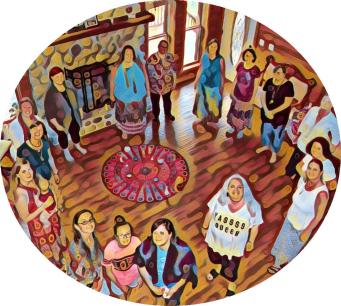
The women have gathered in a large open living room, under high ceilings and banisters draped with goddess tapestries, their faces are turned towards me, waiting expectantly. We are here for our first overnight Red Tent Retreat, our women’s circle’s second only overnight ceremony in ten years. We are preparing to go on a pilgrimage. I tell them a synopsis version of Inanna’s descent into the underworld, her passage through seven gates and the requirement that at each gate she lie down something of herself, to give up or sacrifice something she holds dear, until she arrives naked and shaking in the depths of the underworld, with nothing left to offer, but her life.

In our own lives, I explain, we face Innana’s descents of our own. They may be as difficult as the death of an adult child, the loss of a baby, the diagnosis of significant illness, or a destroyed relationship. They may be as beautiful and yet soul-wrenchingly difficult as journeying through childbirth and walking through the underworld of postpartum with our newborns. They may be as seemingly every day as returning to school after a long absence. There is value in seeing our lives through this mythopoetic lens. When we story our realities, we find a connection to the experiences and courage of others, we find a pattern of our own lives, and we find a strength of purpose to go on. Continue reading “Sacred Water by Molly Remer”

The Mountain Mother: Reading the Language of the Goddess in the Symbols of Ancient Crete by Carol P. Christ

Before he told the story of how his people received the sacred pipe, Black Elk said:

So I know that it is a good thing I am going to do; and because no good thing can be done by any man alone, I will first make an offering and send a voice to the Spirit of the World, that it may help me to be true. See, I fill this sacred pipe with the bark of the red willow; but before we smoke it, you must see how it is made and what it means. These four ribbons hanging here on the stem are the four quarters of the universe. The black one is for the west where the thunder beings live to send us rain; the white one for the north, whence comes the great white cleansing wind; the red one for the east, whence springs the light and where the morning star lives to give men wisdom; the yellow for the south, whence come the summer and the power to grow.

But these four spirits are only one Spirit after all, and this eagle feather here is for that One, which is like a father, and also it is for the thoughts of men that should rise high as eagles do. Is not the sky a father and the earth a mother, and are not all living things with feet or wings or roots their children? And this hide upon the mouthpiece here, which should be bison hide, is for the earth, from whence we came and at whose breast we suck as babies all our lives, along with all the animals and birds and trees and grasses. And because it means all this, and more than any man can understand, the pipe is holy. [italics added]

In this passage Black Elk illustrates the multivalency of symbols: the sacred pipe does not have a single meaning, but many meanings, in fact, more meanings than anyone can understand. Continue reading “The Mountain Mother: Reading the Language of the Goddess in the Symbols of Ancient Crete by Carol P. Christ”

Join the Rebellion by Jessica Bowman

Like many other thousands of Americans, I watched the newest offering from the Star Wars legacy last autumn and was re-inspired to be an active part of the rebellion against oppression. Viewing the movie through my feminist lens I was cheered on by the choice of actors and actresses in lead roles and was reminded of Margaret Mead’s famous quote, “Never doubt that a small group of thoughtful, committed, citizens can change the world. Indeed, it is the only thing that ever has.”

It may be easy to compare the new president to Lord Vader because he is an easy target who encourages mockery and ridicule. However, tyranny, violence, and power trips have long been a part of world societies, for centuries.  It is as evident as ever that we must continue to stand against such debilitating realities. We must stand together.

And, like millions of other people across the world, I had the privilege to participate in a Sister March to the Women’s March on Washington; shoulder to shoulder with passionate and caring people determined to make a difference. The experience generated feelings of elation, hope, and unity. I was most impressed by the kindness radiating from every person I came in contact with.  Even though spaces were packed with people the overall atmosphere was conscientious, polite, and caring. Peaceful activism is critical to progress.  

I also listened intently to the speeches made at the marches; especially by the women well known in popular culture. Gloria Steinem, a cornerstone of the modern feminist movement, spoke words that I believe reflect the change in values that I visualize in the form of a river current. “God may be in the details, but the Goddess is in connections. We are at one with each other, we are looking at each other, not up.” Women’s work is the creation of the web; the tapestry of connections between us all and the building of momentum in the stream bed. Continue reading “Join the Rebellion by Jessica Bowman”

It’s a Small Thing in Relation to Everything Else: Or Is It? by Carol P. Christ

carol-p-christ-photo-michael-bakasYesterday morning when I learned about the Open Letter to Attorney General Sessions: Join Us In Selma On the Right Side of History, I paused Joy Reid’s interview with William Barber II in order to search for the petition site. The letter’s authors invited the Attorney General to join them in Selma to commemorate the 52nd anniversary of “Bloody Sunday” when peaceful marchers demanding the right to vote were attacked with billy clubs and tear gas. The Letter also asks the Attorney General, who was born in Selma, to join them in a non-partisan commitment to ensure the right to vote for all Americans. The letter calls upon the Justice Department to restore the protections against voter suppression enshrined in the Voting Rights Act.

I was pleased to sign the Open Letter because I have been thinking about how those who came together in the Women’s March and other marches can channel their energy into registering voters, helping them get the identification required by “voter suppression laws” enacted with the purpose of disenfranchising voters of color and elderly voters in nearly half of all US states. I believe it is imperative to focus a part of our energy on helping people to get the necessary ID’s while at the same time working to throw out every single rascal who voted for these laws. We must take back the state legislatures that have the power to enact voting laws. And we must do what we can to make sure that everyone who wants to vote is able to vote.

While I was adding my name to the petition, I was asked to check if I am a faith leader. Continue reading “It’s a Small Thing in Relation to Everything Else: Or Is It? by Carol P. Christ”

Reflections on Death, Evil, and Divinity by Carol P. Christ

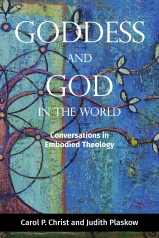
carol-p-christ-photo-michael-bakasIn our book Goddess and God in the World, Judith Plaskow and I discuss and debate our contrasting and conflicting views of the nature of divinity and the cause of evil. In the passage that follows, I respond to Judith’s questions.

This brings us to the major philosophical issue that divides us: the nature of divine power and the relation of divine power to the world. It is fair to say that our major difference in this regard is whether the divine power is personal, conscious, intelligent, loving, and good. You ask, “If all we know of that exists is a mixture of the good and the bad . . . , if our creativity and the creative power that births and sustains the world brings forth both good and evil, then how can the Goddess be less than ambiguous? How can the Goddess be ‘the ground of all being’ if she does not ‘form light and create darkness, make weal and create woe’ (Isa. 45:7)? This question lies at the heart of our differences.

. . .

You ask whether “evil finally has less metaphysical warrant or reality than good” in my worldview. Continue reading “Reflections on Death, Evil, and Divinity by Carol P. Christ”

She is Here by Mary Petiet

Mary Petiet photoOn the morning of January 20, 2017, the world watched Donald J. Trump stand on Capitol Hill for inauguration as the 45th president of the United States. He did not stand alone. Timothy Michael Dolan, Catholic cardinal and archbishop of New York, also stood, and he invoked the divine feminine as he opened the inaugural ceremony with a recitation of King Solomon’s prayer from the Book of Wisdom.

As Dolan stood before the capitol building, which houses the US congress, he called upon the divine feminine with the words:  “Now with you is wisdom, who knows your will and was there when you made the world, who understands what is pleasing in your eyes, what is conformable with your commands, send her forth from your holy heavens. From your glorious throne, dispatch her that she may be with us and work with us, that we may grasp what is pleasing to you. For she knows and understands all things and will guide us prudently in our affairs and safeguard us by her glory.”

She is here. Continue reading “She is Here by Mary Petiet”

A Serpentine Path: The Dance Is About To Begin by Carol P. Christ

carol-p-christ-photo-michael-bakasEntering the archaeological site of Kato Zakros, which includes a Sacred Center and part of a town on a small hill above it, I felt too tired to continue with the others. As we passed a stone bench to the north and west of the open court, I lay down and closed my eyes. I don’t know if I actually slept, but when I opened my eyes, I was in a trance.

I could see the air vibrating, and as I looked up the hill, I could almost see women walking up and down the stepped paths. My eyes were fixed on the path where women I could not quite see with my eyes went about their daily tasks. After a while Cathleen joined me. “I don’t want to talk,” I said, “but if you sit quietly beside me, you will see women walking in the village. She sat down and said nothing, but smiled broadly and nodded when I asked her if she could see what I saw.

After a while, I moved and sat facing the Central Court. I could still see the vibrations of the air, and as I looked across the court, I felt a sense of anticipation. “The dance is about to begin,” I told Cathleen when she joined me a few minutes later. She nodded. It was an hour before sunset, and the ancient stones were bathed in the last light of day. Jana and Patricia were talking in the central shrine room, while the others leaned over the ancient cistern watching turtles and turtle babies dive into the water and emerge again. “The dance is about to begin,” I said again.

kato-zakros-central-court

Cathleen exclaimed, “I see the path of the dance rising up in the court. It looks like the Processional Paths we saw at Knossos, Phaistos, and Malia. Do you see it?” Though I did not “see” it, I was moved to the court, where I could “feel” it. I raised my arms, bent at the elbows, and slowly wove my way back and forth across the court, following a snakelike path I could feel with my feet. As I neared the center of the court, I almost lost my footing. Turning to face Cathleen, I gazed at her solemnly, sending energy through my palms. Cathleen raised her arms in greeting. I turned again, continuing to trace the snakelike path, back and forth, across the court. When I reached the south end of the court, I turned again to greet Cathleen and Robin who was sitting next to her. “The path you followed was exactly the path I saw,” Cathleen cried out with astonishment. “You were meant to stop at the center.” “It was an ancient path,” I said solemnly. 

Jana and Patricia, who must have been watching, entered from the northwest entrance to the court. Jana was leading, arms upraised, tracing another path, walking with the same slow rhythm in which I had been led. I turned and slowly walked towards Jana until I could sense the energy flowing between our palms, then we softly touched our upraised hands. Carol, Patricia, Cathleen, and Robin formed a circle around us, and stood, arms upraised one in each of the four directions. Sensing that we were meant to share the blessing with the others, Jana and I turned, walking slowly towards the women standing in the north and south, feeling the energy, then touching their palms. Back to the center, we turned to the east and the west, completing the ceremony. As we turned to face each other again, I whispered to Jana, “We were called to this dance. It was an initiation.”

. . .

[A few days later] thinking of the snakelike path I had traced on the ancient stones, my eyes fixed on the gold snake bracelet on my right arm. I reviewed the many meanings the symbol of the snake held in ancient cultures. Goddess temples were used for storing grain, the harvest returned to She who presided over it. Snakes were guardians of the temples, eating the mice and rats that came to take the grain. The coiled snake and the snake biting its tail are symbols of wholeness. Snakes shedding their skins are images of rebirth and regeneration. Snakes hibernate under the earth and are reborn. But there was more: the rhythm of the snake in movement. I picked up a pen and wrote: “a serpentine path.”

These words described our initiation in the dance at Zakros: the serpentine path is the path of life, a snakelike, meandering path, winding in and out, up and down, with no beginning and no end, into the darkness, into the light. There is no goal, only the journey.

A cycle was coming to completion in my life. Through hard work and amazing grace, I found my way back to the Goddess, to myself. The mystery that was revealed to me as my mother died was unfolding in my life. Love had never abandoned me and never would. The Goddess would be with me at every turn in the path, and in that knowledge. I could give up control and open myself to life.

***

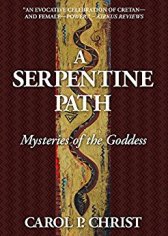
a-serpentine-path-amazon-coverThis is an excerpt from A Serpentine Path, Carol P. Christ’s newly released, moving memoir of transformation. Order it now in paperback or on Kindle. Carol’s other new book written with Judith Plaskow is Goddess and God in the World: Conversations in Embodied Theology. Carol also wrote the first Goddess feminist theology, Rebirth of the Goddess.

Join Carol on a Goddess Pilgrimage to Crete in 2017. Save $200.

Read two more the chapters in the book: Mysteries and Dionysian Rites.

Thanks to Judith Shaw for the cover art “Downward Serpent.”

If the paperback is unavailable on Amazon, you can order it from Barnes and Noble.