Gift From the Beyond, part 1 by Sara Wright

The words came unbidden “go outdoors”. It was dark but I felt my way to the door. I always listen when Nature calls.

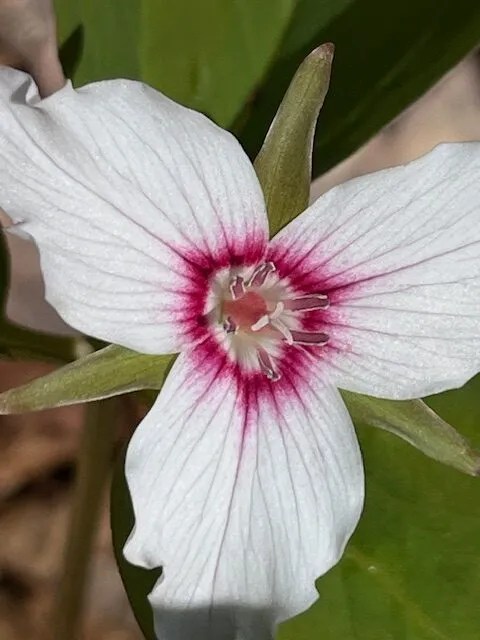
Trillime

I had just re -membered that Davey’s birthday was the next day. ‘Happy birthday Beloved’. My little brother would have been 75. I calculated the years with difficulty imagining what it would have been like if he had lived…

Dead at 21 from a self – inflicted gunshot wound, part of me died with my Gemini Twin. I failed him at the end, turning into a parent who was incapable of being emotionally present to listen to a young boy on the verge of adulthood at a time of desperate need. Instead, I parroted my parents’ script, not having developed one of my own…

”You have everything to live for,” I screamed when Davey tried to tell me that he was tired of living.

I no longer blame myself for my inadequacy, but regrets linger on just the same.

It would be eleven years before I was able to begin grieving. Catapulted out of my body at the time of my brother’s death I felt nothing for years as I self- medicated with alcohol and a dreary round of boyfriends while being unable to be emotionally present for my own young children. To feel one must inhabit a body but mine was overflowing with anguish and abandonment. Too dangerous to go there. Isolated and alone, I huddled in my house in silent torment, an absentee mother following the parental script with children of my own.

Continue reading “Gift From the Beyond, part 1 by Sara Wright”

Mayflower Crowning by Sara Wright

I sit under the snowy crabapple as fragile flower petals drift one by one to the ground, covering my hair in white butterflies, soon to become the first mulch of the year. Our Lady is always nourishing new life…

 The hum of a thousand bees is deafening – bumblebees – glorious golden rotund bodies swarming from one tree to another with so many relatives – everyone seeking sweet nectar.

The scent is beyond description – intoxicating – a poignant perfume lasting only a few days and keeping me rooted to my bench every single morning to soak in the sweetness under impossible heat. Heavily polluted air is thick and metallic but here I inhale a plethora of fragrances so intense they drown out poisoned air.

Continue reading “Mayflower Crowning by Sara Wright”

Processing my experiences of patriarchy has changed my faith for the better by Liz Cooledge Jenkins

As my first book, Nice Churchy Patriarchy, approaches six months of being out there in the world, I find myself reflecting on the journey. The process of unpacking all the ways patriarchy shows up in faith communities—and, in particular, the ways patriarchy has impacted my experience of church—has been a long one, and a winding one. It is no easy path.

How could a person travel this road and have their faith remain unscathed? Or perhaps a better question is this: How could one’s faith remain unchanged? And is this even a desirable goal?

After spending eleven years in “complementarian” (that is, explicitly patriarchal) evangelical church spaces and then two years in evangelical spaces that were egalitarian in theory but still had a long way to go to reach full gender equity—and, especially, after spending four years intentionally reflecting on these experiences and writing about them—I certainly see questions about gender roles and women in leadership differently. But it’s not only that. I see everything differently.

Continue reading “Processing my experiences of patriarchy has changed my faith for the better by Liz Cooledge Jenkins”

A Feminist Reading of Saint Wilgefortis by Sofia Meskhidze

The legend of Saint Wilgefortis tells the story of a Christian woman who was martyred for her faith. While there are numerous women martyrs in the Christian tradition, Wilgefortis is distinguished by her gender non-conformity. She is often referred to as female Christ[1] and is almost always depicted with a beard, in a dress, and nailed to a cross. According to the legend, she was a Christian princess from Portugal whose father had promised her to the pagan king of Sicily. Wilgefortis, refusing to marry, prayed all night for God to make her unmarriable and as a result miraculously grew a beard, causing her father’s rage, after which he had her tortured and crucified[2]. The origin of the legend is thought to be the Volto Santo sculpture in Lucca, Italy, one of the most well-known examples of a clothed crucifix[3]. Misinterpretation or not, it is without doubt that the legend spread wide and Wilgefortis was in medieval times venerated almost as much as the Virgin Mary. In fact, this popularity displeased the Catholic Church, who actively discouraged it and even removed Wilgefortis from the official list of saints in 1969[4]. Here I argue for the importance of Wilgefortis to feminist theology, feminist and queer Christians, and her potential as a non-binary/gender non-conforming icon.

Continue reading “A Feminist Reading of Saint Wilgefortis by Sofia Meskhidze”

FRANCESCA CACCINI (1587-1646): THE FIRST WOMAN TO COMPOSE AN OPERA by Maria Dintino

Moderator’s Note: We are pleased to announce that we are forming a co-operation with The Nasty Women Writers Project, a site dedicated to highlighting and amplifying the voices and visions of powerful women. The site was founded by sisters Theresa and Maria Dintino. To quote Theresa, “by doing this work we are expanding our own writer’s web for nourishment and support.” This was originally posted on their site on January 19, 2024. You can see more of their posts here. 

The featured image above is from the 2018 performance of Caccini’s La Liberazioine at the Morgan Library & Museum’s Gilder Lehrman Hall in New York City. Photo credit goes to Vincent Tullo of the New York Times.

I’ve always been an insomniac and of late I’ve become a regular listener of the app Calm’s sleep stories. One night I listened to an enchanting story called Songbird, written by Eurydice Da Silva and narrated by May Charters. Songbird is about Francesca Caccini, who is said to be the first woman to compose an opera, a musical genius and wonder. The next morning, I set out to learn more about her.

Continue reading “FRANCESCA CACCINI (1587-1646): THE FIRST WOMAN TO COMPOSE AN OPERA by Maria Dintino”

Time to Heal the Ancestral Wounds From the Burning Times by Marilyn Nyborg

My work has been in the areas of social justice and the empowerment of women. Until somewhere in 1990, I saw a series of films from women in Canada on the Early Modern European Witchcraft trials which included “The Burning Times”. (Still available on You Tube.)  The film talked about three centuries of Witch burnings. The narration and graphics really shocked me and awakened an interest.  Intuitively I recognized the way in which women have embedded the limitations and pain of that era from centuries ago.  I now know it to be called ancestral wounding. 

Not to say the abuse of women began there.  It didn’t.  But the intensity of three centuries of extreme violence on women have impacted us and cultures through time: sowing the limitations and lack of respect for women into cultures globally.

Continue reading “Time to Heal the Ancestral Wounds From the Burning Times by Marilyn Nyborg”

Human Being or Human Doing? by Mary Gelfand

As a cis white woman in her mid-70s, with a family history of arthritis, I am sometimes confronted by various challenging questions that I prefer not to explore. Who am I if I can’t take care of my basic physical needs? Do I have value if I can’t do my fair share of the household tasks? Who am I if I can’t contribute to my communities? Who am I if I can’t ‘do’? Can I learn to just ‘be’?

These questions swirling around in my head are indicative of the fact that, despite my best efforts, I am still shedding the ubiquitous patriarchal conditioning that tells me I have no value or worth unless I can do—something. Traditionally that something was bearing and raising children, cooking and cleaning house, making and mending clothing, growing food. I have long felt that I must ‘do’ in order to earn my right to inhabit this planet.  Patriarchy tells me I am only valued to the extent I am productive. As my body ages, being productive becomes harder. Many women struggle with these questions daily, especially older women like myself. And no doubt some men as well.

Continue reading “Human Being or Human Doing? by Mary Gelfand”

From the Archives: Writing: Changing the World and Ourselves. By Ivy Helman

This was originally posted on October 12, 2014

20140903_180423

I still remember the first time I read Mary Daly’s Gyn/Ecology. It awoke something within me. Her use of language, the power of her writing and the ease with which she created new words taught me so much about the world around me and about the way the language, and subsequently its use in writing, shapes lives, choices, abilities and destinies. She also taught me about myself.

I was hooked, but not just on Mary Daly. Shortly after I finished her book, I moved onto other feminists writing about religion like Katie Cannon, Judith Plaskow, Alice Walker, Carol Christ, Rita Gross, Gloria Anzaldua, Audre Lorde, Adrienne Rich, Margaret Farley and Starhawk to name just a few. All of them, in fact every feminist I’ve ever read, has shown me the way in which words have power and how words speak truth to power. Ever since, I’ve wanted to be the kind of writer whose words carry a power that not only affects people but also inspires a more just, more equal, more compassionate and more humane world. In other words, I wanted to be a writer activist.

Continue reading “From the Archives: Writing: Changing the World and Ourselves. By Ivy Helman”

I Don’t Want Jesus by Katherine Rose Wort

Pietá – Anónimo

Well, you may ask, who said I should?

My grandparents, mother, father, sisters, aunts, uncles, cousins, nieces, nephews, godparents, a good many teachers, childhood friends, a former therapist, myriad internet strangers who felt compelled to try to divert the flames approaching my immortal soul, an astrologer I met once, innumerable people encountered on public transportation and sidewalks, all of my exes’ parents, and, of course, the Roman Catholic Church — an institution of such enormous weight as to have crushed frames far sturdier than my own.

Continue reading “I Don’t Want Jesus by Katherine Rose Wort”

Herstory Profiles: Love, Devotion, and Ecstasy in the life of Indian Poet Mirabai by Anjeanette LeBoeuf

Mira was born in Northwest India in 1498 CE. She is considered a 16th Century Hindu Mystic, Poet, and Wandering Devotee of Krishna. Her relevance and importance is cemented in the moniker given to her of Bai. Bai, is a honorific ending which can also mean elder sister.  Mirabai is quite known throughout India and even across religious traditions. She is a celebrated Bhakti Saint whose devotion to the god Krishna is now lauded and praised.

Mira was born into a Rathore Rajput Royal Family (in modern day Rajasthan). It is said that from the very young age of 5, Mira expressed her devotion to Krishna. Her upper caste status did allow Mira to have access to education and religious practice. But her status also came with forced responsibilities. Mira was forced into a marriage to the crown prince of Mewar and would become a widow five years later. Her father and father-in-law would also later die during the ongoing struggles with Babur, the first Mughal Emperor. As she was still considered part of the Mewari royal family, her remaining in-laws tried to assassinate her on multiple occasions. Some of the attempts included sending her a vial of poison disguised as nectar and a basket of flowers which contained poisonous snakes.

Continue reading “Herstory Profiles: Love, Devotion, and Ecstasy in the life of Indian Poet Mirabai by Anjeanette LeBoeuf”