


In the book, Women v. Religion: The Case Against Faith and for Freedom, editor Karen L. Garst puts together the voices of women from a variety of backgrounds in an effort to present a case against faith.
While the introduction to the full volume suggests that women ought to turn away from all forms of religion the majority of the individual pieces that the book features focus on the Abrahamic religions: Judaism, Christianity, and Islam. The included pieces are written from a variety of disciplines and viewpoints, some feature historical facts and timelines, while others are the raw and difficult personal stories of women struggling to leave the religions they were raised within.
Most of the articles dig into many of the traditional critiques of religion. For example that the Abrahamic faiths are inherently patriarchal, and cannot be redeemed for women. Others take these traditional arguments against religion a step further and argue that in addition to religion being a tool for female subjugation, religion has in fact inhibited Western progression and is a key reason why the United States has not yet had a female president, and why women continue to have to fight for their bodily and human rights.
 For almost four years, I’ve been living with the long-term effects of an inner ear lesion. The lesion is long gone but its side effects are not. Throughout the day, I feel a combination of unsteadiness and sudden, unpredictable sensations of movement. On better days, the unsteadiness is almost non-existent and the feelings of movement are minimal. On worse days, I’m troubled with a type of brain fog that makes it hard to concentrate as well as disrupting unpredictable sensations of being on a boat that can’t pick one direction in which to move. It’s frustrating, tiring and demoralizing.
 My birthday was last Wednesday. Perhaps more than any other time of the year (yes, even more than Rosh Hashanah and Yom Kippur), the days and weeks leading up to my birthday are filled with personal reflection. Not that religious and secular new years don’t give me pause to reflect, but I think the lack of buzz around this personal event seems to offer me more space and time to think.
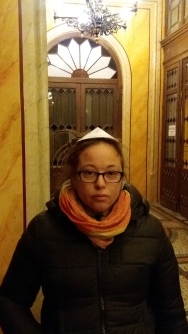 Last week Sunday, my partner and I were in Budapest, Hungary. We stopped at the Dohany Street Synagogue, the second largest synagogue in the world and the largest in Europe. After we bought our tickets and proceeded through security, we decided to go into the synagogue first and then the museum.
 My partner and I are getting married in a little over a month. She, a lawyer, and I, a professor, live in the Czech Republic. Technically, we aren’t getting married because the Czech Republic doesn’t have marriage equality. Our relationship will not be recognized in the U.S. For that, we need to be married in a state or nation that has marriage equality. Germany might soon. Other options would be a number of EU countries or the United States, but that doesn’t affect our status in the Czech Republic. Finally, our marriage will also not be recognized by some in Jewish circles as well since the
  Kavannah is a Jewish concept meaning intention or motivation, perhaps most associated with Hasidism. Hassidism teaches that prayer and the fulfillment of mitzvot connects one more with the Holy One if the right state of mind is cultivated before participating in said activity. While going through the motions (prayer, mitzvot, etc.) is important and still technically fulfills the mitzvot, it is not as spiritually beneficial to the individual as is doing those tasks with kavannah. Praying and fulfilling mitzvot within a certain mental space more fully connects you to the divine. Judaism is not alone regarding this religious insight. Clearly there is something to it.
 It is, I think, quite common knowledge that most Jewish holidays relate to the seasonal cycles of the Earth. Sukkot celebrates the fall harvest. Chanukah sheds light on the winter darkness. Tu B’Shevat marks the end of the dry season and so begin the prayers for rain in Israel. For Purim, we throw off our winter doldrums and let off a little steam to settle our cabin fever. Pesach is no exception: welcome spring: birth, renewal and even creation. The leaves return to the trees, baby animals are born, flowers bloom, warmer weather arrives and somehow the possibilities of the coming summer are endless.
 Embodiment is a feminist principle which has, as its basis, two fundamental criteria. First, humans require their bodies to live. We must acknowledge that our existence is tied to our bodies. This fact grounds us in this world. Here, and not in some other-worldly place, we live out our lives. We are dependent on our bodies and what the world provides for our survival. In other words, humans are inseparable and interconnected to this world. Humans are not above nature as the Western hierarchical dualist mindset would suggest.
 The morning air is hot around the pillars of Jerusalem stone, but the congregation is already tired. The prayers are old, pro forma and remote, drawing power now from the sound of the Hebrew more than from the meaning of the words. “Thank you for mercifully restoring my soul to me…” intones the small group of gathered men, “and for not making me a woman.”
 Feminism and Religion