The Coming of Spring: Reflections on Pesach and Judaism by Ivy Helman

meandminiIt is, I think, quite common knowledge that most Jewish holidays relate to the seasonal cycles of the Earth.  Sukkot celebrates the fall harvest.  Chanukah sheds light on the winter darkness.  Tu B’Shevat marks the end of the dry season and so begin the prayers for rain in Israel.  For Purim, we throw off our winter doldrums and let off a little steam to settle our cabin fever.  Pesach is no exception: welcome spring: birth, renewal and even creation.  The leaves return to the trees, baby animals are born, flowers bloom, warmer weather arrives and somehow the possibilities of the coming summer are endless.

In fact, the associations between Pesach and spring are many.  Arthur Waskow in Seasons of Our Joy explains the origins of the connections (pages 133-139).  There were probably two different seasonal celebrations – one of shepherds and one of farmers – that came together around the time of the Babylonian exile into one festival which we can see in Exodus 12 – 13: Pesach.  Farmers in preparation for the harvest of spring wheat cleared out the old crumbs and fermentations of the last year to make room for the new.  Shepherds celebrated the arrival of baby sheep and their flock’s fertility in general by slaughtering a sheep, putting its blood on their tents and dancing around a fire.   Continue reading “The Coming of Spring: Reflections on Pesach and Judaism by Ivy Helman”

Feminist Interpretations by Elise Edwards

Elise EdwardsI’ve written a few posts recently referencing biblical themes or stories. I’m not a biblical studies scholar; I’m an ethicist and theologian. So I know that ways I use the texts disturb some people who study them from a historical or biblical studies perspective. To say I don’t use the Bible as those scholars do, though, doesn’t mean I don’t have a disciplined approach. I aim to apply a consistent approach to scripture and to encourage my students to do the same.

I get really annoyed when someone proclaims a variation of “The Bible says it; I believe it; that settles it!” in moral debates. Obviously, people within a religious tradition are going to believe there is truth in the scriptures of their tradition. That’s simply how scripture functions. So I’m okay with “I believe it.” I have a problem with the two other parts of the statement – the Bible says it, and that settles it. The assertion that “the Bible says it” masks the task of interpretation that anyone encountering a text takes on. The statement “that settles it,” when adopted in moral debate, rejects the accountability and humility in sharing our interpretations with others. Continue reading “Feminist Interpretations by Elise Edwards”

Liberation Lessons for Pesach by Ivy Helman

Each year we read the story of our exodus from Egypt during the Pesach seder. The story is one of human liberation from oppression. Yet, most of the imagery we encounter, the drama of the story so to speak, involves nature: a river that saves a baby, a burning bush, the plagues, the re(e)d sea, the wilderness, lack of food and water and the promised land itself. What does this mean?

In general, it means that human liberation is intimately connected to the liberation of all of creation.  In particular, the exodus story can teach us many lessons about environmental justice.  I’m going to explore five of them here: do not manipulate nature, use water wisely, form a connection to the land, imagine G-d differently and treat humans, animals and the land well.

Continue reading “Liberation Lessons for Pesach by Ivy Helman”

Pesach, Patriachy and the Unfinished Work of Liberation.

headshot2Pesach, or Passover, begins tomorrow at sunset. It has always seemed strange to me that a festival centered on liberation begins with a focus on housework and cleanliness to the point where one is almost a slave to the process of chametz (leavened food) removal.  Not only that, but the spiritual interpretation of what the chametz represents adds to this conundrum.

The Rabbis of the Talmud teach us that chametz represents egotism and arrogance. The divine instruction to eat only unleavened bread for the festival of Pesach is a call to cultivate humility because they believe that our inflated sense of self-worth causes harm to other human beings as we value ourselves and our lives more than them. As we remove the chametz from our homes, we are also supposed to be removing the self-centeredness, arrogance and egotism within ourselves. Cultivating humility redirects our attention to all those parts of our lives that have suffered by being too self-centered, including our relationship with the Holy One. Continue reading “Pesach, Patriachy and the Unfinished Work of Liberation.”

Encountering “the Change” as a Personal Exodus and Liberation by Michele Stopera Freyhauf

Freyhauf, Durham, Gender, John Carroll, Menopause, Celebration, ExodusThe story of Exodus, through a liberation lens, has different meanings depending on the person’s experience in life.  I recently experienced my own kind of liberation, a freedom from decades old enslavement.  Through this realization, I celebrated with many other women with the reminder – you are not alone!

The story of the Exodus is a familiar one. It is a text of oppression, journey, and freedom – a freedom that finds us in new surroundings, a place of revelation and transformation.  Many have written about the Exodus text found in the Hebrew Scriptures from different ideological lenses and social locations.  For me, I propose to apply this to menopause (also known as the “change”).

It is not too far fetched to look at menopause as a transformative event in a woman’s life.  For a woman like me, who struggled with the disease Endometriosis since my teen years, menopause it is not only transformative, but liberative.  The only effective treatment for this disease (for me) was the injections of Lupron Depot that put my body in “medical menopause.” Because of that experience,  I felt like my  body was being liberated from disease – this disease that debilitated me monthly or, at the very least, caused me tremendous pain.

A few weeks ago, I had the experience of attending a musical with a group of friends. I am not in the habit of blogging about my personal life, but I cannot help but wonder if my story and experience might help another.  The problem about “the change” is that we joke about it and usually face it with unbelievable dread.  I propose to look at the “change” as a positive – a new beginning, with a reminder to all women out there – you are not alone!

I received this revelation several months after my surgery at a musical named – you guessed it – Menopause!  What started out as a much needed get together of friends turned into an awakening and celebration. Something that has me celebrating the change – even as I fan myself through the hot flashes (I prefer “personal summers”), tear-up during emotional commercials for no reason (something I haven’t experienced since pregnancy), clinching my teeth due to a quick-igniting temper that causes me to exercise remarkable restrain (and you thought patience was a gift to children and teens), to searching every cabinet for that holy grail of comfort food – chocolate.  As I reflected on that evening, it occurred to me that I was living my own exodus story and the very thing that enslaved me can no longer hurt me – I am now free – renewed and emerged, but still in a strange wilderness that holds different challenges. Continue reading “Encountering “the Change” as a Personal Exodus and Liberation by Michele Stopera Freyhauf”

Mindfulness of Putting Ourselves Down by Oxana Poberejnaia

oxanaFrom the Buddhist point of view, all phenomena are conditioned, i.e. they arise, carry on, and come to an end because of other phenomena. Buddhism does not look at anything we experience as “things”, but rather as processes.

Confusion arises due to various factors, chief among them : 1) vague sense of “ego”, and 2) language. The vague sense of ego is portrayed in Khemaka Sutta as the last delusion that a monk drops before getting Enlightened, so we won’t worry about it now. Where language is concerned, Buddhism stands on similar positions to those of postmodernism and feminism, i.e. our social world is defined by how we speak about it. One can say that we actually create society by the act of speaking.

Continue reading “Mindfulness of Putting Ourselves Down by Oxana Poberejnaia”

On Pronouns and Liberation in the Classroom by Ivy Helman

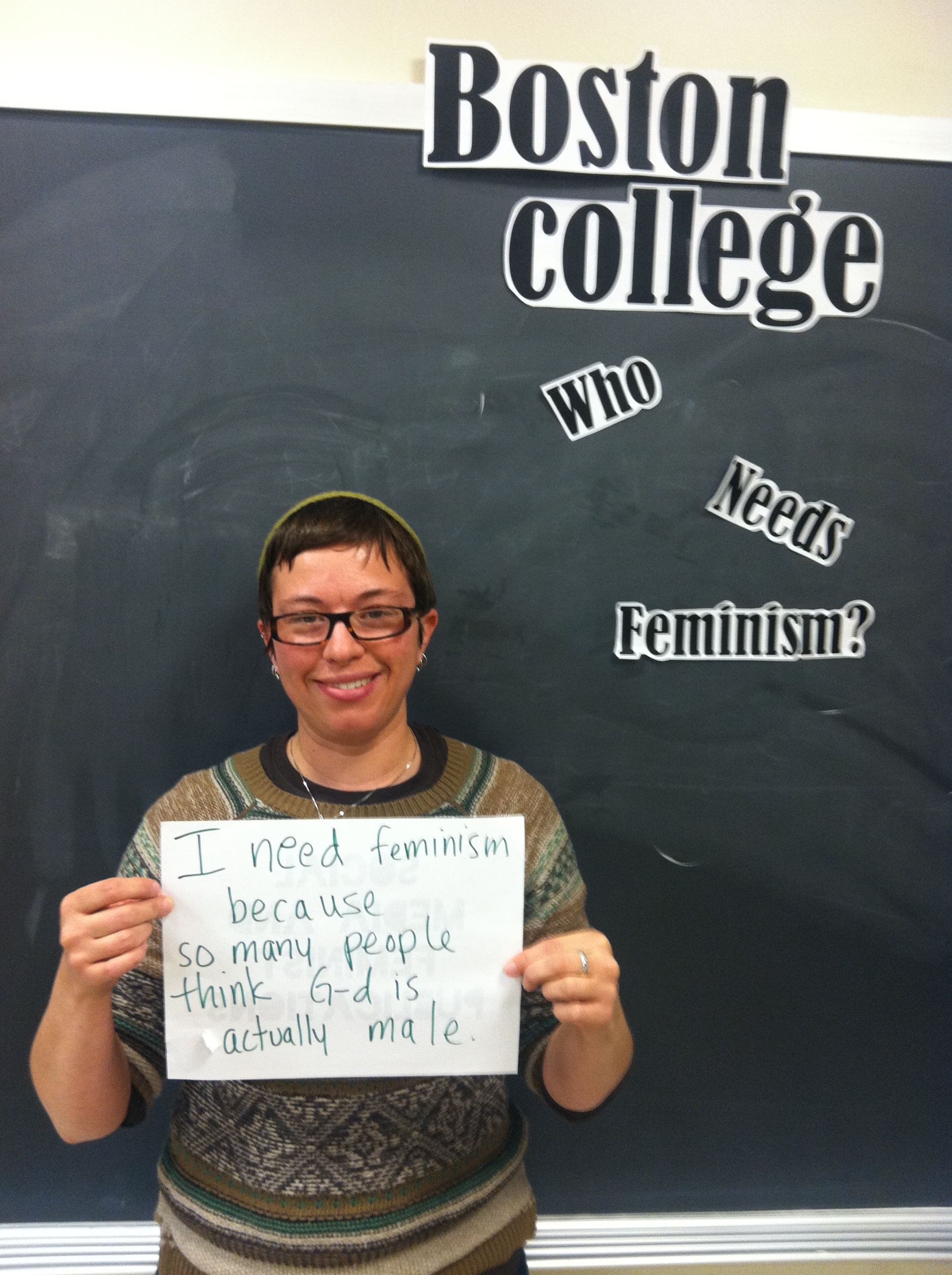
photoIn my introduction to Christianity class, almost every one of my students (who come from diverse religious backgrounds – primarily Roman Catholic, Protestant and Muslim), continues to believe that the best image if not the only appropriate image for G-d is male.  When probed they may speak generically about G-d as genderless, an entity or spiritual presence of some kind, yet conclude by affirming their belief that G-d is male often by adding something along the lines that G-d is best described as Father.  Some go so far in these affirmations that they articulate G-d’s maleness as fact.  It never fails that every semester I struggle with how to address this basic feminist issue within the classroom.

At least as early as 1973, Mary Daly, in Beyond G-d the Father: Towards a Philosophy of Women’s Liberation, articulated the problematic basis of the relationship between gender and divine imagery.  She argues that “If G-d in ‘his’ heaven is a father ruling ‘his’ people, then it is in the ‘nature’ of things and according to divine plan and the order of the universe that society be male-dominated.”  In other words, if maleness is associated with divinity, then the power, domination and running of society by men seems to be divinely ordained. Continue reading “On Pronouns and Liberation in the Classroom by Ivy Helman”

The Joy of Honoring Rosemary Radford Ruether by Dirk von der Horst

DirkA cutting-edge voice in many theological conversations, Rosemary Radford Ruether has been an inspiration to many of us over the last few decades.  The tremendous joy of my last couple of years was co-editing a volume of essays in her honor.  Even discovering just how dreary indexing is was a labor of love for a true pioneer in feminist theology.  The result: Voices of Feminist Liberation: Writings in Celebration of Rosemary Radford Ruether, a collection of fourteen essays by Ruether’s doctoral students, put together by Emily Leah Silverman and Whitney Bauman, along with myself.

Voices of Feminist Liberation documents the current state of her impact and legacy.  The richness of her thought is manifest here in the variety of directions her students have taken her insights.  While most of the essays are scholarly works that engage her ideas above all else, some essays have more personal recollections.  Rosemary’s preface recounts her personal experiences of and with us, with descriptions of incidents from her relationships ranging from hearing a live-in student coming down the hall to slip a paper under the door, to seeing a student’s dissertation prospectus enrage a committee member, to switching from same-sex hand-holding in Palestine to male-female hand-holding in Israel as a small gesture of recognizing cultural difference. Continue reading “The Joy of Honoring Rosemary Radford Ruether by Dirk von der Horst”

Silencing Miriam: Prophetess, Liberator, and Leader By Michele Stopera Freyhauf

The prophetess Miriam, Aaron’s sister, took a tambourine in her hand, while all the women went out after her with tambourines, dancing; and she led them in the refrain: Sing to the LORD, for he is gloriously triumphant; horse and chariot he has cast into the sea.”(NAB, Exodus 15:20-21)

The Song of Miriam is not a story of death and destruction, but rather liberation.  It is a poetic celebration of God’s liberation of the Israelites from the oppressive Egyptians, which, according to Bernhard W. Anderson in “The Song of Miriam Poetically and Theologically Considered,” marks the beginning of the Israelite tradition (292).  Phyllis Trible in “Bringing Miriam out of the Shadows” states that this act marks the end of the Exodus, which was started by Miriam, not Moses (169, 172).  The act of liberation reveals God’s action in humanity.  Gerald Janzen in Exodus believes this act also moved the Israelites “to fear the LORD and believe in the LORD and in his servant Moses” (109).  The uniqueness of this passage is that the most unlikely person leads – this person is not a man but rather a woman.

This brief passage in the Hebrew Scriptures is revelatory – Miriam is revealed for the first time.  She is a prophetess, Aaron’s sister, and the role of leader of the victory dance to honor the Divine Warrior.

Continue reading “Silencing Miriam: Prophetess, Liberator, and Leader By Michele Stopera Freyhauf”