The disdain with which the work of archaeologist Marija Gimbutas has been held in the field of classics and archaeology was shown to me when I stated quietly at a cocktail party at the American School of Classical Studies in Athens that I was interested in her work. This comment, tentatively offered, unleashed a tirade from a young female archaeologist who began shouting at me: “Her work is unscholarly and because it is, it is harder for me and other women scholars in the field to be taken seriously.”
Responding to the backlash against her theories, Gimbutas is said to have told a female colleague that it might take decades, but eventually the value of her work would be recognized. It is now more than twenty years since Marija Gimbutas died in 1994, and the value of her work is beginning to be recognized by (at least some of) her colleagues—including one of her harshest critics. In a lecture titled “Marija Rediviva: DNA and Indo-European Origins,” renowned archaeologist Lord Colin Renfrew (allied with the British Conservative Party**), who had been one of Gimbutas’s most vociferous antagonists and a powerful gate-keeper, concluded the inaugural Marija Gimbutas Lecture at the Oriental Institute of the University of Chicago with these words: “Marija [Gimbutas]’s Kurgan hypothesis has been magnificently vindicated.” Continue reading “Marija Gimbutas Triumphant: Colin Renfrew Concedes by Carol P. Christ”
 Before he told the story of how his people received the sacred pipe,
 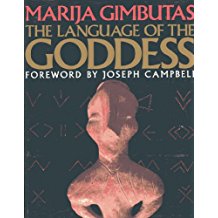 Marija Gimbutas coined the term “Old Europe” c.6500-3500 BCE to describe peaceful, sedentary, artistic, matrifocal, matrilineal and probably matrilocal agricultural societies that worshipped the Goddess as the power of birth, death, and regeneration in all of life.
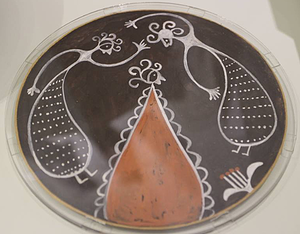
 Birds soaring high above the earth reaching for the heavens have long inspired humans as links to the divine realm. Birds fulfill various functions in world cultures and religions – from playing a central role in creation, to birth, to healing, to death; from messenger to trickster to oracle. Some birds are associated with shape shifting and transformation.
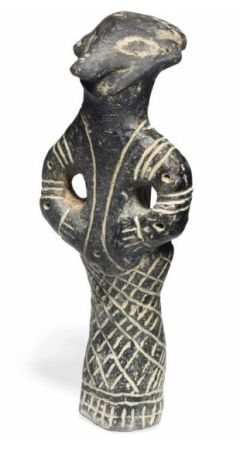 Divine embodied in the feminine.
  Thus through an enormous network of mythological narrative, every aspect of culture is cloaked in the relationship of ruler and ruled, creator and created. . . . [Sumerian] legend endows the Sumerian ruler-gods with creative power; their subjects are recreated as servants. . . . [This new narrative was] deployed with the purpose of conditioning the mind anew.(20, italics added)
 In her comment following