Celtic Awen, Spiritual Homecoming, and Singing with Trees by Trelawney Grenfell-Muir

Does your name have a special meaning? Mine does. In fact, in one corner of the world, you would be very hard pressed to find anyone who did not know the significance of the name Trelawney and its history. They could probably even sing you a rousing song about it:

And shall Trelawny live? Or shall Trelawny die?

There’s twenty thousand Cornish here, will know the reason why![1]

But growing up in New England, no one had ever heard the name Trelawney before, or the name “Cornwall,” the land of Trelawney. If I said “Celtic,” they would finally nod.

Then with the internet came affordable communication “across the pond” to Britain, and my earliest internet explorations connected me with Cornwall, where my grandfather came from. I taught myself Cornish folk songs, I found folktales, recipes, and a more richly detailed cultural nourishment than my Cornish grandfather had managed to pass along to us. A lifelong mystic and Methodist minister, but if you ever asked my grandfather his religion, he would reply, “Druid,” with just that hint of mysterious twinkle in his eye.

Continue reading “Celtic Awen, Spiritual Homecoming, and Singing with Trees by Trelawney Grenfell-Muir”

Tree of Life: The Festival of the Trees in an Age of Treefall by Jill Hammer

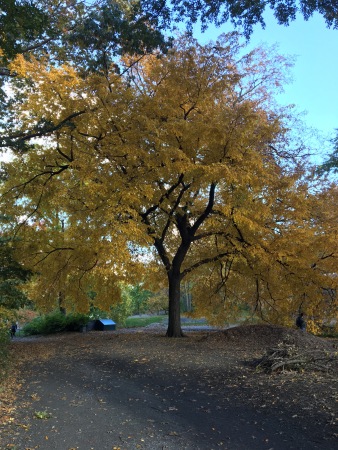
Almost every day, I walk in Central Park.  There are certain trees there I’ve come to know: the gnarled cherry trees by the reservoir, the bending willows and tall bald cypress by the pond, the sycamores that drop their bark each summer, the hawthorn not far from Central Park West.  Lately I’ve been taking photos of the trees to try to capture their essence, their posture in the world.  The trees around me feel like friends, which is what an ancient midrash (interpretation/legend) called Genesis Rabbah says about trees: that they are friends to humankind.  To me, they’ve always been a central manifestation of Mother Earth.

Currently, the national parks in the United States have no staff because of the government shutdown. Some people have taken the opportunity to cut down the rare and endangered Joshua trees in the Joshua Tree National Park—just for fun, I guess, or as a trophy of some kind.  Meanwhile, President Bolsonaro of Brazil recently has indicted that he wants to remove protection for the rainforest, in order to allow development.  It appears that my friends the trees have enemies.  Sometimes the enmity is for personal/corporate gain, and sometimes the enmity seems to have no reason at all.

Continue reading “Tree of Life: The Festival of the Trees in an Age of Treefall by Jill Hammer”

Emergence: Poem to a Plant Goddess by Sara Wright


Her name is Datura.

Delicate fluted deep-throated trumpets open to

humming honey bees and summer rains.

She communicates through scent.


 In the fall I collect her sharp-needled pods.

They rattle like dry bones.

I chill them.

In the spring I coax seeds to sprout

wrapping each in papery white cloth,

sing love songs  –  siren calls

to rouse each root from winter’s sleep.


I am patient…

 a woman in waiting for the heat of the sun

to unfurl the mystery of becoming

 that is re-acted in spring.


Only seeds know when to swell and burst.

Continue reading “Emergence: Poem to a Plant Goddess by Sara Wright”

A Feminist Retelling of Noah’s Ark by Trelawney Grenfell-Muir

My daughters came to me after Sunday School one day, concerned about a story they had heard in which God drowned almost everyone on Earth. So I sat down and thought about why a community might want to tell that story, and what valuable wisdom might be lifted from it for my children. Here is what I told them:
God/ess  has  many  faces,  which  help  us  understand  different  things we  need  to  know  at different  times.  Sometimes we think of God/ess  as  Crone,  an  old,  old  woman  crowned  with  silver  hair  as  an  emblem  of  her  wisdom,  who helps  us  learn  to  let  go  of  anything  that  is  holding  back  the  wellness  of  our  community  and ourselves.  Continue reading “A Feminist Retelling of Noah’s Ark by Trelawney Grenfell-Muir”

Please, Let’s Give Feminists a Break by Sara Wright

Please, Let’s Give Feminists a Break.

I remember so vividly entering graduate school in my early forties and being told I was an “eco – feminist” by my professors. What does that phrase mean I asked having no relationship that I knew of to feminism. Feminists, I thought vaguely, naively, even stupidly, burned bras and hated men…

I was asked to read “Woman and Nature; The Roaring Inside Her” by Susan Griffin to help me see who I was, and after finishing this one book I submerged myself in feminist writings like a starved woman – child. My teachers were right. I was a feminist – an eco –feminist because I had already made the connection between what was happening to the Earth and what had happened to me. Every tree that was chopped down was a part of me, every stream that was polluted was a part of me, every animal that was slaughtered was a part of me because I was a part of Nature. I owed my life to Nature, the only mother I had ever had. I loved Her, honored her, became her fierce advocate and in the process She eventually taught me to love myself.

Continue reading “Please, Let’s Give Feminists a Break by Sara Wright”

Knowing the Live Oaks: Finding the Balance Between Historicity and Inspiration in Neopaganism and Goddess Spirituality by Chris Ash

IMG_0754Last fall, my family took a vacation to Myrtle Beach, South Carolina, where I grew up. As a child, one of my favorite places to visit was Brookgreen Gardens, a wildlife preserve that was once the winter home of Archer and Anna Hyatt Huntington. Anna was a prominent sculptor of the early twentieth century, and decided that part of the property should be sculpture gardens open to the public.

When they purchased the property, many of the trails were lined with live oak trees; Spanish moss still drips like thick honey off twisted and gnarled branches that drape over bricked pathways. As a child in the Low Country, live oaks always symbolized timelessness. They felt eternal and otherworldly, and my memories of visiting the Angel Oak near Charleston on school field trips – of throwing my legs over her lower branches, bark scratching up my scrawny legs – these are memories I still carry with me when I look to what was beautiful about my childhood. Continue reading “Knowing the Live Oaks: Finding the Balance Between Historicity and Inspiration in Neopaganism and Goddess Spirituality by Chris Ash”

“Respect: Dualism Subversion and So Much More in Survival Reality Television,” by Ivy Helman.

20151004_161012In “Ecofeminism and Wilderness,” Linda Vance believes that Western society defines wilderness by “… the absence of humans, we are saying, in effect, that nature is at its best when utterly separated from the human world. The idea of wilderness is thus an extreme manifestation of the general Western conceptual rift between culture and nature,” (62).  Reality television shows, focusing on survival or living off the land, often reproduce this dualistic way of thinking.

At the same time they reproduce another of Vance’s concerns, “I would argue that wilderness recreation “re-creates” more than the self: it also recreates the history of the conquest of nature, the subjugation of indigenous peoples, the glorification of individualism, the triumph of human will over material reality, and the Protestant ideal of one-on-one contact with G-d. And as for the elements of physical challenge and risk, I think it goes without saying that they appeal most to those for whom day-to-day mobility is a given, and for whom danger isn’t always close at hand,” (71).  However, by presenting this dichotomy, many of the shows also subvert the ideal of untouched wilderness, challenge the notions of human abilities and highlight our lack of embeddedness and embodiment when it comes to survival situations. Continue reading ““Respect: Dualism Subversion and So Much More in Survival Reality Television,” by Ivy Helman.”

More Than Just an Image by Jassy Watson

jassyI spent 2015 teaching an Intentional Creativity program ‘Wisdom of the Goddess” to an intimate tribe of women creatives from our local community. In December we held an end of Year Art Gala displaying a portion of the work which saw over 100 paintings of Goddesses created over a 10-moon period.

The program was divided into the cycles of Creation, Transformation and Celebration, as inspired by Hallie Inglehard’s book “The Heart of the Goddess”. Each month, through ritual, visioning and painting, we explored a Goddess that represented these cycles; Eve, Anjea, Demeter, Cerridwen, Kali, Persephone, Aphrodite, Ochun and finally, our Inner Goddess.

It took great courage for the artists to display their paintings in public. It is often hard to explain this work because it requires such deep and thoughtful exploration of one’s inner world along with a commitment to a creative practice that favours personal growth and discovery over outcome. It can be difficult finding the language to elucidate on this process that is not just about the act of painting.

It is painting to grow and heal.

It is sacred.

It honours and empowers women.

It inspires authentic creative expression.

It unites one with self.

It connects one back to the earth.

It transforms.

It reveals.

The show was a great success. A gallery full of Goddesses was surely a sight to behold! It was a humbling experience to be out and proud about our creative work in our regional, agricultural, largely conservative community. I feel it is imperative for the restoration of female empowerment to be remembering and re-imagining the Goddess by way of image and it was through Her that these astounding women artists found the courage to put their heart and soul on the wall for all to see.

The influence that image has is far-reaching and cannot be under-estimated. Image is a universal language that evokes emotion and can go as far as mobilising the masses and even change the course of history. The famous photo of ‘Phan Thi Kim Phuc’ running naked down a road after a napalm attack during the Vietnam War is but one outstanding example.

As I reflected on the years work however, I was reminded that while these paintings carry with them incredible insights and powerful messages of change, growth, discovery and transformation, the Goddess is so much more than just an image; and certainly more than just an image to mass-produce and sell. While “the strength and independence of female power can be intuited by contemplating ancient and modern images of the Goddess” (Carol P. Christ in ‘Why Women Need the Goddess’), it cannot be forgotten that She is the sacred made immanent in the natural world, expressed in the diversity of all forms of life and death. We seek Her, sometimes even travelling to the ends of the earth to find Her, forgetting that She is everywhere. She is you and me and Her sacred sites are found in our own backyards.

With this in mind I recently returned to some creative investigations I had begun a few years ago exploring woman in nature and the Goddess as the body of the earth through paint. The earth speaks and I am listening to Her stories and bringing them to the canvas to re-affirm my sense of wonder and respect for nature. My aim is to awaken an ancient memory of the sacred relationship between human and nature, for now, more than ever, it is critical that this relationship be restored. In doing so, the earth may once again be seen and valued as a living, breathing body that sustains and nourishes all life rather than being merely a commodity to be devastated and destroyed in the name of capitalism and greed. Further, these images are reminders of the interconnectedness of all life; we are not separate from the earth, but part of its’ intricate web.

The following image was inspired in part by Terry Tempest Williams ‘When Women Were Birds’ but is also an image born from a revelation I had many, many years ago when I first starting seeing woman in nature, especially in the body of trees.
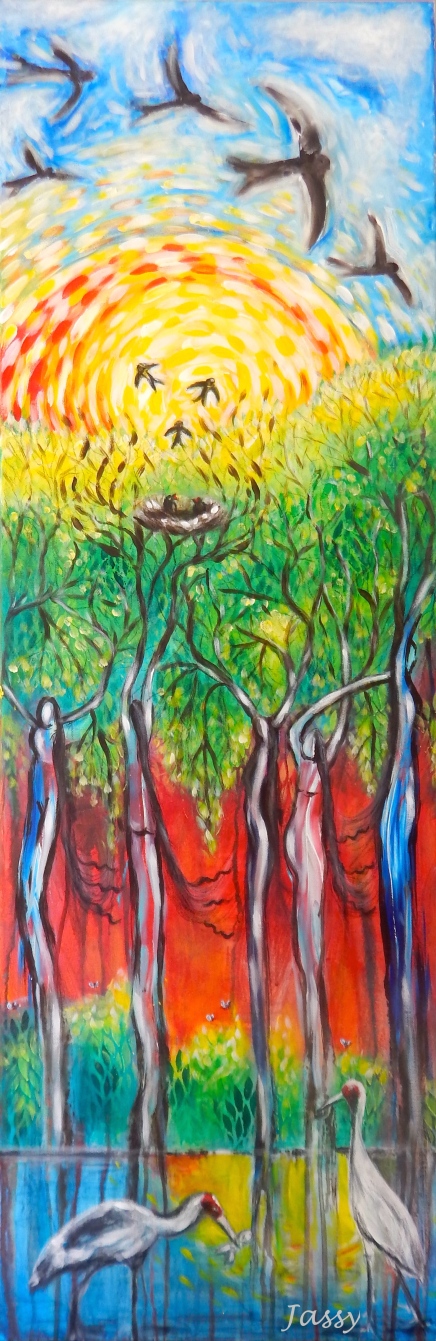
When women were birds FINAL


“We are the birds eggs. Birds eggs, flowers, butterflies, rabbits, cows, sheep; we are caterpillars; we are leaves of ivy and sprigs of wallflower. We are women. We rise from the wave. We are gazelle and doe, elephant and whale, lilies and roses and peach, we are air, we are flame, we are oyster and pearl, we are girls. We are woman and nature. And he says he cannot hear us speak.

 But we hear.”

 Susan Griffin, Woman and Nature: The Roaring Inside Her

Jassy Watson, who lives on the sub-tropical coast of Queensland Australia, is a Mother of four, passionate organic gardener, Intuitive/Visionary Artist, Intentional Creativity Coach and a student of Ancient History and Religion at Macquarie University, Sydney. She is the Creatress of Goddesses Garden Studio & Gallery; a small school for the Sacred Creative Arts. Jassy teaches regular painting workshops in person, nationally, internationally, and online based around themes that explore myth, history, earth connection and the Goddess. Her latest SOULSCAPES (TM) exploring woman in nature will be on show at ‘Dreaming Into Being’, Percolator Gallery, Paddington, Brisbane April 5th-11th. You can see her work at http://www.goddessesgardenandstudio.co

Pause, Stop and Re-evaluate your place within patriarchy and capitalism by Oxana Poberejnaia

oxanaThere are three vicious circles: patriarchy, samsara and wanton destruction of environment. All three lead ultimately to annihilation of life. All three are incredibly difficult to escape. One of the reasons for this difficulty is that there are pay-offs. Someone or something benefits from keeping the cycles going.

Men and Mothers-in-Law seemingly benefit from patriarchy. However, the privileges granted by patriarchy are based on a pyramid scheme of tyranny. You get to bully people who are below you on the patriarchal pecking order: women, men of the lower status, daughters-in-law. Everyone at the higher level gets to bully you. The top man lives in constant fear of de-throning. Continue reading “Pause, Stop and Re-evaluate your place within patriarchy and capitalism by Oxana Poberejnaia”

Do You Believe in Magic? by Deanne Quarrie

I went online to dictionary.com and pulled three definitions for the word “magic.”

The art of producing illusions as entertainment by the use of sleight of hand, deceptive devices, etc., conjuring.

To pull a rabbit out of a hat by magic.

The art of producing a desired effect or result through the use of incantation or various other techniques that presumably assure human control of supernatural agencies or the forces of nature.

Any extraordinary or mystical influence, charm, power, etc.

The magic in a great name; the magic of music; the magic of spring.

The first definition is the one that most people think of when the word is used. The second is what people think storybook witches and wizards do and the third, a great way of using the word when talking about marvelous things in life.

I am going to toss out definition number one because, while valid, it just isn’t the kind of magic I want to discuss. Continue reading “Do You Believe in Magic? by Deanne Quarrie”