

Everywhere I go seeds are taking to the air or spilling out of capsules, flowerheads, mushrooms and lichens.
Yesterday two women gathered in the local pollinator garden where millions of seeds were rattling in light winds. Hundreds of wild asters had shriveled flowerheads, seeds still hidden. Some bean pods were splitting open spilling out black and white beads. The entire garden was a celebration of what seeds do so effortlessly. Provide for the Future of Life.
Accustomed to a riotous bouquet of blossoms, initially I noted the lack of brilliance that characterized summer in this overstuffed garden! But because we were meandering, I began paying more attention to seed heads while the woman I was with was collecting seeds. The more I looked the more ingenious these capsules, seedheads, pods became! I too began seeding, entranced by the infinite variations on one theme; after a while all I could see were seeds!
This was a perfect day to acknowledge the autumn equinox turning because this was the time of the seeding up and the time of letting go.
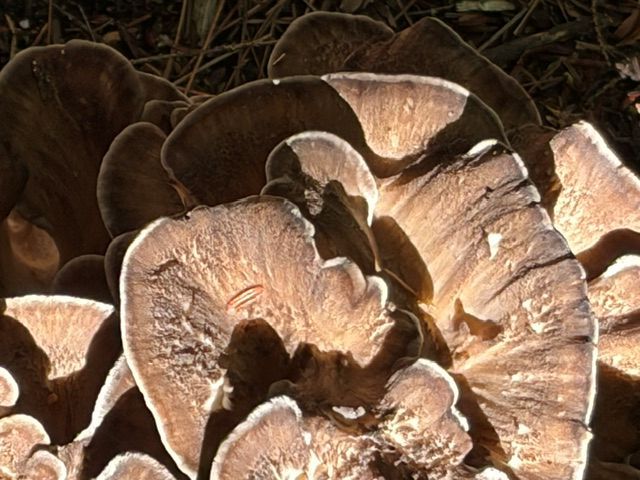
Afterwards Coalie (my dog) led us down her favorite trail through the old pines sniffing fragrant tree stumps. Pinecones and acorns were strewn around our feet. We stopped to peer at mushrooms, some were desiccated, having gone by untouched. One clump had been stripped, cutaway at ground level by foragers. No spores remained to seed the future here. When we returned to the car my friend had collected enough seeds to create an entire garden!
At the equinox it is my custom to pour water into the earth to give thanks for abundance so after returning home I crossed the bridge over my brook shuddering involuntarily at the trickle even as I dipped in my cup. Pebbles and gravel now defined the slippery serpentine edges some still dressed in tufts of green moss. The hemlocks were too silent. I didn’t stay long. On my way back to the house, I picked a small bouquet of asters and black-eyed Susans – the last of my flowers except for nasturtiums. The latter would survive the first frosts (which have already occurred in the valley below).
It seems important to highlight what is happening to edible mushroom clumps at this turning because mushrooms come into their own in September and October and each carries billions or even trillions of seeds. Some mushroom spores seed next year’s crop of mushrooms. Others will take to the air. What is not well known is that these billions or trillions of mushroom spores help create clouds that will help bring us rain. Rain, we desperately need. Foragers routinely take entire clumps of edible mushrooms leaving nothing behind.
Just the day before I had run into a couple who had just removed an entire clump of hen mushrooms from the forest floor. I told them quietly that when foraging it was always important to leave half of the clump so it can re -seed. I don’t know what they did because just ahead there were a lot of people. Oh dear, I had run into some kind of mushroom walk by accident. The question being asked by a participant was about a lichen: ‘It’s some kind of plant’ the leader responded with a loud horsey laugh. I winced, shrinking out of sight, not wanting to hear more misinformation.
And this brings me round the circle to lichens the last ‘seeds’ I will include in this essay. Just two days before in this same area (off the trail) I had come upon a beautiful cluster of what I used to call british soldiers. These lichens that I loved as a child are still one of my favorites with their scarlet protrusions (fruiting bodies). I stayed a while and photographed some, wondering why I so rarely saw them anymore. Those red caps produced spores that might seed future generations. However, only the DNA of the fungus is released so a fungal spore must find an algal partner. The most effective reproduction occurs during fragmentation when both partners are released together.
I did read that this Caldonia lichen is very sensitive to air pollution and that these lichens are the first to disappear when a natural habitat is disrupted as all forests have been around here.
Lichens are complex organisms made up of a photobiont green alga, cyanobacteria, that also photosynthesizes and a (mycobiont) fungus that provides minerals water and purchase for the two three or more partners who all work symbiotically as one organism. Sometimes bacteria and yeasts are part of this whole. The definition of lichens keeps becoming more complex each time I research this creature! It wasn’t long ago that lichens were considered the first inhabitants of dry land. Currently, science tells us they are not. My geologist/scientist friend at MGMM disagrees saying that evidence of lichens is much older than supposed and has been found in the most ancient of stones – so who knows. Because we are dependent on fossils for evidence it is possible that we will never know!
What we do know is that ‘seeding’ is critical to ongoing life.
It wasn’t until this morning that I realized that unwittingly two women had reenacted an ancient woman’s fall equinox ritual of seed gathering without conscious awareness. This outing was spontaneous and had not been planned. I think the Seed Goddess directed the day!
Discover more from Feminism and Religion
Subscribe to get the latest posts sent to your email.


Beautiful essay, Sara Wright…knowledge of Nature combined with deep insight and connection to Mother Earth.💕
LikeLike
“What is not well known is that these billions or trillions of mushroom spores help create clouds that will help bring us rain.” I did not know that before. I love knowing that now. Wow just wow! I remember seeing the red capped lichens you describe. Maybe in Maine. I also new nothing about the fungal spores needing an algal partner. I know very little about lichens; now I am fascinated. This is a fascinating revelatory post! Thank you!
LikeLiked by 1 person
Ah I hooked you just like they hooked me! I have a suggestion for you – Read Merlin Sheldrake’s Entangled Life – I love knowing that these spores seed rain – utterly amazing…. Robin Wall Kimmerer will educate you on mosses in her book – Lichens – I am utterly enthralled by lichens who may still have more partners we know nothing about! I could go on here…. Like my friend the geologist I think they began all plant life on land – science changes it’s mind every time it finds one new thing which can mean anything – it makes absolute sense to me that green algae and a fungi partnered all life on land – just feels right
LikeLike
Thank you for the book recommendations! I shall seek them out!
LikeLiked by 1 person