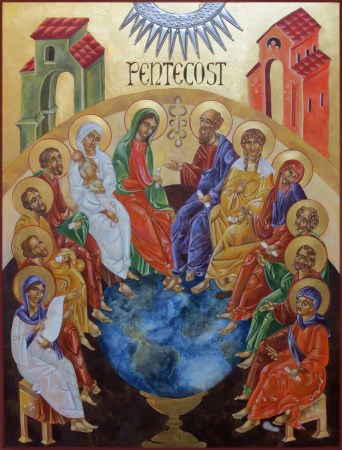
PENTECOST a time to FILL THE WORLD WITH SPIRIT by Mary Jane Miller

Pentecost is followed by Ordinary time, the longest season of the church year. It gives us plenty of time to think about what happened when the Holy Spirit descended on the Apostles. I have always loved the idea that this one moment changed us, it was and is the fulfillment of God’s promise to pour out the Holy Spirit on all flesh, empowering diverse people to exercise divine power. It is commonly understood that the first to receive the power from on high are the male disciples, “locked in a closed room for fear of persecution.” Apparently these Jewish disciples were not too worried about their wives and children.

After painting several Pentecost Feast Day icons as an artist, iconographer and child of God I cannot remain silent with what I think the icon has taught me. It feels obvious that the great gift of the Holy Spirit was for all of humanity. I want to commemorate an ongoing Pentecost, a time to fill the world with spirit, where women and children are invited into the closed room and given a rightful place at the table. Images have a great deal of influence in opening the heart and the mind. Imagine a new contemporary understanding of divine light touching all human beings as well as the planet.

The Spirit Descending

A half circle of twelve descending rays is commonly found at the top of any Pentecost icon. This representation is critically important for the beginning of our narrative. “Then there appeared to them divided tongues, as of fire, and one sat upon each of them.  And they were all filled with the Holy Spirit and began to speak with other tongues, as the Spirit gave them utterance. (Acts 2:2-4)

Imagine that these rays represent the uncreated energies filling the universe, the same rays any of us might feel when touched by grace. These divine rays envelope us as they come from beyond time and space.

Continue reading “PENTECOST a time to FILL THE WORLD WITH SPIRIT by Mary Jane Miller”

Gentle Moments in a Violent World by Marcia Mount Shoop

mms headshot 2015“Be gentle with yourself.”

It may be some of the most redemptive guidance I have ever received.  And I share that invitation daily with people in painful situations.

“Be gentle with yourself.”

In a world seemingly hell bent on self-destruction, being gentle even for a moment is a radical act of resistance. A moment of tenderness. A moment of trust. A moment of attentiveness to need.

But really, what good does gentleness do in a world as brutal as ours can be?  How does being gentle provide any kind of answer to the assault of being commodified or objectified or betrayed or assaulted or oppressed or erased or abused or discarded or exploited? Continue reading “Gentle Moments in a Violent World by Marcia Mount Shoop”

Plant Trees, Trees, and More Trees by Carol P. Christ

I dream that all of us who are suffering burn-out because of national and world politics come together to plant and nurture trees. Scientists say that planting ONE TRILLION TREES would neutralize two-thirds of carbon emissions and reverse climate change. Yes, we need to march, to organize, and to vote. But it is also important to embody our commitment to life and the living. Putting our hands in the soil, tenderly teasing the roots of the trees we plant as we nestle them into the earth, we move from our heads to our bodies, re-membering the interdependence of life.
This has already begun to happen in India—a country where what Vandana Shiva named “maldevelopment” has produced massive deforestation. At the Paris climate change conference India pledged to “make India green again” by reforesting 235 million acres of land. The government allotted 6.2 billion dollars to support the plan. What was not expected was the overwhelming enthusiasm of those who volunteered to plant trees. Continue reading “Plant Trees, Trees, and More Trees by Carol P. Christ”

And We Are Singing, Singing for Our Lives! by Carol P. Christ

Last week I wrote about the grief I feel for the state of my nation (the United States) and of the world. A few days later one of my favorite writers, Katha Pollitt, asked why we are not all in the streets all the time, keeping alive the enormous energy that came together in the first of the women’s marches against Trump and that continued for several months thereafter in protests women’s rights, for immigrants, for the planet.

After reading Pollitt’s essay, I thought: we should be weeping and wailing in the streets. Instead of pink hats we should be wearing black, the color of mourning. But then I pulled myself up short. In the symbolism of our Old Europe, black is the color of rebirth and regeneration: the dark place where seeds must be placed if they are to germinate, the color of rich and fertile earth. If we are going to protest the racism of the Donald and his followers, we must be careful not to repeat the Indo-European binary in which light is associated with truth and goodness, while the devil and all that is evil is dark.

Nonetheless, I like the idea of acknowledging our grief for all that is being lost publicly and with others. Continue reading “And We Are Singing, Singing for Our Lives! by Carol P. Christ”

Coming to Terms with Privilege: A Personal Reflection by Elise M. Edwards

elise-edwardsIn my two previous posts, I shared my recent experience talking about privilege at a church near me.  Today, I will wrap up this short series with a more personal reflection about privilege from a Christian perspective.  Last month, I was thinking theologically about what those of us who have privilege should do with it.  But, as feminists and womanists, acknowledging our privilege can be complicated.  Most of us in this FAR community do possess some forms of privilege while, at the same time, we lack other forms of privilege.  Each of us remains the same person wherever we go, yet our status can change when we switch contexts.  As a black woman, I do not have white privilege or male privilege.  But I am privileged when it comes to education and class and physical ability.  I am a Christian who works at a Christian university in a part of Texas that is culturally predominantly Christian. So that’s a form of privilege.  Although as a single woman without children, I don’t fit the cultural norm where I live, my sexual orientation and cis-gendered identity afford me some privilege, too.

Continue reading “Coming to Terms with Privilege: A Personal Reflection by Elise M. Edwards”

Patriotism Reconsidered by Carol P. Christ

Originally published on July 8, 2013 on FAR under the title “What Is Patriotism?,” this blog asks questions that seem even more important today, when tanks have been paraded in front of the Lincoln Memorial and children are held in appalling conditions at our borders because their parents dared to seek asylum in the United States.
July 4, American Independence Day, has come and gone. Perhaps now is as good a time as any to reflect on patriotism. What is it? What does it mean from a feminist perspective?  What is the relationship between patriotism and militarism?  Can one be a patriot and oppose war?  Can one be a patriot and deny that “America is the greatest country in the world,” the foundation of  the doctrine of American exceptionalism?

In a recent blog, Caroline Kline called attention to the use of patriarchal God language in the patriotic hymns her child was asked to sing in the 1st grade.  She wondered if this God language could be changed to female positive or gender neutral.  Her post prompted me to ask if changing pronouns would be enough and to revisit the question of patriotism and nationalism. Continue reading “Patriotism Reconsidered by Carol P. Christ”

The Berlin Wall—what did the US learn? by Marie Cartier

I am writing this from Berlin. I am here for two weeks for the ALMS conference entitled, “Queering Memory.” Berlin is a city of such memory. You walk the streets and there are small brass plaques in the sidewalk in front of you memorializing Jews that were deported who lived in the residence. Everywhere there is memory of war, and hope.
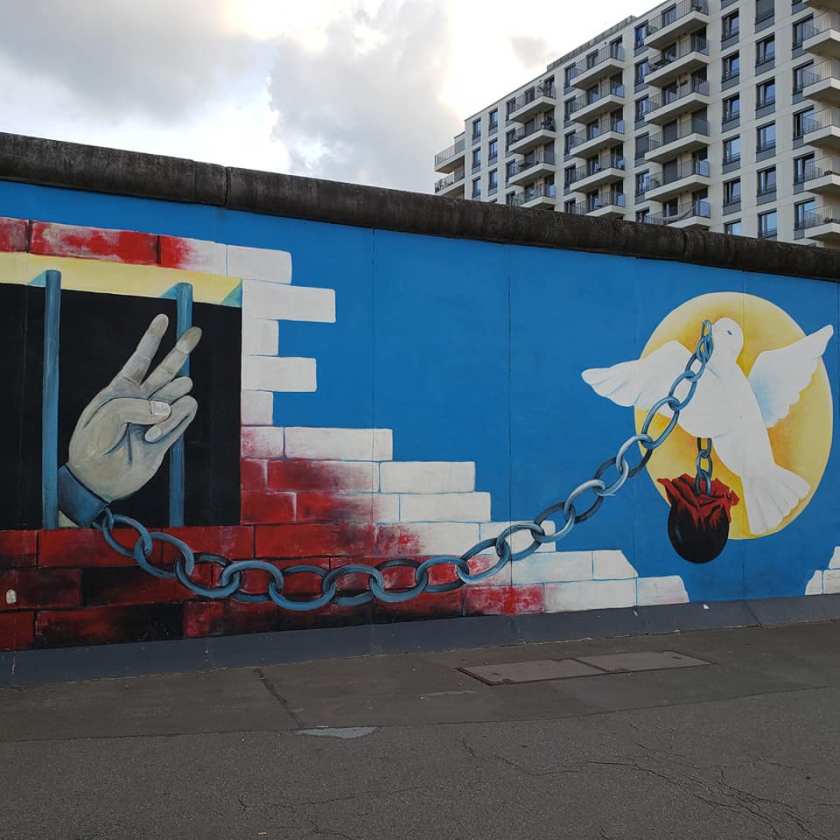
For me, perhaps the most visible symbol is the wall. The Berlin wall was in place from 1961-1989. When it fell, the East Side which had been closed off for decades, burst into freedom, as evidenced by the images on the east side of the wall, at the East Side Gallery – an open air mural gallery painted directly on that side of the wall.

Continue reading “The Berlin Wall—what did the US learn? by Marie Cartier”

We Won’t Go Back by John Erickson

Bottom line: abortion is healthcare. Nearly a fourth of women in America will have an abortion by age 45. Every day, people across the United States make deeply personal decisions about their pregnancies. Those decisions deserve respect.

Someone once asked me: John, why are you a feminist?  It is always a jarring question because I believe all people should be feminists and we should all fight for gender equality no matter what.  I’ve been drawn to Martin Niemöller’s prolific quote:
First they came for the socialists, and I did not speak out—because I was not a socialist.
Then they came for the trade unionists, and I did not speak out— because I was not a trade unionist.
Then they came for the Jews, and I did not speak out—because I was not a Jew.
Then they came for me—and there was no one left to speak for me.

Right now, it seems like a full on frontal assault against all of us.  No matter what community you’re in, you can draw back to an instance of discrimination you’ve faced both pre-2016 as well as after the election of President Trump. Continue reading “We Won’t Go Back by John Erickson”

Moments by Katie M. Deaver

The phone rings loud on the bedside table near my head, and I wake with that tiny heart attack that only truly jarring things, like middle of the night phone calls, seem to trigger. It takes me a moment to gather myself, to remember who I am, where I am, and what that sound is… and then I grab the phone, hop out of bed and cross the hall into the office where I can finally answer.

It’s a familiar voice, Eli, my colleague and friend from the domestic violence and sexual assault shelter where I volunteer. They’ve just received a call from the emergency room about a sexual assault survivor asking for an advocate and I’m the volunteer on-call this week.

Eli handles himself so very well, knowing that while he is awake working the night shift I am still trying to grasp his words, trying to shake the sleep from my body and my mind. As his words sink in I write down the survivor’s name and start pulling on clothes to head to the hospital.

Though I’ve taken a fair amount of these calls during daylight hours, this middle of the night call is a new experience for me. I live in the upper peninsula of Michigan and while I love it here, this particular night also happens to be yet another night with significant snowfall, and it takes me quite a while to dig my car out enough to get it out of the tiny alley next to our house and up the hill toward the emergency room.

Continue reading “Moments by Katie M. Deaver”

A Beary Peaceful Day Part One by Sara Wright

It is overcast and a few drops of rain are falling. I have been out talking to Tree Bear (TB), a yearling who has brightened my life in these dark soul days. Tree Bear comes up the mossy pine strewn path to the clearing and peeks at me from behind his white pine intermittently as he snacks.

There are so many old felled trees full of tasty grubs and ants now that the spring grasses have matured and gone by; soon the berries will ripen and Tree Bear will begin to put on weight. Acorns will be the choice of food for fall. Few people know that Black Bears are 93 percent vegetarian.

The other night I watched TB in the cherry tree, sitting in the branches like a monkey calmly combing out his thick under fur as he munched on cherry leaves and hard green cherries. He is a healthy looking and very beautiful yearling with brown eyebrows and a bump in his nose that is only visible from some angles. He probably weighs 50 – 60 pounds and has some brownish fur in places.

He was recently separated from his mother who left him because she needed to mate and his little sister has also disappeared. His face is so full of compassion that it takes my breath away. I say compassion because my personal experience has taught me that some (if not all) of these animals understand human suffering and respond to it by taking concrete actions. One slept outside my window while my dog was dying, another came to sit by me one night while I was wildly weeping outside in the dark. Stark and hopeless depression brings them in. Empathy flows like a deep underground river between us – why – because bears like other animals have deep feelings that are not mediated by abstract intellectual rational thinking.

Continue reading “A Beary Peaceful Day Part One by Sara Wright”