The Berlin Wall—what did the US learn? by Marie Cartier

I am writing this from Berlin. I am here for two weeks for the ALMS conference entitled, “Queering Memory.” Berlin is a city of such memory. You walk the streets and there are small brass plaques in the sidewalk in front of you memorializing Jews that were deported who lived in the residence. Everywhere there is memory of war, and hope.

For me, perhaps the most visible symbol is the wall. The Berlin wall was in place from 1961-1989. When it fell, the East Side which had been closed off for decades, burst into freedom, as evidenced by the images on the east side of the wall, at the East Side Gallery – an open air mural gallery painted directly on that side of the wall.

Continue reading “The Berlin Wall—what did the US learn? by Marie Cartier”

We Won’t Go Back by John Erickson

Bottom line: abortion is healthcare. Nearly a fourth of women in America will have an abortion by age 45. Every day, people across the United States make deeply personal decisions about their pregnancies. Those decisions deserve respect.

Someone once asked me: John, why are you a feminist?  It is always a jarring question because I believe all people should be feminists and we should all fight for gender equality no matter what.  I’ve been drawn to Martin Niemöller’s prolific quote:

First they came for the socialists, and I did not speak out—because I was not a socialist.
Then they came for the trade unionists, and I did not speak out— because I was not a trade unionist.
Then they came for the Jews, and I did not speak out—because I was not a Jew.
Then they came for me—and there was no one left to speak for me.

Right now, it seems like a full on frontal assault against all of us.  No matter what community you’re in, you can draw back to an instance of discrimination you’ve faced both pre-2016 as well as after the election of President Trump. Continue reading “We Won’t Go Back by John Erickson”

Moments by Katie M. Deaver

The phone rings loud on the bedside table near my head, and I wake with that tiny heart attack that only truly jarring things, like middle of the night phone calls, seem to trigger. It takes me a moment to gather myself, to remember who I am, where I am, and what that sound is… and then I grab the phone, hop out of bed and cross the hall into the office where I can finally answer.

It’s a familiar voice, Eli, my colleague and friend from the domestic violence and sexual assault shelter where I volunteer. They’ve just received a call from the emergency room about a sexual assault survivor asking for an advocate and I’m the volunteer on-call this week.

Eli handles himself so very well, knowing that while he is awake working the night shift I am still trying to grasp his words, trying to shake the sleep from my body and my mind. As his words sink in I write down the survivor’s name and start pulling on clothes to head to the hospital.

Though I’ve taken a fair amount of these calls during daylight hours, this middle of the night call is a new experience for me. I live in the upper peninsula of Michigan and while I love it here, this particular night also happens to be yet another night with significant snowfall, and it takes me quite a while to dig my car out enough to get it out of the tiny alley next to our house and up the hill toward the emergency room.

Continue reading “Moments by Katie M. Deaver”

A Beary Peaceful Day Part One by Sara Wright

It is overcast and a few drops of rain are falling. I have been out talking to Tree Bear (TB), a yearling who has brightened my life in these dark soul days. Tree Bear comes up the mossy pine strewn path to the clearing and peeks at me from behind his white pine intermittently as he snacks.

There are so many old felled trees full of tasty grubs and ants now that the spring grasses have matured and gone by; soon the berries will ripen and Tree Bear will begin to put on weight. Acorns will be the choice of food for fall. Few people know that Black Bears are 93 percent vegetarian.

The other night I watched TB in the cherry tree, sitting in the branches like a monkey calmly combing out his thick under fur as he munched on cherry leaves and hard green cherries. He is a healthy looking and very beautiful yearling with brown eyebrows and a bump in his nose that is only visible from some angles. He probably weighs 50 – 60 pounds and has some brownish fur in places.

He was recently separated from his mother who left him because she needed to mate and his little sister has also disappeared. His face is so full of compassion that it takes my breath away. I say compassion because my personal experience has taught me that some (if not all) of these animals understand human suffering and respond to it by taking concrete actions. One slept outside my window while my dog was dying, another came to sit by me one night while I was wildly weeping outside in the dark. Stark and hopeless depression brings them in. Empathy flows like a deep underground river between us – why – because bears like other animals have deep feelings that are not mediated by abstract intellectual rational thinking.

Continue reading “A Beary Peaceful Day Part One by Sara Wright”

What Can We Do to Weaken Privilege? by Elise M. Edwards

elise-edwardsIn my previous post, I talked about discussing the concept of privilege (male privilege, white privilege, and class privilege) with nuance.  Earlier that week, I had led a workshop at a local church on “Fine-tuning Privilege,” using Peggy McIntosh’s 1989 essay “White Privilege: Unpacking the Invisible Knapsack” as a resource.  (If you are unfamiliar with it, take a few minutes to read it and reflect upon it.)  Part of my talk was about naming and understanding privilege.  Discussion and comprehension are not enough, though.  We must counter it.

One strategy for fighting privilege is making it visible. The recipients of privilege are often unaware that they have to systemic advantage over others. Privilege, used in the context of racism, sexism, heterosexism, classism, and religious dominance, is not something earned on merit alone. In the essay linked above, McIntosh describes it like this: “I have come to see white privilege as an invisible package of unearned assets which I can count on cashing in each day, but about which I was meant to remain oblivious.” These are conditions built into our culture that some groups receive which benefit them to the detriment of others. Making privilege visible means naming it and calling it out. Wage gaps, digital divides, and racial profiling practices exist; ignoring them perpetrates the problems.

Continue reading “What Can We Do to Weaken Privilege? by Elise M. Edwards”

Coming Home to Spring by Sara Wright

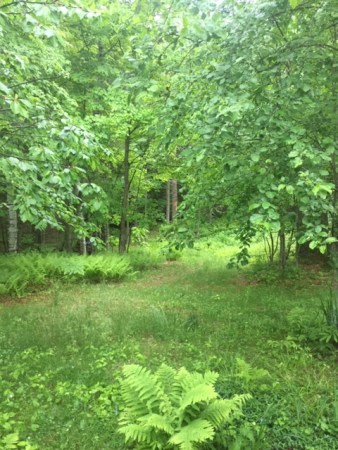
The older I become the more I appreciate Nature as she is, Nature the Creatrix of the Earth. Nature creating without human intervention. The cycles of life and death are so intimately intertwined and never more evident than in the spring when each rotting log becomes home to ants who are feasted upon by black bears (whose primary protein source 93% comes from ants, grubs and larvae). Splintered detritus becomes the rich soil that supports the seedlings of the next generation of trees, even as the ground peppers the moment with the delicate three lobed trillium, lady-slipper, twin flower, partridge berry trailing arbutus, unfurling spirals – the birthing of ferns, and perhaps my favorite, wild lily of the valley soon to fill this forested glade with her intoxicating scent.

Outside my window, diversity reins as Royalty! Maples, ash, oak, beech moose maple, witch hazel, spruce hemlock, fir, balsam converse with one another, above and below ground – their language is made of pulsing vibrations, sound and scent. The naturally fallen white birch logs crisscross each other creating complex and unique patterns apparent to any artistic eye. The brook is wending her serpentine way to the sea, her spongy banks of sphagnum moss are steeped in emerald. The translucent papery thin leaves of the beech tree ripple in the slightest breeze.

Continue reading “Coming Home to Spring by Sara Wright”

Climate Change as a Socio-Spiritual Feminist Issue (Or 10 ways to be a leader in the era of climate change) by Nurete Brenner

Authorities have observed that climate change is a feminist issue because it disproportionately affects women. Among these, the United Nations has gone further to acknowledge that climate change is a feminist issue because women are on the forefront of adopting climate-change mitigating techniques and technologies. A recent UN report states that “women are key actors in building resilience and responding to climate-related disasters…” But overarching these admittedly important issues is the greater understanding – not mentioned by the UN report – that climate change is a feminist issue on the socio-spiritual level. This side of the issue is often overlooked because the institutions who compile reports are immersed in a masculine way of thinking.  

What do I mean by a masculine way of thinking and why do I label it in this seemingly gendered way? Masculine values are those of winning, achieving, proving, succeeding, counting, controlling. pursuit of achievement and status; individual self-reliance; strength and aggression. The UN climate report cited above goes on to say that “Enacting good policies requires quality data, so that we can quantify the issue and measure improvement…” Reports such as this make their points by tabulating numbers and citing statistics, not seeing that these are already masculine ways of expressions and that numbers can only ever tell part of the story.  These masculine traits and values are social constructs and not necessarily to be associated with the male biological sex. Both men and women and other-gendered can display masculine values and attributes but they are labeled masculine because society typically associates them with the male gender. Continue reading “Climate Change as a Socio-Spiritual Feminist Issue (Or 10 ways to be a leader in the era of climate change) by Nurete Brenner”

Photo Essay–Long Beach, California by Marie Cartier

Long Beach Pride 2019
50 YEARS OF PRIDE CELEBRATING
THE STONEWALL REBELLION of 1969!
**All photos by: Marie Cartier**
See the photo essay from last year’s Pride week-end here.
And the photo essay from Pride 2017 here.

Continue reading “Photo Essay–Long Beach, California by Marie Cartier”

Talking about Privilege with Nuance by Elise M. Edwards

elise-edwardsYesterday evening, I led a seminar at a local church as part of their series on “Unpacking Privilege.” Once before, I’d been invited to this church, Lake Shore Baptist Church, to speak about intersectional feminism with one of my colleagues, so I expected them to be open-minded and welcoming.  They were.  Although the attendees were overwhelmingly white and older than me, they were attentive and engaged.  We had an enriching time together diving into topics like male privilege, white privilege, and class privilege with Peggy McIntosh’s 1989 essay “White Privilege: Unpacking the Invisible Knapsack” as a resource.  (If you are unfamiliar with it, I recommend taking a few minutes to read it and reflect.)

In the essay, McIntosh writes about becoming critical of male privilege and men’s obliviousness to it through her work in Women’s Studies, which then led her to see her own race privilege (as a white woman) and her obliviousness to it.  The essay does not offer a precise definition of white privilege, but the entire piece is a reflection about it.  She explains:

“I have come to see white privilege as an invisible package of unearned assets which I can count on cashing in each day, but about which I was ‘meant’ to remain oblivious. White privilege is like an invisible weightless knapsack of special provisions, maps, passports, codebooks, visas, clothes, tools and blank checks.”

Continue reading “Talking about Privilege with Nuance by Elise M. Edwards”

Befriending our Dragons by Sara Wright

“We are an overflowing river.
We are a hurricane.
We are an earthquake.
We are a volcano, a tsunami, a forest fire…”

These words written by Judith Shaw speak to the underlying merging of woman’s anger with Earth’s natural disasters, suggesting to me that women use “natural” violence in order to create change.

Violence, not the values of compassion and cooperation.

Violence and power over are the primary tools that Patriarchy uses to control women and the Earth.

Engaging in more violence will not solve the problems we face.

So many women including me are struggling like never before to survive on the edge of a culture that continues to sanction the vicious ongoing rape of both women and the Earth.

I use the death of trees as a primary example of the latter. By logging trees by the billions or killing them in “controlled burns” we are literally destroying human and non – human species. Without trees/plants we lose the oxygen we need to breathe.

We need “woman – centered” women to say NO!!! WE WON’T TOLERATE LIVING IN A DEATH DESTROYING CULTURE PREDICATED ON RAPE OF WOMEN AND THE EARTH.

We need women who are willing support other women – Women who refuse to remain neutral – Women who don’t wait until their mothers, daughters, sisters, nieces, granddaughters are assaulted to take a stand with other women – Women who refuse to stand behind their men when those men continue to support individuals (males or male identified women  – the latter are often “Father’s Daughters” in Jungian parlance) – Women who refuse to support a Patriarchal system that is destroying us all.

Continue reading “Befriending our Dragons by Sara Wright”