The Blue No Gaia Wants: Protecting the Sacred through our Lawns by Elisabeth Schilling

blue lawnIf Gaia is a living body, why are we painting her blue? Whether it is public parks or residential lawns, when there is that special odor in the air, I know to look down and there it is, an endless dye job on the grass indicating treatment. My city is concrete and blue dye for miles. Furthermore, I have sales people knocking at my door monthly asking if I want to spray pesticide around the house to decimate wasps, ants and spiders.  

Many religious texts encourage us to mindfully consider the earth. The Jain Acaranga sutra, for instance, says, “a wise [person] should not act sinfully toward plants” (I.1.5.7). One way we sin against the earth so casually is by these mindless manipulations of our lawns, if we have them. (Technically, I do not have a lawn, but my roommate does, and I try to protect it). I do not think most people think about researching what they allow into the earth. Continue reading “The Blue No Gaia Wants: Protecting the Sacred through our Lawns by Elisabeth Schilling”

What Could ‘Masculinity’ Mean in 2017? by Meghana Bahar

PART II of II – see PART I here

Last year, the leader of the (un)Free World was elected by ‘right choice’, much to the collective dismay of liberal leftists, a huge proportion of people of colour, progressive educationists, environmental conservationists, human rights defenders, religious reformists, and a large fragment of the developing world in the south of the globe. Today, Donald Trump has brought the world to the brink of World War III. ­­­Amidst accusations of undeclared tax returns and unabashed grabbing of female genitalia, the term ‘toxic masculinity’ is thrown about in a variety of media platforms. Many critiques lament how “inflammatory” the term is, one that is not quite “hopeful” for men, whilst the criticisms by media oligarchs reflect a hatred towards femininity.

Entitlement, sexism and narcissism can no longer be virtues of a millennial masculinity – we have lost so much already to corporate greed, warlords and racist bigots. Traditional, armorial masculinity is breaking our homes and our planet. At the ecological scale, the lungs of the earth mother are clogged. Wisdom-keepers decry the daily rape and plunder of their lands. The planet’s heart valves bleed toxins that can no longer sustain flora, fauna, fungi. Continue reading “What Could ‘Masculinity’ Mean in 2017? by Meghana Bahar”

What Could ‘Masculinity’ Mean in 2017? by Meghana Bahar

There have been so many times
I have seen a man wanting to weep
but instead,
Beat his heart until it was unconscious.

— ‘Masculine’, Nayyirah Waheed


PART I of II

There have been many times when I have wondered whether the world has reached a peak in a broken kind of masculinity.

The notion that there is only one kind of masculinity deserving pedestalisation, or even just one kind of masculinity, has long been discarded in the enclaves I have access to as a grassroots activist and scholar. These are not secret societies that are password-protected. They are protected, of course, by communities that uphold principles of freedom, dignity, equality and justice. But anyone is welcome.

It remains to be seen whether everyone will come.

Six years ago, news broke out that sixty-six teenaged boys had been sent to a government-authorised “anti-gay” boot camp in the state of Terengganu, a rather conservative Islamic province in eastern Malaysia. Their offence? They were considered ‘effeminate’ by their custodian-teachers. The boys were sent to a week-long counselling camp to ‘correct’ their behaviour. Continue reading “What Could ‘Masculinity’ Mean in 2017? by Meghana Bahar”

Gay Pride and Gay Resistance by Marie Cartier

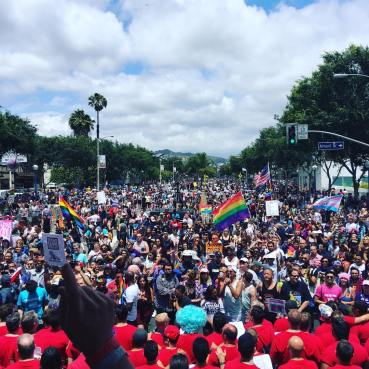
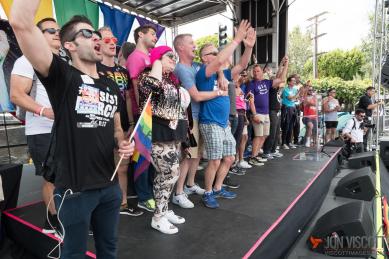
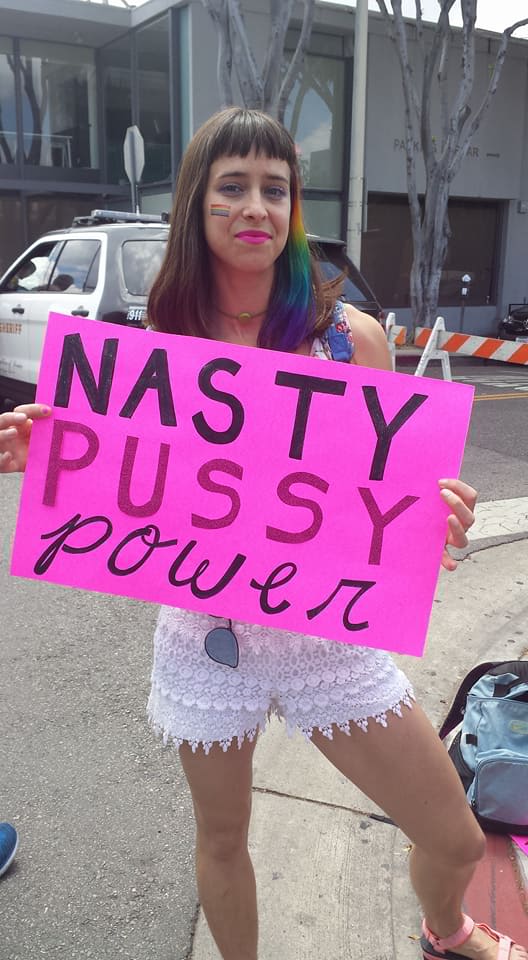
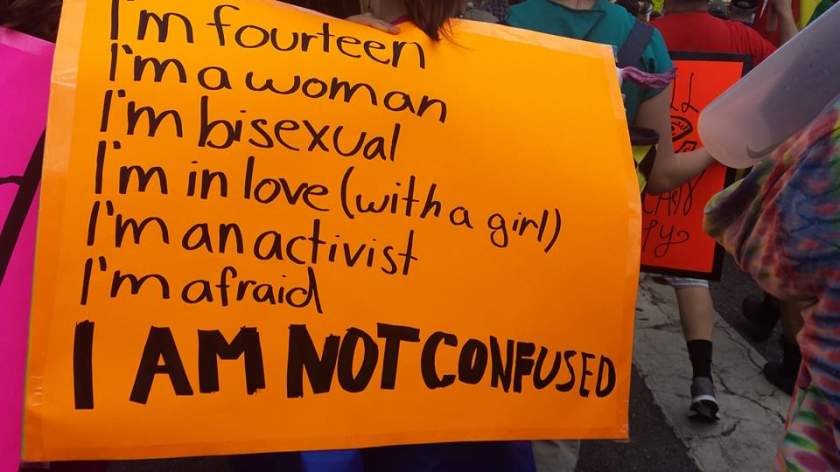
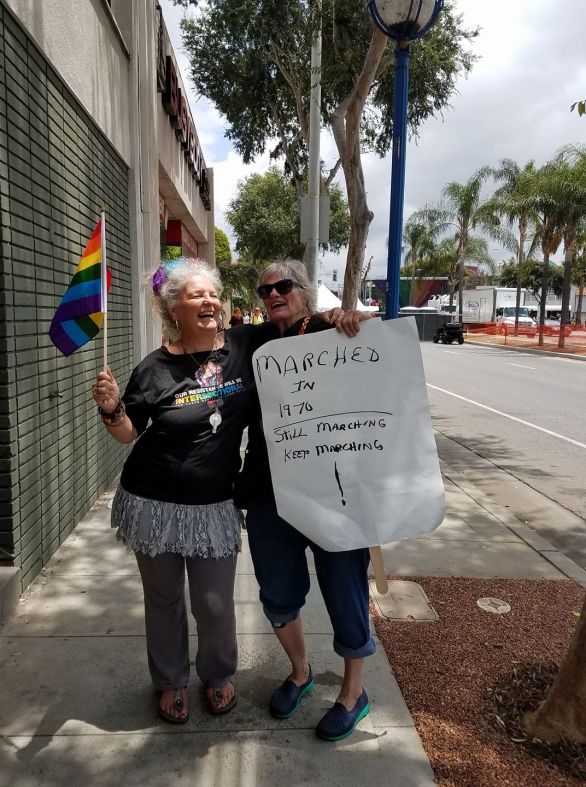
marie-with-pussy-hat-made-by-sister-cast-member-amandaWelcome to the resistance, Feminism and Religion family. This month is Gay Pride Month in many cities, including mine—Long Beach, California—where we just celebrated our 34th gay pride parade and our annual “Dyke March.” gay pride slogan

This blog is primarily a photo essay of those events and past pride events I have been in—a celebration of pride and gay family during the spring months which commemorate the first televised gay uprising against police harassment by the gay and lesbian and transgender family on June 28, 1969 at the Stonewall inn in New York City, NY.  Continue reading “Gay Pride and Gay Resistance by Marie Cartier”

Leadership in the Kali Yuga by Elisabeth Schilling


green pathSince the U.S. has elected a reality TV show billionaire to represent our nation, we should be no longer be able to shy away from the ignorance, violence, and frivolity that is within us. Happiness and peace in humanity seem to be in short supply. How many of us experience continuing bliss, or do we only fantasize and find brief reprieves in our suffering? Even the more extreme privileged among us most likely share the same emotional landscape.

In Indian cosmology, Hinduism specifically, there are four stages (yugas) of humanity that occur in a cycle. They represent the ascending and declining spiritual, psychological, and physical well-being of humanity. The Satya Yuga is first (descending) and last (ascending) era, where people are without strife, disease, or fear. Satya means “truth.” Life increasingly deteriorates through out the Treta Yuga to the Dvapara Yuga to the Kali Yuga.

Continue reading “Leadership in the Kali Yuga by Elisabeth Schilling”

The Bird No Longer Perches by Esther Nelson

esther-nelsonExcept for a couple of Dr. Phil shows, I have not watched TV since last November’s presidential election. I don’t want to be assaulted by the images of men (and a few women) occupying positions of power and leadership in the United States. I’m still outraged that so many inept, mean people are at the helm, being led, at least symbolically, by the “tweeter-in-chief.” I struggled for weeks after the election to achieve some balance. I cried. I raged. I signed petitions. I marched in protest. After the frenzy of all that physical and emotional activity, I have calmed down.

I’ve accepted the inevitable (and unnecessary) suffering—animals, humans, the Earth—that the new administration appears inured to and hell bent on continuing. I’m not hopeful things will improve. Continue reading “The Bird No Longer Perches by Esther Nelson”

Do We Need Wonder Woman Today? by Barbara Ardinger

We all remember the protests—and the pink knitted caps with the pussy ears—that filled the streets of our major cities after the inauguration of the Troll-in-Chief. Some members of this FAR community went to those marches and wrote about their thoughts and feelings in this space. I don’t go to marches and demonstrations anymore, mainly because it would be majorly inconvenient if I had an asthma attack right in the middle of when other people are trying to do important things. But I always send my thoughts.

And so I have recently been thinking about a feminist hera who can inspire us resisters. (Note that “hera” is not only the name of the queen of the Olympians, but it’s also the feminine form of “hero.” I’ve heard some women say “shero.” I guess that works, but it’s an ungainly word. Let’s call our courageous women heras and superheras. But I digress.) I’ve been thinking about Wonder Woman since the election. Here’s what I wrote about her in my book Pagan Every Day. (Note that I’m expanding what I wrote in 2003.) Continue reading “Do We Need Wonder Woman Today? by Barbara Ardinger”

Careful Criticism: Resisting Hetero-Patriarchy while Resisting Trump by Sara Frykenberg

My students are taking their final exams this week, which means I will be spending the week frantically, but attentively grading in order to make our grade submission deadline next week. End of semester grading is a mountain of careful criticism we educators scale one step at a time, with deliberateness, towards an ultimate goal of student success (if not in our classes, then in the next, or in life, relationships, etc.). Thus, I often find myself returning to the question: what am I hoping to create in what I say and write, and in how I critique?

One of the goals of feminist pedagogies is to help us prevent recreating the domination of kyrio-patriarchy in classroom spaces. While activism is not the same thing as education, and strategies of resistance are different than pedagogy in important ways, the concern for careful critique is warranted in both praxes. What do we create in how we critique, resist, and protest? What do we recreate, wittingly or no? I have found myself concerned with this since the election of Trump, DT (cause I can only write that name so many times), to the presidency. Continue reading “Careful Criticism: Resisting Hetero-Patriarchy while Resisting Trump by Sara Frykenberg”

After the First 100 Days—What Do We Do Now? by Marie Cartier

deb-and-i
Marie & Deb

I am sitting here again with my friend Deb—you can see our first conversation here,  where we were excited about the activism ensuing from the Women’s March. A photo essay of the Los Angeles Women’s March is here. However, like so many conversations we are all having still, we ask each other— “after the first 100 days…what do we do now?” We are speaking of the first 100 days of the 45th president. When we last got together, we gave a list of options for doing activism as a daily part of life. In this blog, we want to expand on that idea.

Let’s first take stock of where we have gone since the last blog that Deb and I collaborated on February 24th . . Among other things Trump accused President Obama of illegally wiretapping his phones. Here is a list of many other terrifying things he has done. As we write this, we have also recently bombed Syria, sent warships to Korea, and appointed an extremely conservative Supreme Court Justice, because the Republican Senate voted to remove the ability to filibuster, which allowed Gorsuch’s appointment to go through with only 54 votes (rather than the formally required 60). Continue reading “After the First 100 Days—What Do We Do Now? by Marie Cartier”

Patriarchy is Killing Us by Vanessa Rivera de la Fuente

FemicideLA

And not softly..

More than 2000 died by feminicide … More than 700 disappeared in Argentina … And more in Latin America and the world.

A few days ago they found Micaela dead. Her family, friends and my fellow activists searched for her for days, campaigned on social networks, shouted her name everywhere, without quitting and  accepting her death—totally avoidable. Micaela Garcia, a 21-year-old girl, raped and murdered by a repeat sexual offender who was questionably released by Judge Carlos Alfredo Rossi in Argentina. Micaela is one more victim of the depredation with which colonial and capitalist patriarchy attacks the lives of women in Latin America.

I just completed my first six months in South Africa. I live in Cape Town. I love this city, I am delighted by its colors and flavors. I am studying a Master’s in Women and Gender Studies—a goal I had longed struggled for.

In my trip from my home to the university, I think of Micaela Garcia and also of Stasha Arend and Tracy Roman—two girls killed in Cape Town recently. Their lives were violently interrupted while they were returning home. At the end of each of my days, 27 women will be raped, likely by someone they know. Some of them will be killed and thrown in the garbage or into a soccer field, or half-buried in an abandoned house; even in death it seems that we have no right to some dignity.

No matter where, death is my guest and part of my landscape; the scenario of its violence has as background the Andean Cord or Table Mountain. It is the same, because it is the same indolence when it comes to the life of a woman, here or there. And I think: I can move my city and even change the country, and start a new life, even with another name, and my life will remain insignificant because I am a woman—a woman of color, from the south, with all the oppression surrounding me in the air.

How to deal with that pain? Well, I have enrolled as a Rape Crisis facilitator. It is not only for solidarity; it is for survival. Do you see what I see? How could I just watch?

The body of a murdered woman is becoming something so common that daily dead had to receive their own name to describe this horror: FEMICIDE. In Mexico, Susana Chavez coined the slogan “Ni Una Más” (Not One More) to lead the fight against femicides. The writer and activist was herself found murdered in 2011.

About two years ago, women from all over Latin America got together to claim “Ni Una Menos, Vivas nos Queremos” (Not One More, We Want Us Alive). And I wonder why this clamor is not yet worldwide, if everywhere patriarchy is killing us, one by one, on our way home and in broad daylight, with no shame or remorse.

Patriarchy is killing us and many murders only matter while selling magazines and newspapers. Then, the rest is silence, as the silenced femicides of indigenous women whose bodies oppose the last stronghold in territorial conflicts against agro-business or mining corporations, as silenced as those women murdered in the “tranquility of their houses” in the name of love for their jealous partners, as silenced as the girls kidnapped on the way to school to appear later killed with their hands and feet tied, with signs of having been raped.

It is no longer just about reporting and visibilizing, but also about counting them: 57 femicides in the first 43 days of 2017 in Argentina, 3 this week in Chile, 27 rapes per day in Cape Town, all of those lost in the trafficking networks. The hunting of women is systematic. Human beings have bad memories, and who has no memory tends to repeat the horrors. As Karina Bridaseca says:

We must check the systematicity. The bodies, found, disappeared, the bones in the desert, are claimed today and always. Our strength is to have managed to gather them all, to alter the regime of the invisible. This feeds the hope of making the account closed. What is important is that today we all share the same language and demand that the account closes.

Patriarchy is killing us … and not softly. Every time the news reports another woman or girl dead, I check my mother, my sister, my daughter, my friends in Chile. I double check my close friends in Cape Town, to know that they are as I saw them last time: OK. And then I can sleep, knowing that they have returned home.

In Santiago de Chile and in Cape Town we must count, dead or alive. Hope for the figthers and memory for those who are no longer here. We won’t stop asking about all of you. We want to know you have returned home. Our lives must matter.

Vanessa Rivera de la FuenteVanessa Rivera de la Fuente works in community development, gender equality and communication for social change. She has led initiatives for women’s empowerment in Ecuador, Peru, Argentina, Morocco and South Africa. As a Gender Justice advocates with a broad scope of interests, she is a social and digital entrepreneur committed with the strengthening of grass roots organizations and the developing of an independent pathway of thinking, research and academic writing around Gender, Politics and Religion. Loyal lover of books, cats and spicy chai.

Photo: Artivism installation. Crosses represent the women dead and shoes, the gender bias of femicide. Shoes are one of the first things found at the site of a murder.