

 I remember being blown away when I read Judith Plaskow’s book, Standing Again at Sinai: Judaism from a Feminist Perspective, shortly after it was published in 1990. She writes, “The need for a feminist Judaism begins with hearing silence.” She notes it’s a “silence so vast [it] tends to fade into the natural order….” Women’s presence throughout Judaism has not been reflected in Jewish scripture, Jewish law, or in liturgical expression.
Plaskow zeroes in on the story in Exodus where the entire Israelite congregation, gathered at the base of Mt. Sinai, eagerly anticipates entry into the covenant, “the central event that established the Jewish people.” Before this communal event, the covenant had been entered into by way of the individual patriarchs—Abraham, Isaac, and Jacob. The particularly disturbing verse for Plaskow is Exodus 19:15: “Be ready for the third day; do not go near a woman.”
The specific issue Moses addresses is ritual impurity since the emission of semen renders both parties that engage in coitus temporarily unfit to engage with the sacred. Both women and men need to be ceremonially purified before approaching the holy. However, Moses does not say “Men and women do not go near each other.” At this crucial juncture in Jewish history, “Moses addresses the community only as men.” The text makes women invisible. Clearly it was men’s experience that shaped Torah.
Plaskow writes that “[Jewish] women have always known or assumed our presence at Sinai.” Exodus 19:15 “is painful because it seems to deny what we have always taken for granted. Of course we were at Sinai; how is it then that the text could imply we were not there?”
Why make a big deal of this? Can’t the text, asks Plaskow, be relegated to a time in history “way back then” when people and communities accepted gender inequality as the natural order? Why not just accept the past for what it was and get on with things? Because Torah (Hebrew Bible) is not “just” history, “but also living memory.” When the story of Sinai is read and recited in services as part of the lectionary reading over and over again, year after year, “women each time hear ourselves thrust aside anew, eavesdropping on a conversation among men and between men and God.” Continue reading “Of Monument(al) Importance by Esther Nelson”

 I don’t know if I could be a deep-sea welder. I don’t know what the risks of lethal electrocution, broken limbs, or the bends would be. I suspect it can be a dangerous occupation, like operating heavy equipment on good old dry land or fishing for crab or even collecting garbage from the neighbors’ driveways. So too is this the case with window washing, paving, disposing of medical waste, brick making, driving a giant tanker truck, and more. There are aspects of the world I know I take for granted, but the moment I stop to consider what those aspects might be, I am humbled and reminded of the privilege it is to philosophize and ponder the functions of religion in the shaping and making of society.
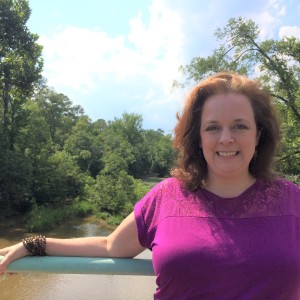 Over the past few months, a precious person has come closer into my family’s life in such a way that their presence in my home, among my loved ones, has come to feel natural and easy. This is someone I love, someone who adores my children and appreciates my partner of 18 years and whose sweet spirit and vibrant laughter have added joy and mirth to our family home.
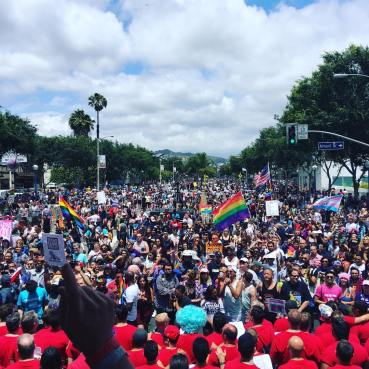 Although my involvement during the 120 days or more that led up to the #ResistMarch happened in a flash, one thing is for certain: miracles exist not because of divine intervention but because G-d places people on this Earth to make positive impacts. The beauty of the #ResistMarch was not just the passion of the organizers but the beauty of the rainbow that came out in full force on June 11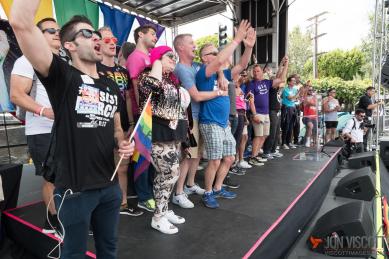



 Feminism and Religion