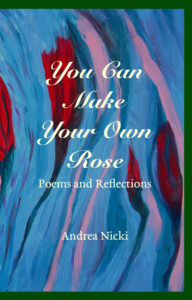
You Can Make Your Own Rose BOOK REVIEW by Lila Moore

You Can Make Your Own Rose by Andrea Nicki is a collection of poems infused with the spirit of feminist sensibility, social justice and activism. The poems offer more than mere therapeutic comfort while depicting shamanic-inspired healing rituals and magical encounters. They are trauma-free in the sense that Nicki doesn’t ask for our sympathy nor does Nicki simply wish to share traumatic memories. On the contrary, she utilizes somewhat analytical and educational language, interlaced with subtle picturesque and lyrical details alongside a severe social critique, to depict the emotional, intellectual, and social landscape of her reflections on incest and other gender-related forms of abuse.

Continue reading “You Can Make Your Own Rose BOOK REVIEW by Lila Moore”

Death and Re-birth through a Project by Elisabeth Schilling

Art by Magdalena_Korzeniewska

For about a year and a half, I have been working on a collection of poetry that I feel is worth something. I have been writing poetry since I scribed pages hidden between my math textbook when I was 9, gone through poetry workshops in graduate school where I produced a creative thesis, and continued to write off-and-on after that. I have an extensive cornucopia of poetry, but it was around last October of 2016, perhaps, that I decided to write my experience.

As a pre-teen, I wrote about what I thought my life could be, fantasizing about being an older woman with mottled relationships, missing opportunities to discuss my fragile relationship with my parents as the only-child-golden-child, my passion and doubts as a religious, my shame at not being more experienced. Even when I was in graduate school for poetry in Ohio, I didn’t think my life was worth excavating. I wrote dreamy, dense poetry that was surreal and symbolic but largely incoherent. I could again have written about my evolving religious beliefs, my curiosities and risks I took living outside of my home state of Oklahoma as a young woman for the first time, my declining relationship with my mother, or my insecurities again, but this time as a lesser-prepared graduate student in comparison with my literary and theory-laden colleagues.

On one hand, some might say the culture I come from is narcissistic and navel-gazing. I would agree, but just like I feel women can sometimes be selfish in a quite necessary and liberating way (as opposed to those around her accusingly saying she is “so selfish” for abandoning them/following her own path/needing a room of her own), I feel the confessional and self-reflective can be the healing and helpful side of the coin. For me, at least in my experience, my “finished” collection feels exactly this way.

Continue reading “Death and Re-birth through a Project by Elisabeth Schilling”

Kingdom of Women BOOK REVIEW by Katie M. Deaver

In her novel, Kingdom of Women, Rosalie Morales Kearns imagines a reality that is post-patriarchy, and post male violence while showing us what near-future women had to go through in order to get to that reality.  Morales Kearns weaves this story through the voices of multiple characters.  One of these characters is Averil Parnell, a female Catholic priest. Part I of the book opens with a woman visiting Averil to seek her counsel in regards to taking revenge on her male college professor who has been harassing her ever since she refused to sleep with him.

While Averil seems to be of little help with this particular conversation, we learn that Averil was one of the twenty three original female priests that were to be ordained by the Catholic Church. On the day of their joint ordination however, the Cathedral Massacre took place and twenty two of the female seminarians were killed in cold blood.  Averil then, is most definitely a woman who understands the yearning for revenge, the feeling of survivors guilt, and the expectation to be a wonderful priest for her dear friends who had that chance ripped away from them.

At the same time this conversation is taking place it has become clear that small groups of vigilante women are popping up around the world and punishing men for acts of violence against women.  The male dominated government of course sees all these punishing acts as coincidental, explaining them away in one way or another, or ignoring them completely, never imagining that it is in fact the beginning of women rising up to truly end male dominance and violence.

Continue reading “Kingdom of Women BOOK REVIEW by Katie M. Deaver”

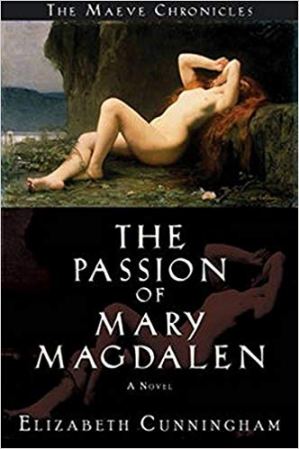
Did You Have to Make Her a Prostitute? by Elizabeth Cunningham

When I toured with The Passion of Mary Magdalen, opening by belting out the first paragraphs of the novel’s prologue in song, (ending with the line “when only a whore is awake!”) that question almost always came up.  In celebration of Mary Magdalen’s feast day, I’d like to offer answers that continue to evolve.

There is no scriptural evidence that Mary Magdalen was a prostitute. In a sermon, 6th century Pope Gregory I gave as his opinion: “This woman, whom Luke calls a sinner and John calls Mary, I think is the Mary from whom Mark reports that seven demons were cast out.” (This confusion and proliferation of Marys inspired me to make a joke. Q: How many holy Marys does it take to change a lightbulb? A: I don’t know. I keep losing count.)

In fact, very little is known about Mary Magdalen. There are fourteen references to her in the Gospels, then she disappears from the New Testament. The possibly Gnostic gospel of Mary dates to the 2nd century CE, and there is no scholarly consensus as to which Mary is the source of the tradition. Early on Mary Magdalen gave history the slip and took on an extended life in legends, which take her to Ephesus as well as to France where her alleged fingernails, bones, and skull reside and continue to be venerated.

Continue reading “Did You Have to Make Her a Prostitute? by Elizabeth Cunningham”

Knowing my Voice through Writing by Elise M. Edwards

elise-edwardsOver the summer, I’ve been writing more than I do during the traditional academic year when other tasks consume the bulk of my workday.  I have spent more time experiencing the joy of creative discovery and production, but I’ve also had more time confronting the difficulties of creative work as I’ve wrestled with some of its unique challenges.  One of those challenges has been to refine my academic writing voice. I’ve approaches the challenge of developing my voice as both a spiritual and feminist practice and this has helped me find confidence in my work.

Continue reading “Knowing my Voice through Writing by Elise M. Edwards”

Thus Saith Eve BOOK REVIEW by Katie M. Deaver

“I am the Queen of Sheba and I am not impressed.”  This is the first line of one of the monologues from chris wind’s book Thus Saith Eve.  This book features 18 stories of biblical women, and a 19th, Lilith, from Jewish mythology.  Each monologue offers a new interpretation and gives a voice to the women that we think we know.

In this book the voices and personalities of women such as Noah’s wife, Mary of Bethany, Zipporah, and Vashti are reimagined in an exciting and empowering way.  Each of the stories also features an appendix where the reader can learn more about the biblical or mythological context of the woman who is telling her story.

As in her other works, wind uses historical people, events, and understandings to build a truly wonderful source of feminist fiction.  In addition to being an extremely enjoyable and thought provoking read, the monologues can also be used for audition and performance pieces.  On her website wind explains that two of the monologues, “I am Eve” and “I am Mary” can be performed with specific musical selections in the background.  You can find those selections linked to her website above.


Continue reading “Thus Saith Eve BOOK REVIEW by Katie M. Deaver”

Spiritual Ideas, Existential and Eastern, in Jonathan Livingston Seagull by Elisabeth Schilling

Peaceful Solitude

After my year of teaching high school students, I found a kinship with them in their frustrations, longing, apathy, hopelessness, and hope. Fortunately, we studied together Jean Paul Sartre, whom I want to get to know more intimately, but we, the teens and myself, could take the spiritual answer to our questions about the meaning of life (is there one? What is it?): The meaning of life is to give it meaning.

I am not sure about their generation, but adolescence for me, in mine, was about discovering, not necessarily creating. Of course, now I think it is a little of both.

Sometimes I wonder if there is also a lesson. Being an academic, perhaps I love learning and teaching. I demonstrate my love as Jonathan Livingston Seagull does, by offering to others, perhaps a specific community of others, those who have chosen or must be in a state of learning (easily found in institutions of high school and college), the truths I have gathered (59). Of course ‘truth’ is a word that tastes a bit tannic, for it needs to be rolled around by the tongue a bit to be cleansed; perhaps to mitigate its toxic potential, we can never consume it undigested, but must gestate it and transform it within our warm bodies, just at the cliff, before we allow it to permeate our organs in a chemical structure that serves us.

Continue reading “Spiritual Ideas, Existential and Eastern, in Jonathan Livingston Seagull by Elisabeth Schilling”

Bless This House: Creating Sacred Space Where You Live, Work & Travel by Mama Donna Henes – A Book Review by Joyce Zonana

“There is no such thing as a bad blessing,” Mama Donna tell us, “no rules . . . no recipes, no prescriptions, no instruction manuals,” no “one-size-fits-all” House Blessing. Yet it’s not so much “anything goes” as “everything matters”: “The only thing you can do wrong in a ritual is to not pay attention to your true intentions.”

jz-headshotDonna Henes, familiarly known as “Mama Donna,” is a national treasure. From her “House of Many Altars” in what she mischievously calls “Exotic Brooklyn,” she serves as an exuberant, irrepressible urban shaman: holding outdoor public rituals at each solstice and equinox for over forty years; blessing and leading New York City’s annual Halloween Parade; creating meaningful, personalized ceremonies for funerals, weddings, new babies, new homes, and new businesses. In 2009, the governor of New York State called on her to bless the fleet during the quadricentennial celebration of Henry Hudson’s voyage to the New World. She is the author of five books, including The Queen of Myself  and Celestially Auspicious Occasionsand publishes a monthly e-newsletter, The Queen’s Chronicles, that offers “meaning, moxie, and magic for midlife women.”

In her most recent book, Bless This House: Creating Sacred Space Where You Live, Work & Travel (Ixia Press, 2018), Mama Donna generously shares her house-blessing “secrets”—revealing that they are not secrets after all. Demystifying the blessing process, the book details everything you need to know to “claim and consecrate” your own house with “authority and aplomb.” Continue reading “Bless This House: Creating Sacred Space Where You Live, Work & Travel by Mama Donna Henes – A Book Review by Joyce Zonana”

“The Burning Lava of a Song” by Joyce Zonana

Aurora’s autobiographical narrative is a passionate paean to poets as the “only truth-tellers, now left to God”; she celebrates them as agents for personal and social transformation. As we come to the end of this National Poetry Month in the U.S., where truth is under siege, it’s worth recalling Aurora Leigh and its daring exploration of poetry, gender, divinity, and social justice.

jz-headshotI was in graduate school when I first read Aurora Leigh, Elizabeth Barrett Browning’s fiery 1856 epic about a young woman claiming her vocation as a poet despite Victorian society’s patriarchal strictures. The poem was not on any assigned reading-list; I’d simply stumbled across it while doing research for my dissertation. The opening lines brazenly assert the speaker’s authority and ambition:

OF writing many books there is no end;
And I who have written much in prose and verse
For others’ uses, will write now for mine,–
Will write my story for my better self . . .

Encountering those words, I was immediately possessed by Aurora’s voice and vision, a welcome change from all the male poets and critics I’d been reading. I devoured the verse novel’s nine books in one night. The poem became the centerpiece of my dissertation, and I studied and enthusiastically taught it for years.

Continue reading ““The Burning Lava of a Song” by Joyce Zonana”

“Womenspiration” for International Women’s Day by Elise M. Edwards

elise-edwardsHappy International Women’s Day!  I hope it is a happy day for you as we recognize women’s achievements throughout the world.  Our FAR community is not only for or about women, but as feminists in some form or another, collectively we support women, their growth, their health, and their contributions to the world.  On a day like today, we should take note of what still needs to be done and recommit ourselves to our work.  But let’s not rush past an opportunity for joy and celebration. Many generations of women have fought for equal rights and participation in all sectors of society, and we have made progress. To commemorate that legacy today, I am highlighting just a few of the women who inspire me with their lives and with their work. They are my “womenspiration.”  My hope is that you join me in recognizing them and that as you read about them, you reflect on the women who inspire you.

Continue reading ““Womenspiration” for International Women’s Day by Elise M. Edwards”